Abstract
The private sector is essential for improving the coffee sector by supporting farmers through cooperatives and groups. The study objective is to assess the impact of policy changes on moral hazard and private-farmers investment synergy. The present study used data collected from coffee farmers and cooperatives in Mbeya, Songwe and Ruvuma in Tanzania. Analyses were achieved by using descriptive statistics and difference-in-difference (DiD) at both the farm level and cooperative level. The results indicate that the 2017/2018 government policy changes ameliorated moral hazard and free-riding behaviors among farmers, owing to repay loans. Cooperatives with contractual arrangements with private investors suffered from moral hazards attributable to policy changes whereby the decline in the coffee collection was 33,040 kg (with an average treatment effect on the treated (ATT)) of coffee parchment, whereas, at the farmers’ level, farmers reduced the collection of coffee with an ATT of 24.6 kg. In addition, because of these changes, some central pulse units were found to be non-functional, while others were under-utilized. In this regard, such moral hazard behavior among coffee farmers destabilized cooperatives, as well as the existing synergy between private investors and cooperatives. It is recommended that before policy or any institutional change, it is important to consider strategies and paths to reduce the moral hazard and free-riding behaviors of any stakeholder to improve market efficiency. For the coffee sector, this would include farmers collecting coffee from member cooperatives only. The government must consider having an effective institutional/policy change mechanism, in particular having a preparatory stage for policy change, to ensure that all contracts that have to be affected by such changes are reinforced properly to reduce unnecessary losses for any actor in the value chain. The government can facilitate or mediate disputes related to investments in agriculture, provide administrative support, and help negotiate compensation.
Keywords
- Private- Cooperatives Synergy Search this journal for Private- Cooperatives Synergy (opens in a new tab)
- Policy Changes Search this journal for Policy Changes (opens in a new tab)
- Moral Hazard Behavior Search this journal for Moral Hazard Behavior (opens in a new tab)
- Coffee Marketing Search this journal for Coffee Marketing (opens in a new tab)
References
- Andrew, R. & Philip, D. (2014). Coffee Production in Kigoma Region, Tanzania: Profitability. Tanzania Journal of Agricultural Sciences, 13(2), 75-85.
- Arouna, A., Michler, J. D. & Lokossou, J. C. (2021). Contract farming and rural transformation: evidence from a field experiment in Benin. Journal of Development Economics, 151.
- Ashraf, N., Gine, H. & Karlan, D. (2009). Finding Missing Markets (And a Disturbing Epilogue): Evidence from an Export Crop Adoption and Marketing Intervention in Kenya. American Journal of Agricultural Economics, 91(4), 973-990.
- Bachmann, R., Ehrlich, G., Fan, Y., Ruzic, D. & Leard, B. (2019). Firms and Collective Reputation: a Study of the Volkswagen Emissions Scandal. Available at http://www-personal.umich.edu/~yingfan/BEFRL_current.pdf
- Bonroy, O., Garapin, A., Hamilton, F. S. & Monterio, D. Z. (2018). Free-riding on Product Quality in Cooperatives: Lessons from an Experiment. American Journal of Agricultural Economics, 101(1). doi: https://doi.org/10.1093/ajae/aay025
- Castriota, S. & Delmastro, M. (2015). The Economics of Collective Reputation: Evidence from the Wine Industry. American Journal of Agricultural Economics, 97(2), 469-489.
- Cinyabuguma, M., Page, T. & Putterman, L. (2004). Cooperation Under the Threat of Expulsion in a Public Goods Experiment. SSRN Electronic Journal, 1421-1435. doi: http://dx.doi.org/10.1016/j.jpubeco.2004.05.011
- Clair, T. T. & Cook, T. (2015). Difference-In-Differences Methods in Public Finance. National Tax Journal, 68(2), 319-338. doi: 10.17310/ntj.2015.2.04
- Craparo, A. W., Van Asten, P. A., Laderach, P., Jassogne, L. P. & Grab, S. W. (2015). Coffea arabica yield decline due to climate change: Global Implication, 207(1), 1-10. doi: https://doi.org/10.1016/j.agrformet.2015.03.005
- De Janvry, A. & Elisabeth, S. (2007). Optimal share contracts with moral hazard on effort and in output reporting: managing the double Laffer curve effect. Oxford Economic Papers, 253–274. doi: 10.1093/oep/gpl034
- Deloitte. (2016). Reputation matters: Developing reputational resilience ahead of your crisis. London.
- FAO. (2012). Cooperatives: Empowering women farmers, improving food security. Available at https://www.fao.org/gender/insights/detail/en/c/164572/ site visited on 5/9/2022
- FAO. (2020). New strategies for mobilizing capital in agricultural cooperatives. Available at http://www.fao.org/3/y5469e/y5469e04.htm site visited on 15/7/2022
- Fares, M. (2009). Brokers as Experts in the French Wine Industry. Journal of Wine Economics, 4(1), 1-14.
- Fares, M. & Orozco, L. (2014). Tournament Mechanism in Wine-Grape Contracts: Evidence from a French Wine Cooperative. Journal of Wine Economics, 9(03). doi: http://dx.doi.org/10.1017/jwe.2014.29
- Gibbons, S. M., Duvallet, C. & Alm, J. E. (2018). Correcting for batch effects in case-control microbiome studies. PLoS Comput Biol. doi: https://doi.org/10.1371/journal.pcbi.1006102
- Hanns, R. & Neumann Stiftung. (2018). Investing in youth in Coffee growing communities: A review of current programs and practices in Latin America. Available at https://sustainable foodlab.org/wp-content
- Harwig, L. (2019). Securing a Supply Chain for the Future: The Role of Private Sector Extension in Building a Sustainable Coffee Industry. Available at: https://www.agrilinks.org/post/securing-supply-chain-future-role-private-sector-extension-building-sustainable-coffee-industry
- Holmstrom, B. (1979). Moral Hazard and Observability. The Bell Journal of Economics, 10(1), 74-91. doi: https://doi.org/10.2307/3003320
- IDH the sustainable trade initiative. (2015). Investing In Resilience: A Blended Finance Approach to Farm Renovation. Available at https://www.idhsustainabletra de.com/uploaded/
- IFAD. (2013). Small-scale producers in the development of coffee value chain partnerships. Rome. Available at https://www.ifad.org/.
- International Cooperative Alliance. (2020). Legal Framework Analysis. National Report-Tanzania. Available at https://coops4dev.coop/site
- Kilpatrick, D. G. (2010). Definitions of public policy and the law. Available at https://www.musc.edu/vawprevention/policy/definition.shtml
- Klein, B. & Leffler, K. B. (1981). The role of market forces in assuring contractual performance. Journal of Political Economy, 89(4), 615-641.
- Liang, Y. & Coble, K. H. (2009). A Cost Function Analysis of Crop Insurance Moral Hazard and Agricultural Chemical Use. Available at https://core.ac.uk/download/pdf/7130372.pdf
- Makoye, K. (2015). Cabbages trump coffee for Tanzania's farmers. Available at http://beta.iol.co.za/scitech/science/environment/cabbages-trumpcoffee-for-tanzanias-farmers
- Marwa, N. (2015). Collectives Action Theory and Practice of Public Policy: The Relationship between Public Policy and Collective Action. Public Policy and Administration Research, 5(5), 56-62. Available at https://www.iiste.org
- Megyesi, B. & Mike, K. (2016). Organizing collective reputation: An Ostromian perspective. International Journal of the Commons, 10(2), 1082–1099. doi: http://doi.org/10.18352/ijc.657
- Merel, P., Saitone, T. L. & Sexton, R. J. (2015). Cooperative Stability under Stochastic Quality and Farmer Heterogeneity. European Review of Agricultural Economics, 45(5), 765-795.
- OEC. (2022). Product Trade Data. Available at: https://oec.world/en/profile/hs92/coffee?redirect=true site visited on 25/8/2022
- Offe, C. (2000). Democracy and Trust. Theoria: A Journal of Social and Political Theory, 1-13. doi: https://doi.org/10.1017/CBO9780511659959
- OXFAM. (2012). Private investment in agriculture: why it‘s essential, and what‘s needed. Discussion paper.
- Ozanne, A., Hogan, T. & Colman, D. (2001). Moral Hazard, Risk Aversion and Compliance, Monitoring and Agri-Environmental Policy. European Review of Agricultural Economics, 28(3), 329-347.
- Ruben, R., Allen, C., Boureima, F., Mhando, D. & Dijkxhoom, Y. (2018). Coffee value chain analysis in the southern highlands of Tanzania: Final report. Wageningen University & Research. Available at https://edepot.wur.nl/464999
- Ruete, M. (2014). Inclusive Investment in Agriculture: Cooperatives and the role of foreign investment: Investment in Agriculture Policy Brief #2. International Institute for Sustainable Development.
- Tanzania Coffee Board. (2011). Tanzania Coffee Industry Development Strategy 2011-16. Available at http://www.coffecboard.or.tz
- Tanzania Coffee Board. (2017). Tanzania Coffee Industry Report 2016-2017. Available at http://www.coffecboard.or.tz
- Technoserve. (2015). The Initiative for Smallholder Finance. Case Study: The Return On Investment From Technoserve’s Coffee Initiative. Available at https://www.technoserve.org/wp-content/uploads/2015/02/ISF-briefing-9-case-study-coffee-initiative.pdf
- Tirole, J. (1996). A Theory of Collective Reputations (with Applications to the Persistence of Corruption and to Firm Quality). Review of Economic Studies, 63, 1-22. doi: https://doi.org/10.2307/2298112
- Urassa, C. G. (2014). The effect of the regulatory framework on the competitiveness of the dairy sector in Tanzania. International Journal of Public Sector Management, 27(4), 296 – 305. doi: 10.1108/IJPSM-08-2011-0100
- Wooldridge, J. M. (2005). Fixed-effects and related estimators for correlated random-coefficient and treatment-effect panel data models. Review of Economics and Statistics, 87(2), 385-390.
- World Bank. (2021). Regulation of Sectors and Regulatory Issues Impacting Public Private Partnerships. Available at https://ppp.worldbank.org/public-private-partnership/
Downloads
No downloads have been recorded for this article yet. Figures appear here once readers begin downloading the full text.
How to Cite
Share this article
License
Copyright (c) 2023 Rogers A. Lumenyela, Provident Dimosso, Tafuteni Chusi (Author)

This work is licensed under a Creative Commons Attribution 4.0 International License.
Author (s) should affirm that the material has not been published previously. It has not been submitted and it is not under consideration by any other journal. At the same time author (s) need to execute a publication permission agreement to assume the responsibility of the submitted content and any omissions and errors therein. After submission of revised paper in the light of suggestions of the reviewers, the editorial team edits and formats manuscripts to bring uniformity and standardization in published material.
This work will be licensed under Creative Commons Attribution 4.0 International (CC BY 4.0) and under condition of the license, users are free to read, copy, remix, transform, redistribute, download, print, search or link to the full texts of articles and even build upon their work as long as they credit the author for the original work. Moreover, as per journal policy author (s) hold and retain copyrights without any restrictions.
Keywords
- Private- Cooperatives Synergy Search this journal for Private- Cooperatives Synergy (opens in a new tab)
- Policy Changes Search this journal for Policy Changes (opens in a new tab)
- Moral Hazard Behavior Search this journal for Moral Hazard Behavior (opens in a new tab)
- Coffee Marketing Search this journal for Coffee Marketing (opens in a new tab)
Section
Published in
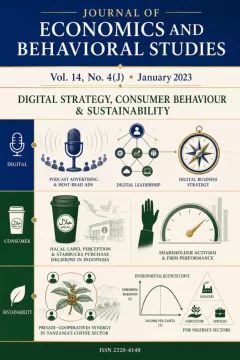 Vol. 14 No. 4(J) (2022)
Digital Strategy, Consumer Behaviour & Sustainability
View issue contents
Published
Submissions
Have research to publish? Journal of Economics and Behavioral Studies welcomes submissions.
Make a Submission