Abstract
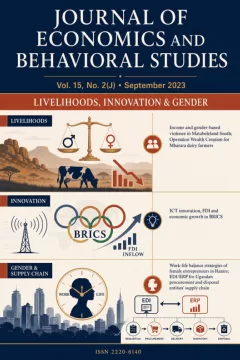
Helping subsistence farmers make the leap into commercial agriculture was the driving force behind OWC or Operation Wealth Creation. The purpose of this research was to assess how the OWC program has affected the Mbarara area, dairy producers. The researchers used a descriptive study strategy and surveyed 161 dairy producers. There was a dramatic drop in poverty from 68 percent to 47 percent as a result of the 70.2% increase in milk output (using the poverty line criteria of $1.90 per day). This indicates that a majority of dairy producers (53.3%) have successfully adopted the use of currency. The major source of income in the Mbarara area is dairy farming, which is the focus of this study and sets it apart from previous studies. The advantages might be increased by enhancing post-harvest handling practices, particularly by finding ways to get the most out of milking equipment. The government should also emphasize the construction of auxiliary factories that can raise milk's value and increase the number of goods made from it. These efforts might increase agricultural productivity and decrease poverty while providing job possibilities for industrialists and farmers.
Keywords
References
- Adhiguru, P., Birthal, P. S. & Ganesh Kumar, B. (2009). Strengthening pluralistic agricultural information delivery systems in India. Agricultural Economics Research Review , 22, 71–79.
- Africa poverty report (2016). Poverty in a rising Africa.
- African Research Institute. (2016). Steady Progress? 30 years of Museveni and the NRM in Uganda
- Anderson, J. R. & Feder, G. (2004). Agricultural extension: Good intentions and hard realities. The World Bank Research Observer , 19(1), 41-60.
- Badiane, O. & Makombe, T. (2014). The Theory and Practice of Agriculture, Growth, and Development in Africa. WIDER Working Paper 061.
- Best, R. & Kaganzi, E. (2003). Farmer participation in market research to identify income-generating opportunities. CIAT in Africa Highlights. International Center for Tropical Agriculture. Africa Coordination Kawanda Agricultural Research Institute, Kampala.
- Bill and Melinda Gates Foundation. (2011). Agricultural Development Strategy Overview
- Booth, D. & Golooba-Mutebi, F. (2012). Developmental patrimonialism? The case of Rwanda. African Affairs , 111(444), 379-403.
- COHA. (2013). The Cost of Hunger Study in Africa. A joint AU/ECA/WFP project.
- De Vries, G. J., Timmer, M. P. & de Vries, K. (2015). Structural Transformation in Africa: Static Gains, Dynamic Losses. The Journal of Development Studies , 51(6), 674-688.
- De Waal, A. (2018). Mass Starvation. The History and Future of Famine
- Department for International Development (DFID). (2019). Growth building jobs and prosperity in developing countries.
- Diao, X., McMillan, M. & Harttgen, K. (2017). The Changing Structure of Africa’s Economies, NBER Working Paper 23021, Cambridge, MA: National Bureau of Economic Research.
- Diriba, G. (2020). Agricultural and Rural Transformation in Ethiopia. Obstacles, Triggers and Reform Considerations Policy Working Paper 01/2020
- Equal Opportunities Commission Report. (2016).
- FAO. (2019). Ethiopia: Availability and Utilization of Agro-Industrial By-products. Food and Agriculture Organization. Rome.
- FAO-UN. (2018). Food and Agriculture Organization of United Nations. 20 Success Stories of Agricultural Innovation from the Innovation Fair.
- Ferris, S., Kaganzi, E., Best, R., Ostertag, C., Lundy, M. & Wundschneider, T. (2006). Enabling Rural Innovation in Africa. Enabling Rural Innovation (ERI) Guide 2. A Market Facilitator’s Guide to Participatory Agro Enterprise Development. Centro International de Agricultura Tropical, International Centre for Tropical Agriculture (CIAT), Kampala
- Ferroni, M. & Zhou, Y. (2012). Achievements and Challenges in Agricultural Extension in India. Global Journal of Emerging Market Economies. DOI: 10.1177/0974910112460435
- Ggoobi, R., Musekese, B. & Ntayi, M. J. 92017). Economic Development and Industrial Policy in Uganda
- GoU. (2015). Second National Development Plan 2015/16-2019/20 (NDPII). National Planning Authority, Kampala.
- Hassen, H. & Teshome, A. (1993). Trainers Guide: Concepts, Principles, and Methods of Training, With Special Reference to Agricultural Development. FAO, Rome, 407.
- Hauser, M., Aigelsperger, L., Owamani, A. & Delve, R. J. (2010). Learning achievements of farmers during the transition to market-oriented organic agriculture in rural Uganda. Journal of Agriculture and Rural Development in the Tropics and Subtropics, 111(1), 1-11.
- International labor organization. (2020). Poverty alleviation through social and economic transformation. Paper prepared for the Employment Working Group under the 2020 Russian presidency of the BRICS
- International poverty reduction in China report. (2020). Economic transformation and poverty reduction. How it happened in China, helping it happen in Africa.
- Ivanic, M. & Martin, W. (2008). Food prices and food security. The World Bank.
- Kaaria, S., Njuki, J., Abenakyo, A., Delve, R. & Sanginga, P. (2008). Assessment of the Enabling Rural Innovation (ERI) approach: Case studies from Malawi and Uganda. Natural Resources Forum , 32, 53–63.
- Krejce, R. & Morgan, D. (1970). Determining the sample for Research Activities, Education and Psychological Measurement, 30(9), 607-610.
- MAAIF. (2020). Ministry of Agriculture, Animal Industry and Fisheries
- McCullough, E. B. (2016). Occupational Choice and Agricultural Labor Exits in Sub-Saharan Africa, Working Paper Series N° 244, African Development Bank, Abidjan, Côte d’Ivoire.
- MFPED. (2016). (Ministry of Agriculture, Animal Industry and Fisheries) and MFPED (Ministry of Finance Planning and Economic Development) 2016: Plan for Modernization of Agriculture, Eradicating Poverty in Uganda, Entebbe MAAIF, Kampala, MFPED.
- Mittal, S., Gandhi, S. & Tripathi, G. (2010). Socio-economic impact of mobile phones on Indian agriculture. Indian Council for Research on International Economic Relations, Working Paper No. 246
- Mugenda, O. M. & Mugenda. A. G. (2003). Research Methods: Quantitative and Qualitative Approach, Nairobi: Acts Press.
- Mukwaya, P., Bamutaze, Y., Mugarura, S. & Benson, T. (2012). Rural-urban transformation in Uganda. Journal of African Development , 14(2), 169-194.
- Nabudere, D. W. (1987). The Uganda crisis; what next. Ufahamu: A Journal of African Studies. UFAHAMU, 15(3), 1986/87.
- Naseem, A. et al. (2017). Measuring Agricultural and Structural Transformation. Selected Paper prepared for presentation at the 2017 Agricultural & Applied Economics Association Annual Meeting, Chicago, Illinois.
- Okiror, G. G. (2017). Liberation movements turned governments: The Ugandan experience. In National Liberation Movements as Government in Africa, 189-202. Routledge.
- Parliament of Uganda. (2017). Parliament of Uganda report on operational wealth creation
- Proctor, F. J. & Lucchesi, V. (2012), Small-Scale Farming and Youth in an Era of Rapid Rural Change, London: International Institute for Environment and Development.
- Rama, B. R., Etlling, A. W. W. & Bowen, B. E. (1993). Training of Farmers and Extension Personnel. In R, K. Samanta (ed.), Extension strategy for Agricultural Development in 21st Century. New Delhi.
- Salami, A., Kamara, A. B. & Brixiova, Z. (2010). Smallholder agriculture in East Africa: Trends, constraints and opportunities. Tunis: African Development Bank.
- Saunders, M., Lewis, P. & Thornhill, A. (2003). Research Methods for Business Students. Prentice Hall Pearsons, Education Ltd, UK
- Sekaran, U. (2003). Research Methods for Business: A Skill-Building Approach, Fourth Edition, Southern Illinois University of Carbondale.
- Taremwa, C. (2019). Assessing the impact of operation wealth creation in improving the socio-economic welfare of households, a case study of Ngomba parish, Nyakyera sub-county, Ntungamo district. Research dissertation.
- Uganda Media Centre. (2019). Socio-Economic Transformation of the Peasantry is Possible . Ministry Of ICT and National Guidance | Republic Of Uganda.
- Uganda National Household Survey report. (2020).
- Uganda strategy support program. (2012). Rural-Urban Transformation in Uganda
- UNDP. (2019). Human Development Report 2019. Beyond income, beyond averages, beyond today: Inequalities in human development in the 21st century.
- UNIDO. (2013). Ethiopian Agro-Industry Strategy - Dairy Sub-sector. Ministry of Industry, Ethiopian Meat and Dairy Technology Institute, Ministry of Agriculture
- World Bank. (2020). Uganda Agricultural Extension Programme: Implementation completion report.” http//www- wds.worldbank.org/
- Yeboah, F. K. & Jayne T. S. (2016). Africa’s Evolving Employment Structure, International Development.
Downloads
No downloads have been recorded for this article yet. Figures appear here once readers begin downloading the full text.
How to Cite
Share this article
License
Copyright (c) 2023 Violah Mpangwire, Benjamin Musiita, Richard Akisimire (Author)

This work is licensed under a Creative Commons Attribution 4.0 International License.
Author (s) should affirm that the material has not been published previously. It has not been submitted and it is not under consideration by any other journal. At the same time author (s) need to execute a publication permission agreement to assume the responsibility of the submitted content and any omissions and errors therein. After submission of revised paper in the light of suggestions of the reviewers, the editorial team edits and formats manuscripts to bring uniformity and standardization in published material.
This work will be licensed under Creative Commons Attribution 4.0 International (CC BY 4.0) and under condition of the license, users are free to read, copy, remix, transform, redistribute, download, print, search or link to the full texts of articles and even build upon their work as long as they credit the author for the original work. Moreover, as per journal policy author (s) hold and retain copyrights without any restrictions.
Keywords
Section
Published
Submissions
Have research to publish? Journal of Economics and Behavioral Studies welcomes submissions.
Make a Submission