Abstract
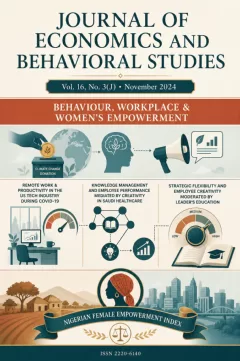
This study examines the impact of remote working arrangements on employee productivity within the tech industry in the United States during the COVID-19 pandemic. Utilizing an online survey of 295 tech professionals, the research compares self-reported productivity levels before and after transitioning to remote work. Findings indicate a significant increase in high productivity levels and a decrease in low productivity levels post-transition. Key factors enhancing productivity include improved work-life balance and increased flexibility in working hours, while challenges such as maintaining work-home boundaries and internet connectivity issues were identified as impediments. The study offers actionable insights for managers to optimize remote work practices and contributes to the evolving discourse on business management in the postpandemic era.
Keywords
- Remote Work Search this journal for Remote Work (opens in a new tab)
- Employee Productivity Search this journal for Employee Productivity (opens in a new tab)
- Tech Industry Search this journal for Tech Industry (opens in a new tab)
- COVID-19 Search this journal for COVID-19 (opens in a new tab)
- Work-Life Balance Search this journal for Work-Life Balance (opens in a new tab)
References
- Alexander, A., Smet, A., Langstaff, M., & Ravid, D. (2021). What employees are saying about the future of remote work? McKinsey & Company. https://www.mckinsey.com/business-functions/organization/our-insights/what-employees-are-saying-about-the-future-of-remote-work
- Allen, T. D., Golden, T. D., & Shockley, K. M. (2015). How effective is telecommuting? Assessing the status of our scientific findings. Psychological Science in the Public Interest, 16(2), 40–68. https://doi.org/10.1177/1529100615593273 DOI: https://doi.org/10.1177/1529100615593273
- A.P.A. (2017). Ethical Principles of Psychologists and Code of Conduct. American Psychological Association. https://www.apa.org/ethics/code/
- Ashforth, B. E., Kreiner, G. E., & Fugate, M. (2000). All in a day’s work: Boundaries and micro role transitions. Academy of Management Review, 25(3), 472–491. https://doi.org/10.5465/amr.2000.3363315 DOI: https://doi.org/10.2307/259305
- Bakker, A. B., Demerouti, E., & Verbeke, W. (2007). Using the job demands?resources model to predict burnout and performance. Human Resource Management, 43(1), 83–104. https://doi.org/10.1002/hrm.20004 DOI: https://doi.org/10.1002/hrm.20004
- Battiston, D., Vidal, J., & Kirchmaier, T. (2017). Is distance dead? Face-to-face communication and productivity in teams. Centre for Economic Performance Discussion Paper, 1465. https://cep.lse.ac.uk/pubs/download/dp1465.pdf DOI: https://doi.org/10.2139/ssrn.2934290
- Belanger, F., Collins, R. W., & Cheney, P. H. (2001). Technology requirements and work group communication for telecommuters. Information Systems Research, 12(2), 155–176. https://doi.org/10.1287/isre.12.2.155.9699 DOI: https://doi.org/10.1287/isre.12.2.155.9695
- Bernstein, E., Shore, J., & Lazer, D. (2018). How intermittent breaks in interaction improve collective intelligence. Proceedings of the National Academy of Sciences, 115(35), 8734–8739. https://doi.org/10.1073/pnas.1802407115 DOI: https://doi.org/10.1073/pnas.1802407115
- Bloom, N., Liang, J., Roberts, J., & Ying, Z. J. (2015). Does working from home work? Evidence from a Chinese experiment. The Quarterly Journal of Economics, 130(1), 165–218. https://doi.org/10.1093/qje/qju032 DOI: https://doi.org/10.1093/qje/qju032
- Buhrmester, M., Kwang, T., & Gosling, S. D. (2011). Amazon’s Mechanical Turk: A New Source of Inexpensive, Yet High-Quality, Data? Perspectives on Psychological Science, 6(1), 3–5. https://doi.org/10.1177/1745691610393980 DOI: https://doi.org/10.1177/1745691610393980
- Bulger, C. A., Matthews, R. A., & Hoffman, M. E. (2007). Work and personal life boundary management: Boundary strength, work/personal life balance, and the segmentation-integration continuum. Journal of Occupational Health Psychology, 12(4), 365–375. https://doi.org/10.1037/1076-8998.12.4.365 DOI: https://doi.org/10.1037/1076-8998.12.4.365
- Carnevale, J. B., & Hatak, I. (2020). Employee adjustment and well-being in the era of COVID-19: Implications for human resource management. Journal of Business Research, 116, 183–187. https://doi.org/10.1016/j.jbusres.2020.05.037 DOI: https://doi.org/10.1016/j.jbusres.2020.05.037
- Chandler, J., Mueller, P., & Paolacci, G. (2014). Nonnaïveté among Amazon Mechanical Turk workers: Consequences and solutions for behavioral researchers. Behavior Research Methods, 46(1), 112–130. https://doi.org/10.3758/s13428-013-0365-7 DOI: https://doi.org/10.3758/s13428-013-0365-7
- Choudhury, P., Foroughi, C., & Larson, B. (2021). Work-from-anywhere: The productivity effects of geographic flexibility. Strategic Management Journal, 42(4), 655–683. https://doi.org/10.1002/smj.3251 DOI: https://doi.org/10.1002/smj.3251
- Clark, S. C. (2000). Work/family border theory: A new theory of work/family balance. Human Relations, 53(6), 747–770. https://doi.org/10.1177/0018726700536001 DOI: https://doi.org/10.1177/0018726700536001
- Cochran, W. G. (1977). Sampling techniques (3rd ed.). Wiley.
- Coenen, M., & Kok, R. A. W. (2014). Workplace flexibility and new product development performance: The role of telework and flexible work schedules. European Management Journal, 32(4), 564–576. https://doi.org/10.1016/j.emj.2013.12.003 DOI: https://doi.org/10.1016/j.emj.2013.12.003
- CompTIA. (2020). Cyberstates 2020 [Research Report]. https://connect.comptia.org/content/research/cyberstates-2020
- Contreras, F., Baykal, E., & Abid, G. (2020). E-leadership and teleworking in times of COVID-19 and beyond: What we know and where do we go. Frontiers in Psychology, 11. https://doi.org/10.3389/fpsyg.2020.590271 DOI: https://doi.org/10.3389/fpsyg.2020.590271
- Daft, R. L., & Lengel, R. H. (1986). Organizational information requirements, media richness and structural design. Management Science, 32(5), 554–571. https://doi.org/10.1287/mnsc.32.5.554 DOI: https://doi.org/10.1287/mnsc.32.5.554
- Demerouti, E., Bakker, A. B., Nachreiner, F., & Schaufeli, W. B. (2001). The job demands-resources model of burnout. Journal of Applied Psychology, 86(3), 499–512. https://doi.org/10.1037/0021-9010.86.3.499 DOI: https://doi.org/10.1037/0021-9010.86.3.499
- Derks, D., Mierlo, H., & Schmitz, E. B. (2014). A diary study on work-related smartphone use, psychological detachment and exhaustion: Examining the role of the perceived segmentation norm. Journal of Occupational Health Psychology, 19(1), 74–84. https://doi.org/10.1037/a0035076 DOI: https://doi.org/10.1037/a0035076
- DeSanctis, G., & Poole, M. S. (1994). Capturing the complexity in advanced technology use: Adaptive structuration theory. Organization Science, 5(2), 121–147. https://doi.org/10.1287/orsc.5.2.121 DOI: https://doi.org/10.1287/orsc.5.2.121
- Ford, D., Storey, M. A., Zimmermann, T., Bird, C., Jaffe, S., Maddila, C., & Butler, J. (2021). A tale of two cities: Software developers working from home during the COVID-19 pandemic. ACM Transactions on Software Engineering and Methodology, 31(2), 1–37. https://doi.org/10.1145/3487567 DOI: https://doi.org/10.1145/3487567
- Gajendran, R. S., & Harrison, D. A. (2007). The good, the bad, and the unknown about telecommuting: Meta-analysis of psychological mediators and individual consequences. Journal of Applied Psychology, 92(6), 1524–1541. https://doi.org/10.1037/0021-9010.92.6.1524 DOI: https://doi.org/10.1037/0021-9010.92.6.1524
- Gibbs, M., Mengel, F., & Siemroth, C. (2021). Work from home & productivity: Evidence from personnel & analytics data on IT professionals. University of Chicago, Becker Friedman Institute for Economics Working Paper No. https://doi.org/10.2139/ssrn.3846680 DOI: https://doi.org/10.2139/ssrn.3846680
- Golden, T. D., & Veiga, J. F. (2005). The impact of extent of telecommuting on job satisfaction: Resolving inconsistent findings. Journal of Management, 31(2), 301–318. https://doi.org/10.1177/0149206304271768 DOI: https://doi.org/10.1177/0149206304271768
- Hackman, J. R., & Oldham, G. R. (1976). Motivation through the design of work: Test of a theory. Organizational Behavior and Human Performance, 16(2), 250–279. https://doi.org/10.1016/0030-5073(76)90016-7 DOI: https://doi.org/10.1016/0030-5073(76)90016-7
- Hara, K., Adams, A., Milland, K., Savage, S., Callison-Burch, C., & Bigham, J. P. (2018). A data-driven analysis of workers’ earnings on Amazon Mechanical Turk. Proceedings of the 2018 CHI Conference on Human Factors in Computing Systems, 449, 1–14. https://doi.org/10.1145/3173574.3174023 DOI: https://doi.org/10.1145/3173574.3174023
- Hartman, R. I., Stoner, C. R., & Arora, R. (2015). Developing successful organizational telecommuting arrangements: Worker perceptions and managerial prescriptions. SAM Advanced Management Journal, 80(3), 38–50.
- Hern, A. (2020). Twitter announces employees will be allowed to work from home “forever.” The Guardian. https://www.theguardian.com/technology/2020/may/12/twitter-announces-employees-can-work-from-home-forever
- Huws, U., Korte, W. B., & Robinson, S. (1990). Telework: Towards the elusive office. John Wiley & Sons.
- Kelly, J. (2020). Facebook and Twitter employees will work from home for the rest of the year. Forbes. https://www.forbes.com/sites/jackkelly/2020/05/08/facebook-and-twitter-employees-will-work-from-home-for-the-rest-of-the-year
- Kirkman, B. L., Rosen, B., Gibson, C. B., Tesluk, P. E., & McPherson, S. O. (2002). Five challenges to virtual team success: Lessons from Sabre, Inc. Academy of Management Executive, 16(3), 67–79. https://doi.org/10.5465/ame.2002.8540322 DOI: https://doi.org/10.5465/ame.2002.8540322
- Kniffin, K. M., Narayanan, J., Anseel, F., Antonakis, J., Ashford, S. P., Bakker, A. B., & Vugt, M. V. (2021). COVID-19 and the workplace: Implications, issues, and insights for future research and action. American Psychologist, 76(1), 63–77. https://doi.org/10.1037/amp0000716 DOI: https://doi.org/10.1037/amp0000716
- Kossek, E. E., Lautsch, B. A., & Eaton, S. C. (2012). Telecommuting, control, and boundary management: Correlates of policy use and practice, job control, and work-family effectiveness. Journal of Vocational Behavior, 80(2), 347–358. https://doi.org/10.1016/j.jvb.2011.08.011 DOI: https://doi.org/10.1016/j.jvb.2005.07.002
- Majchrzak, A., Rice, R. E., Malhotra, A., King, N., & Ba, S. (2000). Technology adaptation: The case of a computer-supported inter-organizational virtual team. MIS Quarterly, 24(4), 569–600. https://doi.org/10.2307/3250948 DOI: https://doi.org/10.2307/3250948
- Mann, S., & Holdsworth, L. (2003). The psychological impact of teleworking: Stress, emotions and health. New Technology, Work and Employment, 18(3), 196–211. https://doi.org/10.1111/1468-005X.00121 DOI: https://doi.org/10.1111/1468-005X.00121
- Martins, L. L., Gilson, L. L., & Maynard, M. T. (2004). Virtual teams: What do we know and where do we go from here? Journal of Management, 30(6), 805–835. https://doi.org/10.1016/j.jm.2004.05.002 DOI: https://doi.org/10.1016/j.jm.2004.05.002
- Mazmanian, M., Orlikowski, W. J., & Yates, J. (2013). The autonomy paradox: The implications of mobile email devices for knowledge professionals. Organization Science, 24(5), 1337–1357. https://doi.org/10.1287/orsc.1120.0806 DOI: https://doi.org/10.1287/orsc.1120.0806
- Messenger, J. C. (2019). Telework in the 21st century: An evolutionary perspective. Edward Elgar Publishing. DOI: https://doi.org/10.4337/9781789903751
- Messenger, J. C., & Gschwind, L. (2016). Three generations of telework: New ICTs and the (r)evolution from home office to virtual office. New Technology, Work and Employment, 31(3), 195–208. https://doi.org/10.1111/ntwe.12073 DOI: https://doi.org/10.1111/ntwe.12073
- Moore, M. G. (1993). Theory of transactional distance. In D. Keegan (Ed.), Theoretical principles of distance education (pp. 22–38). Routledge.
- Nilles, J. M. (1975). Telecommunications and organizational decentralization. IEEE Transactions on Communications, 23(10), 1142–1147. https://doi.org/10.1109/TCOM.1975.1092687 DOI: https://doi.org/10.1109/TCOM.1975.1092687
- Oakman, J., Kinsman, N., Stuckey, R., Graham, M., & Weale, V. (2020). A rapid review of mental and physical health effects of working at home: How do we optimize health? BMC Public Health, 20(1). https://doi.org/10.1186/s12889-020-09875-z DOI: https://doi.org/10.1186/s12889-020-09875-z
- Olson, G. M., & Olson, J. S. (2014). How to make distance work work. Interactions, 21(2), 28–35. https://doi.org/10.1145/2567788 DOI: https://doi.org/10.1145/2567788
- Olson, M. H., & Primps, S. B. (1984). Working at home with computers: Work and nonwork issues. Journal of Social Issues, 40(3), 97–112. https://doi.org/10.1111/j.1540-4560.1984.tb00194.x DOI: https://doi.org/10.1111/j.1540-4560.1984.tb00194.x
- Ozimek, A. (2020). The future of remote work. Economics Working Paper. https://doi.org/10.2139/ssrn.3638597 DOI: https://doi.org/10.2139/ssrn.3638597
- Richter, A. (2020). Locked-down digital work. International Journal of Information Management, 55, 102157. https://doi.org/10.1016/j.ijinfomgt.2020.102157 DOI: https://doi.org/10.1016/j.ijinfomgt.2020.102157
- Saba, F., & Shearer, R. L. (1994). Verifying key theoretical concepts in a dynamic model of distance education. The American Journal of Distance Education, 8(1), 36–59. https://doi.org/10.1080/08923649409526844 DOI: https://doi.org/10.1080/08923649409526844
- Savi?, D. (2020). COVID-19 and work from home: Digital transformation of the workforce. Grey Journal, 16(2), 101–104.
- Spataro, J. (2020). 2 years of digital transformation in 2 months. Microsoft 365 Blog [Blog]. Microsoft 365. https://www.microsoft.com/en-us/microsoft-365/blog/2020/04/30/2-years-digital-transformation-2-months/
- Staples, D. S. (2001). A study of remote workers and their differences from non-remote workers. Journal of End User Computing, 13(2), 3–14. https://doi.org/10.4018/joeuc.2001040101 DOI: https://doi.org/10.4018/joeuc.2001040101
- Waizenegger, L., McKenna, B., Cai, W., & Bendz, T. (2020). An affordance perspective of team collaboration and enforced working from home during COVID-19. European Journal of Information Systems, 29(4), 429–442. https://doi.org/10.1080/0960085X.2020.1800417 DOI: https://doi.org/10.1080/0960085X.2020.1800417
- Walter, S. L., Seibert, S. E., Goering, D., & O’Boyle, E. H. (2019). A tale of two sample sources: Do results from online panel data and conventional data converge? Journal of Business and Psychology, 34(4), 425–452. https://doi.org/10.1007/s10869-018-9552-y DOI: https://doi.org/10.1007/s10869-018-9552-y
- Wang, B., Liu, Y., Qian, J., & Parker, S. K. (2021). Achieving effective remote working during the COVID?19 pandemic: A work design perspective. Applied Psychology, 70(1), 16–59. https://doi.org/10.1111/apps.12290 DOI: https://doi.org/10.1111/apps.12290
- World Health Organization. (2020). WHO Director-General’s opening remarks at the Mission briefing on COVID-19—12 March 2020. https://www.who.int/director-general/speeches/detail/who-director-general-s-opening-remarks-at-the-mission-briefing-on-covid-19---12-march-2020
- Yang, L., Holtz, D., Jaffe, S., Suri, S., Sinha, S., Weston, J., & Teevan, J. (2021). The effects of remote work on collaboration among information workers. Nature Human Behaviour, 6(1), 43–54. https://doi.org/10.1038/s41562-021-01196-4 DOI: https://doi.org/10.1038/s41562-021-01196-4
Downloads
Full-text downloads recorded for this article, by month.
No downloads have been recorded for this article yet. Figures appear here once readers begin downloading the full text.
How to Cite
Share this article
License
Copyright (c) 2024 Eric Strandt (Author)

This work is licensed under a Creative Commons Attribution 4.0 International License.
Author (s) should affirm that the material has not been published previously. It has not been submitted and it is not under consideration by any other journal. At the same time author (s) need to execute a publication permission agreement to assume the responsibility of the submitted content and any omissions and errors therein. After submission of revised paper in the light of suggestions of the reviewers, the editorial team edits and formats manuscripts to bring uniformity and standardization in published material.
This work will be licensed under Creative Commons Attribution 4.0 International (CC BY 4.0) and under condition of the license, users are free to read, copy, remix, transform, redistribute, download, print, search or link to the full texts of articles and even build upon their work as long as they credit the author for the original work. Moreover, as per journal policy author (s) hold and retain copyrights without any restrictions.
Keywords
- Remote Work Search this journal for Remote Work (opens in a new tab)
- Employee Productivity Search this journal for Employee Productivity (opens in a new tab)
- Tech Industry Search this journal for Tech Industry (opens in a new tab)
- COVID-19 Search this journal for COVID-19 (opens in a new tab)
- Work-Life Balance Search this journal for Work-Life Balance (opens in a new tab)
Section
Published
Submissions
Have research to publish? Journal of Economics and Behavioral Studies welcomes submissions.
Make a Submission