Articles

  • Article 1 in this issue

    Work-Addiction: A Poison by Slow Motion

    • Author: Parul Sharma, Jyoti Sharma

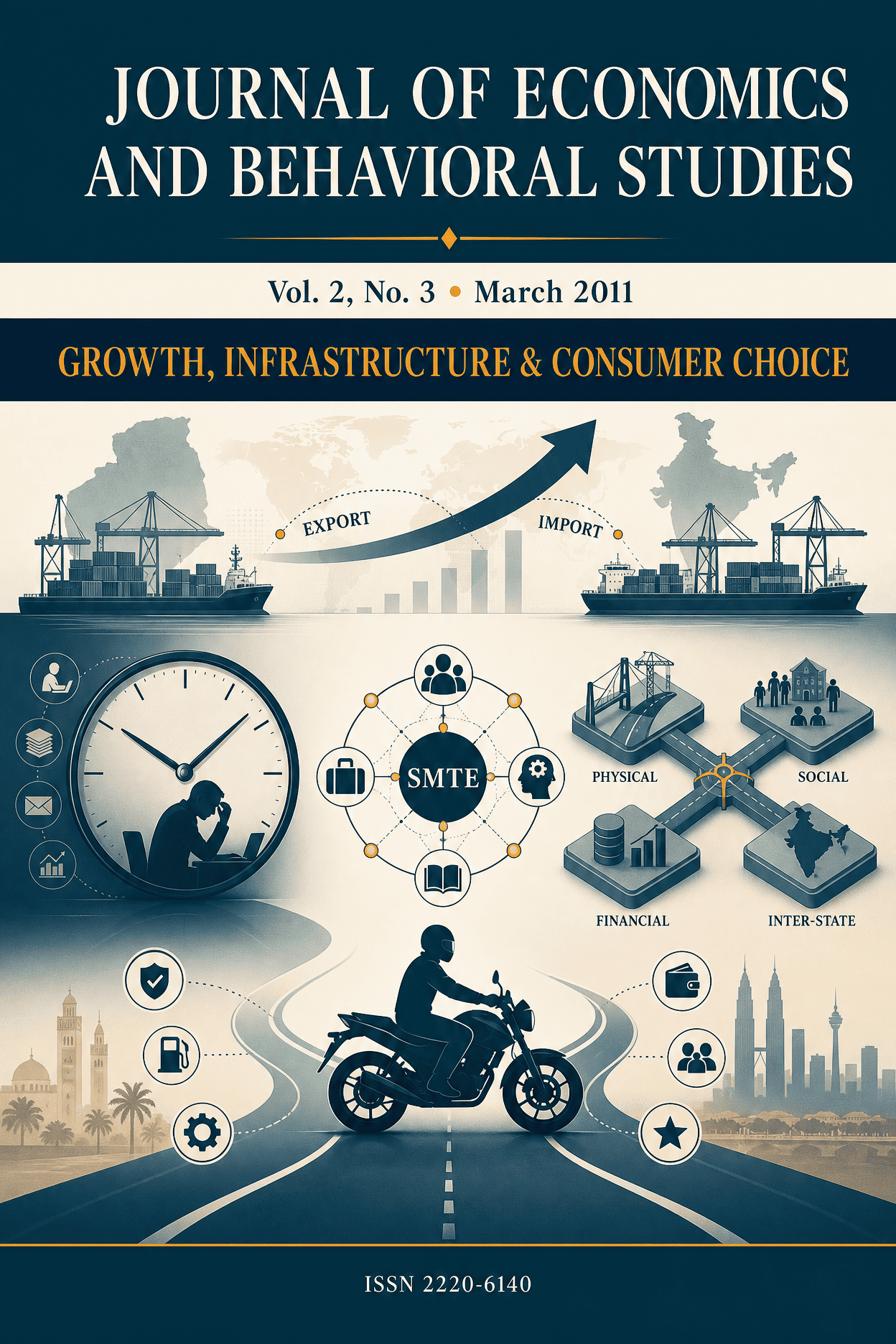
    Today’s professionals work long hours for a variety of reasons and are dominated by increasing work pressures, tough competitors and day to day challenges. Due to this they are getting addicted to work. Addiction to work is a new concept and the effect of work addiction is more severe than the people realize. Keeping this in view, the paper attempts to throw light on the underlying dimensions of work addiction and depicts the consequences of work addiction. The study also suggests some preventive and remedial measures to overcome/reduce the outcomes of this addiction to work.

    Pages 86-91

    PDF - Work-Addiction: A Poison by Slow Motion (opens in a new tab)
  • Article 2 in this issue

    Exploring Exports and Economic Growth Causality in Algeria

    • Author: Abdus Samad

    This paper investigates the causality relationship between economic growth, exports and imports in Algeria using Cointegration, Error Correction Model, and VEC Granger causality/Wald Exogeniety tests. The paper finds that economic growth in Algeria is linked to export industries and import is linked to economic growth. In other words, the growth in export sectors Granger causes economic growth which, in turn, promotes the growth of imports in Algeria. The paper suggests policy prescription that the government of Algeria should put emphasis on promoting growth and development of export industries by ensuring increased productivity in such sector.

    Pages 92-96

    PDF - Exploring Exports and Economic Growth Causality in Algeria (opens in a new tab)
  • Article 3 in this issue

    Harnessing Explicit Knowledge

    • Author: Wusheng Zhang, Mikyung Kim

    In the search for sustainable competitive advantage, managing knowledge is critical not only for large organizations but also for Small and Medium sized Tourism Enterprises (SMTEs) where limited resources and the lack of the strategic direction are prevalent. Findings from the literature review suggest that, in relative terms, SMTEs are less ready for implementing knowledge management projects than are large organizations. It is also suggested that SMTEs are in need of practical strategic guidance if they are to make the most of the, often under-exploited, knowledge within and available to their organizations. For the support of SMTEs’ initial needs for knowledge management, this paper proposes a strategy aimed at harnessing explicit knowledge and strategic activities based on an extensive analysis of the literature. The proposed strategy contains actionable steps with timelines and milestones that can be implemented and modified iteratively by SMTEs, with in-built assessment and measurement mechanisms. The results of our study suggest that implementation itself can be flexible as well as iterative with no need for all the steps outlined for an improvement of the knowledge management process to be followed.

    Pages 97-107

    PDF - Harnessing Explicit Knowledge (opens in a new tab)
  • Article 4 in this issue

    Factors Affecting the Consumer’s Decision on Purchasing Power

    • Author: Sher Akbar, Abu Hassan Abu Bakar

    The purpose of this study is to evaluate the determinants of decision making, purchasing motorcycles from students’ perspectives of University Sains Malaysia in Penang. The research model used in this study was adapted from “Model of Buyer Behavior”. This study shows three factors (product, price, and place) affected the consumer’s decision on buying motorcycles in Penang, Malaysia. The primary data were collected from 415 students of University Sains Malaysia, main campus, and analyzed by using statistical techniques, like Percentage, mean and standard deviation. The result has shown that the mention three factors was significance in students’ decision on buying motorcycles. Most respondents have given importance to purchase the cheapest Motorcycles from competitors. The consumers give keen interest in shops distributing only Motorcycles and also respondents have an importance on Personal Relationship with owners/providers.

    Pages 108-116

    PDF - Factors Affecting the Consumer’s Decision on Purchasing Power (opens in a new tab)
  • Article 5 in this issue

    Infrastructure in India: The Present Status and Its Constraints

    • Author: Rudra P. Pradhan

    Provision of adequate infrastructure, in terms of both quantity and quality, is very essential for the rapid achievement of sustainable economic growth, both by increasing productivity and by providing amenities that enhance the quality of life. The objective of this paper is to investigate the role played by infrastructure, grouped under physical, social and financial, in determining economic development in India over the different time periods. An attempt is also made to find out the existence of intra-regional disparities, in terms of infrastructure, among the states of India. Using Factor analysis and regression analysis, the paper finds that infrastructure plays a significant role in determining the inter-state level of development in India during the past quarter century. The paper at the end discusses various challenges and opportunities for the infrastructure development in India and its link with sustainable economic growth.

    Pages 117-124

    PDF - Infrastructure in India: The Present Status and Its Constraints (opens in a new tab)