Articles

  • Article 1 in this issue

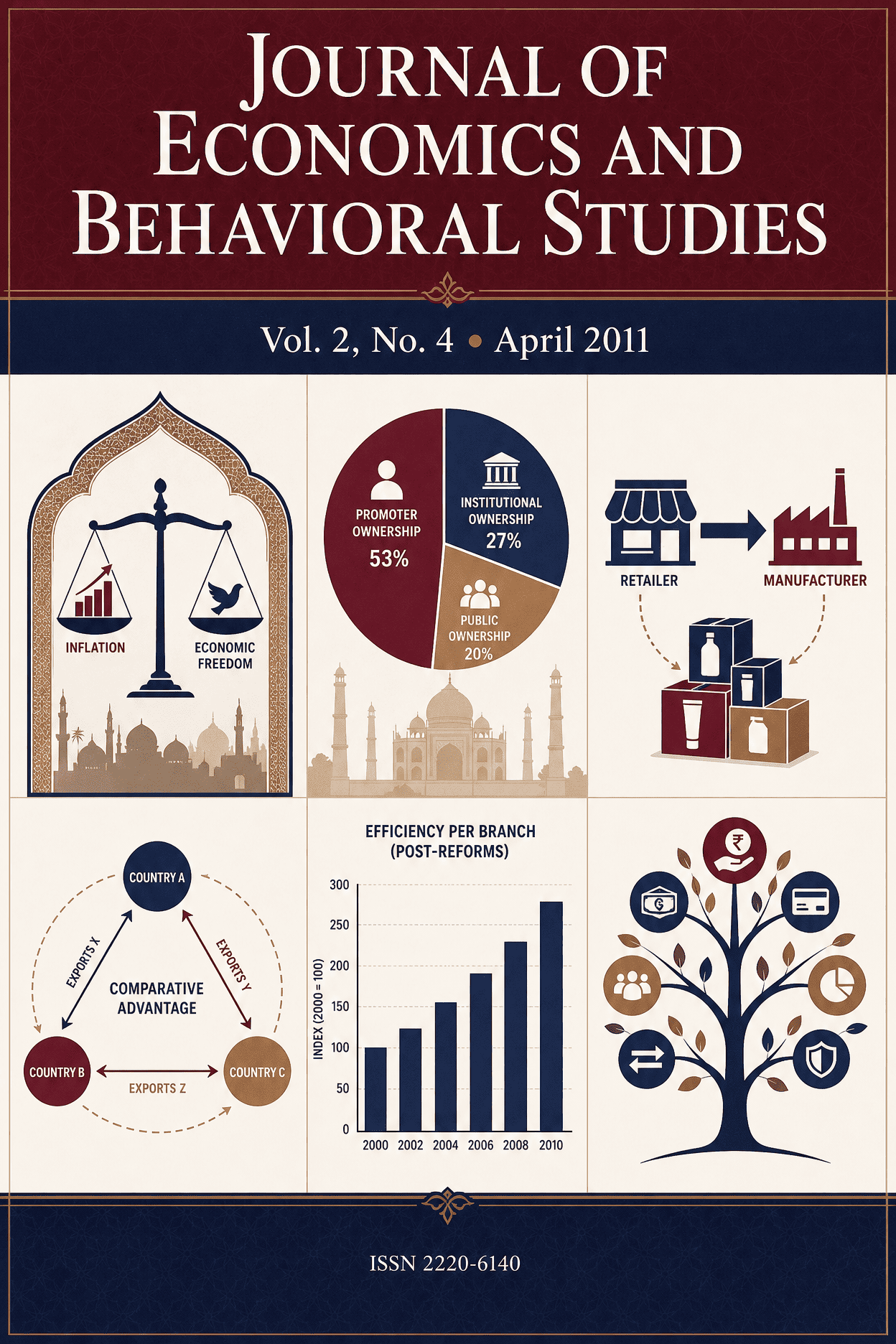
    Inflation & Economic Freedom: Evidence from MENA Region

    • Author: Ahmad Jafari Samimi, Mahmood Mahmoodzadeh, Leila Shadabi

    Since1980s economic freedom policies have been popular in most countries, especially in developing countries. There are many studies regarding relationship between economic freedom and other socio-economic variables, but few dealt directly with the impact of economic freedom on inflation. This study analyses the effect of economic freedom on inflation in MENA region during 1996- 2006 using panel data regression analysis on the basis of the so- called Gordon theory. Our findings indicate that although the impact of economic freedom on inflationis not considerable butit is statistically significance.

    Pages 125-130

    PDF - Inflation & Economic Freedom: Evidence from MENA Region (opens in a new tab)
  • Article 2 in this issue

    Equity Ownership and Financial Performance

    • Author: Aman Srivastava

    This paper attempts to examine the relationship of equity ownership and financial performance of firms in India. The study explored the possibility that whether equity ownership type affects the financial performance of listed Indian firms. The study examined the relationship of equity ownership with accounting as well as market measures of financial performance of the firms. The study sampled the 500 listed companies constituting BSE 500 indices of Bombay Stock Exchange of India. The 397 most actively listed companies on BSE 500 indices of Bombay Stock Exchange of India, which constitute the bulk of trading, were chosen to constitute the sample of the study as of end of 2009-10. The study used Ordinary least square (OLS) to examine the relationship between the equity ownership and financial performance of the Indian listed firms. The findings of the study depict the presence of highly concentrated ownership structure in the Indian market. The results of the regression analyses interestingly indicate that the dispersed equity ownership influences certain dimensions of accounting financial performance measures (i.e. ROA and ROE) but not market performance measures (i.e. Tobin’s Q, P/E and P/BV ratios), which indicate that there might be other factors (Behavioral, macro economic, political, contextual) affecting firms performance other than ownership structure. The findings of the study might be relevant for practitioners and investors for taking their financing and investment decisions.

    Pages 131-137

    PDF - Equity Ownership and Financial Performance (opens in a new tab)
  • Article 3 in this issue

    Factors Affecting Retailers Attitude towards Manufacturers: A Study on Unilever

    • Author: Muhammad Intisar Alam, Afreen Choudhury

    The study addresses broadly the performance related issues as to what extent is the impact of various factors responsible in terms of retailers for doing business with manufacturers in FMCG (Fast Moving Consumer Goods) sector at Dhaka in Bangladesh. The theoretical framework was designed based on the literature and hence two hypotheses were formulated. The samples were selected by Proportionate Stratified Sampling method. The data were collected by distributing 10 items questionnaires to 50 retailers under different categories in Dhaka. The questionnaire was developed on the basis of exploratory research which were used to measure retailers attitude. Data collected were sorted out and keyed in into SPSS and were analyzed using descriptive statistics to answer the research question. Using the Factor analysis we have extracted four factors and named those factors as Manufacturer’s Production Standard, Managerial Efficiency, Promotional Capability and Customer Solution Capability. The result of the Multiple Regression analysis showed that there is a significant relationship between retailers’ attitude (dependent variable) and the factors determined in the factor analysis (independent variables). Together the independent variables explained 67.9% of the variance of the dependable variables whereas the remaining 32.1% was due to unidentified variables. Therefore the results of the study definitely play a vital role and leave an ever lasting impact to be used in decision making by retailers and the entire company as a whole. Moreover this study can be used as a reference for the future studies to understand the perceptions and opinions of the other channel members in addition to retailers as well.

    Pages 138-150

    PDF - Factors Affecting Retailers Attitude towards Manufacturers: A Study on Unilever (opens in a new tab)
  • Article 4 in this issue

    Fragility of Comparative Advantage in Higher Dimensions: An Experimental Investigation

    • Author: Baboo M Nowbutsing

    In this study, an experimental analysis of the fragility of the law of the comparative advantage in higher dimensions is performed. Noussair et al (1995) invoked a trading environment similar to the 2 x 2 Competitive Ricardian Model (CRM) and observed the law of comparative advantage. In this experiment, the same experimental setting is invoked however the number of goods and countries is increased. There were three countries and three goods, two countries were categorised as ‘intermediate’ comparative advantage while one as ‘extreme’ comparative advantage. However, the Jones (1961)’s criterion for optimal assignment was satisfied. The experimental findings reveal the following (1) both the autarky model and the competitive model are rejected as a representation of the data but the competitive model performs better than the autarky model (2) the CRM does not predict the production pattern (3) the CRM does not predict pattern of trade (4) output prices do not converge to the prediction of the theoretical model. Thus the results support the claim of Deardoff (2005).

    Pages 151-170

    PDF - Fragility of Comparative Advantage in Higher Dimensions: An Experimental Investigation (opens in a new tab)
  • Article 5 in this issue

    Global Crisis: Problems and Prospects for Indian Banking Industry

    • Author: R. K. Uppal

    The present paper analyses the efficiency of all the bank groups in the post- banking sector reforms era. Time period of the study is related to second post-banking sector reforms (1999-2000 to 2005-06). This period has been chosen taking into consideration the following factors; On the basis of some parameters of efficiency i.e. profitability per employee, per branch, business per employee, per branch and expenses per employee and per branch, the paper concludes that efficiency of all the bank groups has increased in the second post-banking reforms period but these banking sector reforms are more beneficial for new private sector banks and foreign banks. At the end, paper suggests some measures for the improvement of efficiency of Indian nationalized banks. Key Words : Banking Sector Reforms, Efficiency Parameters, Future areas of Research, Implications of the study and conclusion

    Pages 171-176

    PDF - Global Crisis: Problems and Prospects for Indian Banking Industry (opens in a new tab)
  • Article 6 in this issue

    Most Preferred Business Banking Product of HDFC Bank in Trichy City

    • Author: Uma Rani T. S., N. Panchanatham

    Change is the only constant factor in this dynamic world and banking is not an exception. The changes staring in the face of bankers relates to the fundamental way of banking-which is undergoing rapid transformation in the world of today, in response to the forces of completion productivity and efficiency of operations, reduced operating margins better asset/liability management, risk management, any time and any where banking. The major challenge faced by banks today is to protect the falling margins due to the impact of competition. Another significant impact of banks today is the technology issue. In this study the business banking products of HDFC bank, that best suits the needs of the borrower were analysed. The Customer feels that loans to be obtained require a process that is extremely complicating and time consuming. This calls for an ombudsman setup separately for the domain. The observation and findings of the study have helped to give useful recommendation to bank. The implementation of the suggestion can help to improve strategies and build competencies over that of their competitors. This study has there by helped me by giving exposure into new concepts in today’s banking scenario as the interface shifts from service to products. There has also been some insight into competency recognition.

    Pages 177-185

    PDF - Most Preferred Business Banking Product of HDFC Bank in Trichy City (opens in a new tab)