Articles

  • Article 1 in this issue

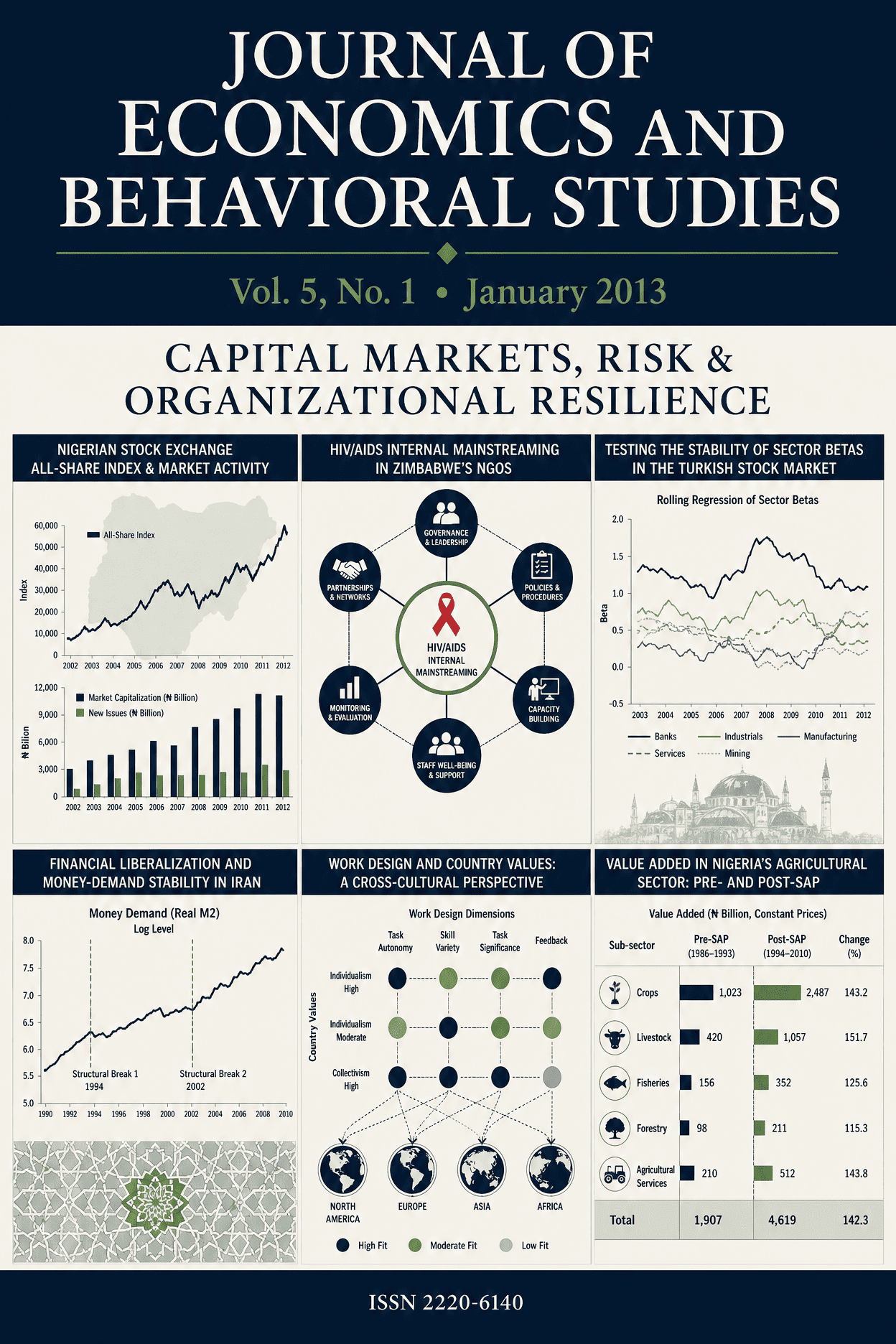
    Impact of Capital Market Development on the Nigerian Economy: A Post-SAP Analysis

    • Author: Adeusi, S.O., Sulaiman, L.A., Azeez, B. A.

    This paper addresses the impact of capital market development on economic growth and development since the liberalization policy in 1986 to 2010 in Nigeria. It employs Ordinary Least Square (OLS) and Johansen CO-integration estimation techniques. Gross Domestic Product (GDP) was used as measure for economic growth while the capital market development are represented with Market Capitalization (MCAP), Total Value of Transaction (TVT), Total New Issues (TNI), All-Share Index (ALSI) and Total Listing on the NSE (TLT). The result of the study shows that capital market development has not impacted positively on Nigeria economic growth and development due to the relative small size of the market despite its development as a result of the liberalization policy. Thus, it recommends that policies that would encourage domestic as well as foreign investors to participate in the market should be formulated.

    Pages 1-7

    PDF - Impact of Capital Market Development on the Nigerian Economy: A Post-SAP Analysis (opens in a new tab)
  • Article 2 in this issue

    Internal Mainstreaming of HIV and AIDS in Zimbabwe’s Non-Governmental Organisations

    • Author: Rutendo Fran Chitapi, Togara Warinda

    Organisations remain exposed to risk and are vulnerable to HIV and AIDS impacts for as long as they are unprepared to mainstream HIV and AIDS. Certainly without infusing sustainable strategies for the HIV and AIDS pandemic into day to day operations there would be considerable waste of resources. This study sought to establish the level of internal mainstreaming of HIV and AIDS in an international NGO operating in Zimbabwe. Questionnaires were used to collect data from a sample of employees of the NGO, while senior managers were interviewed. Relevant internal documents were also reviewed to help ascertain the extent of internal mainstreaming in the NGO. The main finding was that HIV and AIDS internal mainstreaming had not been successfully done. While the organisation had certain comparative advantages, these were not harnessed to address the causes and effects of HIV and AIDS in an effective and sustained manner within the NGO. The major barrier was lack of commitment by senior management of the NGO. While management were aware of the impacts of HIV and AIDS, there were no tools to enable them to quantify the effect on the NGO. Getting it right for this NGO does not require more financial resources but a paradigm shift and modifying or realigning what is already on the ground for an effective and sustained response to HIV and AIDS.

    Pages 8-17

    PDF - Internal Mainstreaming of HIV and AIDS in Zimbabwe’s Non-Governmental Organisations (opens in a new tab)
  • Article 3 in this issue

    Testing the Stability of Beta: A Sectoral Analysis in Turkish Stock Market

    • Author: Sibel Celik

    The paper aims to test the stability of sector betas (systematic risk) in Turkish Stock Market for the period 03.01.2005-31.12.2009. We use rolling regression and recursive regression methods to test the stability of beta and two sub-samples to examine the impact of structural breaks on the beta behaviour, considering the 2007-2009 Global crisis. The findings support the instability of beta for most of the sectors and the results are robust when taking into account structural breaks. The paper is different from other studies in the Turkish literature because it uses different methodology, takes into account the crisis effect and focuses on the all sector betas.

    Pages 18-23

    PDF - Testing the Stability of Beta: A Sectoral Analysis in Turkish Stock Market (opens in a new tab)
  • Article 4 in this issue

    Financial Liberalization and the Stability of Short-run and Long-run Money Demand in Iran

    • Author: Maryam Zare, Ali Haghighat

    Money demand is one of the most important macro-economic variables that could be of great importance to the economic prospect of a country. Therefore, awareness on how this function behaves and by adoption of appropriate economic policies, it is possible, by and large, to avoid the emergence of disorder. The present study, employing the annual time series data related to Iranian economy during 1973-2009, tries to investigate possible relationships between financial liberalization and money demand stability in Iran, in the form of 4 models. To do so, Zivot-Andrews (1992) Unit Root Test was applied in order to clarify endogenous structural changes and Gregory-Hansen (1996) Cointegration Test was administered to investigate the long-run relationships between financial liberalization and money demand stability in Iran, with an emphasis on the structural breaks during the period under study. The results of the study show that by taking the structural break into consideration, there is a significant short and long run relationship between financial liberalization and money demand stability in Iran.

    Pages 24-37

    PDF - Financial Liberalization and the Stability of Short-run and Long-run Money Demand in Iran (opens in a new tab)
  • Article 5 in this issue

    A Study on Work Design and Country Values

    • Author: Ahsan Qamar, Saqib Muneer, Ahmad Jusoh, Halimah Idris

    The performance of an organization is dependent on the work design or in other words, the job design. It includes the elements of work included in the job as well as the work environment. With the creation of multinational companies operating in different countries, the cultural element has been added to the organization entity. The question has been whether work design of an MNC, which was originated in the country of origin of the MNC, can also be exported to other countries resulting in the same efficiency of work. This study through literature review looks into major work designs developed in various countries and regions of the world to answer the above given question i.e. whether culture is the moderating factor between job design and the performance.

    Pages 38-43

    PDF - A Study on Work Design and Country Values (opens in a new tab)
  • Article 6 in this issue

    A Review of Value Added in Nigeria’s Pre and Post–SAP Agricultural Sector: Background and Issues

    • Author: Ogujiuba Kanayo, Stiegler Nancy, Ogbonnaya Ufiem Maurice

    In spite of the growing importance of oil, Nigeria has remained essentially an agrarian economy, with agriculture still significantly contributing to its Gross Domestic Product. However, the potentials of the agricultural sector to contribute to economic development in Nigeria have varied widely in the last two decades. This variation appears to be correlated to the nature of the political and economic regimes that exists. There were indications of some moderate output increase following the introduction of SAP. But, it is not yet certain whether the extent of deregulation policy currently being pursued by the Government and the preliminary outcome has elicited the desired response. One of the indications of the adverse development is the diversion of scarce foreign exchange from financing capital and intermediate imports to paying for food imports. Successive governments have experimented with various options in the promotion of agro-based industries, import substitution, promotion of specific sectors and specific areas. The outcome is an imbalance growth of various sub-sectors in the sector, poor capacity utilization, eroded competitiveness of local manufacturers and uneven playing field within the country. This paper basically reviews and analyzes the components of Nigeria’s agricultural sector, its contributions to economic development, and strategies adopted within the sector before and during the Structural Adjustment Program. It recommends that providing the right policy framework/enabling environment and incentives for private sector investment in the sector enshrined in the new economic blue print‘Transformation Agenda’ could be a viable option for revitalizing the sector.

    Pages 44-56

    PDF - A Review of Value Added in Nigeria’s Pre and Post–SAP Agricultural Sector: Background and Issues (opens in a new tab)