Articles

  • Article 1 in this issue

    A Review of Performance Evaluation Measures for Actively-Managed Portfolios

    • Author: Heng-Hsing Hsieh, Kathleen Hodnett

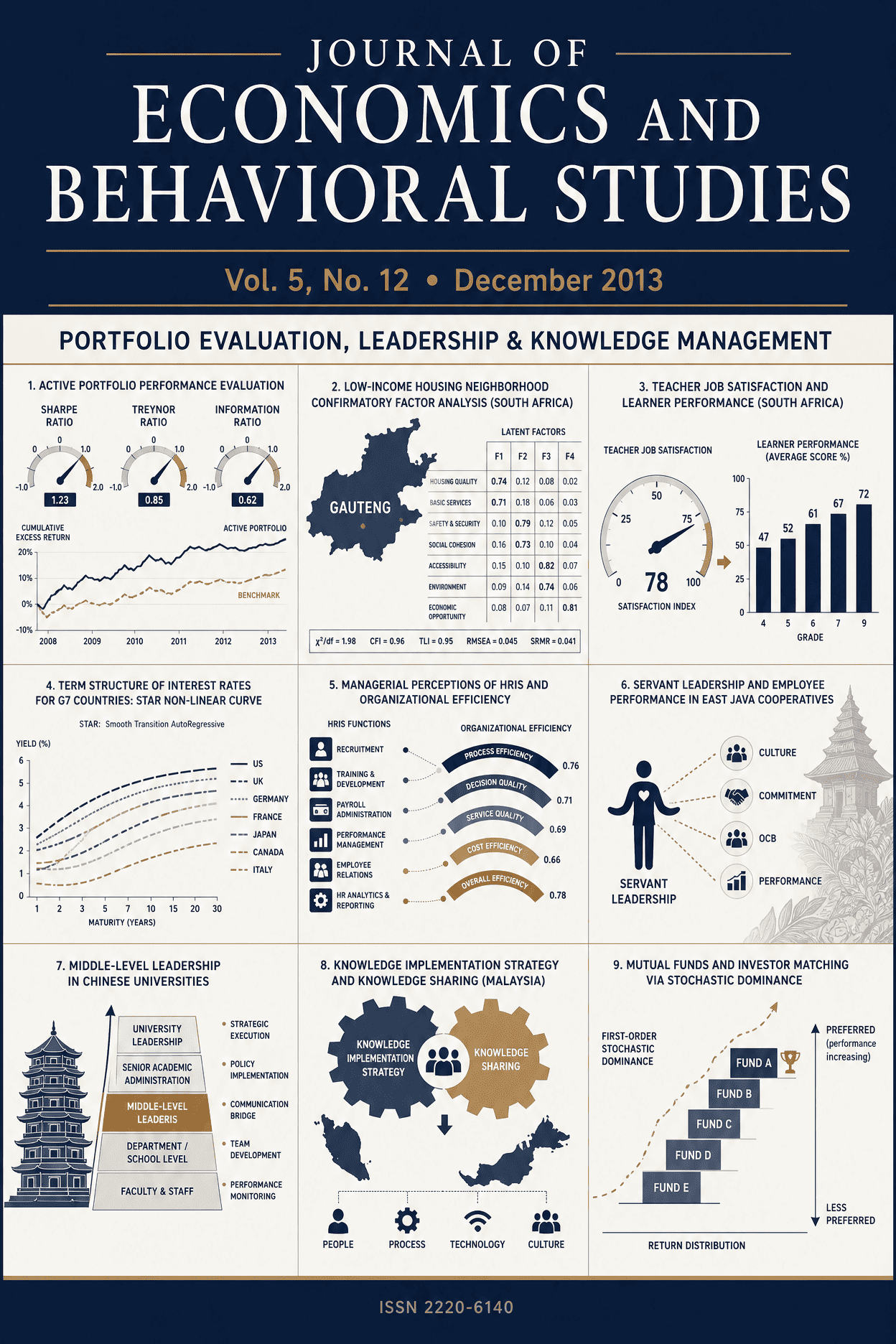
    In the recognition that investment management is an on-going process, the performance of actively-managed portfolios need to be monitored and evaluated to ensure that funds under management are efficiently invested in order to satisfy the mandate specified in the policy statement. This paper discusses the primary performance evaluation techniques used to measure a portfolio’s basic risk and return characteristics, risk-adjusted performance, performance attribution and market timing ability. It is concluded that the Treynor measure is more suitable for evaluating portfolios that are constituents of a broader portfolio, while the information ratio is useful for evaluating hedge funds with an absolute return objective. Although the Sharpe ratio and M-squared arrive at the same evaluation result, M-squared provides a direct comparison between the portfolio and the benchmark. With regard to the analysis of portfolio performance attribution, it is found that the return-based multifactor model of Sharpe (1992) is not suitable for analyzing the performance of hedge funds that engage in short-selling, leverage and derivatives. Additional factors generated by factor analysis could be used as factors in the extended model of Sharpe (1992) to analyze hedge fund return attributions. Finally, the Treynor and Mazuy (1966) model and the Henriksson and Merton (1981) model essentially distinguish the market timing ability from the security selection ability of the portfolio manager.

    Pages 815-824

    PDF - A Review of Performance Evaluation Measures for Actively-Managed Portfolios (opens in a new tab)
  • Article 2 in this issue

    Confirmatory Factorial validity of Neighborhood Features amongst South Africa low-income Housing Occupants’

    • Author: Aigbavboa, C.O., Thwala W.D.

    There is a fundamental link between theory and measurement advising that factorial confirmation of measures should be the first stage of theory testing. The aim of this paper was to confirm the factorial validity of the neighborhood features in a residential satisfaction study amongst South Africa low-income housing occupants’. The study was conducted amongst subsidized low-income housing occupants’ in South Africa. Data used in the study were obtained from a Delphi and field questionnaire study. Primary data was collected through the use of a structured questionnaire survey conducted among 751 low-income housing residents’ in three metropolitan and one district municipality in the Gauteng Province of South Africa. Data gathered via the questionnaire survey were analyzed using structural equation modeling (SEM) which was used to confirm the factorial structure of the constructs. SEM analysis revealed that the Rho coefficient and the Cronbach’s alpha coefficient of internal consistency were over 0.70 criterions for acceptability. Further finding was that neighborhood features influence on the residents’ satisfaction was not statistically significant and hence was weak in the prediction of the residents’ satisfaction with their houses. However, due to the idiosyncratic dataset used in the study, it remains to be seen if the evaluated indicator factors of neighborhood features can replicate to other cross-cultural datasets. If this is the case, the paper makes a significant contribution towards understanding neighborhood features on subsidized low-income housing projects. This study provided significant insight into how residents’ satisfaction with their houses could be improved.

    Pages 825-837

    PDF - Confirmatory Factorial validity of Neighborhood Features amongst South Africa low-income Housing Occupants’ (opens in a new tab)
  • Article 3 in this issue

    Teacher job satisfaction and learner performance in South Africa

    • Author: Chux Gervase Iwu, Saphetha Appie Gwija, Henrie Olumide Benedict, Robertson Khan Tengeh

    Against the backdrop of the dismal performance of a number of South African high Schools in recent years, this study investigates the relationship between poor performance of learners and teacher motivation in selected high schools in the Western Cape Province of South Africa. Adopting an exploratory approach, a random sample of 279 educators was drawn from the database of the poorly performing high schools as provided by the Western Cape Department of Education. Using closed and open-ended questions, a survey questionnaire was utilized to collect data. The Statistical Package for the Social Sciences (SPSS version 21) was utilised to analyse the data. A number of descriptive statistical tests including Chi Square, and Spearman’s correlation were conducted on the data. The results suggest that highly motivated educators experience job satisfaction; and also perform better than their poorly motivated counterparts. In terms of motivation, the results further suggest that a mix of intrinsic and extrinsic factors tend to exert influence on the educators motivation. For instance, working conditions, job security, and perceived growth opportunities in order of importance were noted to be contributing factors. As far as the obstacles that these educators encounter, lack of resources, work over load and lack of recognition were noted in order of severity. A positive relationship between the factors that influence an educators’ motivation and the level of obstacles encountered was noted. The implication is that, notwithstanding the rankings of the two sets of factors, no factor should be addressed in isolation.

    Pages 838-850

    PDF - Teacher job satisfaction and learner performance in South Africa (opens in a new tab)
  • Article 4 in this issue

    The Term Structure of Interest Rates: A Cointegration Analysis in the Non-Linear STAR Framework

    • Author: Pelin ÖGE GÜNEY

    This paper analysis the term structure of interest rates for the Group of Seven (G7) countries. In addition to standard cointegration testing procedures, a cointegration test in a nonlinear smooth transition autoregression (STAR) framework developed by Kapetanios et al. (2006) is also employed. While the standard cointegration test results suggest the existence of cointegration relationship between short and long-term interest rates for Canada, France, Italy, Japan, and US data, these tests fail to establish a cointegration relationship for Germany and the United Kingdom. In case we take account of cointegration with non-linear adjustment, the results provide clear evidence of cointegration for all countries except Germany. Our finding implies that, especially in the case of UK, we may achieve important implications by taking account of possible nonlinearities. Overall, our findings support the proposition of expectation hypothesis for all of the G7 countries except Germany.

    Pages 851-860

    PDF - The Term Structure of Interest Rates: A Cointegration Analysis in the Non-Linear STAR Framework (opens in a new tab)
  • Article 5 in this issue

    Managerial Perceptions of the Impact of HRIS on Organizational Efficiency

    • Author: Nikhal Aswanth Kumar, Sanjana Brijball Parumasur

    This study evaluates the impact of the HRIS system on HR functions, time management, cost management, managerial satisfaction and organizational efficiency. A sample of 101 managers was drawn from a Municipality in South Africa using cluster sampling. Data was collected using a selfdeveloped, closed-ended questionnaire comprising of 28 items, the psychometric properties (validity, reliability) of which was statistically assessed using Factor Analysis and Cronbach’s Coefficient Alpha respectively. Data was analyzed using descriptive and inferential statistics. The results indicate that managers have a fairly positive view of the impact of the HRIS on organizational effectiveness with the greatest degree of confidence being placed on the impact of HRIS on time management and on HR functions. The results confirm that a well implemented and managed HRIS enables readily available information to be translated into more information sharing, greater knowledge transfer and management. Consequently, the HRIS has the potential to enhance the speed and quality of decision making and the realisation of the HR strategy, thereby enhancing organizational effectiveness.

    Pages 861-875

    PDF - Managerial Perceptions of the Impact of HRIS on Organizational Efficiency (opens in a new tab)
  • Article 6 in this issue

    The Influence of Servant Leadership on Organization Culture, Organizational Commitment, Organizational Citizenship Behavior and Employees’ Performance (Study of Outstanding Cooperatives in East Java Province, Indonesia)

    • Author: Wiwiek Harwiki

    The purposes of this research to investigate the influence of Servant Leadership to Organization Culture, Organizational Commitment, OCB and Employees’ Performance on Outstanding Cooperatives in East Java Province. Samples were collected amount 249 employees as unit samples. 30 managers as informant were asked to answer Employees’ Performance variable. Servant Leadership, Organization Culture, Organization Commitment and OCB variables were answered by employees. Structural Equal Modeling is used as a technique of analysis. The research findings: Servant Leadership influences to Organization Culture, Organizational Commitment, and Employees’ Performance significantly, but not to OCB; Organization Culture influences to OCB and Employees’ Performance significantly; Organizational Commitment influences to OCB significantly, but not to Employees’ Performance; OCB influences to Employees’ Performance significantly. The dominant indicators contribute to variables are: people orientation to Servant Leadership, power distance to Organization Culture, continuance commitment to Organizational Commitment, civic virtue to OCB, and individual attitude to Employees’ Performance. Servant Leadership encouraging employees easier, conducting their tasks better and building the organization values thus employees done their job well, honest and increasing their performance. Managers should be more empower themselves to help fellow workers help others voluntarily, fostering sportsmanship, altruism, conscientiousness, courtesy, and civic virtue of the employees.

    Pages 876-885

    PDF - The Influence of Servant Leadership on Organization Culture, Organizational Commitment, Organizational Citizenship Behavior and Employees’ Performance (Study of Outstanding Cooperatives in East Java Province, Indonesia) (opens in a new tab)
  • Article 7 in this issue

    Middle Level Leadership in Chinese Universities in a Time of Change

    • Author: Jinyu Feng, Xudong Sun

    This study explored leadership in higher education based on the researchers’ interpretation of the perspectives of a specific group of participants, which refers to middle level academic leaders (MLL) and an interrogation of leadership literature. There are 32 respondents in total including, deans of faculties, associated deans, heads of schools, associated heads and teachers. The major findings of the research are the multiple conceptions of leadership and educational reforms influence on leadership, which have been identified by examining the importance of the roles and current status of MLLs within the university, the activities undertaken by MLLs and the relative importance of those activities, the ambiguities, conflicts and pressures to which MLLs are subject. A key outcome of the investigation is the tension it revealed between how these academic middle level leaders perceive their management roles against their perceptions of their roles as academics. The research also indicated that the multiple conception of leadership from respondents was strongly influenced by traditional Chinese culture. Meanwhile, the recent higher education reforms affected the leadership styles of MLLs, i.e. the potentially further development of collective leadership.

    Pages 886-893

    PDF - Middle Level Leadership in Chinese Universities in a Time of Change (opens in a new tab)
  • Article 8 in this issue

    A Study on the Knowledge Implementation Strategy and its influence on the Knowledge Sharing Attitude among Knowledge Workers and Individual Job Performance

    • Author: Tong-Ming Lim, Siew Hoong, Angela Lee

    Knowledge is asset that empowers individual and organizations to stay competitive in a borderless business world. For organizations that successfully deploy knowledge sharing and reuse, they have claimed to have observed job performance improvement. Even though the success or failure of KM implementation have been aggressively investigated by researchers, nevertheless, besides factors such as culture, business strategy, size, capacity and needs of organizations, KM strategy may vary depending on the organizations’ eco-system. Hence, there is a need to investigate organizations operate in Malaysian to understand influences of KM strategy and its influence to knowledge sharing atttitude among knowledge workers in the organizations. And the effect of KM strategy and knowledge sharing atttitude on individual job performance. The research subjects are IT related companies in Malaysia that practise knowledge sharing. MSC status companies will be invited to participate. Questionnaire will be sent to these companies to solicit responses. Structural Equation Modelling (SEM) will be adopted as analysis technique to analyze the responses from research subjects that take part. In this research, a selected group of companies in Kuala Lumpur/Selangor/Klang Valley will be interviewed to collect their views for qualitative analysis. Campbell Job Performance Theory will be used in the research to evaluate performance of knowledge workers in organizations. Questionnaire survey will be circulated to knowledge workers to collect their responses. The outcomes of the research provides a better understanding of the relationships between KM implementation strategy, knowledge sharing attitude, and individual job performance of knowledge workers.

    Pages 894-904

    PDF - A Study on the Knowledge Implementation Strategy and its influence on the Knowledge Sharing Attitude among Knowledge Workers and Individual Job Performance (opens in a new tab)
  • Article 9 in this issue

    Do Mutual Funds Attract the Right Investor? A Stochastic Dominance Approach

    • Author: Yudhvir Seetharam, Christo Auret

    Decision theory is concerned with identifying values and uncertainties in a given decision that result in the optimal outcome (Wald, 1939). It is one of the core aspects of any financial or investment decision. We consider the case where the investor has the choice between a passive index (such as a market index) and an actively managed mutual fund. Our analysis aims to determine which option an investor will choose based on a statistical ranking method known as stochastic dominance. We then evaluate this choice against the background information supplied by the mutual fund to ascertain whether the choice given by stochastic dominance is indeed in line with the investor profile given by the mutual fund. It is found that of the 11 mutual funds examined over the sample period of April 2006 to April 2013, only 4 attract the correct type of investor, 3 attract a mixture of investors and 4 attract (arguably) the wrong type of investor.

    Pages 905-914

    PDF - Do Mutual Funds Attract the Right Investor? A Stochastic Dominance Approach (opens in a new tab)