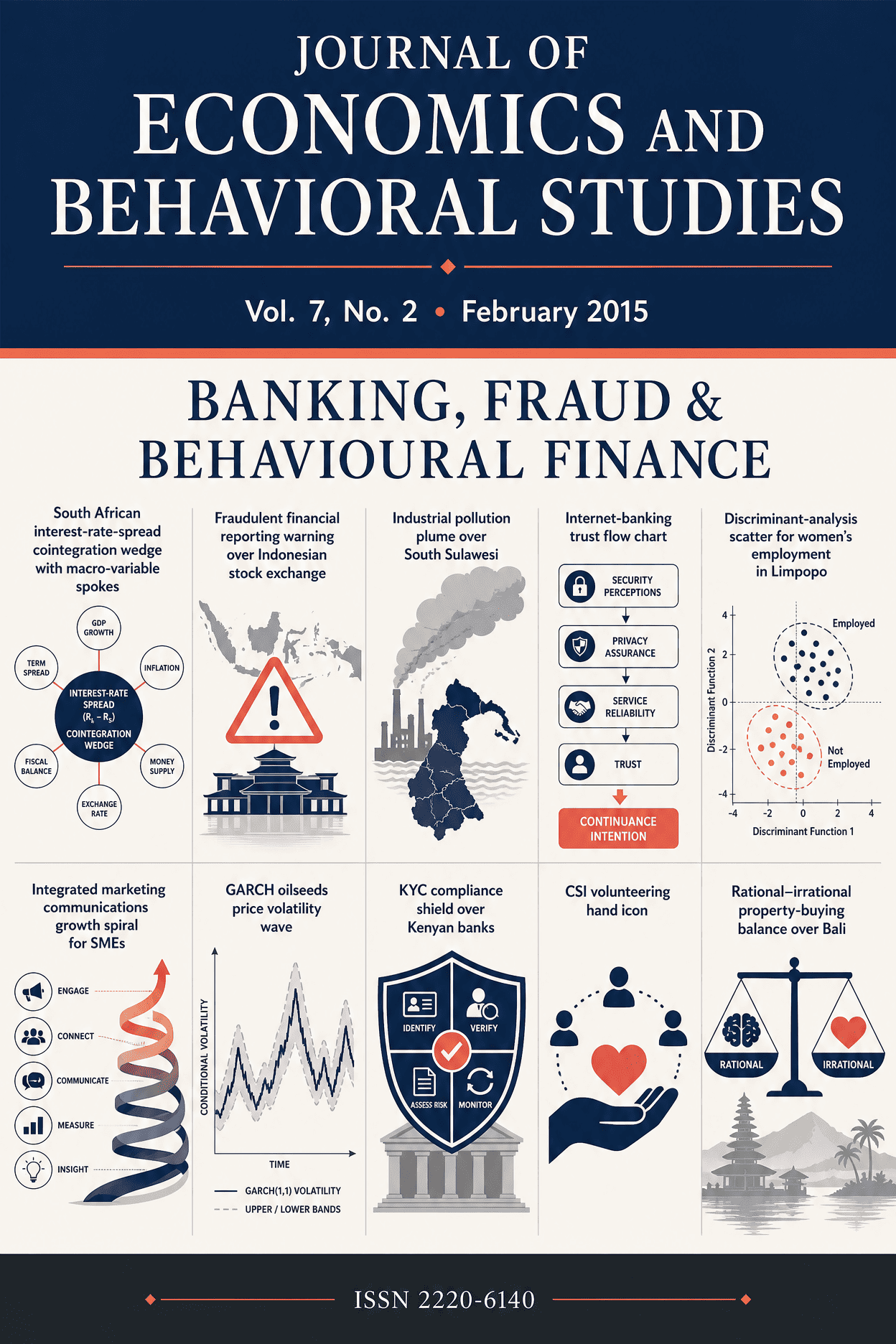
Articles

  • Article 1 in this issue

    The Determinants of Interest Rate Spreads in South Africa: A Cointegration Approach

    • Author: Ferdinand Niyimbanira, Rachel Nishimwe-Niyimbanira, Sanderson Sabie Kuyeli, Koleka Rangaza

    This study empirically identifies the determinants of interest rate spreads (IRS) in South Africa over the period 1990 to 2012. The study uses the Johansen Cointegration Approach and Vector ErrorCorrection techniques to identify the variables in explaining the interest rate spreads in South Africa. It considers the inflation rate, reserve requirements, Treasury bill, discount rate, money supply (M2) and gross domestic product per capita variables as they explain the movement of interest rate spreads. A significant short-run relationship between IRS and its explanatory variables was observed. These macroeconomic variables are significant in explaining the behavior of the South African IRS in the longrun. This paper has focused on illuminating on how the interest rate spreads are impacted by both exogenous and endogenous variables. If controlled, these variables are most likely to have the largest effects on reducing such spreads. In addition, it suggests that the reduction in the reserve requirements prescribed by the South African Reserve Bank would help to reduce the interest rate spreads. Based on the results of the study, policy implications and suggestion for future research are made.

    Pages 101-108

    PDF - The Determinants of Interest Rate Spreads in South Africa: A Cointegration Approach (opens in a new tab)
  • Article 2 in this issue

    Effect Ownership, Accountant Public Office, and Financial Distress to the Public Company Financial Fraudulent Reporting in Indonesia

    • Author: Ana Mardiana

    This study empirically examine the influence of ownership, accountant public office and the financial distress on fraudulent financial reporting. The variables studied were foreign ownership, family ownership, accountant public office and the financial distress of public companies in Indonesia in 2009 to 2012. The research was conducted by quantitative methods using secondary data. Secondary data comes from a list of cases Bapepam-LK and the annual reports listed companies on the Stock Exchange. This population of study was company listed on the Stock Exchange, and then the samples were taken by purposive sampling criteria the company's corporate criteria sanctioned Bapepam-LK and the sanctions contained elements of fraud, including the non-financial corporate sector and have the data required in this study. At the end, the total sample of 64 companies that the company. This study uses logistic regression statistical tools as the dependent variable is a dummy variable (non-metric), while the independent variable is a variable mixture of metric and non-metric. The results show that the family ownership significantly affect financial reporting fraud but in the opposite direction because of the negative impact. Foreign ownership of a significant negative effect on fraudulent financial reporting. This indicates the greater ownership by the family, the lower the level of financial of fraudulent reporting accountant public office has no effect on fraudulent financial reporting. This occurs because both KAP Big Four and Small Firm have the same standards in Generally Accepted Accounting Principles (GAAP) in carrying out their duties as auditor. Financial distress negatively affects fraudulent financial reporting.

    Pages 109-115

    PDF - Effect Ownership, Accountant Public Office, and Financial Distress to the Public Company Financial Fraudulent Reporting in Indonesia (opens in a new tab)
  • Article 3 in this issue

    The Role of Manufacturing Industrial Activity in the Environmental Pollution in South Sulawesi

    • Author: Tri Astuti

    Deteriorating environmental conditions can be a hindrance in creating a sustainable economic development so that necessary concern of all parties. The study aims to identify the industrial sectors causing the heaviest pollution and to confirm the environmental economic theories applicable to the condition in South Sulawesi. The study objects are the economic activities in South Sulawesi as summarized in the I-O table transactions. The data used are secondary data of the income per capita and of environmental pollution, table I-O of South Sulawesi in 2010, and the IPPS standard of pollution intensity estimate, and cost coefficient for pollution eradication. The tools used are conventional input-output, environmental input-output, and trend analyses. The reveals that the chemical and metal manufacturing industry sectors are the primary causes of severe pollution in South Sulawesi in 2010 and the environmental economic cases tend to comply with Hypothesis Haven. This research is an academic study limited only to investigate the role of economic activities in industrial manufacturing sector so that further study can be foccused on the role of the whole activities of the economic sector in the environmental pollution.

    Pages 116-123

    PDF - The Role of Manufacturing Industrial Activity in the Environmental Pollution in South Sulawesi (opens in a new tab)
  • Article 4 in this issue

    Acceptance of Banking Information Technology in PT BNI of Makassar

    • Author: Muchriana Muchran

    Various advantages offered by the use of internet banking, but some customers are still associated with conventional ways of doing that is through ATM transactions or queue. The research aimed to analyze trust, perceived ease of use, perceived usefulness and experience to intention to use internet banking. This research was conducted in PT BNI of Makassar. The data were obtained using questionnaire given to customers. The populations were customers of BNI Bank listed as service users of Internet banking. The sample was selected using simple random sampling technique. Hypotheses tested use of Partial Least Square (PLS) method by means of AMOS program. The results of the research indicate that among the eight hypotheses, four of them are significant, while the other four not significant. Trust has significant to perceived ease of use. Trust does not have significant to perceived usefulness. Trust has significant to intention to use internet banking. Perceived ease of use has significant to perceived usefulness. Perceived ease of use does not have significant to intention to use internet banking. Perceived usefulness does not significant to intention to use internet banking. Perceived ease of use has significant relationship with intention to use internet banking modernized by experience. Perceived usefulness does not have significant relationship with intention to use internet banking modernized by experience.

    Pages 124-130

    PDF - Acceptance of Banking Information Technology in PT BNI of Makassar (opens in a new tab)
  • Article 5 in this issue

    Level and Factors of Women’s Employment in the Sekhukhune District in the Limpopo Province of South Africa: Some Discriminant Analysis

    • Author: Kwabena A. Kyei, Maboko Tumisho

    Unemployment is very high in South Africa with the official rate ranging from 26.7% to 35%. The Limpopo province has the highest proportion of rural dwellers in South Africa and possibly higher unemployment rate than the national average. Women’s unemployment is a much bigger problem especially when women are the bread winners. Most women singularly look after their children due to polygamy and / or labour migrant system which usually takes the men from home to other parts of the country. This study focuses on factors which militate against women’s employment. A 3-stage sample survey was conducted between May 2013 and January 2014 covering all the municipalities in the Sekhukhune district. About 2000 women aged between 20 and 55 years were interviewed. Applying discriminant analysis, this study shows that over 85% of the women in the district are unemployed; and factors like: education, age, family status and marital status affect the employment status of women in Sekhukhune. DA = 0.734educ + 0.654age +0.490familystatus + 0.153marital status If Limpopo wants to reduce unemployment of women and to redress family’s crises, this study recommends that efforts be made to “educate” women, i.e. encourage women to complete higher/ tertiary education and also be given special preference/family support in job offers.

    Pages 131-138

    PDF - Level and Factors of Women’s Employment in the Sekhukhune District in the Limpopo Province of South Africa: Some Discriminant Analysis (opens in a new tab)
  • Article 6 in this issue

    The Role of Integrated Marketing Communications in Enhancement of SMEs Growth in South Africa

    • Author: Lawrence Mpele LEKHANYA

    The intention of this paper is to discover and empirically test the knowledge gap exist with regard to the role that integrated marketing communication (IMC) plays in the enhancement of SMEs growth. A quantitative approach is followed in this paper, with a questionnaire as the research instrument and questionnaire items established through a literature review. A sample of 374 SMEs owners/managers agreed to complete the questionnaire. In order to give a descriptive overview of variables relevant to the objectives of the study, a Cronbach test was performed. Certain ability in marketing communication by SMEs was evident from the sample. However, very few marketing communication tools are fully applied in order to enhance SMEs growth. A significant starting point, in attaching importance to the role of IMC enhancement of SMEs growth, is constituted by this paper’s sample, even though it is restrictively small. Practitioners may, from this paper, understand where intervention guidelines are needed, in order to improve an IMC plan needed for SMEs. Compared to previous research done on large company practices, this paper represents an original trial to empirically apply the marketing communication approach within SMEs.

    Pages 139-144

    PDF - The Role of Integrated Marketing Communications in Enhancement of SMEs Growth in South Africa (opens in a new tab)
  • Article 7 in this issue

    A Comparison of World and Domestic Price Volatilities of Oilseeds: The Ethiopian Case

    • Author: Zerihun G. Kelbore

    This study investigates and compares oilseeds price volatilities in the world market and the Ethiopian market. It uses a monthly time series data on oilseeds from February 1999 to December 2012; and analyses price volatilities using unconditional method (standard deviation) and conditional method (GARCH). The results indicate that oilseeds prices are more volatile, but not persistent, in the domestic market than the world market. The magnitude of the influence of the news about past volatility (innovations) is higher in the domestic market for Rapeseed and in the World market for Linseed. However, in both markets there is a problem of volatility clustering. The study also identified that due to the financial crisis the world market price volatilities surpassed and/or paralleled the higher domestic oilseeds price volatilities. The higher domestic oilseeds price volatility may imply that the price risks are high in the domestic oilseeds market. As extreme price volatility influences farmers production decision, they may opt to other less risky, low-value and less profitable crop varieties. The implications of such retreat is that it may keep the farmers in the traditional farming and impede their transformation to the high value crops, and results in lower income hindering the poverty reduction efforts of the government. This is more important to consider today than was before, because measures undertaken to reduce poverty must bring sustainable change in the lives of the rural poor. For this reason, agricultural policies that enable farmers cope with price risks and enhance their productivity are crucial.

    Pages 145-161

    PDF - A Comparison of World and Domestic Price Volatilities of Oilseeds: The Ethiopian Case (opens in a new tab)
  • Article 8 in this issue

    Determinants of Know Your Customer (KYC) Compliance among Commercial Banks in Kenya

    • Author: Robert Arasa, Linah Ottichilo

    KYC conformity entails the creation of auditable evidence of due diligence activities, in addition to the need for customer identification. There is necessity for financial institutions to validate that their customers are not or have not been involved in illegal activities such as fraud, money laundering or organized crime in order to meet KYC conformity requirements. This study examines factors that determine the level of compliance with KYC requirements by commercial banks in Kenya. Specifically, this study investigates the effect of customer characteristics, staff competency, information communications technology infrastructure and bank size on the level of KYC compliance requirements. The study used descriptive research design. The target population of this study was the top and middle level officers who are directly involved in the day-today operations of the commercial banks. For purposes of this study a descriptive survey design was employed. The target population was 43 commercial banks and 1 mortgage finance firms operating in Kenya. Target respondents comprised of top and middle level involved in the day-to-day institution’s operations. Questionnaire was used as the main data collection instrument. To address the objectives of the study, descriptive and inferential analysis techniques were utilized. Regression analysis was employed to ascertain the relationships between KYC compliance and the four variables of interest in this study. Computations of coefficient of determination indicates that four independent variables that were studied, explain 78.3 percent of the commercial banks compliance level with KYC requirements in Kenya, implying that 21.7 percent could be explained by other factors not examined in this study. Study findings reveal that customer characteristics are a key determinant of KYC compliance, small banks are not capable of meeting KYC compliance cost and that staff attitudes and physical facilities affect customer service and effective KYC procedures compliance. Regression analysis further reveals that there is a significant relationship between the four variables and KYC compliance level. Finally the study recommends that ICT is a useful tool that could be used to enhance compliance with KYC requirements.

    Pages 162-175

    PDF - Determinants of Know Your Customer (KYC) Compliance among Commercial Banks in Kenya (opens in a new tab)
  • Article 9 in this issue

    Denied Investment: A Case of Community Member’s Attitudes towards Volunteering in Corporate Social Investment Initiatives

    • Author: Paul-Francois Muzindutsi, Ferdinand Niyimbanira

    Companies use corporate social responsible investment (CSI) initiatives to contribute to the wellbeing of the society they operate in. South African companies continue to increase their involvement in CSI initiatives in the areas of education and training, capacity building, community development and health care. The impact of these initiatives can be extended, if community members, who are mostly the beneficiaries of these initiatives, are willing to work with companies through volunteering in CSI initiatives. This study used a combination of qualitative and quantitative research designs to assess the attitude of community towards volunteering on a CSI project. Interviews and survey questionnaire were used to collect data from households’ members who benefited from a CSI initiative of re-roofing houses in one of low income areas of South Africa. Qualitative analysis revealed that the CSI project provided skill which opened employment opportunities to community members who worked on the project. However, quantitative results showed that only 30% of participants were willing to volunteer on the CSI project. The majority of those who were not willing to volunteer on the CSI project were unemployed and did not have any skills; implying that volunteering on the CSI project could have provided them with some skills. Based on the investment model of volunteering, findings of this study showed that beneficiaries of the CSI initiative denied an investment opportunity due to their attitude towards volunteering. Hence, it was concluded that CSI initiatives could have a greater impact if community members are encouraged to participate in CSI initiatives as volunteers.

    Pages 176-182

    PDF - Denied Investment: A Case of Community Member’s Attitudes towards Volunteering in Corporate Social Investment Initiatives (opens in a new tab)
  • Article 10 in this issue

    The Rational and Irrational Factors Underlying Property Buying Behavior

    • Author: Njo Anastasia, Aileen Liana Suwitro

    Property buying behavior is part of the development of financial behavior. This research will be focused on the buyers perspectives on residential and commercial properties in Bali Island of Indonesia. Rational and irrational factors are the factors underlying the property buying process. The Physical, Location, Environment, Finance factors were part of the rational; while Psychological (over-confidence, conservatism bias, information and familiarity, herd behavior, mental accounting, and loss aversion), Emotion, Intuitional, Socialization, Evaluation were the irrational part. The purpose of this study was, first, to determine the factors that distinguish buyers behavior toward purchasing a property; second, to determine the factors that distinguish buyers behavior between buyers intending to live in compared to those seeking to invest. The study sample consisted of individuals who are prospective buyers and those who have bought property in Bali. Data were analyzed using Discriminant Analysis. The results showed that only financial factor that had significant impact on buyer decisions. Furthermore, this study also showed that there were significant differences in factors between buyers intending to live in compared to those seeking to invest. The factor were psychology, emotion, intuitional, and evaluation.

    Pages 183-191

    PDF - The Rational and Irrational Factors Underlying Property Buying Behavior (opens in a new tab)