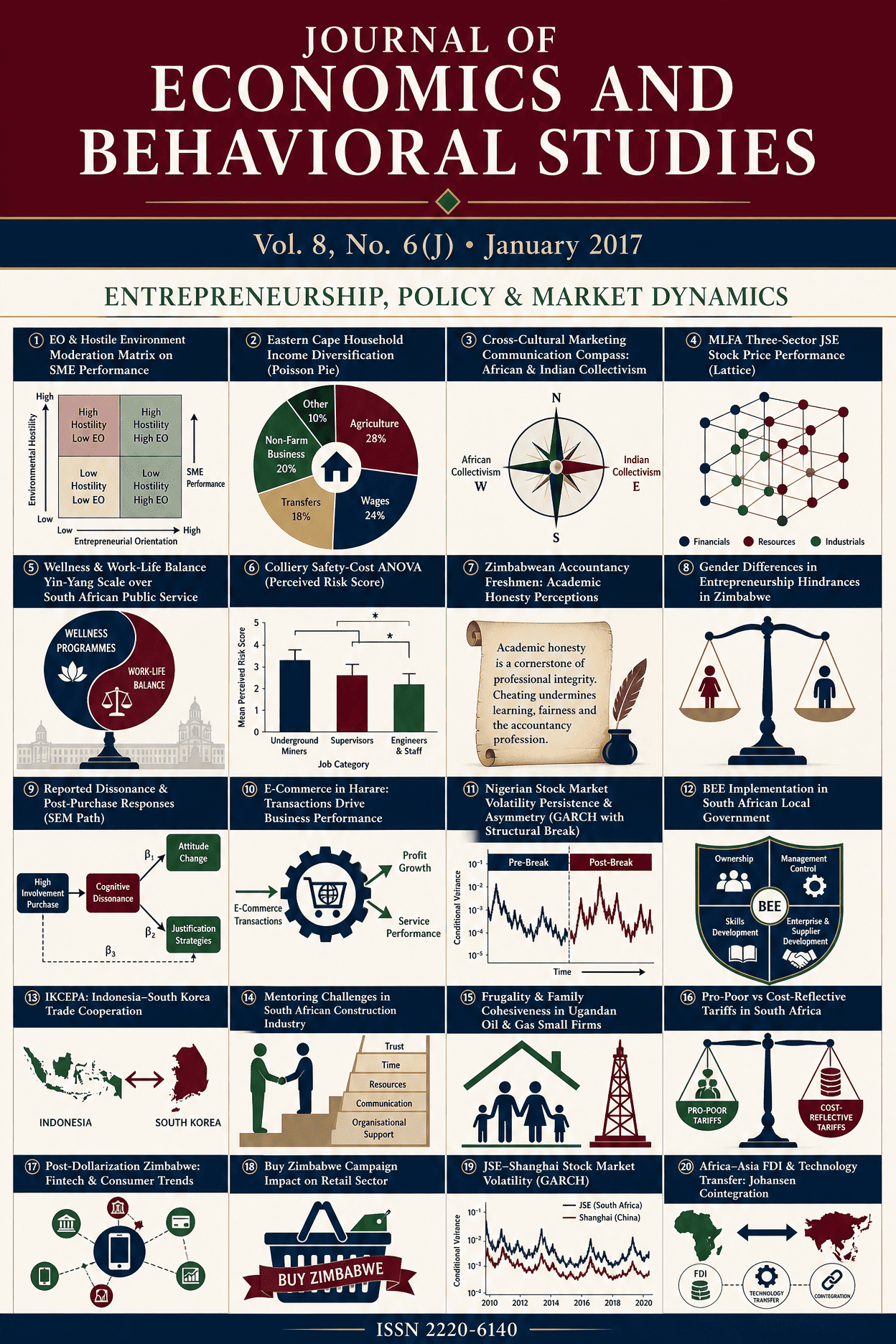
Articles 11–20 of 20

  • Article 11 in this issue

    Influence of electronic commerce on business performance: Evidence from e-commerce organisations in Harare, Zimbabwe

    • Author: Christine Ivy Hurasha, Tafara Chiremba

    The purpose of the study was to explore the impact of electronic commerce on business performance with specific focus on business organisations in Harare, Zimbabwe. This was achieved through investigating the relationship between e-commerce investment and indicators of business performance such as cost operations, service operations and profit levels. A structured questionnaire was developed and administered to 40 respondents from 10 e-commerce organisations. The study revealed that there was a positive relationship between e-commerce investment and business performance. It was revealed that an investment in e-commerce by organisations in Zimbabwe would increase profit levels, improve service operations and reduce transaction costs. The researchers recommended that organisations that have already adopted e-commerce should raise customer awareness and interest in e-commerce and promote the usage of the technology. They also recommended that policy makers such as the Government must take a leading role in the funding of education and the development of infrastructure in order to encourage more organizations and consumers to participate in e-commerce.

    Pages 146-152

    PDF - Influence of electronic commerce on business performance: Evidence from e-commerce organisations in Harare, Zimbabwe (opens in a new tab)
  • Article 12 in this issue

    Modelling Volatility Persistence and Asymmetry with Structural Break: Evidence from the Nigerian Stock Market

    • Author: Aluko Olufemi Adewale, Adeyeye Patrick Olufemi, Migiro Stephen Oseko

    This study contributes to existing literature on the Nigerian stock market by modelling the persistence and asymmetry of stock market volatility taking into account structural break. It utilises returns generated from data on monthly all-share index from January 1985 to December 2014. After identifying structural break in the return series, the study splits the sample period into pre-break period (January 1985 – November 2008) and post-break period (January 2009 – December 2014). Using the symmetric GARCH model, the study shows that the sum of ARCH and GARCH coefficients is higher in the pre-break period compared to the post-break period, thus indicating that persistence of shock to volatility is higher before structural break in the market. The asymmetric GARCH model provides no evidence of asymmetry as well as leverage effect with or without accounting for structural break in the Nigerian stock market. This study concludes that the Nigerian stock market is characterised by inefficiency, high degree of uncertainty and nonasymmetric volatility.

    Pages 153-160

    PDF - Modelling Volatility Persistence and Asymmetry with Structural Break: Evidence from the Nigerian Stock Market (opens in a new tab)
  • Article 13 in this issue

    Black Economic Empowerment in South Africa: Challenges and Prospects

    • Author: Elvin Shava

    The purpose of this paper is to assess if the Black Economic Empowerment act has brought new economic horizons for the historically disadvantaged South Africans, or it has contributed to further impoverishmentof the lower classes in communities. The paper based its argument on an extensive literature review which envisaged that, despite many years of its implementation, BEE has caused the emergence of classes resulting fromfraud and corruption, fronting, difficulties in registering status, political interference, and poor accountability strategies. The paper interrogates the implementation strategies of BEE in the local government context to assess whether historical imbalances have been addressed or not. The paper concludes that the government needs to revisit BEE as an economic empowerment policy to see whether it has benefited the black majority or not. The paper reiterates further that, BEE as a black economic emancipation blueprint requires proper implementation and alignment with other economic policies such as the National Development Plan to accelerate economic opportunities for the black majority. The paper recommends the government of South Africa through local municipalities to exercise monitoring and evaluation in the BEE procurement systems are prerequisites in safeguarding the manipulation and corrupt tendencies arising from the awarding of tenders in the local government.

    Pages 161-170

    PDF - Black Economic Empowerment in South Africa: Challenges and Prospects (opens in a new tab)
  • Article 14 in this issue

    Analysis of Trade in Goods between Indonesia and South Korea on Cooperation Forum IKCEPA

    • Author: Ragimun Abdullah

    Indonesia Korea Comprehensive Economic Cooperation Partnership (IKCEPA) arises from the desire of both countries to boost trade performance and make the free trade agreement more comprehensive. CEPA agreement with South Korea has targeted the reduction and elimination of tariffs that cover more products and services. This study analyzed the relationship between Indonesia merchandise trade cooperation with South Korea. Besides, look at the potential of the Korean market for goods exports from Indonesia featured. To deepen the study simple equilibrium analysis is used to analyze the potential of the South Korean market for goods exports Indonesia. The analysis showed that after the implementation of AKFTA in 2007, Indonesia merchandise trade performance by sector turned out to have an average growth of imports by 21.36 percent, higher than the average export growth of 8.19 percent. There are some items which have the potential to become a mainstay of exports to Korea that includes textiles, wood processing, manufacturing goods such as spare parts of household appliances, bicycles and others. Likewise, there are some agricultural products such as pineapple, guava, and animals such as freshwater fish, crabs, cuttlefish and others. However, the export of these items to South Korea is still hampered by their tariff barriers. Forum IKCEPA cooperation can be a bridge to fill the gap between the two countries for tariff reduction, market acces and an increase in exports of both countries.

    Pages 171-182

    PDF - Analysis of Trade in Goods between Indonesia and South Korea on Cooperation Forum IKCEPA (opens in a new tab)
  • Article 15 in this issue

    Challenges of Mentoring in South African Construction Industry

    • Author: Clinton Aigbavboa, Ayodeji Oke, Madidimalo Mutshaeni

    One of the major requirements in the development and growth of an industry or organisation is the incubation of new workforce through appropriate recruitment processes, proper training and effective mentoring by experienced members. However, the process is not expected to be smooth owing to individual dispositions and attitudes, organisation interest, and avenues and opportunities for mentoring, amongst others. In this study, various challenges of mentoring encountered by mentees and mentors were examined with a view to promoting effective mentoring among professionals in the construction industry in the quest to improve their productivity and thereby enhance better performance in construction projects. Data on professionals in the built environment were collected through the administration of questionnaires using a convenient sampling technique. Personality issues that are concerned with differences in behaviours and dispositions to matters are the major challenges of mentoring in the construction industry. More so, attitudes of the mentees dictate and affect behaviours of mentors, and vice-versa. In view of this, professionals involved in mentoring should be concerned about their attitudes to each other and personal beliefs should not be a basis for judgment. Mutual respect and concern for growth and development should form the basis of mentoring relationships.

    Pages 183-187

    PDF - Challenges of Mentoring in South African Construction Industry (opens in a new tab)
  • Article 16 in this issue

    Frugality, Family-Cohesiveness and Firm Growth; A Case of Small Firms around Oil & Gas Fields in Uganda

    • Author: Rogers Matama

    A common impression is that most small firms largely face resource scarcity challenges that inhibit firm growth. This study concentrates on the elements of frugality, operationalized as spending discipline and delaying gratification as well as family cohesiveness, operationalized as family member supportiveness and usefulness in firms. This study is focused around Uganda’s oil and gas fields and these natural resources are expected to influence to small firms growth. In the current study, firm growth is measured in terms of asset value accumulation over time. Empirical findings on frugality, family cohesiveness and growth aim essentially to answer the overarching dilemma of small firm recurrent failures in Uganda. Results in study show that there is a mild relationship between frugality and family cohesiveness thus augmenting the existing perspectives of the resource based view theory. However, the random effect logistic regression results show contrasting results on the predictor effects of; family financing support, oil and gas operations, frugality, and family cohesiveness on the outcome variable - small firm asset growth.

    Pages 188-205

    PDF - Frugality, Family-Cohesiveness and Firm Growth; A Case of Small Firms around Oil & Gas Fields in Uganda (opens in a new tab)
  • Article 17 in this issue

    The Trade-Offs Between Pro-Poor and Cost-Reflective Tariffs in South Africa: A Regulatory Perspective

    • Author: Michael Maphosa, Patrick Mabuza

    This paper presents arguments for and against cost reflectivity and pro-poor tariff policy in South African electricity supply from a regulatory perspective. This debate has been ongoing for decades in developing countries; however, there is still no clear direction on how countries should approach these two important competing policy positions. There are those that argue that achieving cost-reflective tariffs will attract private sector investment into the electricity supply industry (ESI) that will lead to much needed competition and reduced electricity tariffs. However, there are also those who argue that costreflective tariffs will make it difficult to achieve government social objectives of universal access through pro-poor tariffs, as cost-reflective tariffs will be unaffordable to the majority of the population. The fundamental question is what should come first, between cost-reflective tariffs and pro-poor tariffs in a developing country context, specifically in South Africa. This paper therefore attempts to examine the real trade-offs between pro-poor tariff policies and cost-reflective tariffs. The study attempts to answer one critical question: How can the electricity sector attract local and foreign investors, without necessarily affecting government social objectives such as universal access to electricity? The study finds that electricity consumers, and in particular poor households, have historically benefited from relatively cheap electricity and that tariffs have not been cost reflective. In other words, there is a mismatch between tariffs and the underlying costs of supplying electricity in South Africa. It also finds competing expectations between poor consumers and utilities. Consumers expect to receive electricity at an affordable price, while utilities argue that a good, reliable electricity supply’s tariffs must be matched with costs. Lastly, the study finds that it is difficult to achieve cost reflective tariffs in the short run, in an environment characterised by a high number of consumers dependent on government social grants and cross-subsidies. The study therefore recommends a gradual movement towards cost-reflective tariffs, together with the introduction of competition and energy efficiency and demand side management (EEDSM), in order to minimise the impact on the poor.

    Pages 206-215

    PDF - The Trade-Offs Between Pro-Poor and Cost-Reflective Tariffs in South Africa: A Regulatory Perspective (opens in a new tab)
  • Article 18 in this issue

    The Impact of Emerging Market Trends on the Development and Marketing of Financial Service Products in Zimbabwe Post Dollarization

    • Author: Tinevimbo Chokuda, Wilford Mawanza, Farai Chimboza

    The research sought to analyse the impact of emerging market trends as measured by competition, technology and consumer demographics on the development and marketing of financial service products in Zimbabwe post dollarization. The Zimbabwean financial service sector has been largely characterised by new and changing market trends since dollarization. These trends have largely manifested in the form of entrance of new players in the market, a growing informal sector at the expense of the formal financial sector and the emergence of new technology paving way for the need to develop and market new financial service products. There is therefore need for financial service providers in Zimbabwe to continually embrace innovative product development and marketing strategies so as to shape banking products to fit consumers’ evolving financial needs much of which are well beyond the realm of traditional banking products. An explanatory research design was adopted in conjunction with a descriptive research design. Results from the study indicate that the entry of new financial institutions, removal of barriers between institutions, emergence of non-regulated financial institutions, increased consumer access to financial information owing to increased adoption of technology, market fragmentation and increased formal unemployment have a significant impact on the way financial service products are structured, provisioned. In light of that, it is recommended that financial service providers should design and tailor new business models to suit the emerging market environment.

    Pages 216-226

    PDF - The Impact of Emerging Market Trends on the Development and Marketing of Financial Service Products in Zimbabwe Post Dollarization (opens in a new tab)
  • Article 19 in this issue

    The Impact of the “Buy Zimbabwe” Campaign on Performance of Zimbabwean Companies in the Retail Sector

    • Author: Ndlovu N., Mafumbate J., Mafuka, A., Brena, M

    The majority of the Zimbabwean retail companies were in the collapsing mode over the past ten years. This miserable predicament necessitated the government to craft locally-driven remedies, and one of them was the “Buy Zimbabwe” campaign. This prompted the researcher to assess the impact of the “Buy Zimbabwe” campaign on the performance of the Zimbabwean firms. The study objectives were to establish the impact of “buy Zimbabwe” campaign on demand for local products and factors affecting demand for local products. Furthermore to establish if a company participating in the “buy Zimbabwe” campaign performs better than non-participating firms, earnings per Share was used in the inter-firm performance comparison. The descriptive research design was employed, although the research was both quantitative and qualitative in nature. The classical linear multiple regression analysis was used to establish and explain the relationship between company performances. The results indicated a positive linear relationship between “buy Zimbabwe” campaign and company performance in case of those that adopted Buy Zimbabwe, whereas in case of those that did not adopt Buy Zimbabwe there was a negative linear relationship. The results also discloses that quality and affordability of the product are the most influential factors affect demand for local products and buy Zimbabwe campaign was regarded as the least factor to be considered by consumers. Results from this study point towards the need to put in place supportive policies for the “buy Zimbabwe” campaign to be effective.

    Pages 227-236

    PDF - The Impact of the “Buy Zimbabwe” Campaign on Performance of Zimbabwean Companies in the Retail Sector (opens in a new tab)
  • Article 20 in this issue

    Stock Market Volatility Using GARCH Models: Evidence from South Africa and China Stock Markets

    • Author: Priviledge Cheteni

    This study looks into the relationship between stock returns and volatility in South Africa and China stock markets. A Generalized Autoregressive Conditional Heteroscedasticity (GARCH) model is used to estimate volatility of the stock returns, namely, the Johannesburg Stock Exchange FTSE/JSE Albi index and the Shanghai Stock Exchange Composite Index. The sample period is from January 1998 to October 2014. Empirical results show evidence of high volatility in both the JSE market, and the Shanghai Stock Exchange. Furthermore, the analysis reveals that volatility is persistent in both exchange markets and resembles the same movement in returns. Consistent with most stock return studies, we find that movements of both markets seem to take a similar trajectory.

    Pages 237-245

    PDF - Stock Market Volatility Using GARCH Models: Evidence from South Africa and China Stock Markets (opens in a new tab)