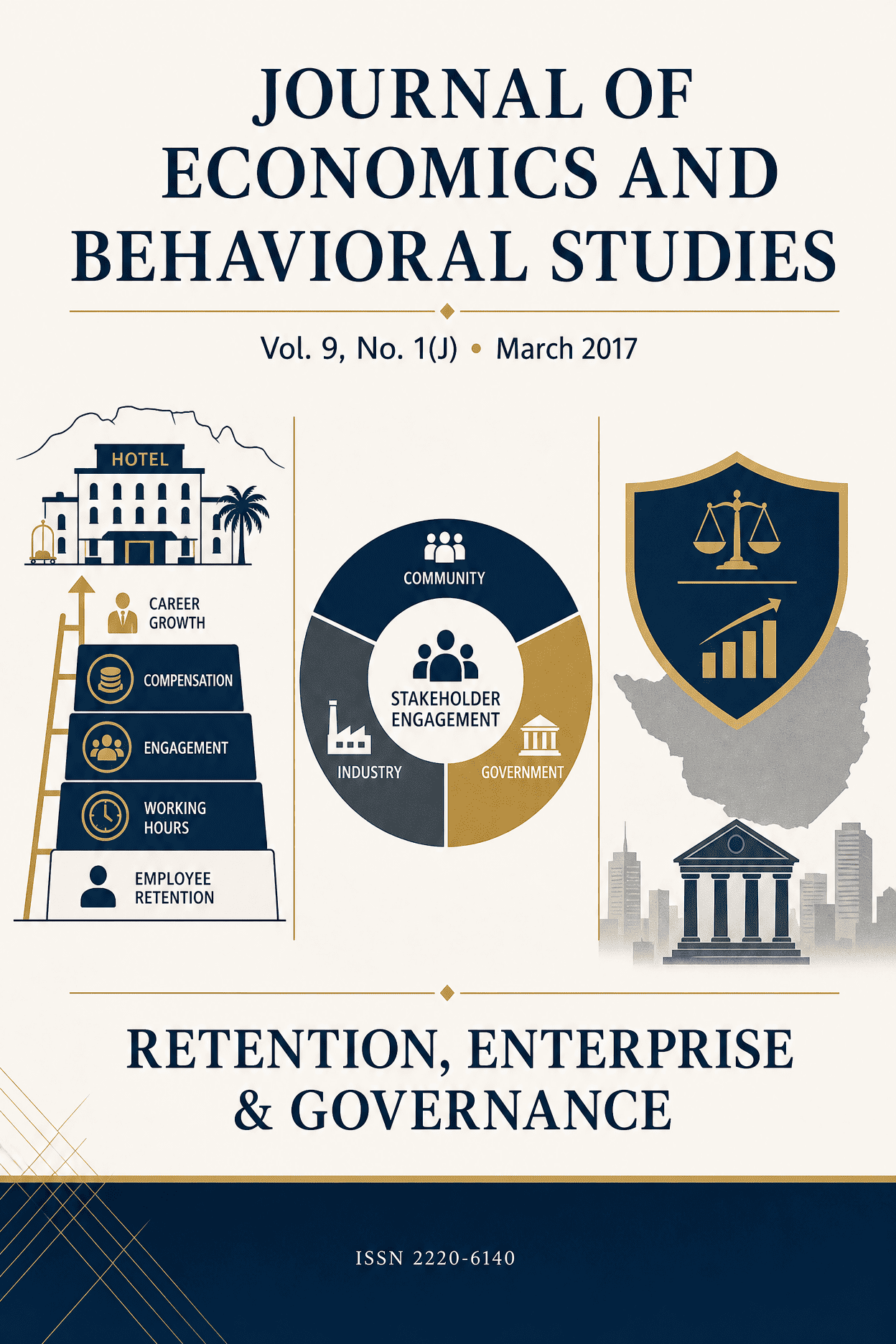
Articles 1–10 of 20

  • Article 1 in this issue

    Employee Retention Factors: The Case of Hotels in Cape Town, South Africa

    • Author: Ikechukwu O. Ezeuduji, Thandokazi Lulu Mbane

    High turnover of employees in the hotel sector has been widely reported in academic papers. This high turnover has associated costs, such as financial costs, inconsistency in delivering service quality, and probable loss of customer loyalty. This empirical study investigates hotel employees’ responses to statements that relate to work conditions that support employee retention. Selected three, four and five star hotels in Cape Town, South Africa participated in this study. A structured respondent-completed questionnaire was used to collect data that were subjected to descriptive, bivariate and multivariate analyses. Result highlights suggest that hotel employees, dominated by the female population, are mostly not so desperate to leave their employment soon, however not many of them have worked in the hotel for more than five years. There are positive inter-correlations among ‘employee retention’ factor and other factors that relate to work conditions that support employee retention (compensation, employee development, work engagement, work relations, and working hours). Results also show that ‘strict supervision’, ‘long working hours’ and ‘perceived unfair salary’ are the top major concerns for hotel employees. These findings will enable hotel employers address employee concerns in order to curb the high employee turnover costs. Possible comparative research in other nations and continents will help establish cultural similarities and differences among nations or continents.

    Pages 6-16

    PDF - Employee Retention Factors: The Case of Hotels in Cape Town, South Africa (opens in a new tab)
  • Article 2 in this issue

    Re-examining Nigeria’s Contributions to the African Union and the Domestic Socio-Economic Ramifications

    • Author: Samuel A. Umezurike, Chux Gervase Iwu, Lucky E. Asuelime, Chinelo Augustine Umezurike

    While there have been scholarly studies that address Nigeria’s diplomacy and contribution to the African Union (AU), many of them have failed to compare and contrast how those have added to the socioeconomic development of Nigeria. We encountered a few instances where attempts were made to explain such, yet a fully-fledged analysis lacked in their conclusions. We applied documentary analysis methodology in our review and found that there is a serious misalignment between Nigeria’s diplomacy and support for the African Union on one hand and positive socio-economic development in Nigeria on the other. The study also looks at exploring how the general framework of Nigeria’s foreign policy goals and strategies in Africa can serve both its national interest and the overall development goals of Africa. We argue that for Nigeria’s role in the AU to be meaningful, the country needs to simultaneously revive its internal socio-economic condition.

    Pages 17-26

    PDF - Re-examining Nigeria’s Contributions to the African Union and the Domestic Socio-Economic Ramifications (opens in a new tab)
  • Article 3 in this issue

    Entrepreneurial Barriers that are Confronted by Entrepreneurs Living with Physical Disabilities: A Thematic Analysis

    • Author: Eugine Tafadzwa Maziriri, Welcome Madinga, Thobekani Lose

    Living with a physical disability can interfere with an individual’s ability to participate actively in economic and social life. It is imperative to comprehensively understand the entrepreneurial barriers hindering the development of entrepreneurs living with physical disabilities. In spite of the increasing research on entrepreneurship, there seems to be a paucity of studies that have investigated the entrepreneurial barriers that are faced by entrepreneurs living with physical disabilities in South Africa. This study set out to explore the entrepreneurial barriers that are confronted by entrepreneurs living with physical disabilities. In this study, data were collected within the Sebokeng Township, which is an African township located in the Vaal Triangle, south of Johannesburg in South Africa. A qualitative research approach was used to collect data for the study. The researchers gathered qualitative data by means of semi-structured face-to-face interviews and focus groups. The analysis of the qualitative data was conducted through the use of thematic analysis. The themes that emerged from the findings include lack of equipment and machinery, discrimination, business networking, hardships in obtaining start-up capital, knowledge of support centres for entrepreneurs living with physical disabilities, and lack of education and training. Each theme was discussed individually, followed by substantiating quotes. Most respondents stressed that the barriers they face hinder the survival and growth of their ventures. The paper suggested that in order to help entrepreneurs living with physical disabilities, the South African government must formulate some schemes that are most necessary for their improvement and betterment of their life.

    Pages 27-45

    PDF - Entrepreneurial Barriers that are Confronted by Entrepreneurs Living with Physical Disabilities: A Thematic Analysis (opens in a new tab)
  • Article 4 in this issue

    Stakeholder Engagement as a Core Management Function: Analysing the Business Value of Stakeholder Engagement for Nigerian Business Organizations

    • Author: Christopher Isike, Alice Ajeh

    This article examines the importance of adopting credible stakeholder engagement (SE) as a core management function, with particular reference to Nigerian business organizations. It used content analysis method to specifically examine the role of SE in business organizations; determine the utility of credible SE as a core management function rather than as an add-on; and trace measurable links between SE and business value (profit) with reference to selected multinational companies operating in Nigeria’s Niger Delta region. The article situated its arguments within the Stakeholder Model of Business Value Creation, which it used as a conceptual analytical framework to justify why business organizations in the region should dedicate more attention and resources to quality SE for sustainable profitability. As the findings show, business organizations in the Niger Delta tend to treat SE as an add-on rather than as a core management function. Therefore, given the business value that effective SE adds to an organization, a paradigm shift is required. Business organizations in Nigeria should elevate SE to core management level with the requisite budget to make it fully functional.

    Pages 46-55

    PDF - Stakeholder Engagement as a Core Management Function: Analysing the Business Value of Stakeholder Engagement for Nigerian Business Organizations (opens in a new tab)
  • Article 5 in this issue

    South Africa’s Youth Unemployment Dilemma: Whose Baby is it anyway?

    • Author: Natanya Meyer

    Youth unemployment is a major concern to various different countries, including South Africa, which ranked fourth-worst in the global youth unemployment ratings in 2013 and 2014reaching rates of more than 50 percent. Entrepreneurship development and increased employability through appropriate skills development have been considered as possible solutions to this growing problem. The aim of this study is to determine perceptions of students pertaining their entrepreneurial outlook and perceived employability. Validated Entrepreneurship- and Employability Scales were used to determine entrepreneurial outlook and perceived employability perception. A total of 293 students from a South African University participated in this study. Data were analyzed using descriptive statistics, histograms, Pearson correlation, MANOVA and ANOVA. The findingsof this studyshow that student’sperceptions indicated that if they haveamore entrepreneurial outlook, it could strongly increase their employability. They also do not think that after the completion of their degrees that they would be more employable. A significance difference was found between year level of study, race, age, and perception of entrepreneurial outlook and employability variables of the students.They seem to have a realistic view when it comes to the risk of possible unemployment for some time after graduation. Based on these findings, it is suggested that introducing entrepreneurship training and employability programs (skills development) to students during the completion of their higher education career, could assist in the reduction of youth unemployment in South Africa.

    Pages 56-68

    PDF - South Africa’s Youth Unemployment Dilemma: Whose Baby is it anyway? (opens in a new tab)
  • Article 6 in this issue

    The Influence of Brand Trust, Brand Familiarity and Brand Experience on Brand Attachment: A Case of Consumers in the Gauteng Province of South Africa

    • Author: Chinomona E, Maziriri ET

    In today’s post-modern era, brands significantly play an important role in consumer behaviour. This paper aimed at examining how brand trust, brand familiarity and brand experience have an influence on brand attachment using a sample of consumers within the Gauteng Province of South Africa. A quantitative method using Smart PLS was employed to test the relationships among the three hypotheses. A structured questionnaire consisting of validated scales for brand trust, brand familiarity, brand experience and brand attachment w as administered to a sample of 181 consumers within the Gauteng province of South Africa. The results of this study showed that brand trust, brand familiarity and brand experience positively influences brand attachment in a significant and direct way. The results of this empirical study provided fruitful implications toacademicians, practitioners as well as policy makers from the perspective of academicians.This study makes a significant contribution to the brand management literature by systematically examiningthe influence of brand trust, brand familiarity and brand experience on brand attachment. On the practitioners’ side, this study therefore submits thatbrand managers for companies in the Gauteng province ought to concentrate on strategies that enhance brand experience because it is likely to yield the desired brand attachment when compared to other research constructs. The results which have been obtained from this study may also be used to generate new policies and revision of the existing policies. Precisely,policies or strategies which exist in numerous organizationsare there in order to make consumers remain attached to certain brands.Moreover, this study vastly add new knowledge to the present body of brand management literature in Africa - a context that is neglected by some academicians in developing countries.

    Pages 69-81

    PDF - The Influence of Brand Trust, Brand Familiarity and Brand Experience on Brand Attachment: A Case of Consumers in the Gauteng Province of South Africa (opens in a new tab)
  • Article 7 in this issue

    Internal and External Factors of Future Returns in the Banking Business: Time Series Analysis of Interrelationship

    • Author: Kwabena A. Kyei, Albert Antwi

    The paper seeks to find the interrelationship between internal and external factors of future returns in the banking business. A multivariate time series regression models are fitted for the dependent variable: return on equity (ROE) against the lag one independent variables, namely: deposit, size, loan, capital, inflation, gross domestic product (GDP) and stock market capitalization (SMC), for ABSA bank; using secondary data, which span from 1998 to 2014 fiscal years. Logarithm transformation of the absolute value of the de-trended data and first differencing at lag one were the smoothing techniques applied to the data. Multivariate time series regression by the least square approach with special consideration of the stepwise method was used in fitting the models to the data. Results indicated that first, there is a positive linear relationship between ROE and loans, a negative linear relationship between ROE and inflation from the differencing techniques; and equally a negative log-linear relationship between ROE and capital as well as a positive log-linear relationship between ROE and ROA for the logarithm de-trend technique.

    Pages 82-89

    PDF - Internal and External Factors of Future Returns in the Banking Business: Time Series Analysis of Interrelationship (opens in a new tab)
  • Article 8 in this issue

    Nexus of Working Capital Management and Firm Performance in Nigerian Food and Beverages Industries: A Link with Risk-Return Theory

    • Author: Odunayo Magret Olarewaju, Mishelle Doorasamy, Titilayo Moromoke Oladejo

    This paper examines the nexus of working capital management and financial performance of selected multinational food and beverages industries in Nigeria for the period between 2006 and 2014 and establishes its linkage with risk-return theory. An explanatory research design is adopted and the secondary data used were gathered from 5 purposively selected quoted food and beverages companies using GLS panel regression analysis. The pooled regression shows that account receivable ratio (ARR) and debt ratio (DER) have negative effect but significant at 1%, working capital (WCA) is also significant at 5% but had positive effect, however, sales growth (SGR) was insignificant. It is also discovered from the Fixed Effect Estimation that working capital management variables such as account receivable ratio (ARR) and debt ratio (DER) have negative effect but significant at 1%, working capital (WCA) is also significant at 5% but has positive effect, while sales growth (SGR) has negative effect but insignificant to the performance of the companies. This signifies reduction in the performances of food and beverages industries which calls for urgent attention since they are posting inverse effect. The unison in both estimations shows that those variables are the major factors influencing the performance of food and beverages industries in Nigeria and thus, it is concluded that the management board of these industries should restructure their working capital management policy as it has the tendency of affecting the dividend policy and firms’ liquidity, which invariably affects the maximization of shareholders’ wealth. This can only be done when managers reduce account receivable days; ensure proper debt management technique, improve sales strategies to enhance sales growth as well as maintain optimal working capital level to reflect the risk-return theory of firms.

    Pages 90-98

    PDF - Nexus of Working Capital Management and Firm Performance in Nigerian Food and Beverages Industries: A Link with Risk-Return Theory (opens in a new tab)
  • Article 9 in this issue

    Does Financial Development Lead to Poverty Reduction in China? Time Series Evidence

    • Author: Sin-Yu Ho, Bernard Njindan Iyke

    The impact of financial development on poverty reduction has received attention in the literature recently. While the connection between financial development and poverty may appear straight forward in theory, in empirics it may be much complicated. This study attempted at empirically assessing the causal links between financial development and poverty reduction in China for the period 1985–2014. The study used the Toda-Yamamoto causality test to avoid pretesting bias that has featured majority of the existing studies. The study utilized two standard proxies for financial development, namely: the domestic private credit by banks as percentage of GDP, and money supply (M2) as percentage of GDP; and a standard proxy for poverty reduction namely: the household final consumption expenditure per capita growth (annual percentage). The study found a bidirectional causal flow between financial development and poverty reduction, implying that the causal flow between these important variables is independent of the proxy for financial development. This means that financial sector reforms and poverty reduction programs are more of “win-win” strategies in the case of China. Therefore policymakers in China should continue to implement robust financial sector reforms and poverty reduction strategies.

    Pages 99-112

    PDF - Does Financial Development Lead to Poverty Reduction in China? Time Series Evidence (opens in a new tab)
  • Article 10 in this issue

    The influence of Ghana's national culture on latent entrepreneurs: An application of Social Rule System Theory

    • Author: Martin Owusu Ansah, Richard Chinomona

    The impact of Ghana's national culture on its latent entrepreneurial activities are in frequently studied on - as compare to social, economic and financial influences. The current studyexamined the impact of Ghana's national culture on its latent entrepreneurs amongSmall and Medium Sized Enterprises (SMEs) from the view point of Social Rule System theory. The study employeda simple random sampling technique ineliciting251 respondents from the Business city of Kumasi in Ghana.It employedStructural Equation Modelling statistical technique (SEM) using Amos software version 22 in analysing the data. The results showed that, masculine and high power distance cultures in Ghana have significant positive effects on peoples' intention to become entrepreneurs. High uncertainty avoidance and collective cultures had positive and insignificant effects on latent entrepreneurs. Thestudy presents significant contribution to the existing academic literature on national culture and latent entrepreneurial activities. Italso brings additional step towards a fundamental means of empowering people into SMEs in any developing country. Recommendationsare also providedfor useful suggestionstogovernment and policy makers in Africa towards the improvement of Small and Medium Sized Enterprises.

    Pages 113-126

    PDF - The influence of Ghana's national culture on latent entrepreneurs: An application of Social Rule System Theory (opens in a new tab)