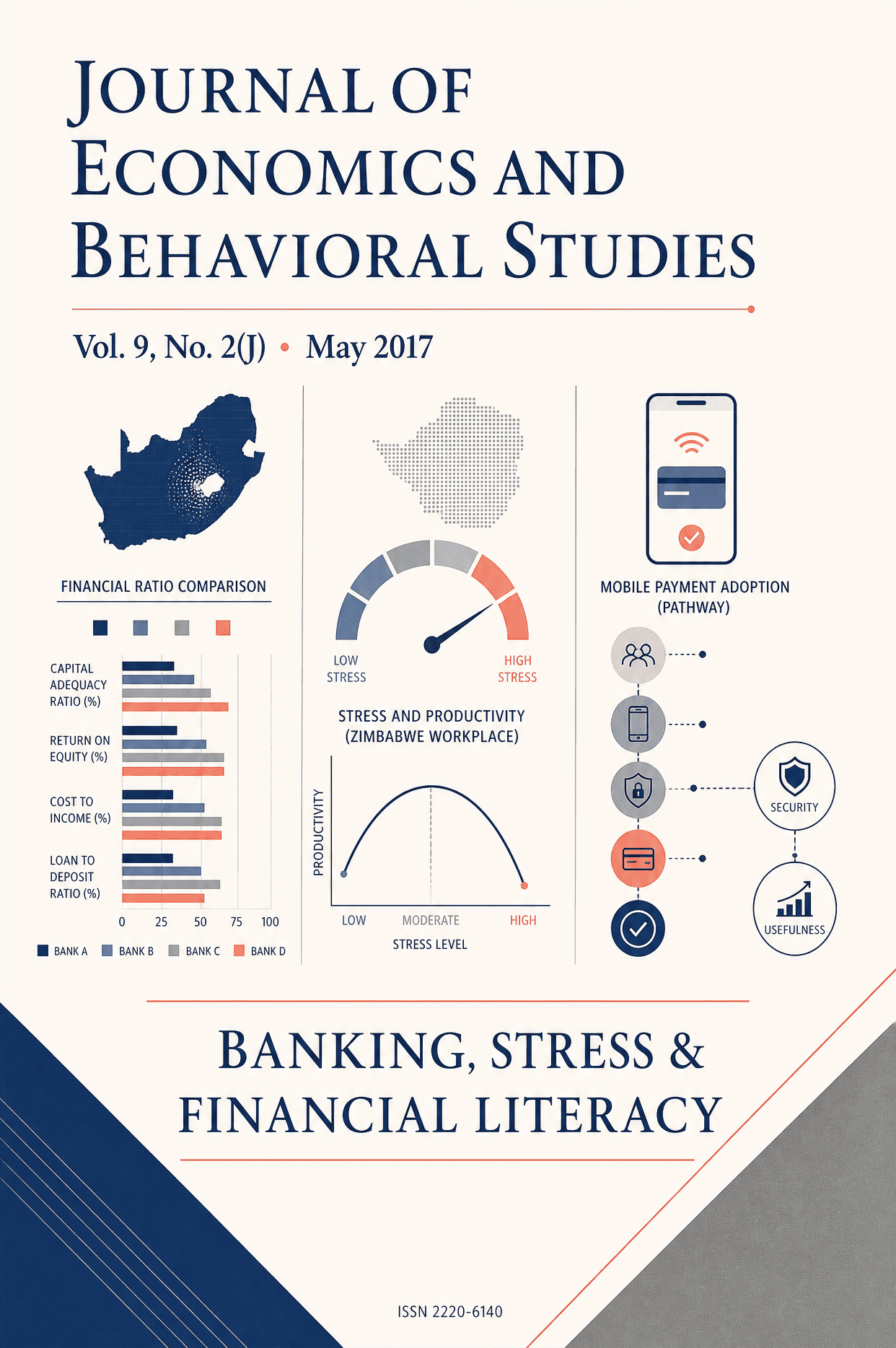
Articles 1–10 of 20

  • Article 1 in this issue

    Critical Assessment of Banking Institutions in South Africa

    • Author: Bakam Fotso, E.I Edoun

    Banks play an important role in a country’s economy through investments, deposits and withdrawals. Many banking products are sold to clients to meet their financial needs and obligations. Their performances are therefore very critical in supporting socio economic development. Financial institutions still facing challenges linked to the lack of financial previsions through the use of financial tool that allows preventing financial distress. Banks are not always well-managed because managers lack capacity and the sound knowledge in dealing effectively with the analysis of risk and return and decision-making. The current study highlights and gives orientations on key performance indicators that bank can use to manage their financial conditions in advance in a sustainable manner. The major objective of this research is to critically assess the South African banks performance using Financial Ratio Analysis (FRA)and descriptive statistics through comparative financial statement analysis form 2010 to 2013 between“ the big four” South African banks. In using correlational analysis, the study aim to establish the link between exogenous and endogenous variables of bank performance. The results showed that FirstRand bank was the best achiever with a higher level of performance following by Standard bank, then Absa and Nedbank. Furthermore, it appears that there is a strong relationship between bank performance and bank size because the volume of assets represents the bigger source of bank incomes. This study opens door to further study including both large and small banks and a comparative analysis between two research methods. The paper is divided into five major sections.

    Pages 6-21

    PDF - Critical Assessment of Banking Institutions in South Africa (opens in a new tab)
  • Article 2 in this issue

    The Effects of Stress on Employee Productivity: A Perspective of Zimbabwe’s Socio-Economic Dynamics of 2016

    • Author: Wilford Mawanza

    This study was motivated by Zimbabwe’s deteriorating economic experience, which has resulted in high unemployment rates, low productivity, high cost of doing business, increased labour disputes, and stress manifestation amongst the working population. The results of the study showed that change factors, demands or pressure factors, lack of support and participation at work by supervisors and other staff members, and work role were to a greater extent the most stressful factors. The perennial economic crisis in the country, high degree of uncertainty due to restructurings and redundancies, and work changes without consultations, had a positive impact on employee’s productivity. The regression results concluded that poor work relationships, lack of support at work, and poor planning had negatively affected productivity.

    Pages 22-32

    PDF - The Effects of Stress on Employee Productivity: A Perspective of Zimbabwe’s Socio-Economic Dynamics of 2016 (opens in a new tab)
  • Article 3 in this issue

    The Implications of Consumer Protection Legislation for Hotels and Guests in South Africa

    • Author: Raeesah Mohamed, Karunanidhi Reddy, P.M. Naidoo

    During the apartheid era, consumers in South Africa, based on their race and ethnicity, were restricted when concluding contracts, as there was no open market trade. As consumers, hotel guests could also be victims of unfair business practices. Hotels use standard form contracts that may include unfair terms that favour the business and which are over-protective of business interests. A significant percentage of the population have low literacy levels, which severely disadvantage them when it comes to understanding the content and consequence of contracts. The Consumer Protection Act (CPA) introduces wide-ranging legal measures to protect consumers, including hotel guests, from exploitation and abuse in the marketplace and sets out comprehensive obligations for hotels. This article provides a descriptive critique based on literature and describes the challenges faced by hotel guests and discusses the implications of the Act for hotels and guests. It concludes that not only does the CPA advocate ethical business practices that are mandatory for hotels, but it also introduces a range of rights and protection for guests as consumers. The CPA has introduced a shift in contract law from a standpoint which allowed the parties the freedom to choose the content of the contract to one where fairness and transparency is imperative, as protection in terms of legislation compensates for the weaker bargaining position of the consumer.

    Pages 33-45

    PDF - The Implications of Consumer Protection Legislation for Hotels and Guests in South Africa (opens in a new tab)
  • Article 4 in this issue

    Personality, Attitude and Behavioural Components of Financial Literacy: A Comparative Analysis

    • Author: Erzsébet Németh, Boglárka Zsótér

    Since the financial crisis in 2008 the investigation of financial literacy–especially its components (personality, attitudes, behaviour etc.) - is in the limelight. Modern economics have recognized that in order to effectively forecast financial and economic processes it is primordial to understand the attitudes of the members of society toward finances, as well as the characteristics of various social group sharing the same views and behaviours. In 2015 two relevant pieces of research were conducted in this topic in Hungary. One focuses on the financial personality types, while the other investigates Hungarians’ financial culture in general based on the research methodology of the OECD. Based on these two databases our comparative study highlights the main characteristics of financial personality types. The three clusters based on the OECD research cover the nine personality types from the results of the other Hungarian research. Our findings show that the cluster of “anxious unsatisfied” encapsulates the “economizers with little money”, the “price sensitive” and the “collector” personality types. Furthermore, the “satisfied conscious” covers the “order creates value”, the “diligent” and the “planner” personality types. Finally, the “moderately anxious unconsidered” involves the “ups and downs”, the “money-devouring” and the “cannot control finances” personality types. The clusters identified during the research show idiosyncratic financial and psychological vulnerability and/or protection.

    Pages 46-57

    PDF - Personality, Attitude and Behavioural Components of Financial Literacy: A Comparative Analysis (opens in a new tab)
  • Article 5 in this issue

    Customer Perceptions of Skills of Agents in Effectively Managing Their Needs within a Call Center

    • Author: Devina Oodith

    The world’s dynamics and demands of employment and production have evolved over the past decade. Human resources has today become the single largest unrestrained resource and many firms are striving to enhance competence and interaction between its customers and itself via the customer call center through enhanced skills, knowledge, ability and attitude by fostering better interpersonal skills and through the promotion of training and development of their call center agents. This study was undertaken in EThekwini (Durban), South Africa and was conducted within a Public Sector service environment comprising of four major call centers employing a total of 240 call center agents. Using simple random sampling, 220 customers were drawn from all consumers subscribing to e-billing in EThekwini (Durban). Data for the customer sample was collected using a precoded, self-developed questionnaire whose psychometric properties were statistically determined. Data was analyzed using descriptive and inferential statistics. The results specify that agents were unsuccessful in handling customers’ needs timeously and efficiently and that most customers felt burdened by being transferred to other agents due to the incompetence of original agents in handling their queries/complaints. Furthermore it was found that there was an overall lack of empathy from agents in following-up after a customer communication to ensure that the customer was satisfied with their experience within the call center. Based on the results of the study recommendations have been made to manage the interaction between the customers and call center agents more competently and efficiently.

    Pages 58-75

    PDF - Customer Perceptions of Skills of Agents in Effectively Managing Their Needs within a Call Center (opens in a new tab)
  • Article 6 in this issue

    The Influence of Green Marketing Tools on Green Eating Efficacy and Green Eating Behaviour

    • Author: A. Muposhi, M. Dhurup

    This study employs the Legitimacy Theory and Self-efficacy Theory to examine the potential role of green marketing tools in fostering green eating behaviour. Using the mall-intercept technique at major retailers, data were collected using a self-administered questionnaire survey on South African consumers who regularly buy green products. Data analysis was conducted with the aid of the Statistical Package for the Social Sciences (SPSS) 22.0.The results indicate that South African consumers are significantly influenced by eco-labels and eco-brands when buying green products. The study, however, shows a negative relationship between green advertising and green eating efficacy. It also reveals a positive relationship between green eating efficacy and green eating behaviour. The findings of the study highlighted important implications and policy directions that marketers and policy makers may implement in order to promote green eating behaviour.

    Pages 76-87

    PDF - The Influence of Green Marketing Tools on Green Eating Efficacy and Green Eating Behaviour (opens in a new tab)
  • Article 7 in this issue

    Can Sound Corporate Governance Alleviate Corporate Failure? A Study of the Zimbabwean Financial Services Sector

    • Author: Banele Dlamini, Julius Tapera, Shynet Chivasa

    This study, using the Ordinary Least Squares (OLS) Regression Model, investigated the extent to which good corporate governance practices can minimise or alleviate corporate failure in the Zimbabwean Financial Services Sector. The results of the study reflected that sound corporate governance has a positive effect on corporate success and can alleviate corporate failure. It is thus recommended that financial institutions continuously adhere to sound corporate governance practices to guarantee corporate success and alleviate the collapse of financial institutions as has been witnessed in the past. The findings of the study will assist policy makers, regulators and players in the financial services sector to adhere to sound corporate governance practices, given its impact on corporate success. Further research could be carried out with regards the implementation of sound corporate governance in parastatals, quasi-government institutions and private sector companies in other sectors other that the financial services sector and how it can be monitored or enforced.

    Pages 88-95

    PDF - Can Sound Corporate Governance Alleviate Corporate Failure? A Study of the Zimbabwean Financial Services Sector (opens in a new tab)
  • Article 8 in this issue

    The Shemita Effect, How a Jewish agricultural law prompted fear for Evangelical investors: Confirmation Bias and Bandwagoning in Action

    • Author: Daria J. Newfeld

    This paper examines how Shemita, a Jewish agricultural law only applicable in Israel came to be viewed by Evangelical Christian Investors as a signal of a potential stock market crash in September, 2015 purportedly as a consequence of G-d’s displeasure with the United States. In 2014 Johnathan Cahn, a popular Evangelical preacher, published “The Shemita Effect” which claimed that the seven year Shemita cycle mirrored stock market patterns over the last 50 years and suggested an impending crash. This theory was quickly taken up by conservative Christian Evangelical media and at least one man was convinced enough to start an entire investment company based on it despite the fact that it is easily disproven using basic statistical analysis of freely available data. This bizarre incident illustrates confirmation bias and bandwagoning effects in action, amplified with religious fervor.

    Pages 96-103

    PDF - The Shemita Effect, How a Jewish agricultural law prompted fear for Evangelical investors: Confirmation Bias and Bandwagoning in Action (opens in a new tab)
  • Article 9 in this issue

    The Impact of Leadership Styles on the Entrepreneurial Orientation of Small and Medium Enterprises in South Africa

    • Author: Obey Dzomonda, Olawale Fatoki, Olabanji Oni

    The critical role Small and Medium Enterprises play in the economic prosperity of nations cannot be understated. SMEs actively contribute towards economic growth and development through their active role as innovators and agents for change. The authors of this paper believe that leadership styles exercised by SME owners have a bearing on the innovative ability of SMEs. Hence, this paper aimed at investigating the impact of leadership styles on the entrepreneurial orientation of SMEs in Polokwane Municipality . A quantitative research method was used and 103 SMEs participated in the survey. The random sampling technique was used. Self-administered questionnaires were utilised to collect data in a survey. Data analysis included descriptive statistics, Pearson’s correlation and regression analysis. Reliability of the data collection instruments was measured using the Cronbach’s alpha. The results indicated that the SMEs display average levels of entrepreneurial orientation. In addition, the results showed that SMEs display average levels of leadership styles inclined towards transformational leadership style. Furthermore, the results showed a significant positive relationship between the independent variables: leadership styles with the dependent variable (EO) of SMEs. SMEs were recommended to provide flexible leadership styles that will make EO to flourish in their businesses. Furthermore, the policy makers and relevant authorities were recommended to devise and implement a consortium of strategies and policies that can increase the level of entrepreneurial orientation among SMEs in South Africa.

    Pages 104-113

    PDF - The Impact of Leadership Styles on the Entrepreneurial Orientation of Small and Medium Enterprises in South Africa (opens in a new tab)
  • Article 10 in this issue

    Re-Thinking a Structural Model for M-Phone Paying among South African Consumers

    • Author: Dlodlo N.

    Contemporary payment systems have transformed global businesses extensively. Nevertheless, despite its vast prospects, the widespread utilisation of mobile phone technology for payment transactions (m-phone paying) and reproduction of pecuniary structures has only been hemmed in among a small number of markets. The proliferated reliance on mobile payment services has not been witnessed universally, suggesting that even success stories are still ambivalent and as a result, cannot be easily replicated. This paper is intended to address this issue by evaluating the determining factors towards the continued use of m- phone payment services by existing South African customers. The research model was tested using SMART PLS 3, upon examining the antecedents of users’ intentions toward embracing the emerging mobile phone in commercial transactions. A cross-sectional study was performed on a sample of 474 consumers, wherein security and usefulness were validated as having significant and direct effects on consumers’ attitude towards m-phone paying, of which the latter influences future intentions. The relevance of customers’ future intentions towards m-phone paying was established, thereby sanctioning the idea to include the variable as a proxy for actual usage in technology adoption research. This study provides sound reason for cumulative research that seeks to refine novel models of technology acceptance even further. For marketers and m- phone technologists, understanding the key determinants is vital towards the upgrade and implementation of m-phone payment services. In lieu of this, delivering m-phone applications and payment services that achieve high usage, value and consumer laudation will be an inevitable boon.

    Pages 114-130

    PDF - Re-Thinking a Structural Model for M-Phone Paying among South African Consumers (opens in a new tab)