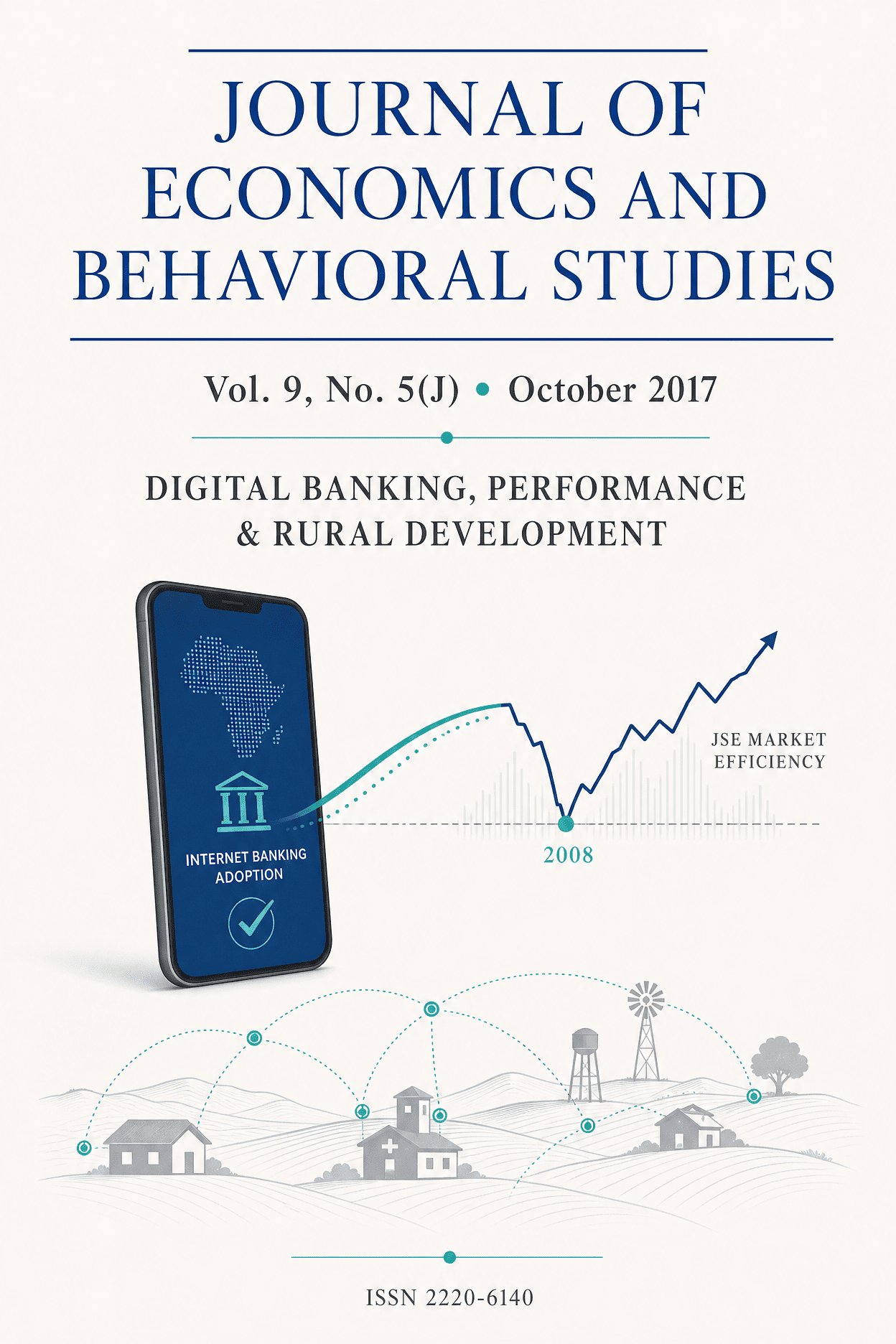
Articles 1–10 of 21

  • Article 1 in this issue

    Internet Banking Adoption in South Africa: The Mediating Role of Consumer Readiness

    • Author: Aguidissou O. C., Richard, Shambare, Rugimbana, R.

    The recent rapid development of Internet banking (IB) around the world is not without certain challenges. For instance while a majority of banking SSTs (Self Service Technologies, e.g. ATMs and debit cards) have been well received by the South African market, consumers seem sceptical towards Internet banking. This paper seeks to test various conceptual frameworks of consumer adoption patterns of IB with the view of a framework with the greatest explanatory power for the South African market. To achieve the stated objective of a framework for IB adoption in South Africa, this paper suggests an approach not yet undertaken, according to the literature review conducted, within the South African retail banking industry – investigating a comparison of the predictive efficacy of two common groupings of variables most cited in the consumer behaviour literature as important determinants of adoptive behaviour in SSTs. These are: perceptions of innovation characteristics and consumer readiness (CR) variables. Therefore, the primary objective of this article is the consideration of this gap within the body of knowledge around South African consumers’ IB adoption behaviour. Through a descriptive quantitative analysis of 1516 large sample size, innovation characteristics as consumer’s perceptions (complexity, perceived risk notably) or views (endogenous variables) were found with greatest predictive power over IB adoption, in the South African consumer market context. This finding is therefore for marketers (particularly in South Africa) a set of useful tools that can be relevant to promote the adoption of IB.

    Pages 6-17

    PDF - Internet Banking Adoption in South Africa: The Mediating Role of Consumer Readiness (opens in a new tab)
  • Article 2 in this issue

    The Influence of Firm Specific Determinants on Financial Performance in the Power Industry

    • Author: Mafumbate J, Ndlovu N, Mafuka A, Gavhure, P

    This study concentrates on the impact of firm specific determinants on financial performance in the power industry. The firm specific determinants used in this study as independent variables were capital structure, firm size and liquidity whilst ROA, ROI and profitability were used as proxies of financial performance. Modigliani and Miller (1958) argue that capital structure has no impact on financial performance whilst the Trade-off theory suggests that the ideal capital structure that helps firm remain financially healthy is the trade-off between cost of leverage and the advantages of debt. Beyond that trade-off point, a firm will start making losses. The target population included 60 employees from all the 5 subsidiaries of the Holding company and researchers used 40 respondents as sample size to enhance reliability. A relationship was established between firm specific determinants and financial performance as measured by ROA, ROI and profitability. The results showed a negative but significant relationship between capital structure and financial performance and they support the pecking order theory which suggests that capital structure is a significant determinant of financial performance. Firm size and financial performance were also negatively related. However, a significant positive relationship was established between liquidity and financial performance. From the findings the researchers concluded that firm specific factors have a significant impact on financial performance. Researchers therefore recommend that ZESA holdings should use its internal funds such as retained earnings and more equity than debt when financing its activities so as to reduce leverage costs which lead to poor performance.

    Pages 18-28

    PDF - The Influence of Firm Specific Determinants on Financial Performance in the Power Industry (opens in a new tab)
  • Article 3 in this issue

    Weak Form Market Efficiency of the Johannesburg Stock Exchange: Pre, During and Post the 2008 Global Financial Crisis

    • Author: Olwetu Fusthane, Kapingura FM

    The importance of the efficiency of the stock market cannot be underestimated, given the critical role the stock market plays through brings together those who demand and supply development finance. It is against this background that this study focused on analysing the weak form efficiency of the Johannesburg Stock Exchange for the period 2005 to 2016 utilising several methodologies which include unit root tests, autocorrelation test and variance ratio. The empirical results from unit root tests indicated that the null hypothesis of a random walk could not be rejected. The same also applied to the autocorrelation test and variance ratio test except for a few instances. Thus irrespective of the few instances which represent the inefficiency of the market, to a greater extent there is evidence of the market being weak form efficient. Thus even though the work done towards ensuring that the market is efficient is commendable, there is need to ensure that further steps are taken to enhance the efficiency of the market. This is, to some extent suggest that investors are able to make abnormal profits from the market.

    Pages 29-42

    PDF - Weak Form Market Efficiency of the Johannesburg Stock Exchange: Pre, During and Post the 2008 Global Financial Crisis (opens in a new tab)
  • Article 4 in this issue

    The Most Effective Strategies to Curb Corruption and Improve Water Service Delivery in Zimbabwe

    • Author: Patrick Mutuma, Trevor Jambawo

    The main objective of this study was to find the most effective strategies to curb and eradicate corruption and improve water service delivery. The study also aimed to present the type, causes, and effects of corruption. A mixed-methods questionnaire survey design was used to collect quantitative and qualitative data. 220 questionnaires were distributed to providers and users of water services in Zimbabwe. 149 respondents returned the completed questionnaires. Data were analysed using descriptive statistics and content analysis. The Analysis of Variance was used to test the significance of mean scores. The study revealed that corruption is highly prevalent in Zimbabwe. The main factors that cause corruption in the water sector are poor governance, economic hardship, and weak accountability. Corruption leads to economic stagnation and poor foreign investments. Organisations such as the Zimbabwe National Water Authority must improve systems and structures, enhance the auditing process, and educate staff on good ethical standards and effective governance to effectively fight against corruption and improve service delivery. They must also put in place strong governance and accountability frameworks and work closely with communities and policy makers to eradicate corruption. The availability of water should be the same across all the suburbs, and the country needs to adjust its water bill rates in line with regional rates. Service providers should make use of mobile technology to promote citizenry participation in sharing ideas and making decisions on water sustainability. This study reaffirms the need to fight corruption and improve water service delivery.

    Pages 43-56

    PDF - The Most Effective Strategies to Curb Corruption and Improve Water Service Delivery in Zimbabwe (opens in a new tab)
  • Article 5 in this issue

    Antecedents of Employee Intention to Stay: A Study of Employees in Zimbabwean SMEs

    • Author: Elizabeth Chinomona

    Most research conducted on the influence of employee perception of equity (EPE), organisational citizenship behaviour (OCB), organisational commitment (OC) and turnover intention (ITS) has been on large organisations and little attention has been paid to SMEs. Studies on EPE and OCB have not filtered down to SMEs in developing countries. The primary objective of the study is to investigate the influence of OCB, EPE and OC on ITS in Zimbabwe’s SME sector. It also sought to ascertain the kind of relationships between OCB and OC, EPE with OC, OCB with ITS, EPE with ITS and finally OC with ITS. Structured questionnaires were distributed to SMEs in five major cities. A quantitative method using Smart PLS was employed to test the relationships among the three hypotheses. The results showed that there is a positive relationship between the three proposed hypotheses. Based on the findings, recommendations will be made to both the government policy makers and SME owners. The proposed study is expected to have practical and theoretical implications to both the policy makers in the government and the owners of small businesses in Zimbabwe. In addition, it will provide added insights and new knowledge to the existing body of literature on human resource management, hitherto not studied extensively in developing countries of Southern Africa and Zimbabwe in particular.

    Pages 57-73

    PDF - Antecedents of Employee Intention to Stay: A Study of Employees in Zimbabwean SMEs (opens in a new tab)
  • Article 6 in this issue

    Measuring employee engagement of low-income workers either working at or visiting Marabastad Mall in the City of Tshwane Metropolitan Municipality

    • Author: Molefe Jonathan Maleka, Cecile Schultz, Lize van Hoek, Leigh-Anne Paul Dachapalli, Suzette Ragadu

    The purpose of this study is to measure employee engagement of low-income workers either working at or visiting Marabastad Mall in the City of Tshwane Metropolitan Municipality (CTMM). The literature review revealed that in the South African context there is a dearth of research on predictors of employee engagement. The research design was a survey and the sample size was six hundred and forty-nine (n=649). The descriptive statistics show that the respondents were moderately disengaged, disaffected, and committed. The descriptive statistics also revealed that respondents moderately disagreed that they had training opportunities and they had a good quality of work life. The inferential statistics showed that males were more engaged than their female counterparts, part-time employees were slightly more engaged than full-time employees and employees who were unionised were more engaged than the non-union members. It was also found that job satisfaction was the highest predictor of employee engagement (β = 0.28, p<0.05). The study has implications for policymakers that employees earning between R1 000.00 and R10 000.00 are less engaged and committed and their job satisfaction levels were low. The implication for managers is that they must be aware that development and recognition of employees and job satisfaction predict employee engagement. Quality of work life and labour relations did not predict employee engagement.

    Pages 74-82

    PDF - Measuring employee engagement of low-income workers either working at or visiting Marabastad Mall in the City of Tshwane Metropolitan Municipality (opens in a new tab)
  • Article 7 in this issue

    Income Diversification, Inequality and Poverty among Rural Households in Oyo State, Nigeria

    • Author: Olubunmi O. Alawode, Isaac B. Oluwatayo, Afusat O. Abdullahi

    The study examined income diversification, inequality and poverty among rural households in Oyo state, Nigeria. Cross-section data were generated from the survey conducted on a sample of 200 households with the aid of structured questionnaire using multi-stage sampling procedure. Descriptive statistics, diversification index, Gini coefficient, FGT poverty index, and the Probit regression model were used to analyze data. Mean income diversification index of 1.22 shows that majority of the respondents had multiple streams of income but crop farming had the largest share (90%) in total income. Mean income of respondents was ₦77,613.2±83575.01, and Gini coefficient of 0.48, 0.46, and 0.39 were obtained for total income, nonagricultural income, and agricultural income respectively. The poverty line was ₦6,490.50 and mean per capita expenditure was ₦9,735.74. The head count ratio showed that 53.5% of the households were poor while 46.5% were regarded as non-poor, and poverty gap was 0.214. From probit results, age, secondary occupation, and farm size had significant inverse relationship with poverty status. Having primary and secondary income sources is poverty reducing, therefore, rural households should be encouraged to remain in farming, especially crop farming, and motivated through skill acquisition to diversify into other income generating activities.

    Pages 83-92

    PDF - Income Diversification, Inequality and Poverty among Rural Households in Oyo State, Nigeria (opens in a new tab)
  • Article 8 in this issue

    The Nature of Host Community Participation in Informative Consultation and Decision-Making Processes in Tourism Development: A Case Study of Umhlwazini, Bergville, KwaZulu-Natal

    • Author: Nduduzo Ngxongo, Nsizwazikhona Chili

    Tourism industry in the central Drakensberg region has enjoyed a noteworthy growth in visitor influx and earnings as well. Conversely, poverty and poor living conditions in and around villages positioned nearby to major tourist destinations in the country continues to degenerate, which ultimately raised the issue regarding the contribution of host communities in tourism decision making and informative consultation processes. Community consultation and participation in decision making processes constitute a crucial component that offers assurance to the host community that tourism benefits will be shared with the community and that their views will be considered when making tourism decisions. Thus, this paper aims at exploring the existing extent of community consultation and participation in tourism decisions making, using a case study of Umhlwazini, Bergville, KwaZulu-Natal. The study incorporates a qualitative research approach with the use of interviews, focus groups and observations. The research findings show that the informative consultation process of community in the study area has been centralised, controlled, and minimal to none regardless of the constant aspirations of the host community to participate in decision making processes. Agreements and decisions relating to tourism and the community resources are agreed upon by outsiders who have no interest of the community at heart. The study recommends a private-public partnership, financial support for small local business enterprises, policy development and amendment to promote active community participation in tourism consultation and decision-making processes. This study contributes to a broader context of community participation in decision making structures, and present scholarly significance to researchers, students and academicians, and theoretical value to government, policy makers, investors and tourism authorities.

    Pages 93-105

    PDF - The Nature of Host Community Participation in Informative Consultation and Decision-Making Processes in Tourism Development: A Case Study of Umhlwazini, Bergville, KwaZulu-Natal (opens in a new tab)
  • Article 9 in this issue

    South African Sucrose Quality in Sugar: Determinants and its Empirical Implications

    • Author: Mishelle Doorasamy, Bruce Rhodes

    The study investigates which factors determine sucrose quality in the South African sugar cane production process. Though South Africa is the 8th largest producer of sugar cane in the world and the highest in Africa, a decline has been observed in the production of high quality sugar in the country. The study adopts the Auto Regressive Distributive Lags (ARDL) technique to analyze sugar cane production time series data from 1980 to 2016 in South Africa. Ten variables were tested, including Average Temperature, Stalk growth, Evaporation, and Soil Water Content (100mm). Our findings revealed that on both the short and long run, some of the variables investigated have the tendency of increasing sucrose level in sugar cane while an increase in other variables would decrease sucrose level altogether. However, the impact of Soil Water Content (100mm) appears not to be statistically significant on sucrose production in our regression model in the short and long run. Of special interest are Stalk growth (Reference sugar cane) and average temperature, as their values are more significantly germane as regards the quantity of sucrose obtained during sugar cane processing in South Africa.

    Pages 106-121

    PDF - South African Sucrose Quality in Sugar: Determinants and its Empirical Implications (opens in a new tab)
  • Article 10 in this issue

    Food Inflation and Passenger Vehicle Purchases in South Africa: Cointegration, Short Run Dynamics and Causality

    • Author: Eric Kateta Tshiakambila, Joseph Chisasa

    Food inflation in South Africa has been observed to be a major source of underlying inflationary pressures in the economy due to its persistence beyond that of other commodities. In this regard, this study investigated whether an increase in the prices of food products has a significant effect on passenger vehicle purchases in South Africa. The Phillip-Perron (PP) test, showed vehicle purchases to be stationary in level while food inflation was stationary in the first difference. Using secondary time series data, the Johansen cointegration test revealed that the variables in the vehicle purchase function were cointegrated in the long run. The vector error correction model showed a long-run relationship, albeit insignificant, between food inflation and vehicle purchases. There was no evidence of a short run relationship between the two variables. The Granger causality test revealed no causal effect between the variables, regardless of the direction of the test. The study concluded that an increase in the prices of food products will not play a considerable role in consumers’ vehicle purchase decisions in South Africa. These results have policy implications for the motor and related industries.

    Pages 122-134

    PDF - Food Inflation and Passenger Vehicle Purchases in South Africa: Cointegration, Short Run Dynamics and Causality (opens in a new tab)