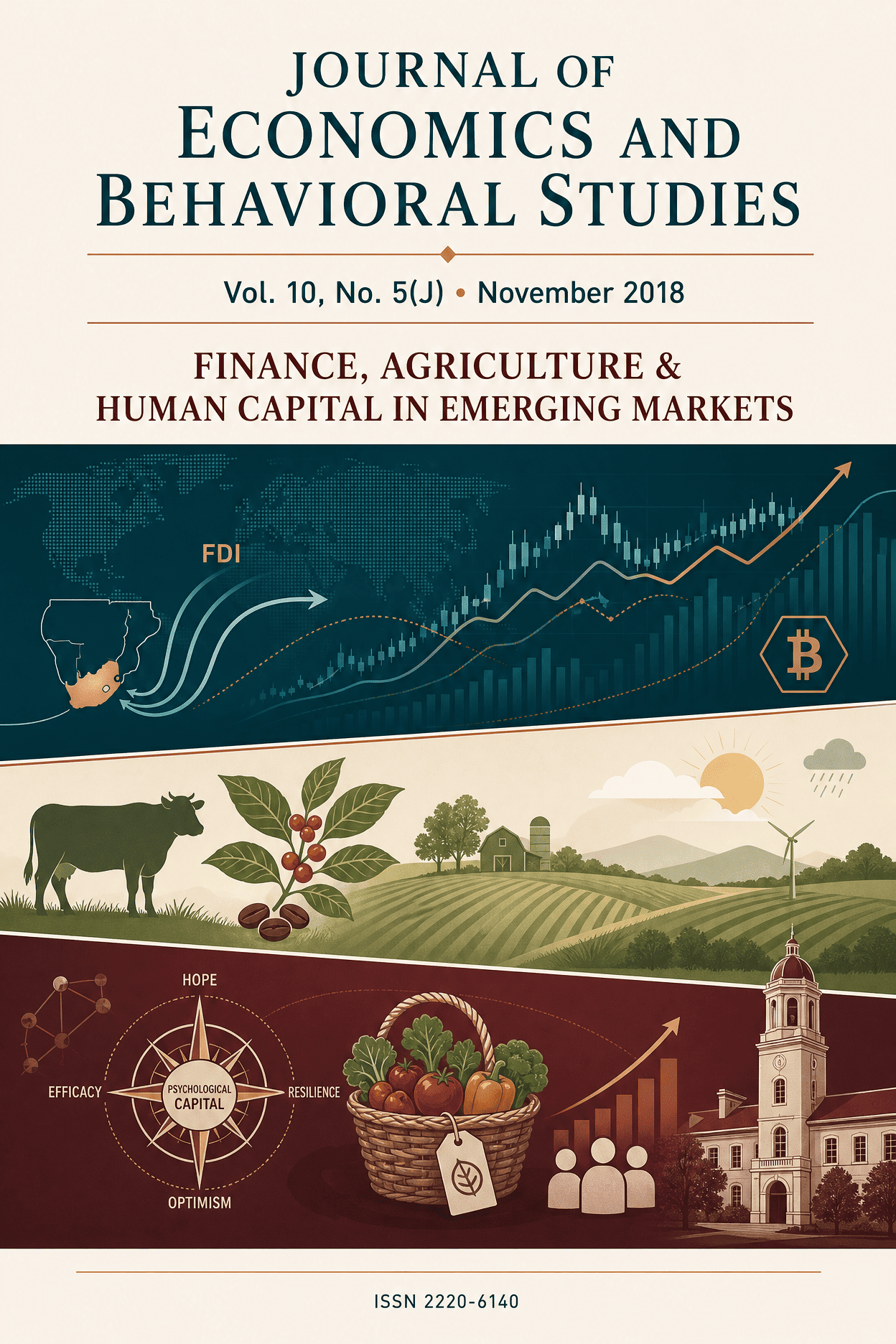
Articles 1–10 of 26

  • Article 1 in this issue

    Determinants of Risk Behaviour in Livestock Development Programs: Evidence from South Africa’s Kaonafatso Yadikgomo (Kyd) Scheme

    • Author: Saul Ngarava, Abbyssinia Mushunje, Amon Taruvinga, Peter Mukarumbwa, Simbarashe Tatsvarei, Ebenezer T Megbowon

    Risk plays a significant role in input use decisions and production of output in agricultural production. Understanding farmer risk attitudes and their responses to risk is significant in designing effective intervention programmes. Few studies have tried to identify how the introduction of a livestock programme has tended to influence farmer risk profile. The objective of the study was to highlight the determinants of risk behaviour in participants of a livestock development programme. The study was carried out in KwaZulu-Natal (KZN) Province of South Africa, utilising a purposive sample of 164 respondents who are part of the Kaonafatso Yadikgomo (KYD) Scheme. The cross-sectional survey collected data pertaining to the risk attitudes of the livestock farmers from an attitudinal scale as well as socio-economic and farm biophysical characteristics. Descriptive statistics and multiple linear regression were used to analyse the data. The results show that the livestock farmers were risk loving, with the risk attitude being influenced by the age of household head, monthly household income and experience in rearing cattle at the ????< 0.1 level. Furthermore, the source of income, herd size, reason for slaughtering cattle distance to the nearest water source and access to a dip tank had significant influence of attitude towards risk at the ????< 0.05 level. The study concludes that being part of a livestock development programme tends inflto uence the risk attitudes of the participants as the determinants were against a priori expectations.

    Pages 7-15

    PDF - Determinants of Risk Behaviour in Livestock Development Programs: Evidence from South Africa’s Kaonafatso Yadikgomo (Kyd) Scheme (opens in a new tab)
  • Article 2 in this issue

    Impact of Chinese, Korean and Japanese Innovation Spillover on Labour Productivity in South African Manufacturing

    • Author: Brian Tavonga Mazorodze, Devi Datt Tewari

    Open economy endogenous growth theories consider physical intermediate imports as a channel through which innovation spreads across international boundaries. We build from this literature and contribute by considering trade in services as the channel through which innovation from China, Korea and Japan influences labour productivity in South Africa’s manufacturing sector between 1995Q1 – 2017Q4. Unlike previous studies, we also compute a composite innovation index using the principal component analysis. Results from the autoregressive distributed lag model are supportive of open economy endogenous growth theories for Japan and Korea. However, for China, the effect is significantly negative adding further concerns over its predatory presence in South Africa.

    Pages 16-28

    PDF - Impact of Chinese, Korean and Japanese Innovation Spillover on Labour Productivity in South African Manufacturing (opens in a new tab)
  • Article 3 in this issue

    An Investigation of the Dynamic Effect of Foreign Direct Investment (FDI) and Interest Rates on GDP in South Africa

    • Author: Thomas Habanabakize, Daniel F Meyer

    Economic growth in South Africa has been in the “doldrums” for the past decade. If well managed, foreign direct investment (FDI) and repo rate (interest rate) could have a positive impact and assist in rapid economic growth so urgently needed in South Africa. FDI has been a driving force for growth in many developing economies. Not enough has been done to attract FDI in South Africa. The country has enormous ability and capacity to attract FDI inflows and to have the advantages from it. A quantitative research approach was used to analyse the association amongst the variables which include FDI, GDP and repo rate in the South African economy. The South African Reserve Bank database was used and the period analysed is from 2000 to 2016. Statistical and econometric methods such as correlation analysis, unit root tests, ARDL Bounds test for cointegration, an error correction model (ECM), and the Granger causality tests were used. Subsequently, after the econometric model was estimated, findings indicated the existence of a long-run relationship between the three variables. While, a significant positive relationship exists between FDI and GDP, a negative long-run relationship was found between GDP and repo rate and interestingly a nonsignificant relationship between repo rate and FDI. In the short run, the positive effect of FDI on GDP is minimal whilst a significant and positive relationship exists between GDP and repo rate. The results did also show some limitations in the results, with regards to FDI and repo rate that there is no significant relationship between the variables, meaning that repo rate does not have an impact on FDIs. Although some long-run evidence was found of FDI playing a role in economic growth in South Africa, such impact is limited. Also very interesting is that the repo rate and FDI do not have a statistically significant relationship. This could be due to the rising risks associated with investments in the country. In conclusion, there are many variables which could have a positive impact on the attraction of FDIs and such factors will be explored further in future studies.

    Pages 29-37

    PDF - An Investigation of the Dynamic Effect of Foreign Direct Investment (FDI) and Interest Rates on GDP in South Africa (opens in a new tab)
  • Article 4 in this issue

    Evaluation of the Components of Psychological Capital and Organizational Citizenship Behavior among Nigerian Graduate Employees

    • Author: John K. Aderibigbe, Themba Q. Mjoli

    In consideration of implications of organizational citizenship behavior, it is quite necessary for scholars and human resource management practitioners, to urgently investigate the correlates of psychological capital dimensions and the dimensions of organizational citizenship behavior. The purpose of the study was twofold. Firstly, to examines the relationship between psychological capital and organizational citizenship behavior. Secondly, to investigate the relationships between the dimensions of organizational citizenship behavior and psychological capital. The study is important, because its outcomes would help the corporate world, governments and human resource managers to avert the problem of underperformance among employees by improving psychological capital and organizational citizenship behavior. The study adopted the positivist explanatory cross-sectional (survey) research design to systematically sample opinions of 1,532 male and female graduate employees across the various sectors of the Nigerian economy, using a structured and validated questionnaire, and the Statistical Package for the Social Sciences (SPSS). The results of the statistical analysis of data showed that there was a significant positive relationship between psychological capital and organizational citizenship behavior, r = 0.588, p<0.01. The results also showed that altruism, conscientiousness and civic virtue dimensions of organizational citizenship behavior are significantly positively interrelated to hope, optimism, resilience and self-efficacy dimensions of psychological capital. The study suggested that human resource managers should develop psychological capital in employees in order to increase the level of organizational performance. Recommendations of the study could assist in training and developing effective manpower capacity towards improving the economy of the nation.

    Pages 38-50

    PDF - Evaluation of the Components of Psychological Capital and Organizational Citizenship Behavior among Nigerian Graduate Employees (opens in a new tab)
  • Article 5 in this issue

    The ‘User Pays’ Principle and the Electricity Sector: A South African Case

    • Author: Michael Maphosa

    This paper discusses the ‘user pays’ principle (UPP) within the South African developmental state concept. The essence of the paper is to ascertain whether UPP can be implemented in the electricity sector without necessarily harming the developmental state agenda taking into account the challenges of inequality, unemployment and poverty in South Africa. In this paper, we present the arguments in support of the UPP in the electricity supply industry (ESI) and its building blocks. The paper analyses the role of regulatory authority in the implementation and adoption of the UPP. Finally, the paper analyses the role of UPP in the developmental state concept and the challenges of implementing it. The analysis shows that adoption of inclining block tariff (IBTs) was based on the individual’s perceived ability to pay and not on UPP while the free basic electricity (FBE) policy is a government-funded initiative meant to provide electricity to poor households. The paper also found that the ESI currently has high levels of inefficiencies in production and use, procurement and operation of utilities, cross-subsidisation, infrastructure and maintenance backlogs which may hinder the full implementation of UPP. Lastly, although the full implementation of UPP could incentivise efficient operation of the ESI and attract the much-needed investment in the sector, the UPP system will pose serious challenges considering the country’s three main problems: inequality, unemployment and poverty.

    Pages 51-58

    PDF - The ‘User Pays’ Principle and the Electricity Sector: A South African Case (opens in a new tab)
  • Article 6 in this issue

    The Influence of Packaging and Brand Equity on Over-The-Counter Herbal Medicines in Kumasi, Ghana

    • Author: Peter Kwasi Oppong, Maxwell A. Phiri

    In todays competitive business environment, packaging and brand equity provide a competitive advantage to a firm which may increase and maintain its market share. However, the role of packaging in supporting the brand equity is relatively new in the over-the-counter pharmaceutical market and currently, there is a lack of empirical research to uncover its significance in this product segment. This paper seeks to investigate the impact of packaging on brand equity through the mediating effect of dimensions of brand equity in the over-the-counter drug market in Kumasi metropolis. Based on Aakers customer-based brand equity model, eight hypotheses were formulated and tested through structural equation modelling. Using systematic sampling, data was collected through survey questionnaires from a sample of 348 consumers who patronize in herbal medicines from herbal stores in Kumasi Metropolis. The study found that packaging significantly contributes to support brand equity of plant medicines through the mediating effect of brand awareness, brand association and brand loyalty. These results indicate that brand managers in the plant medicine industry need to consider packaging as an important brand-building tool in their marketing strategy to enhance brand equity in the over-the-counter pharmaceutical market. This will enh0ance their competitive distinctiveness in the over-the-counter market.

    Pages 59-72

    PDF - The Influence of Packaging and Brand Equity on Over-The-Counter Herbal Medicines in Kumasi, Ghana (opens in a new tab)
  • Article 7 in this issue

    Behavioral and Environmental Influences on Entrepreneurial Orientation

    • Author: Jeff Y-J Chen, Boris Urban

    Traditionally, theories of innovation and entrepreneurship have concentrated on either environmental or dispositional variables to explain different rates and levels in entrepreneurial activity. However, these theories have unsuccessfully represented the complexity of human behavior actions involve the interaction of various environmental, cognitive, and behavioral variables. Recognizing this shortcoming and considering that contextual influences on entrepreneurial behavior in an emerging market context are rarely accounted for, this study empirically examined the degree to which individual-level variables of entrepreneurial alertness and self-efficacy interact with environmental dynamism and hostility to influence a firm’s entrepreneurial orientation. Appreciating the multiplicity of elements facing an entrepreneur who is trying to make sense of the external environment, the study surveyed 310 owner-mangers in South Africa and relied on SEM to determine the best model fit. The study findings reveal that as a result of mediating and interaction effects, an individual with higher levels of alertness and self-efficacy is more likely to be innovative, engage in risk-taking behavior and show pro-activeness, in other words, have higher levels of entrepreneurial orientation. It is recommended that policymakers encourage entrepreneurial orientation by fostering a high-support route in which the effects of the hostile environments are minimized to encourage higher levels of innovation. Moreover, scholars can build on these findings by investigating the interconnectedness of exogenous environmental and individual factors in terms of explaining entrepreneurial orientation.

    Pages 73-88

    PDF - Behavioral and Environmental Influences on Entrepreneurial Orientation (opens in a new tab)
  • Article 8 in this issue

    Organisational Capabilities and Replicating Successful Programs Designed to Empower Poor Youths: A Correlational Study

    • Author: Idahosa Igbinakhase, Vannie Naidoo

    This article reports on the investigated relationship between the organisational capabilities of youth-serving non-governmental organisations (NGOs) and the replication of successful programmes designed to empower poor youths in Nigeria. The data used in this study were obtained from 187 youthserving NGOs in Nigeria registered with the Nigeria Network of Non-Governmental Organisations, the Conference of Non-Governmental Organisations (Edo State chapter), the Civil Society for HIV/AIDS in Nigeria (Edo State chapter) and the National Youth Council of Nigeria (Edo State chapter). Pearson’s correlation r was used to examine the relationship between the research variables and a positive relationship was found between the organisational capabilities of youth-serving NGOs and the replication of successful programmes designed to empower poor youths. In addition, regression analysis was used to determine the organisational capabilities of youth-serving NGOs that predicted the replication of successful programmes designed to empower poor youths in Nigeria, and it was found that adequate staffing, alliance-building, lobbying, replication and stimulating market forces significantly predicted the replication of successful programmes designed to empower poor youths in Nigeria. The study therefore recommends that appropriate measures be put in place by managers of youth-serving NGOs to ensure that the main predictors of the replication. Of successful programmes designed to empower poor youths are adequate to aid successfully in the replication of successful programmes designed to empower poor youths in Nigeria while also giving adequate attention to other organisational capabilities contained in the SCALERS model.

    Pages 89-99

    PDF - Organisational Capabilities and Replicating Successful Programs Designed to Empower Poor Youths: A Correlational Study (opens in a new tab)
  • Article 9 in this issue

    Moral Hazard Effects of Corporate Bond Guarantee Purchases: Empirical Evidence from China

    • Author: Xueying Zhang, Shansheng Gao, Jian Jiao

    This study examines corporate bond guarantees by developing a theoretical model that decomposes the overall impact of a guarantee into signalling and incentive effects and presenting empirical evidence based on data from China’s corporate bond market. Our empirical research yields considerable evidence for the effects we posit in the model and provides some important insights into the problems of adverse selection and moral hazard in China’s bond market. The empirical evidence shows that the bond issuer with lower credit rating are more willing to purchase a bond guarantee and guaranteed bonds have a higher issue spread yield than those non-guaranteed bonds, even though both have the same bond credit rating. Our findings suggest that moral hazard would be better than adverse selection to explain the self- selection of bond guarantees. Prior to bond issuance credit rating signal provides a mechanism to mitigate information inequality, while bond guarantees relieve information asymmetry afterwards.

    Pages 100-115

    PDF - Moral Hazard Effects of Corporate Bond Guarantee Purchases: Empirical Evidence from China (opens in a new tab)
  • Article 10 in this issue

    Determinants of Climate Change Awareness among Rural Farming Households in South Africa

    • Author: Oduniyi, Oluwaseun Samuel, Antwi Micheal, Busisiwe Nkonki-Mandleni

    Climate change and rural livelihood capitals remain the major inextricable dimensions of sustainability in this twenty-first century globally. It is known to be an important challenge facing food security status among African countries. Additionally, it is an indisputable fact that climate change and agriculture are intertwined. In view of this, climate change awareness needs to be strengthened in the rural farming households. The study was carried out in Ngaka Modiri Molema District Municipality, in the North West Province of South Africa to determine awareness of climate change. Stratified random sampling technique was used to select three hundred and forty-six (346) farmers who were interviewed from the study area. Data were analyzed using statistical package for social sciences (SPSS). The binary logistic regression model was employed to analyse the factors driving climate change awareness. The study established that majority of the rural farmers in the study area aware of climate change, in which farm size, education, who owns the farm, information received on climate change, source of climate change information, climate change information through extension services, channel of information received on climate change and support received on climate change are statistically significant (p<0.05) determinants of climate change awareness in the study area.

    Pages 116-124

    PDF - Determinants of Climate Change Awareness among Rural Farming Households in South Africa (opens in a new tab)