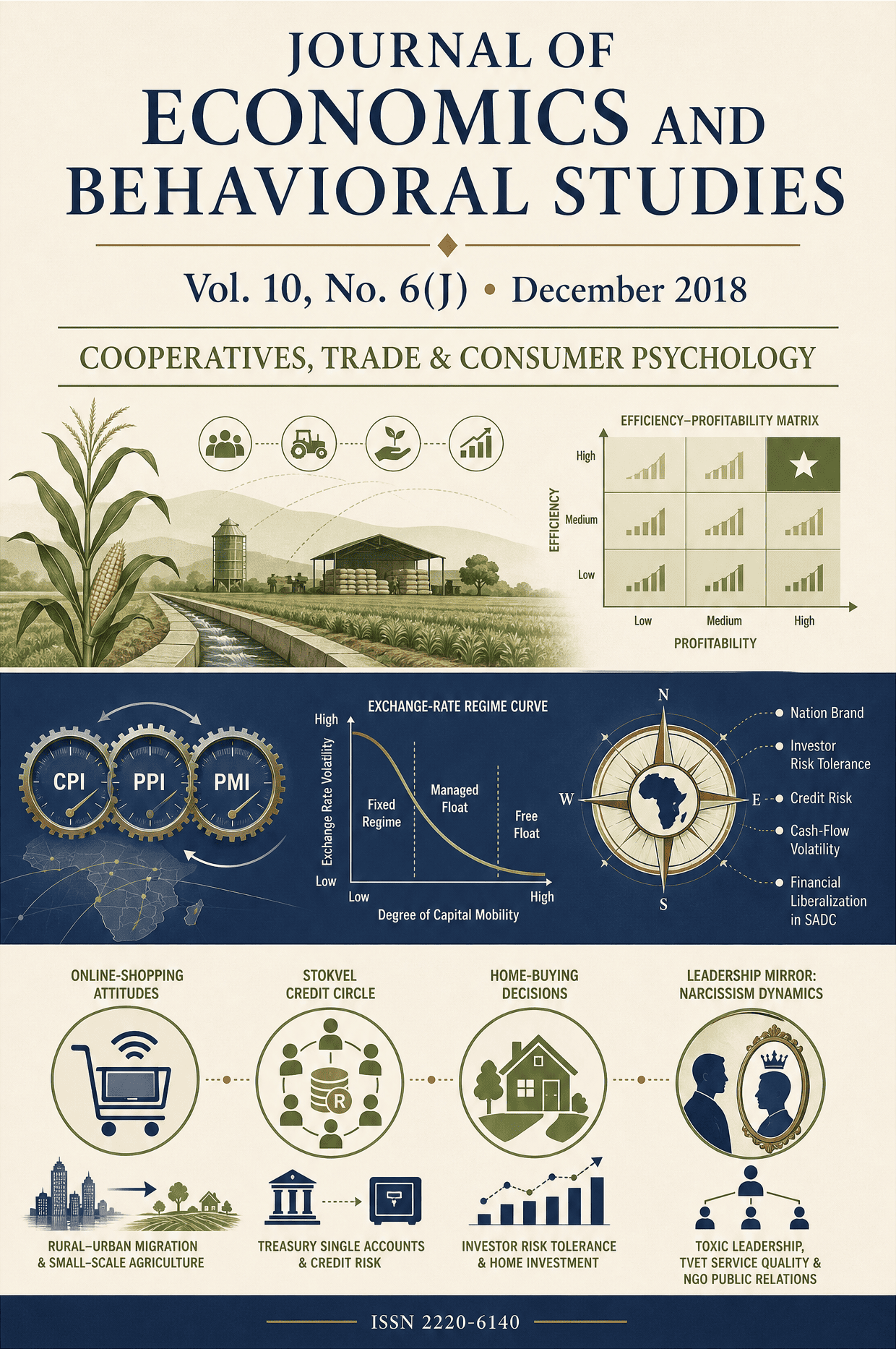
Articles 1–10 of 26

  • Article 1 in this issue

    Efficiency and Profitability Analysis of Agricultural Cooperatives in Mpumalanga, South Africa

    • Author: Thembi Xaba, Nyankomo Marwa, Babita Mathur-Helm

    Agricultural cooperatives are expected to generate sustainable profit as they are established as a vehicle of economic development. Efficiency and profitability analysis measures the performance of a firm, and assists management in decision-making through benchmarking with other firms (Marwa & Aziakpono, 2014). To understand the performance of agricultural cooperatives, our study analysed efficiency and profitability using an efficiency-profitability matrix to provide for multi-dimensional analysis. The study used secondary data from annual financial statements for the financial years 2015/16 collected from 19 agricultural cooperatives. Technical efficiency was estimated using Data Envelopment Analysis (DEA) and profitability was estimated using Returns on Assets (ROA). The median scores were 68% for technical efficiency and 10% for profitability. Using the 68% efficiency and 10% profitability benchmark, the matrix separated best performers from low performers. The matrix indicated that 26% of the cooperatives had highefficiency levels with high profitability (stars), however there was an even distribution between the stars and sleepers: 5 out of 19 cooperatives were sleepers and 5 out of 19 were stars. The majority of the decisionmaking units (DMUs) at 42% (8 out of 19) are in quadrant 3, categorised as ‘question mark’. These DMUs had low-efficiency scores and low profitability ratios. Only 1 out of 19 cooperatives had high-efficiency levels and low profitability scores. The results demonstrate that technically efficient firms do not always translate to profitable firms: in this regard, management needs to investigate how best to allocate resources in order to remain relevant within the business context and competition. Policy makers need to investigate other drivers of efficiency and profitability when measuring the performance of a firm to influence future policy directives.

    Pages 1-10

    PDF - Efficiency and Profitability Analysis of Agricultural Cooperatives in Mpumalanga, South Africa (opens in a new tab)
  • Article 2 in this issue

    The Rural Immigration Effects on Urban Service Delivery in South Africa (SA)

    • Author: Buyani Nkabinde, Lawrence Mpele Lekhanya, Nirmala Dorasamy

    The current socio-economic and political problems of South Africa are rooted in the colonial apartheid era as scholars and researchers suggest through extensive research. However, there have been high levels of service delivery protests related to the government performance on the issues of service delivery to the local communities’ countrywide. Governments departments appear to be lacking much required knowledge and understanding of external factors associated with rural to urban migration such social-economic factors and other various relevant challenges, hence, local authorities are struggling to meet up with demands caused by the ever-increasing number of urban populations, which affects services delivery performance. The study was quantitative approach and used 5 Likert scale questionnaires which were distributed in the selected areas of eThekwini city. A total of 100 with 25 respondents per area, chosen areas include emhlabeni, emalandeni, ezimeleni and silver city. Whereas, qualitative aspects of the study were secondary data through extensive literature review, the study has found that indeed rural to urban migration has a negative impact on service delivery the study argue that service delivery, rural to urban migration, public participation need to be part of the government agenda holistically to improve service delivery and capacity of local authorities. This study recommends proactive urban planning and community involvement through public participation channels. The generalization of the findings of this study should be done with care.

    Pages 11-24

    PDF - The Rural Immigration Effects on Urban Service Delivery in South Africa (SA) (opens in a new tab)
  • Article 3 in this issue

    Analysis of Relationships and Causality between Consumer Price Index (CPI), the Producer Price Index (PPI) and Purchasing Manager’s Index (PMI) in South Africa

    • Author: Daniel Francois Meyer, Thomas Habanabakize

    The variables the consumer price index (CPI), the producer price index (PPI) and the purchasing managers’ index (PMI) and play major roles in economic forecasting. The overall objective of this study is to assess the inter-relationships between CPI, PPI and PMI as predicting variables. This study is quantitative in nature and employed an ARDL econometric model, error correction model (ECM) and Granger causality approaches to establish long and short-run relationships. The ARDL method was used due to the fact that the variables had a mix of stationarity at levels I (0) and the first difference I (1). Quarterly datasets were obtained from Statistics South Africa (Stats SA) and the Bureau of Economic Research (BER) for the period 2000 to 2017. Results from the estimations discovered that variables cointegrate in the long-run. Additionally, evidence of short-run relationships has been determined using ECM. Furthermore, causal relationships were also analysed with results indicating that CPI causes PMI and PPI causes PMI. The implication of the research is the confirmation of the importance of relationships between CPI, PPI and PMI, which is especially significant in the short-run and the three index indicators are important macro-economic indicators for changes in overall economic activity on a macro level.

    Pages 25-32

    PDF - Analysis of Relationships and Causality between Consumer Price Index (CPI), the Producer Price Index (PPI) and Purchasing Manager’s Index (PMI) in South Africa (opens in a new tab)
  • Article 4 in this issue

    Small-Scale Agriculture as a Panacea in Enhancing South African Rural Economies

    • Author: Mfaniseni Wiseman Mbatha, Mfundo Mandla Masuku

    The small-scale agricultural sector is considered as an indispensable role player in improving the South African rural economies by means of enhancing sustainable rural livelihoods. This paper critically assesses the contribution of small-scale agriculture in enhancing the South African rural economies. The South African Government have numerous agricultural interventions as an approach to improving rural livelihoods. Despite various policies and interventions that have been in place to ensure that small-scale agriculture improves rural economies; there is still a dearth of research in understanding small-scale agriculture dynamics that affect rural economies. Some of the essential aspects of the findings reveal that rural communities in South Africa regard small-scale agriculture as a s ource of income generation and enhancing food security . These findings highlight the negative effects on the S outh African small-scale agriculture suffering from insufficient productivity, infertility of soil, insufficient water and climate change. The poor access to markets and inadequate financial support services were identified as the major constraints that hinder small-scale agriculture to contribute to the Gross Domestic Product (GDP) and rural economic development. The small-scale agricultural sector should c ome up with self-sufficient interventions to avoid dependence on the Government and other stakeholders.

    Pages 33-41

    PDF - Small-Scale Agriculture as a Panacea in Enhancing South African Rural Economies (opens in a new tab)
  • Article 5 in this issue

    Financial Sector Liberalization and Financial Instability: Case of Selected Southern African Development Community Member Countries

    • Author: Nolungelo Cele, Kapingura FM

    The importance of financial liberalization is well documented in the literature. However, there has been an emergency of studies, which indicate that this can be another channel through which financial instability is generated in the domestic economy. Utilising data from four SADC countries, the empirical findings show that financial reforms are positively related to financial instability in almost all the specifications. The empirical results further revealed that financial instability intensifies in the face of a financial crisis. The result suggests that financial liberalization can therefore be another source of financial instability in the region. The empirical results imply that though policymakers should liberalise the financial system, policies aimed at maintaining financial stability should also be promoted.

    Pages 42-49

    PDF - Financial Sector Liberalization and Financial Instability: Case of Selected Southern African Development Community Member Countries (opens in a new tab)
  • Article 6 in this issue

    Factors to Measure the Performance of Private Business Schools in South Africa

    • Author: R Asvat, CA Bisschoff, CJ Botha

    This article identifies the latent variables embedded within the model to measure the performance of private business schools. In the quantitative research design, 247 questionnaires, using a five-point Likert scale, were analysed after completion by private business school supervisors and managers. The data has high reliability with a Cronbach alpha coefficient of 0.974 and excellent sample adequacy with a KMO value of 0.926. The analysis identified ten latent variables (or factors), identified using exploratory factor analysis explaining a cumulative variance of 70.56%. These are Regulatory compliance, Strategic communication, Educational technology stack, Strategic finance, Organisational development, Customer orientation, Sales, Pricing, Socio-political influence and Market focus. The study also succeeded to simplify measuring performance by eliminating 26 questions with low factor loadings (<0.40) or those that are cross-loading highly onto more than one factor from the questionnaire while retaining a satisfactory level of reliability. The results are valuable to private business school managers and to the employees wanting to measure and improve the business performance of a private business school. Researchers and academia could also benefit from the contribution of the study to either build on business performance of private business schools or, alternatively, in adopting the methodology employed in this study for another application setting.

    Pages 50-69

    PDF - Factors to Measure the Performance of Private Business Schools in South Africa (opens in a new tab)
  • Article 7 in this issue

    Determinants of Informal Land Renting Decisions by A1 and A2 Farmers in Mashonaland East Province of Zimbabwe

    • Author: Simbarashe Tatsvarei, Abbyssinia Mushunje, Saul Ngarava, Clifton Makate

    Land rental markets are critical in developing economies as they contribute to efficiency, equity and welfare gains to farmers involved under conditions of low transaction costs. Despite lack of policy consistency in Zimbabwe, A1 and A2 farmers have been involved in these land rental markets, albeit in an informal manner. This study sought to establish the determinants of farmers’ decision to take part in these informal markets. A survey was carried out in Mashonaland East province with a sample of 339 households selected through multi-stage sampling methods and data analysed using a bi-variate Tobit model. Results showed that combined together, the proportion of farmers involved in informal land rental markets are as much as those not participating. Determinants of renting-in were identified as gender, household income, permanent labour, cultivated area, tenure certainty, irrigable land size and crop diversification. Factors affecting renting-out decisions were age, permanent labour, irrigable land size and crop diversification and these results are not in any way different from findings from previous studies. The conclusion was that household characteristics and land endowments factors were strong in decisions to rent-in land while land endowments factors were dominant in decisions to rent-out land. Any future considerations for formalising land rental markets should consider these important factors having a bearing on land rental decisions.

    Pages 70-78

    PDF - Determinants of Informal Land Renting Decisions by A1 and A2 Farmers in Mashonaland East Province of Zimbabwe (opens in a new tab)
  • Article 8 in this issue

    Benefits of an Irrigation Scheme and Its Determinants to Surrounding Peripheral Rural Communities

    • Author: Zandile Masela, Abbyssinia Mushunje, Saul Ngarava, Amon Taruvinga, Simbarashe Tatsvarei

    The objective of the study was to identify the extent of benefits and their determinants to communities surrounding the Qamata Irrigation Scheme (QIS) in the Eastern Cape Province, South Africa. The study used a quantitative based cross-sectional survey of 197 households within a radius of 20 km from the QIS. Multiple sampling methods were utilized where the villages were randomly and the households conveniently selected. A semi-structured pre-coded questionnaire was utilized to collect the data which was analyzed using descriptive statistics and multinomial logit regression. The study identified 14 discriminant benefits ranging from job opportunities, income increment food diversification to share cropping. Sixty-two percent of the households identified less than 5 benefits, whilst 27% and 11% identified 6-10 and 11-14 benefits respectively. Determinants of a surrounding household to attain benefits were significantly influenced by the distance from the scheme, the main source of income and gender of household head (P<0.01); marital and employment status (P<0.05); and access to farm land (P<0.1). The study concludes that the level of benefit diffused to surrounding households is based on socio-economic factors. The study recommends conscientization of surrounding communities on the peripheral benefits accrued from the proximity to the QIS, achievable through awareness initiatives.

    Pages 79-90

    PDF - Benefits of an Irrigation Scheme and Its Determinants to Surrounding Peripheral Rural Communities (opens in a new tab)
  • Article 9 in this issue

    China’s Progress in Poverty Reduction: What Can South Africa Learn from China to Attain the Poverty Eradication Goal in the Sustainable Development Goals?

    • Author: Mandla Abednico Mubecua

    During the evaluation of the Millennium Development Goals (MDGs) from 2000 to 2015, it was discovered that there was no country managed to meet the envisioned goal of eradicating poverty. However, it was observed that China is the only country that managed to half its poverty levels. Just like other developing countries, South Africa is one of the countries whose performance in the attainment of the first goal of MDGs was not satisfactory. Through the utilization of secondary data in a qualitative approach, this paper argues that South Africa can perform better if it can learn and follow the strategies used by China to shrink its poverty levels. The study shows that China mostly supports State Owned Enterprises, which make the economy to grow and help in poverty alleviation. For that reason, the study recommends that in order for South Africa to attain the poverty eradication goal by 2030 more SOEs have to be established.

    Pages 91-98

    PDF - China’s Progress in Poverty Reduction: What Can South Africa Learn from China to Attain the Poverty Eradication Goal in the Sustainable Development Goals? (opens in a new tab)
  • Article 10 in this issue

    An Analysis of Nation Brand Attractiveness: Evidence from Brand Zimbabwe

    • Author: Cleven Masango, Vannie Naidoo

    This paper examines the attractiveness of Brand Zimbabwe based on the factors perceived to impact on national competitiveness. Nation brand attractiveness is a necessary condition for a country to achieve influence and to effectively compete for global resources. Countries can enhance their attractiveness by building on their national brand equity and dealing with negatives around the national brands. The research sought to determine the perception towards Zimbabwe’s global risk and competitiveness; to ascertain the variables that promote competitiveness for Brand Zimbabwe and to contribute to the literature on risk perception and its impact on behaviour towards nation brands. The study followed a mixed approach; a combination of interpretivism and positivism. The research drew 372 respondents from politicians, scholars, the media, civic organisations, government officials, church and international organisations. The research established that Brand Zimbabwe faces glaring threats risks that impact on the country’s international image. The brand is affected by politics and governance together with socio-economic factors. Management and control of nation brand perception are critical for nations to distinguish themselves and to create vantage positions for sustainable performance. The way a country is viewed internationally is a function of how the country deals with factors that threaten its global competitiveness and perception towards the nation brand. Zimbabwe’s quest for foreign direct investment, international visitation and export revenue requires that the country deals with its nation brand image.

    Pages 99-112

    PDF - An Analysis of Nation Brand Attractiveness: Evidence from Brand Zimbabwe (opens in a new tab)