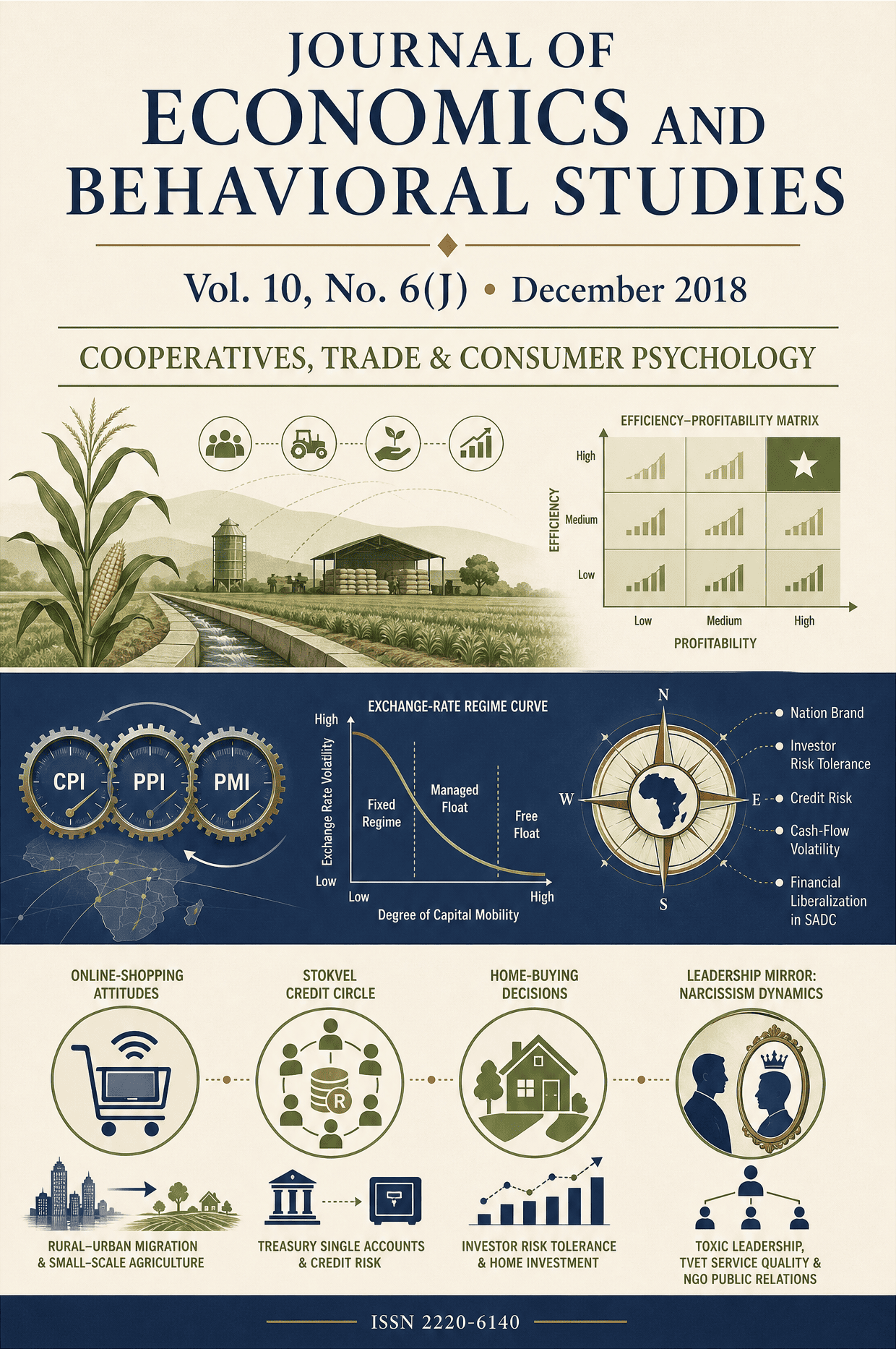
Articles 21–26 of 26

  • Article 21 in this issue

    Financing Smallholder Rice Farmers: A Field-Based Evidence Review of Anchor Borrowers’ Programme (ABP) Model in Nigeria

    • Author: Uchenna Obih, Lloyd Baiyegunhi

    Nigeria’s spending of US$2billion annually on rice importation has been considered a major source of foreign exchange drain and a threat to domestic rice industry. One of the major reasons adduced for this high import bills is the persistent demand-supply gap arising from the country’s inability to increase domestic output of paddy rice to optimize the total capacity of several integrated rice mills established across the country in the last 15 years. In 2015, the government launched the Anchor Borrowers’ Programme (ABP) to make cheap funds accessible to smallholder farmers (SHFs) who produce more than 85% of total farm output in Nigeria. ABP is designed to encourage banks to lend to SHFs to boost paddy rice production. This paper presents the field experiences of SHFs, banks and rice millers who participated in the programme in 2016/2017. This paper concludes that ABP is a laudable programme that can contribute in achieving the food security objective of the government. The key challenges found to be threatening the success and sustainability of ABP included delays in timely disbursement of funds by deposit money banks (DMBs), inadequate personnel and institutional framework, side-selling of harvested paddy rice by SHFs, State government undue involvement in the ABP, and poor rural infrastructure. Policy recommendations to strengthen the ABP model for improved impact were discussed.

    Pages 229-239

    PDF - Financing Smallholder Rice Farmers: A Field-Based Evidence Review of Anchor Borrowers’ Programme (ABP) Model in Nigeria (opens in a new tab)
  • Article 22 in this issue

    Characteristics of Credit Instruments Issued by Stokvels in South Africa

    • Author: Lindiwe Ngcobo, Joseph Chisasa

    Access to formal credit and other financial instruments remains a challenge for the majority of households in South Africa. The objective of this study was, therefore, to determine the characteristics of credit instruments issued by stokvels to households in South Africa. Prior studies have generally focused on mobilization of savings through stokvels while none has paid particular attention to the credit supply function of stokvels. This study attempts to fill this gap by using a self-administered research questionnaire on a sample of 386 respondents. Members of stokvels were surveyed from the cities of Pretoria and Johannesburg in the Gauteng province of South Africa. Data was analysed using descriptive statistics, exploratory factor and correlation analyses. Results show that stokvels issue short-term loans from less than 3 to 6 months. Interest rates are high ranging from 25% to 35% and are charged monthly. Loan sizes are small with approximately two-thirds of the respondents receiving loans above R500 while the remaining third received less than R500. Finally, all loans are secured by the borrower’s identification document or bank card and personal identification number. The results of this study have policy implications for financial institutions in South Africa.

    Pages 240-250

    PDF - Characteristics of Credit Instruments Issued by Stokvels in South Africa (opens in a new tab)
  • Article 23 in this issue

    The nexus between Narcissist Followers and Leaders-Antecedent for Toxic Leadership

    • Author: Nirmala Dorasamy

    Increasingly, it is recognized that organizations have toxic leaders, who harm organizational success. While they harm organizational success, it can be argued that followers who collude are also contributors to such harm. Literature increasingly points to the interrelationship between leaders and organizations and its impact on organizational success. Notably absent is the systematic examination of the toxic relationship between leaders and followers as colluders and its impact on organizational success. The purpose of the paper is to examine the extent to which followers as colluders reinforce toxic leadership through the relational aspects. The focus is on active, destructive and unethical leaders within the negative leadership continuum, since it is difficult to claim that behaviours representing passiveness and incompetence are equally negative. Through a relational approach to leadership study, the situated commonality between leaders and followers is explored to show that manifestations of narcissism in both leaders and followers who collude in perpetuating toxic leadership can cause organizations to drift into failure. The paper does not consider leadership in any organizational or situational context. The study’s methodology contributes to the objective of the research. The use of a qualitative research method was useful in arguing the exhibitionism of narcissism not only among leaders, but also followers. This method aligns with the purpose of the study. There is a paucity of literature on how the relational aspects of the leaderfollower dynamic influence the toxic leadership/ followership reality. The relevancy of the study not only contributes to the literature on toxic leadership, but more specifically showing how narcissist followers as colluders influence narcissist leaders in a toxic leadership relationship. By examining the toxic leader/ follower relationship, a richer understanding of toxic followers can possibly emerge. This is important, since leaders do not produce results alone, together with the followers they contribute to the well-being of the organization. A range of practitioner research articles and published empirical research articles were reviewed to highlight narcissism among toxic leaders and elaborate on the destructive role of followers who reinforce toxic leadership through support. The analysis shows that while leaders and followers as colluders can cause harm to organizational outcomes, the extent of the harm can be largely influenced by the nature of the narcissist traits commonly endorsed by both. The paper highlights an overall framework that may help to identify the major considerations needed to mitigate the harmful effects of the narcissist leader/ follower relationship on positive organisational outcomes. Further, the paper suggests examining the relational aspects of leaders and followers as colluders, especially by looking at the impact of various narcissist traits that potentially strengthen the toxic relationship between the leader and follower. Finally, it is recommended that the proposed guidelines be tested in an empirical paper to measure their effectiveness.

    Pages 251-260

    PDF - The nexus between Narcissist Followers and Leaders-Antecedent for Toxic Leadership (opens in a new tab)
  • Article 24 in this issue

    South Africa’s Trade Performance under Alternative Exchange Rate Regimes

    • Author: Romaine Patrick, Phocenah Nyatanga

    This study examined the effect exchange rates have on import and export volumes under alternative exchange rate policies adopted in South Africa over the period 1960 to 2017. Using quarterly time series data for the stated period, a log-linear error correction model is employed to estimate the country’s export and import elasticities, taking into account Gross Domestic Product (GDP), the real price of exports, the real price of imports and real exchange rates. Using the freely floating exchange rate regime as the base period, the study concluded that both export and import volumes are lower under a system of fixed exchange rates. Export and import volumes were also found to be lower under the dual exchange rate regime, relative to the freely floating exchange rate regime. In accordance with export-led growth strategies, exports were found to be higher and imports lower under a managed floating exchange rate regime. It is therefore recommended that South Africa revert to a more managed exchange rate regime, until the South African economy is developed to accommodate a freely floating exchange rate regime.

    Pages 261-271

    PDF - South Africa’s Trade Performance under Alternative Exchange Rate Regimes (opens in a new tab)
  • Article 25 in this issue

    Dual Process Difference in Families Regarding Home Buying Decision

    • Author: Anastasia, Njo, Narsa, I Made

    The system of thought between rational systems and experience systems is inherent in each individual and produces different decisions. Thinking using logic tends to be used by almost every individual, but cognitive limitations make the individual simplify complex thinking to make practical decisions. This study aims to examine more in dual process on decision home buyers according to dual motives based on demographics and life cycle. Data collection was done by distributing questionnaires to selective home buyers of 235 buyers. Survey instruments include demographic and family life cycle variables. The dual process measurements using Rational-Experiential Inventory (REI-40) are designed to test individual preferences for two decision making, such as cognitive styles (rationality) and intuition (experience) using Likert scales. The results show that dual process cannot be distinguished based on dual motives. However, demographic variables such as gender, age, education, and family life cycle showed the difference in the dual process.

    Pages 272-285

    PDF - Dual Process Difference in Families Regarding Home Buying Decision (opens in a new tab)
  • Article 26 in this issue

    Subjective Risk Tolerance of South African Investors

    • Author: Zandri Dickason-Koekemoer, Suné Ferreira

    In general, the amount of risk an individual is willing to tolerate can be influenced by demographic factors. However, needs for research arise as to whether demographic factors influence the amount of risk investors in South Africa are willing to tolerate. The survey was conducted in 2017 and all South African investors were included in the sample frame. For this study, a sample of 800 was collected and used. Multinomial regression was used to indicate whether there were more than two factors that can influence the four risk tolerance levels of South African investors. The study suggested that gender is a determining factor in the risk tolerance of individuals. African investors were more likely to take the substantial financial risk. Age was also a determining factor of risk tolerance which follows the assumptions of the investor lifecycle where younger investors are more risk tolerant. The study furthermore found that higher annual income attracts more risk-taking while lower-income attracts more risk averseness in individuals. It was lastly observed that married individuals and those that are no longer married will be more likely to be risk-averse. This study makes a significant contribution in profiling investors risk tolerance according to their demographic factors whereby financial institutions can offer more tailored investment options.

    Pages 286-294

    PDF - Subjective Risk Tolerance of South African Investors (opens in a new tab)