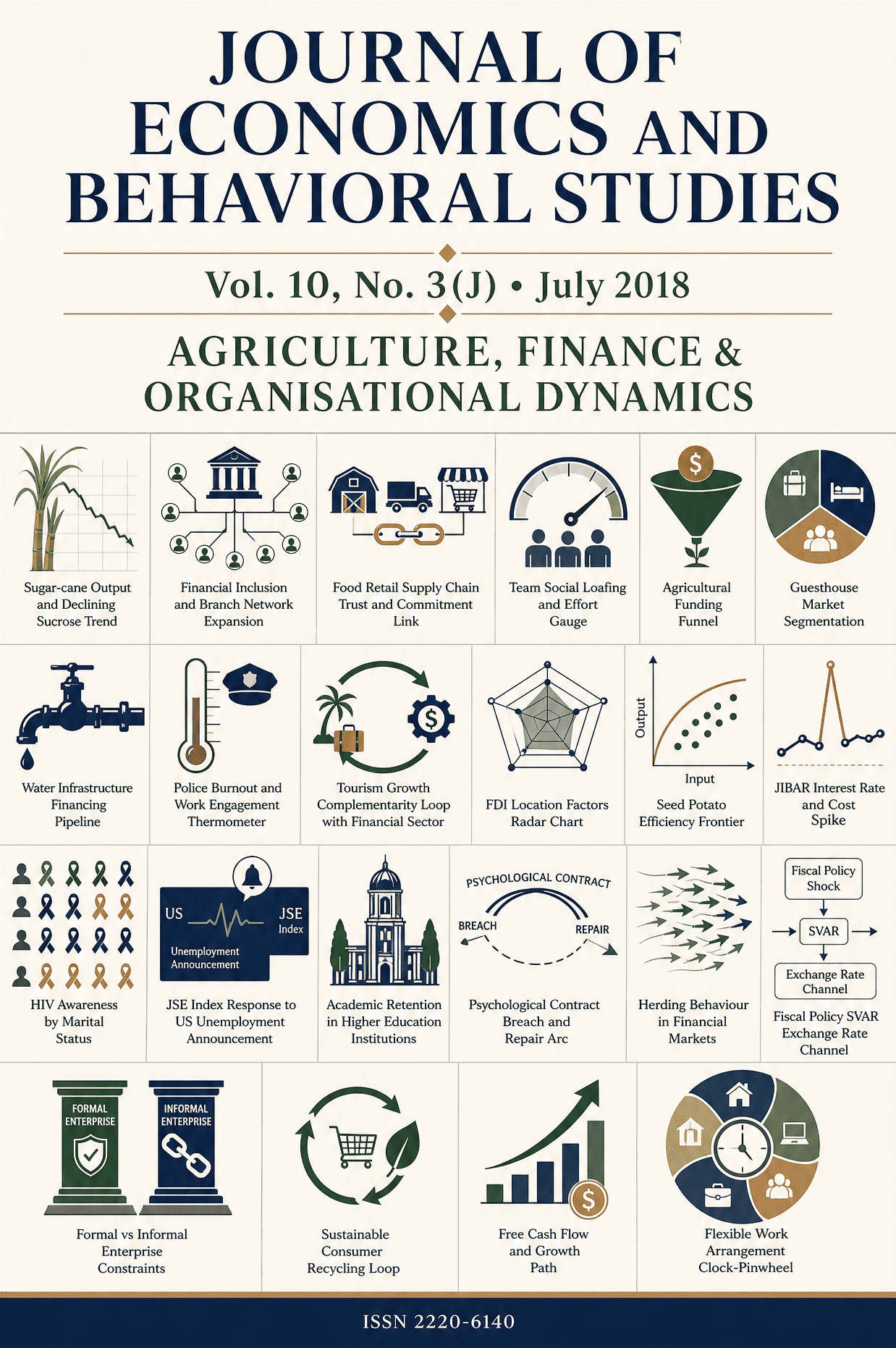
Articles 1–10 of 22

  • Article 1 in this issue

    An Empirical Investigation of the Declining Sucrose Content in South African Sugar Cane

    • Author: Mishelle Doorasamy

    This study is aimed at investigating the declining sucrose levels in South African sugar cane using principal component analysis. The agricultural production of sugar cane has been one of the major sources of income to the South African economy. Sucrose has been classified in the analysis of Brix percentage of sugarcane juice as one of the most important parameters of sugar composition, due to its usefulness, among the components in sugar cane which are needed for farmers to generate income within the economy. However, data indicates that the sucrose content decline which began in 2014 is still ongoing, representing great loss to the farmers. To investigate this trend, this study has regressed the sucrose percentage in cane as a dependent variable against the ratio in Tons of cane to 1 Ton of sugar, tons of cane crushed, tons of sugar made, and yields per hectare of harvested cane. The study used correlation matrices, summary statistics and principal component analysis as tools in carrying out its investigation. From the regression result, the proportional composition value of sucrose which stands at 0.6059 - the highest compared to others in the model - indicates that it is an essential component in the chain of sugar production. However, when the maximum value of sucrose (14.24000) is compared with its minimum (12.92000), a remarkable decline is observed. Since a remarkable difference is also observed when the mean value of 13.55353 is compared with the standard deviation value of 0.378318, the study can conclude that the percentage level of sucrose is low compared to other explanatory variables. This typically signifies a decline in the value of sucrose when compared with other variables under investigation.

    Pages 6-14

    PDF - An Empirical Investigation of the Declining Sucrose Content in South African Sugar Cane (opens in a new tab)
  • Article 2 in this issue

    Financial Inclusion and Macroeconomic Performance in Nigeria

    • Author: Lawal, N. A., Sulaiman, L. A., Migiro, S. O.

    The paper examines the relationship between financial inclusion and macroeconomic performance in Nigeria from 1981 to 2014. The data for the study were sourced from Central Bank of Nigeria statistical bulletins. The study employs the Ordinary Least Square and Granger Causality tests as estimation techniques. From the result, using the coefficient, Gross Domestic Product (GDP) is positive at constant of 2573.946. This means that when all variables are held constant, there will be a positive variation up to 2573.946 units in GDP. This implies that there is a significant and positive effect of financial inclusion on macroeconomic performance in Nigeria. It is concluded that Credit to the Private Sector as a ratio of GDP (CPS/GDP), Money Supply as a ratio of GDP (MS/GDP), and Numbers of Bank Branches (NBB) have a unidirectional relationship to GDP – while Currency Out Banks (COB), Interest Rate (INT) and Total Saving (TSA)are independent of GDP. The study therefore recommends that the government and the Central Bank of Nigeria should improve on the facilitation of credit to the private sector, and money supply should be properly managed. The Central Bank of Nigeria should encourage the provisions of more bank branches to rural and urban areas in order to promote easy access to financial services.

    Pages 15-22

    PDF - Financial Inclusion and Macroeconomic Performance in Nigeria (opens in a new tab)
  • Article 3 in this issue

    Antecedents of Supply Chain Performance: A Case of Food Retail Industry

    • Author: Chriss Narick Mangoukou Ngouapegne, Elizabeth Chinomona

    Food retail industry plays an important part in gross domestic product (GDP). Buyers and suppliers in this industry work in collaboration with each other to achieve an optimal supply chain performance. The purpose of this study is to investigate the drivers of supply chain performance in the food retail industry in Gauteng province. These drivers are known as buyer-supplier trust (BST), buyer-supplier commitment (BSC) and supply chain relationship longevity (RL). This study adopted a quantitative method where a questionnaire was used to collect data from 429 food retailers in the Gauteng province. The study used a convenience sampling technique to select respondents. The Statistical Package for the Social Sciences (SPSS) 24.0 and Smart PLS were used to assist in the data analysis. The results of the research revealed that buyersupplier trust, buyer-supplier commitment and RL have a strong, positive and important impact on supply chain performance. Based on the results of this study, it can be concluded that to achieve supply chain performance, business’s operators should develop a significant relationship based on trust, commitment and relationship longevity. Furthermore, the results of this study provide useful insights on how businesses should benefit from trust, commitment and relationship longevity as well as how to improve supply chain performance. Practical and theoretical contributions, implications and recommendations are provided.

    Pages 23-36

    PDF - Antecedents of Supply Chain Performance: A Case of Food Retail Industry (opens in a new tab)
  • Article 4 in this issue

    The Prevalence and Magnitude of Social Loafing, and Biographical Influences, in a Team-Based Organizational Setting

    • Author: Dhashendra Naicker, Sanjana Brijball Parumasur

    This paper assesses the prevalence and magnitude of social loafing in a team-based organizational setting as social loafing has the potential to threaten and disrupt the effectiveness of teams. The presence of social loafing is evaluated in terms of perceived co-worker loafing, nature of tasks, visibility of contribution, group size, individual outcomes and rewards and, group cohesiveness. Biographical influences on perceptions of the factors having the potential to influence social loafing are also assessed. A consensus sample of 80 employees formed part of the sample. Data was collected using a self-developed, precoded questionnaire whose psychometric properties (validity and reliability) were assessed using Factor Analysis and Cronbach’s Coefficient Alpha respectively. The results indicate that social loafing does exist in the organization and is sparked by various factors which in descending level are perceived co-worker loafing, visibility of contribution, nature of tasks, group size, individual outcomes and rewards and, group cohesiveness. Furthermore, social loafing is moderate in magnitude and is not influenced by biographical variables (gender, age, marital status, tenure) except for the influence of age on individual outcomes and rewards. Recommendations are presented, which when implemented, have the potential to reduce the prevalence and magnitude of social loafing in a work environment.

    Pages 37-51

    PDF - The Prevalence and Magnitude of Social Loafing, and Biographical Influences, in a Team-Based Organizational Setting (opens in a new tab)
  • Article 5 in this issue

    Drivers of Agricultural Funding in a Post Partially Dollarized Zimbabwe

    • Author: Leonard Mbira, Sherman Moyo

    Agriculture has long been the backbone of the Zimbabwean economy contributing in excess of 40% at its peak. There has been a sharp decline in the performance of this sector over the years especially from 2000. Concurrently the sector has been struggling to access financing from the conventional financial system despite its strategic importance to the economy. This study sought to unravel the major fundamentals behind the financing vacuum in the agricultural sector. It adopts a survey approach for data collection and applies both descriptive and inferential methods. A questionnaire was used for data collection on a sample of 117 respondents comprising of farmers’ representatives, bank employees and ministry of agriculture officials. Data was analyzed using SPSS’ Analysis of Moment Structures software which allows for structural equation modeling to identify multiple relationships among variables simultaneously. The study identifies the efficient and reliable value chain mechanism, volatile government policy, short term deposits experienced by banks, land tenure system and lack of investor confidence as the underlying fundamentals behind the low financing in agriculture.

    Pages 52-59

    PDF - Drivers of Agricultural Funding in a Post Partially Dollarized Zimbabwe (opens in a new tab)
  • Article 6 in this issue

    Profile Variables as a Basis for Segmenting Markets: A Guesthouse Perspective

    • Author: Felix Amoah, Laetitia Radder, Marlé van Eyk

    Marketers frequently use profile variables to differentiate between groups of customers. The question arises as to whether these variables can also be used by guesthouses in segmenting their market. Segmentation helps marketers better meet customers’ needs and leads to increased customer satisfaction. This study determines whether significant differences exist in visitors’ perceptions of experience realms, given their age, gender, education level, and prior visits to the guesthouse, and whether these variables can be used in segmenting the market. The analysis of data provided by 541 guests who stayed at 51 guesthouses in Ghana shows that visitors from different age groups differ significantly with respect to the experience realms, except for Escape. Prior visits to the guesthouse resulted in significant differences in perceptions of Entertainment, Escape, Atmospherics, Peace of mind, and Efficiency, while education resulted in different perceptions of the Entertainment realm. The results can assist guesthouse managers in Ghana in allocating resources to segments that would yield maximum returns in Ghana.

    Pages 60-73

    PDF - Profile Variables as a Basis for Segmenting Markets: A Guesthouse Perspective (opens in a new tab)
  • Article 7 in this issue

    An Analysis of the Link between Water Infrastructure Financing and Water Provision South Africa

    • Author: Lerato C. Bapela, Collins C. Ngwakwe, Mokoko P. Sebola

    This paper evaluated the relationship between water infrastructure financing and water provision in South Africa. The research followed a quantitative research design; secondary data for water infrastructure financing and water provision in South Africa was obtained from the Trans-Caledon Tunneling Agency (TCTA) and the World Bank for the period 1994-2014. The regression results indicated two separate findings which offers unique contribution to the current literature; results from water asset finance as a single independent variable on water provision showed a significant relationship. However, an addition of two control variables, corruption and violence, neutralised the effectiveness of water asset finance on water provision to the extent that water asset finance became less significant with a P value of 0.05. The paper makes a nuance contribution from the findings, which specifically is that finance alone may not deliver target water provision if corruption and violence is left unbridled. The paper thus recommends the need for public policy makers to control the rate of corruption and violence to enable effective application of water infrastructure finance in water provision. The paper also recommends the need for further research on other government departments to integrate corruption and violence as control variables.

    Pages 74-83

    PDF - An Analysis of the Link between Water Infrastructure Financing and Water Provision South Africa (opens in a new tab)
  • Article 8 in this issue

    Investigating The Exhaustion of Police officers, Selected Regions Within Namibia

    • Author: Pieters W. R., Hasheela, C.

    Recent studies showed that suicide among police officers are prevalent in certain countries. Burnout and subjective health complaints are considered as risks that are consistent with high levels of suicide ideation. Police officers are exposed to life-threatening traumatic experiences, such as physical assault or witnessing disturbing images of death. The aim of this study was to investigate the relationship between job demands-resources, authentic leadership, work engagement and burnout within the Namibian Police Force. A cross-sectional survey design was used collecting data about police officers in the Erongo, Oshana and Khomas regions (n=369). Data was analysed using SPPS (version, 24) and Pearson product correlations. Results indicated that when police officers experience high a workload and leaders who do not engage in the moral and ethical behaviour, they will experience higher levels of exhaustion. Factors like organisational support and resources also seemed to impact on work engagement. To reduce exhaustion and increase engagement, it is vital that the police force assesses person-job fit, implement stress management and wellness programmes to help employees cope better with work demands. Moral and ethical behaviour can be enhanced through leadership training/development. Improving on colleague relations (team building) and through mentorship programmes employees would have access to social support at work, buffering a high workload.

    Pages 84-99

    PDF - Investigating The Exhaustion of Police officers, Selected Regions Within Namibia (opens in a new tab)
  • Article 9 in this issue

    The Role of Financial Sector Development in the Tourism-Growth Nexus: A Case of Southern African Countries

    • Author: Kunofiwa Tsaurai

    The study explored the impact of financial development on the tourism-growth nexus in Southern African (SADC) countries using the three panel data analysis approaches (pooled OLS, fixed and random effects). Specifically, the study investigated whether financial development is a channel through tourism influences economic growth in SADC countries or if the complementarity between financial development and tourism has a significant positive impact on economic growth in the SADC region? Theoretical and empirical literature review shows that the positive separate impact of tourism and financial development on economic growth is no longer a disputed matter. What has so far not been conclusively studied is whether financial management is a channel through which tourism influences economic growth. It is against this backdrop that the author undertook the current study in order to make a contribution to literature. The study found out that tourism had a significant negative influence on economic growth whereas financial development positively and significantly affected economic growth in the SADC region. The complementarity between tourism and financial development had a positive (fixed effects) and significant positive influence (pooled OLS and random effects) on economic growth in SADC countries, in line with theoretical predictions. SADC countries are therefore urged to improve their financial sector development levels in order to enhance the impact of tourism on economic growth.

    Pages 100-110

    PDF - The Role of Financial Sector Development in the Tourism-Growth Nexus: A Case of Southern African Countries (opens in a new tab)
  • Article 10 in this issue

    An Exploratory Factor Analysis of the Location-Specific Antecedents to Foreign Direct Investment in Post-Crisis Zimbabwe (2009-2015)

    • Author: Tafadzwa Matiza, Sandra Perks

    While there are a plethora of studies based on the generic determinants of foreign direct investment, there is a discernible dearth of research into location-specific antecedents of distinct foreign direct investment typologies. This paper identifies the location-specific antecedents influencing foreign investors considering exploiting international business opportunities in post-crisis Zimbabwe. The literature provided the bases for the propositions advanced by this paper. Quantitative survey data was generated from a purposive sample of n =305 foreign investors. An exploratory factor analysis was conducted. The findings suggest that post-crisis Zimbabwe possesses the location-specific antecedents required by market-, resource-, efficiency-, and strategic asset-seeking FDI inflow. It is recommended that Zimbabwean policy-makers take cognisance of these nuances and implement appropriate market entry strategies to lure investors to Zimbabwe to grow the post-crisis economy.

    Pages 111-121

    PDF - An Exploratory Factor Analysis of the Location-Specific Antecedents to Foreign Direct Investment in Post-Crisis Zimbabwe (2009-2015) (opens in a new tab)