Articles 1–10 of 12

  • Article 1 in this issue

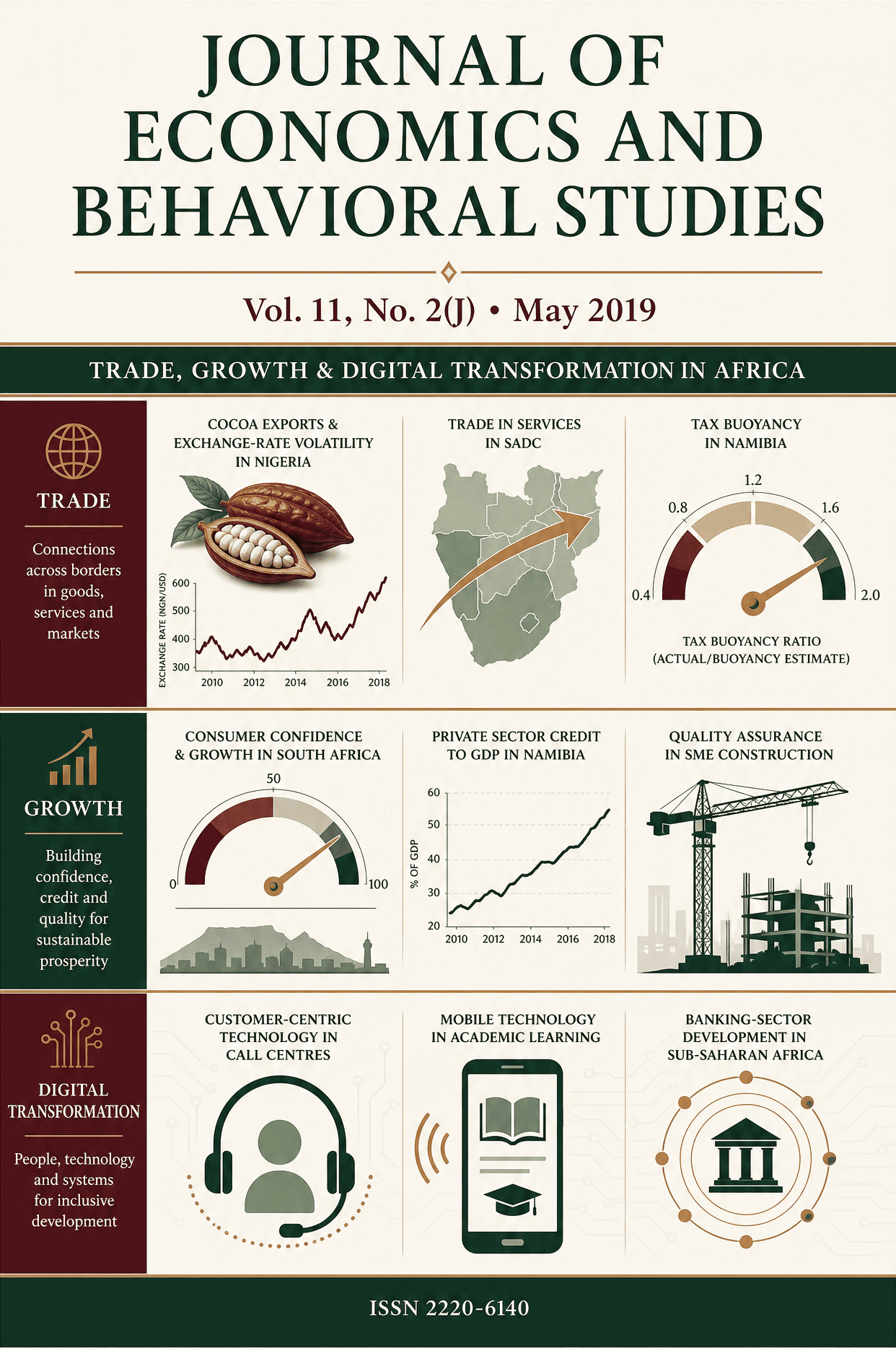
    Export Function of Cocoa Production, Exchange Rate Volatility and Prices in Nigeria

    • Author: Alaba David Alori, Adebayo Augustine Kutu

    This study examined the export function of cocoa production and determined the impact of exchange rates and price volatility on the exportation of cocoa in Nigeria. The Phillips-Perron (PP) and Augmented Dickey-Fuller (ADF) unit root tests, Ordinary Least Square (OLS) and Structural Vector Autoregressive (SVAR) methodologies were employed to analyse the time series data that spanning from 1970:01 to 2016:12. The PP and ADF unit root tests findings indicated that none of the variables was stationary at levels (I (0)) however, after the first difference I (1) they became stationary. At 5%, the OLS results showed that all the variables were statistically significant in analysing the effects of exchange rates and price volatility on the value of cocoa production in Nigeria. The price of cocoa in the international market and the value of exchange rates play a significant role in cocoa exports growth in Nigeria. Further, findings from the SVAR showed that an increase in the price of cocoa would increase cocoa production and cocoa export growth in Nigeria, while the exchange rate volatility would affect cocoa export growth in Nigeria. The result further revealed that the shocks to exchange rate accounted for the greater volatility (positively significant for the entire period) to the value of cocoa exported, as against other variables in the model. Based on those findings, the paper, therefore, recommends that there should be a free exchange rate market determination, in order to enhance the export growth and increase cocoa output in Nigeria.

    Pages 1-14

    PDF - Export Function of Cocoa Production, Exchange Rate Volatility and Prices in Nigeria (opens in a new tab)
  • Article 2 in this issue

    The Nexus between Consumer Confidence and Economic Growth in South Africa: An ARDL Bounds Testing Approach

    • Author: Khayelihle Madlopha

    Consumption expenditure contributed a total of 2.2% to economic growth in 2017. Hence, the South African economy is consumption driven. Therefore, there is a need to understand the growth-economic confidence relationship within the South African context. In this spirit, this paper set to explore the short- and long-run relationship between consumer confidence and economic growth in South Africa for the sample period 1994Q1 to 2017Q4. The method applied, chiefly because our variables were I (0) and I (1) and that we sought short- and long-run estimates were the Autoregressive Distributed Lag (ARDL) model using the bounds testing procedure. The results showed that consumer confidence contributed about 0.025% to economic growth in the short-run, and about 0.4% in the long-run. The results suggest that boosting consumer confidence should be keys for South African policy-makers to boost growth in the short- and longrun. In particular, we recommend policy certainty and political stability as some of the ways to attract consumer confidence.

    Pages 15-22

    PDF - The Nexus between Consumer Confidence and Economic Growth in South Africa: An ARDL Bounds Testing Approach (opens in a new tab)
  • Article 3 in this issue

    Examining the Causal Relationship between Private Sector Credit Extended and Economic Growth in Namibia

    • Author: Andreas, J P S Sheefeni

    The paper examined causality between Private Sector Credit Extension (PSCE) and Economic growth using quarterly data for the period 2000:Q1-2017:Q4, in Namibia. The variables employed were Gross Domestic Product (GDP), Private Sector Credit Extended, Broad Money Supply (M2) and lending rates. The study tested for stationarity in order to determine the order of integration. Furthermore, a co-integration test was conducted on different sets of variables to establish the long run relationship. Granger causality test was also conducted to establish the direction of the relationships between the variables. The results for the stationarity test showed a combination of different orders of integration. The co-integration test revealed a stable long-run relationship among the variables. The Granger causality test results revealed one-directional causality running from PSCE to GDP. Therefore, one can conclude that that change in private sector credit extended can help predict economic growth.

    Pages 23-29

    PDF - Examining the Causal Relationship between Private Sector Credit Extended and Economic Growth in Namibia (opens in a new tab)
  • Article 4 in this issue

    Significant Factors Influencing Quality Assurance Practices in Small and Medium-Sized Construction Projects in South Africa

    • Author: Kgashane Stephen Nyakala, Thinandavha Thomas Munyai, Jan-Harm Pretorius, Andre Vermeulen

    Although implementing quality assurance (QA) processes in construction play an important role in the South African economy has been acknowledged. However, constructions SMEs are faced with difficulties in improving rural road infrastructure and high-quality roads. Additionally, past research has failed to reach consensus on the construction process and socioeconomic settings in previously disadvantaged areas in South Africa, including the factors influencing negatively the performance of such factors. This research examines what factors facilitate or inhibit the success of construction SMEs and what actions can be taken to being distressed construction SMEs under control. The study adopted a quantitative research approach in which a three-section questionnaire was administered to 160 purposively chosen road- building experts in a South African construction SMEs. The questionnaire was structured into three parts, which sought the participants’ profile, identified the quality assurance practices (QAPs) incorporated in the construction SMEs’ road building programmes, and identified the factors that negatively influence the implementation of QA processes. Data was analysed using the Statistical Package for the Social Sciences (SPSS) version 22. Furthermore, to determine the reliability of the various constructs, mean scores, descriptive statistics and standard deviations were obtained. The empirical findings established eight QAPs that were reliable and valid for implementation processes that can control or minimise their causes of poor quality in projects undertaken by construction SMEs, level of skill acquisition; project planning and control techniques; project construction design; process implementation and process improvement; financial management; organisational structures; involvement of people; and quality standards and measurements. The eight factors attained high Cronbach Alpha values above the recommended 0.70 which indicates high internal consistencies among the sub-scales. Findings from this study should be useful to managers in similar environments may use the results of this study as either diagnostic tools or as a reference benchmark for strategic interventions in solving construction projects related problems. Furthermore, the researchers also recommend that these practices are for quality assurance in construction projects undertaken by SMEs in South Africa.

    Pages 30-44

    PDF - Significant Factors Influencing Quality Assurance Practices in Small and Medium-Sized Construction Projects in South Africa (opens in a new tab)
  • Article 5 in this issue

    An Assessment of the Employee Job Satisfaction: Views from Empirical Perspectives

    • Author: Albert Tchey Agbenyegah

    Job satisfaction stresses on the personal feelings within the job environment in relation to job assessment. Various academics and scientists studied in the past, the significant association between personal expectations and job satisfaction of employees. These past studies were based on the model of personality traits and other variables in determination of employee job satisfaction. This study is to assess the relationship and effect between independent and dependent variables. To ensure that the stated objectives are met, a 7 point Likert scale questionnaires were administered to 140 managers and non-manager employees. However, only 128 of the questionnaires were returned without errors and ready to go through the analysis processes. Data analysis was conducted in two phases namely the descriptive and inferential statistics. Descriptive analysis aided by the mean counts was applied in describing the empirical data; whereas the inferential statistics of Pearson’s chi-square test and ANOVA were utilized to determine the relationship and the effect of independent on the dependent variable. ANOVA was used to assess the effect of independent variables on the dependent variable. This empirical study demonstrates mix results through Pearson’s chi-square and ANOVA tests. WEP and employee status does not differ from EJS whereas employee position differs from EJS. The ANOVA test revealed a significant effect of WEP and EPS on EJS. The study revealed that SME owners in FB district municipality experienced very high entrepreneurial challenges in contrast to their counterparts in JTG district municipality. Given these findings, the author called on policymakers to prepare specific strategies and programs that motivate employees within the establishment.

    Pages 45-57

    PDF - An Assessment of the Employee Job Satisfaction: Views from Empirical Perspectives (opens in a new tab)
  • Article 6 in this issue

    Trade in Services-Economic Growth Nexus: An Analysis of the Growth Impact of Trade in Services in SADC Countries

    • Author: Alexander Maune

    The article analysed the trade in services led growth in ten selected countries in the Southern African Development Community region using econometric regression models. Panel data obtained from the World Bank and United Nations Conference on Trade and Development databases for the period 1992 to 2015 was analysed. Five variables were used in the econometric analysis. The marginal effects of service and goods exports were positive while those of goods and service imports were negative and highly significant as was expected from literature. Service exports registered an impact that was almost threefold that of service imports and greater than goods exports. Policy-makers are encouraged to, clearly define their trade in service strategy and reduce or remove trade restrictions. The study is of importance to researchers, the private sector and government policymakers.

    Pages 58-78

    PDF - Trade in Services-Economic Growth Nexus: An Analysis of the Growth Impact of Trade in Services in SADC Countries (opens in a new tab)
  • Article 7 in this issue

    Enhanced Customer Interactions through Customer-Centric Technology within a Call Centre

    • Author: Devina Oodith

    Customer call centres have become a critical form of service delivery for many organisations hence technological innovations serve as a critical point of contact between the organisation and its customers and can assist in raising the stakes in businesses in terms of customer service delivery (Burgess & Connell, 2004). According to the 2017 Global Customer Experience Benchmarking Report technology has been the number one enabler to positively enhance customer service experience in the last 5 years (Business Tech, 2017). Customers have become so empowered that they expect to have flexibility to contact a business however they choose; either via a telephone, email or Facebook. The key to ensuring satisfaction though is system’s efficiency and ease of use. This study was undertaken in EThekwini (Durban), South Africa and was directed within a Public Sector service environment comprising of four major call centres employing a total of 240 call centre agents. Using simple random sampling, 220 customers were drawn from all consumers subscribing to e-billing in EThekwini (Durban). Data for the customer sample was collected using a precoded, self-developed questionnaire whose psychometric properties were statistically determined. Data was analyzed using descriptive and inferential statistics. The results specify that in terms of customers’ perceptions of the influence of technology, on call centre effectiveness the majority of the customers found it challenging to use the technology and to understand the self-help options that were provided to them by the call centre. There were problems encountered with logging in customer queries and complaints and most customers were dissatisfied with their overall customer experience. Based on the results of the study recommendations have been made to manage the interactions between the customers and call centre’s more proficiently and powerfully.

    Pages 79-91

    PDF - Enhanced Customer Interactions through Customer-Centric Technology within a Call Centre (opens in a new tab)
  • Article 8 in this issue

    Mobile Technology as a Learning Tool in the Academic Environment

    • Author: Sidwell Sabelo Nkosi, Rosemary Sibanda, Ankit Katrodia

    Education in South Africa is not equally accessible, and the quality of education is not the same across all educational institutions. Students from low-income societies are scoring lower marks in contrast to students from higher income societies. The influence on this is the unavailability of efficient educational resources and infrastructure. This study uses a focus group of 300 students from the University of KwaZulu-Natal (UKZN) School of Economics. It attempts to examine and explain the effect of the use of mobile technology in academic activities within the school of economics at UKZN. The study divides the sample size into two groups, half is given mobile technology and the remaining group is deprived of mobile technology. The data is recorded in two educational production functions, namely Ordinary Least Squares and Logistic Regression Model. The cumulative distribution function examines the probability, in form of Logit, that a student passes economic if using mobile technology for academic activities or studying. Study findings indicate that it is imperative that institutions invest in mobile technology as their learning tool to improve throughput rate and it allows efficiency in all academic activities. Mobile technology enables students to be disciplined, effective and work ready.

    Pages 92-102

    PDF - Mobile Technology as a Learning Tool in the Academic Environment (opens in a new tab)
  • Article 9 in this issue

    Effects of Public Expenditure on Gross Domestic Product in Zambia from 1980-2017: An ARDL Methodology Approach

    • Author: Mubanga Mpundu, Jane Mwafulirwa, Mutinta Chaampita, Notulu Salwindi

    The paper explored the fundamental changes in public expenditure and the resulting effect on the gross domestic product using an ARDL approach for time series data over the period 1980-2017. The control variables included foreign direct investment and current account balance. The objective was to determine changes which had occurred with regard to the performance of GDP since 1980. A quantitative method approach was used to ascertain the relationship between the variables and analysed using the E-views 9 software. Cointegration results showed a long run relationship between GDP and government expenditure. In this regard, changes in government expenditure have a strong converse effect on GDP. Government expenditure, which has increased significantly in the past decade, is seen to have had negative effects both in the short run and long run. Contrary to theory, increased government expenditure may not be ideal for growing the Zambian economy. This could be due to the allocation of this public expenditure, i.e. the 2018 Budget had 24% of the expenditure directed to economic activities. Thus it is recommended that government practice increased fiscal discipline or reallocated resources as their expansionary fiscal policies are not yielding the intended results. Additionally, policies to promote private investment may be more beneficial for the Zambian economy. On the other hand, increased investment is also recommended with government encouraging more investment promoting policies as FDI is observed to have a positive impact in the short run though insignificant in the long run. These should ensure more investors are encouraged to stay longer and the impacts/externalities of their investments be accrued to the nationals to ensure long run benefits. The Zambian government should also ensure that the country diversifies its export base and enhances its external debt management to ensure positive and consistent impact of Current Account Balance in the long run.

    Pages 103-111

    PDF - Effects of Public Expenditure on Gross Domestic Product in Zambia from 1980-2017: An ARDL Methodology Approach (opens in a new tab)
  • Article 10 in this issue

    Revenue Productivity of the Tax System in Namibia: Tax Buoyancy Estimation Approach

    • Author: J P S Sheefeni, A Shikongo, O Kakujaha-Matundu, T Kaulihowa

    Buoyancy refers to how tax revenue responds to a gross domestic product without correcting for discretionary alterations in the tax system. The paper assessed the buoyancy of Namibia’s overall tax system in an attempt to measure the response of the tax system in entirety because of fluctuations in the national income and/or the deliberate act by the government to increase tax rate, reviewed tax code and tax machinery etc. The study employed the Engle-Granger approach to the error correction model to estimate the tax buoyancy for the period 2001 to 2014. The empirical findings from the study revealed that overall the Namibian tax system is income inelastic and not buoyant. This is confirmed by a low and negative value of 0.036 which is less than unit. Thus, the economy is not generating sufficient revenue both through discretionary tax measure and through the expansion in the economic activities. Therefore, the government need to introduce measures that will allow for more tax revenue collection to have a stable revenue base. This also means the government need to keep track of tax mobilization with growth in the gross domestic product as well as to ascertain taxes that are productive.

    Pages 112-119

    PDF - Revenue Productivity of the Tax System in Namibia: Tax Buoyancy Estimation Approach (opens in a new tab)