Articles

  • Article 1 in this issue

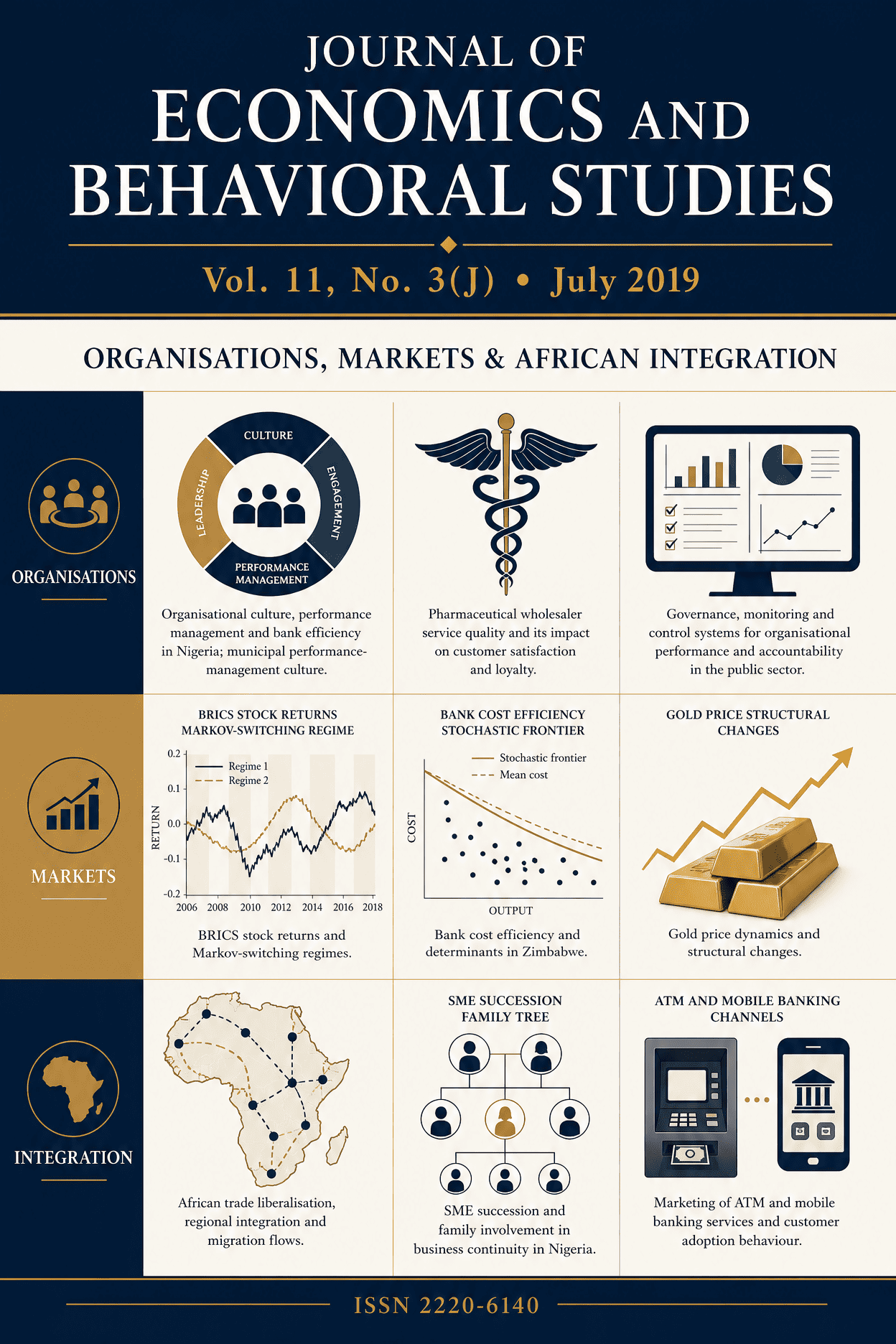
    Organizational Cultural Practices and Employee Efficiency among Selected Nigerian Commercial Banks

    • Author: Lawal Ibrahim Olanrewaju, Thea Van Der Westhuizen, Olusegun Matthew Awotunde

    The study examined the relationship between organizational culture and employee efficiency among commercial banks in Nigeria. Primary data was gathered by means of a self administered questionnaire. to select 223 respondents using simple random sampling technique, and out of which 218 were retrieved. the Statistical Package for the Social Sciences (SPSSS) was adopted to analyze collected data. The findings revealed that organizational processes and structures were significant predictors of employee efficiency. As a result, the staff’s familiarity with the organizational processes and structure, their efficiency levels. Arising from these findings, it is recommended that all bank employees should become familiar with and committed to the corporate culture. Appropriate incentives should be offered to employees. These should not be restricted to monetary rewards, but should include recognition of their performance and present opportunities to achieve individual goals and aspirations. Finally, both managers and employees should receive training to enhance efficiency.

    Pages 1-9

    PDF - Organizational Cultural Practices and Employee Efficiency among Selected Nigerian Commercial Banks (opens in a new tab)
  • Article 2 in this issue

    Modeling Stock Market Returns of BRICS with a Markov-Switching Dynamic Regression Model

    • Author: Diteboho Xaba, Ntebogang Dinah Moroke, Ishmael Rapoo

    This article adopted a Markov-switching dynamic regression (MS-DR) model to estimate appropriate models for BRICS countries. The preliminary analysis was done using data from 01/1997 to 01/2017 and to study the movement of 5 stock market returns series. The study further determined if stock market returns exhibit nonlinear relationship or not. The purpose of the study is to measure the switch in returns between two regimes for the five stock market returns, and, secondly, to measure the duration of each regime for all the stock market returns under examination. The results proved the MS-DR model to be useful, with the best fit, to evaluate the characteristics of BRICS countries.

    Pages 10-22

    PDF - Modeling Stock Market Returns of BRICS with a Markov-Switching Dynamic Regression Model (opens in a new tab)
  • Article 3 in this issue

    A Model to Measure the Service Quality of Pharmaceutical Wholesalers

    • Author: Christo A Bisschoff, Heinrich C Barnard

    The study constituters a model to measure the service quality of pharmaceutical wholesalers in South Africa. Several pharmaceutical wholesalers distribute medical supplies throughout South Africa in a very regulated and competitive market where high service quality levels are anticipated. In this priceundifferentiated market, service quality can have a significant impact on the competitiveness of a pharmaceutical wholesaler. As a result, the primary objective was to develop a model to measure the service quality levels of large pharmaceutical wholesalers. The literature study compiled an industry profile of the South African pharmaceutical market, analysed service quality and then proposed an adapted SERVQUAL model to measure the service quality. A review of the literature also highlighted the general structure of the pharmaceutical industry and the regulatory framework in the supply of pharmaceutical products. The literature study also focuses specifically on the role and function of the pharmaceutical wholesaler in the supply chain. Data was collected from clients of a pharmaceutical wholesaler using to record the service expectations and perceptions on a seven-point Likert scale. Some 385 of the 4468 clients completed and returned the industry-adapted SERVQUAL survey questionnaires on the electronic platform Google Forms (signifying an 8.6% response rate). The results showed that the data were reliable with a Cronbach alpha coefficient higher than 0.70. The results also show that in five, the service dimensions gap where perceptions and expectations are measured had negative gaps. This means that the clients expected better service quality than what they received. The service dimension Assurance showed the largest gap, while Tangibility had the smallest gap. However, none of these gaps was practically significant. Further analysis using exploratory factor analysis identified three underlying service quality variables, namely Positive employee actions, Business process management and Marketing channels. These factors explained a favourable cumulative variance of 67.7%. The study finally proposes a model to measure service quality in the pharmaceutical wholesale industry.

    Pages 23-38

    PDF - A Model to Measure the Service Quality of Pharmaceutical Wholesalers (opens in a new tab)
  • Article 4 in this issue

    African Big Economies on the Continental Trade Liberalisation and Migration Policy Development

    • Author: Andrew Osehi Enaifoghe, Harris Maduku

    African countries are faced with a broad spectrum of political and economic challenges that have shadowed hugely in an anticipated socio-economic prosperity. The continent overtime has resolved to come up with a single currency as well as opening borders for trade but none of that has been realised. Polarisation of economic development has caused brain drain within the continent with educated people from poorly governed countries moving across borders (Europe and America), and the same happens with gifted entrepreneurs who search for a country with a better business enabling environment than their own home countries. There is uneven development in Africa with very poor, fragile and better performing countries constituting the continent. This has caused a huge burden on those economies that are doing well as those economies have to create jobs for immigrants as well and for their own people. However, the founding principles of the African Union were basically to bring African countries together and help each other to see through economic and political prosperity across the continent in as much as there are laid out guiding rules. Africa has continued to be a highly protective continent especially amongst itself as most countries still require visas from citizens of other African countries, while countries still impose import duties and all forms of control on imports and practices that are against the foresights of the founding principles of the African Union. This paper acknowledges the efforts that have been done in the West and South of Africa for the formation of regional blocks that desire to achieve socio-economic progress in those regions. The formation of ECOWAS in the WEST and SADC in the South are good strides towards integration efforts in Africa but if the founding objectives of the African Union are to be achieved, member countries still have to do more. This paper recommends the two biggest countries in Africa to make use of their economic power to influence smaller member states to also envision possible socio-economic benefits that can emanate from total integration of the continent. They could make use of the African parliament, African Union summits and other several platforms to lobby for this important goal.

    Pages 39-47

    PDF - African Big Economies on the Continental Trade Liberalisation and Migration Policy Development (opens in a new tab)
  • Article 5 in this issue

    Evaluating Bank Cost Efficiency Using Stochastic Frontier Analysis

    • Author: Sanderson Abel, Alex Bara, Pierre Le Roux

    The study seeks to assess the cost efficiency of the commercial banks in Zimbabwe using the stochastic frontier analysis. The cost efficiency of the Zimbabwean banks is estimated using the trans-log stochastic frontier approach. The Stochastic Frontier Analysis methodology is among the host of methods that has been used to measure banking sector efficiency. The analysis of cost efficiency of commercial banks has important implications for the economy since an efficient banking system has potential to reduce interest rates which can lead to increased investment and growth for the economy. The cost of doing business in Zimbabwe is perceived to be high hence improved bank efficiency has the potential to reduce the cost of doing business. The average cost efficiency scores for the Zimbabwean banks over the study period show that the banking sector in Zimbabwe experiencing 17 percent inefficiency. The efficiency levels have been declining over the years reflecting increased resource wastage in the system. The study recommends that the banking institutions should continue to innovate so as to reduce their inefficiencies.

    Pages 48-57

    PDF - Evaluating Bank Cost Efficiency Using Stochastic Frontier Analysis (opens in a new tab)
  • Article 6 in this issue

    A Comparative Study of Rural Entrepreneurial Challenges: Towards Rural Economic Development and a Policy Framework

    • Author: Albert Tchey Agbenyegah

    The primary purpose of this rural study was to compare the challenges that impede successful operations of entrepreneurial activities and small businesses. Through quantitative design, a seven-point Likert-scale questionnaire was utilized to gather primary data. Two sampling techniques, namely simple random and purposive, were applied to select the research participants. Based on a Likert spectrum, 267 questionnaires were administered to SME owners by the researcher, assisted by two research trainees. These questionnaires were ranked from (1) strongly disagree to (7) strongly agree. Two main questions, which provided guidance to this study, were certified reliable by the Cronbach alpha coefficient of 0.768 and 0.976. Data analysis was possible through the descriptive and inferential tools supported by the independent t-test, Pearson’s chi-square test, and cross-tabulation. The final outcomes demonstrate higher levels of challenges in the Frances Baard (FB) District than in the John Taolo Gaetsewe (JTG) District. This implies that ownermanagers of small businesses in the FB District experienced more challenges in operating their businesses. The study recommends SME Policy Framework (SPF) training and intensifying the existing processes of monitoring after training to justify the owner-managers’ moral commitments.

    Pages 58-71

    PDF - A Comparative Study of Rural Entrepreneurial Challenges: Towards Rural Economic Development and a Policy Framework (opens in a new tab)
  • Article 7 in this issue

    Structural Changes of the 21st Century and their Impact on the Gold Price

    • Author: Roman Grynberg, Teresa Kaulihowa, Fwasa K Singogo

    Beginning in the trough of 2000 and culminating in the peak of 2012, gold prices have exhibited a spectacular and unparalleled increase. Based on annual averages, the price of gold did not decrease at all over this 12 year period. The paper considers the various factors that have shaped the surge of gold spot prices over the last two decades using quarterly data. The analysis considers the role of structural changes such as China’s liberalization of the domestic gold market post-2003 and its impact on demand as well as other important economic factors such as risk, the role of quantitative easing and other fundamental factors in the gold market. The study investigates which of the macroeconomic and structural factors are responsible for the long term bullish trend in the gold price, of which China, global economic risk assessments along with quantitative easing have been crucial to understanding the almost uninterrupted price increase over the period.

    Pages 72-83

    PDF - Structural Changes of the 21st Century and their Impact on the Gold Price (opens in a new tab)
  • Article 8 in this issue

    Evaluation of Owners’ Characteristics and Succession Practice among Small and Medium Size Manufacturing Enterprises in Ekiti State, Nigeria

    • Author: Ezekiel Jide, Fayomi, Ziska Fields, Kayode Kingsley, Arogundade, Olusegun, Matthew, Awotunde, Olubunmi Christianah, Ijamusan, Temitope Teniola, Onileowo

    This study evaluated owners’ characteristics and succession practice among manufacturing Small and Medium Enterprises (SMEs) in Ekiti State, Nigeria. It assessed the correlation between achieved characteristics (educational level and experience) of owners of manufacturing enterprises and choice of succession practice; and the extent to which owners’ situational characteristics (health, spouse, children’s readiness) influenced the choice of succession practice. The study employed descriptive design and the population comprised of 136 founders and succeeding owners of registered manufacturing SMEs in Ekiti State. To obtain a sample of 100 participants, stratified sampling techniques were used and Descriptive statistics were also used to profile the respondent’s demography. Pearson Product Moment Correlation (PPMC) was employed to determine the association between the demographic and achieved characteristics of owners and succession practice. While multiple regressions were used to analyze learnable and situational characteristics and succession practice the study’s findings revealed that owners’ characteristics, expressed as: demographic characteristics, being female (r=0.315, p=0.012); achieved characteristics, higher education (r=0.300. p=0.017) and average experience (r=0.272, p=0.031); learnable characteristics, need for achievement (β=0.334, p=0.007) and leadership (β=0.288,p=0.035); and situational characteristics of wife (β=-0.256,p=0.04) and children (β=0.284, p=0.018), were significant variables that influenced succession practice among SMEs’ owners. It concluded that practice and belief in succession practices among SMEs owners is strongly influenced by education, experience, and the desire to leave a legacy. Recommendations include that government should encourage graduates to establish SMEs and managers should strive for organized and dependable families and train their children, to ensure successful succession.

    Pages 84-96

    PDF - Evaluation of Owners’ Characteristics and Succession Practice among Small and Medium Size Manufacturing Enterprises in Ekiti State, Nigeria (opens in a new tab)
  • Article 9 in this issue

    Fostering a Culture of Performance Management in Municipalities: Perceptions of Municipal M & E Practitioners in Kwazulu Natal

    • Author: Paul Kariuki, Purshottama Reddy

    Creating a culture that considers monitoring and evaluation as an essential tool for performance improvement is not an easy task. Some employees are likely to resist due to a lack of awareness of the value of monitoring and evaluation while others could do so due to fear of the accountability and transparency implicit in the implementation of such a system. Nonetheless, it is imperative that performance management is prioritised in municipal development interventions. This article is based on a doctoral study that used qualitative participatory research techniques to gather data from evaluation practitioners’ municipalities in KwaZulu-Natal. It presents these practitioners’ perspectives on fostering a culture of performance management in local government. The article expounds on their lived experiences that reflect on how performance management could facilitate an effective monitoring and evaluation culture within this sector. The study found that monitoring and evaluation practitioners were sloppy towards their responsibilities and this contributed to poor tracking of the impact of municipal interventions, thereby compromising their abilities to fulfil their constitutional mandates. Furthermore, the study found that there is no political will to enforce performance in most municipalities. The implication of this study is that a culture of performance management must be enforced by government as a critical institutional norm towards achieving accountable, effective, efficient and responsive developmental local government. Municipalities must harness the necessary political will for this to become a reality in municipalities towards promoting good governance in local government supported by a culture of performance.

    Pages 97-107

    PDF - Fostering a Culture of Performance Management in Municipalities: Perceptions of Municipal M & E Practitioners in Kwazulu Natal (opens in a new tab)
  • Article 10 in this issue

    Assessment of Bank Technology Machine and Mobile Banking as Market Strategies to Raising Performance of Banks in Nigeria

    • Author: Anthony O. Adaramola, Funso T. Kolapo

    The market challenge in form of increasing competition for success in the banking sector calls for market strategies that are customer- based towards raising the performance of Nigerian banks. The use by banks, of Automated Teller Machines and Mobile banking are at the centre stage of this market strategy. Existing knowledge on this aspect of marketing is inadequate. This study assessed the empirical effects of Automated Teller Machine and Mobile banking as marketing tools on return on equity of banks in Nigeria. Both primary and secondary data were used in the study. The data were fitted to Panel regression models of Fixed and Random effects. Findings support increasing distribution of Teller machines and raising awareness on Mobile banking as result-oriented marketing strategy for banks.

    Pages 108-115

    PDF - Assessment of Bank Technology Machine and Mobile Banking as Market Strategies to Raising Performance of Banks in Nigeria (opens in a new tab)