Articles

  • Article 1 in this issue

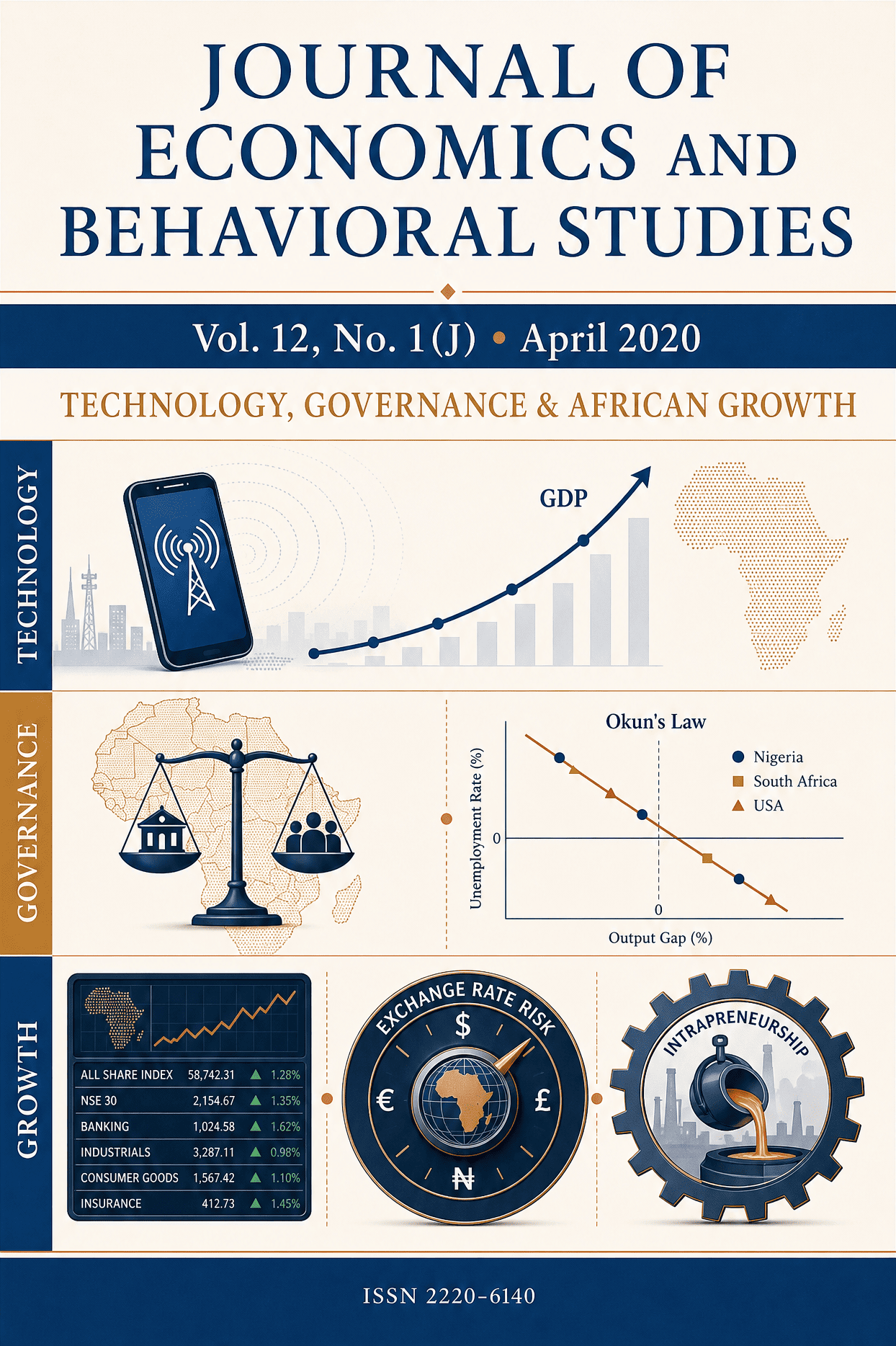
    The Exchange Rate Risk and Financial Sector Performance: Evidence from Nigeria

    • Author: KOLAPO T. Funso, Naheem Abiola Lawal

    This article looked at the connection between exchange rate risk and financial sector performance in Nigeria using time series data from 2008Q1 to 20017Q4. The study employed Autoregressive Conditional Heteroskedasticity (ARCH), and Granger Causality tests as estimation techniques. Financial intermediation index was used as the dependent variable while risk from exchange rate, risk from consumer price index and risk from interest rate were used as the independent variables. The findings from the study showed that exchange rate risk (EXR) coefficient value was -0.276230 with p-value of 0.0000, implying that EXR was negative and significant to influence FII. The risk from financial intermediation index reveals a coefficient value of -5.213590 and the p-value of 0.000 implying that when financial intermediation index increases, volatility or risk reduces which means that financial intermediation index was not a risky variable which was significant during the study period. However, the study concluded that the shock from exchange rate moves at a negative and significant direction to financial intermediation index of the economy. It is also concluded that exchange rate and financial intermediation index does not have uni or bi-directional relationships between each other. It is recommended that the Government and the Apex Bank of Nigeria are encouraged to increase the stabilization measurement for exchange rate to cushion its risk and by so doing; this could improve financial sector performance.

    Pages 1-6

    PDF - The Exchange Rate Risk and Financial Sector Performance: Evidence from Nigeria (opens in a new tab)
  • Article 2 in this issue

    The Effects of Wireless Mobile Phone Technology on Economic Growth in Nigeria

    • Author: Onochie Jude Dieli, Mika Kato, Solomon Osho, Oluwagbemiga Ojumu

    This research studies the effects of wireless mobile phone technology on economic growth in Nigeria. Nigeria is made up of 37 states including the capital territory. The phone ownership and subscription rate per state increased with the availability of wireless mobile phone technology. After deregulation of telecom industry, wireless technology has become widely available, e.g., cellular phone ownership rate per state rose to approximately 80 percent of the population in 2015. This study shows that the availability of wireless mobile phone technology helps to reduce the cost of learning and implementing world technology frontier and thus that it promotes smoother transfer of technology from technologically-advanced countries to Nigeria and brings significant growth in the economy Using the industry-level (NAICS) and the state-level (37) data in two respective econometric models, the study finds that the availability of wireless technology increased transfer of technology measured by the volume of imports and spurred growth in Nigeria. Moreover, it finds that the benefit of the wireless technology is greater for lower income groups and thus the technology helped to reduce distributional inequality of economic benefit.

    Pages 7-21

    PDF - The Effects of Wireless Mobile Phone Technology on Economic Growth in Nigeria (opens in a new tab)
  • Article 3 in this issue

    The Role of Intrapreneurship on the Growth of Iron and Steel Manufacturing Companies in Bulawayo, Zimbabwe

    • Author: Alex Madzikova, Gwendoline Vusumuzi Nani

    This study sought to find out the role of intrapreneurship on the growth of iron and steel manufacturing companies in Bulawayo, Zimbabwe. A post-positivist paradigm, a mixed method approach and a cross sectional design were adopted for the investigation. Three hundred and fifteen (315) middle management and supervisory staff drawn from twenty-two (22) iron and steel manufacturing companies in Bulawayo participated. Multiple stratified random sampling and heterogeneous purposive sampling were used to choose two hundred (200) respondents for the quantitative study and eight participants for the qualitative study respectively. Questionnaires and in-depth interviews were the data collecting instruments for quantitative and qualitative data respectively. Quantitative data was analysed using descriptive and inferential statistics and qualitative data was thematically analysed. Findings revealed that innovativeness, proactiveness, and risk taking were the key dimensions of intrapreneurship. Both quantitative and qualitative analyses showed the prominent measures of company growth in the iron and steel manufacturing companies as financial, employee numbers, productivity, and product range. Statistically intrapreneurship was found to be correlated to the growth of the iron and steel manufacturing companies. The study drew the following conclusions. Firstly, intrapreneurship is not a preferred strategy for driving growth in the iron and steel manufacturing companies in Bulawayo. Secondly, financial and product range were identified as the key measures of company growth. Thirdly, company support for intrapreneurship and individual’s intrapreneurial disposition were statistically linked to company growth. The study recommended that companies should motivate and support employees’ innovativeness, proactiveness, and risk taking through ideas, actions and work. Measurement of company growth should be expanded to include qualitative measures.

    Pages 22-37

    PDF - The Role of Intrapreneurship on the Growth of Iron and Steel Manufacturing Companies in Bulawayo, Zimbabwe (opens in a new tab)
  • Article 4 in this issue

    Political Interference in the Administration of Service Delivery in UMLALAZI Local Municipality of KwaZulu-Natal, South Africa

    • Author: Sengiwakhile Mngomezulu

    South African political interference in the administration of service delivery is a serious problem in many municipalities, where municipalities are experiencing serious challenges on how to deal with the interface between politicians and officials. Inappropriate political interference in administrative matters as well as strained relations between key political and administrative officials in the municipalities appears to be the order of the day. To understand the impact or consequences of political interference in the administration of service delivery, a case approach was adopted to evaluate the political interference in the administration of service delivery in uMlalazi Local Municipality of Kwazulu-Natal, South Africa. Participants comprises of Municipal Officials in the administrative side of the municipality, members of Ward Committee as well as other political parties expect the political party in power. The literature seeks to review the political-administrative interface, South African local government service delivery, conflation of legislative and executive roles of local government, reflection on local government performance and the critical issue of poor service delivery in South Africa.

    Pages 38-45

    PDF - Political Interference in the Administration of Service Delivery in UMLALAZI Local Municipality of KwaZulu-Natal, South Africa (opens in a new tab)
  • Article 5 in this issue

    The Development of Financial Markets in Africa: Trends, Challenges and Prospects

    • Author: Misheck Mutize, Ejigayhu Tefera, McBride Nkhalamba

    This paper explores trends and challenges in the development of African financial markets over the past two decades. Access to capital is essential for government to finance its budget and the performance of government policies is in part evaluated through how financial asset prices respond to the policy choices. Erratic security issuance, thin trading, low turnover ratios and lack of market depth has characterised African financial markets as inefficient. Applying a descriptive research model on key data from international think tanks to observe the behaviour of financial markets data in African countries, the study finds that African financial markets still face the traditional challenge of lack of market depth relative to other regions in other continents due to their limit size and very low market capitalisation. This is a key factor holding back the ability of investors to exploit expansion opportunities. This paper recommends that, part of the solution to challenges faced by African financial markets is for governments to assist in set-up electronic trading platforms, improve trading and settlement infrastructure.

    Pages 46-54

    PDF - The Development of Financial Markets in Africa: Trends, Challenges and Prospects (opens in a new tab)
  • Article 6 in this issue

    Economic Growth and Unemployment Nexus: Okun’s Two-Version Case for Nigeria, South Africa and United States of America

    • Author: ONAKOYA, Adegbemi Babatunde, SEYINGBO, Adedotun Victor

    Okun’s law in its original form was predicated on the experience in the United States of America. Some methodological refinements have been added based on studies conducted in other climes with varied results. This research investigated the applicability of this law in Nigeria, South Africa and the United States of America. The study conducted a comparative analysis of three of the versions of the law. The research employed Ordinary Least Squares method having validated it’s appropriateness with Dickey-Fuller and Philips-Perron tests. The result also showed that the dynamic version of the law was applicable in the three nations while the difference version was applicable only in Nigeria. This study also found that the dynamic version was superior to the difference version. Deployment of employment creative employment schemes, labour market reform and economic restructuring are recommended in the Nigerian case. The policy makers on South Africa and USA are enjoined to pursue both labour and growth-inducing policies.

    Pages 55-65

    PDF - Economic Growth and Unemployment Nexus: Okun’s Two-Version Case for Nigeria, South Africa and United States of America (opens in a new tab)