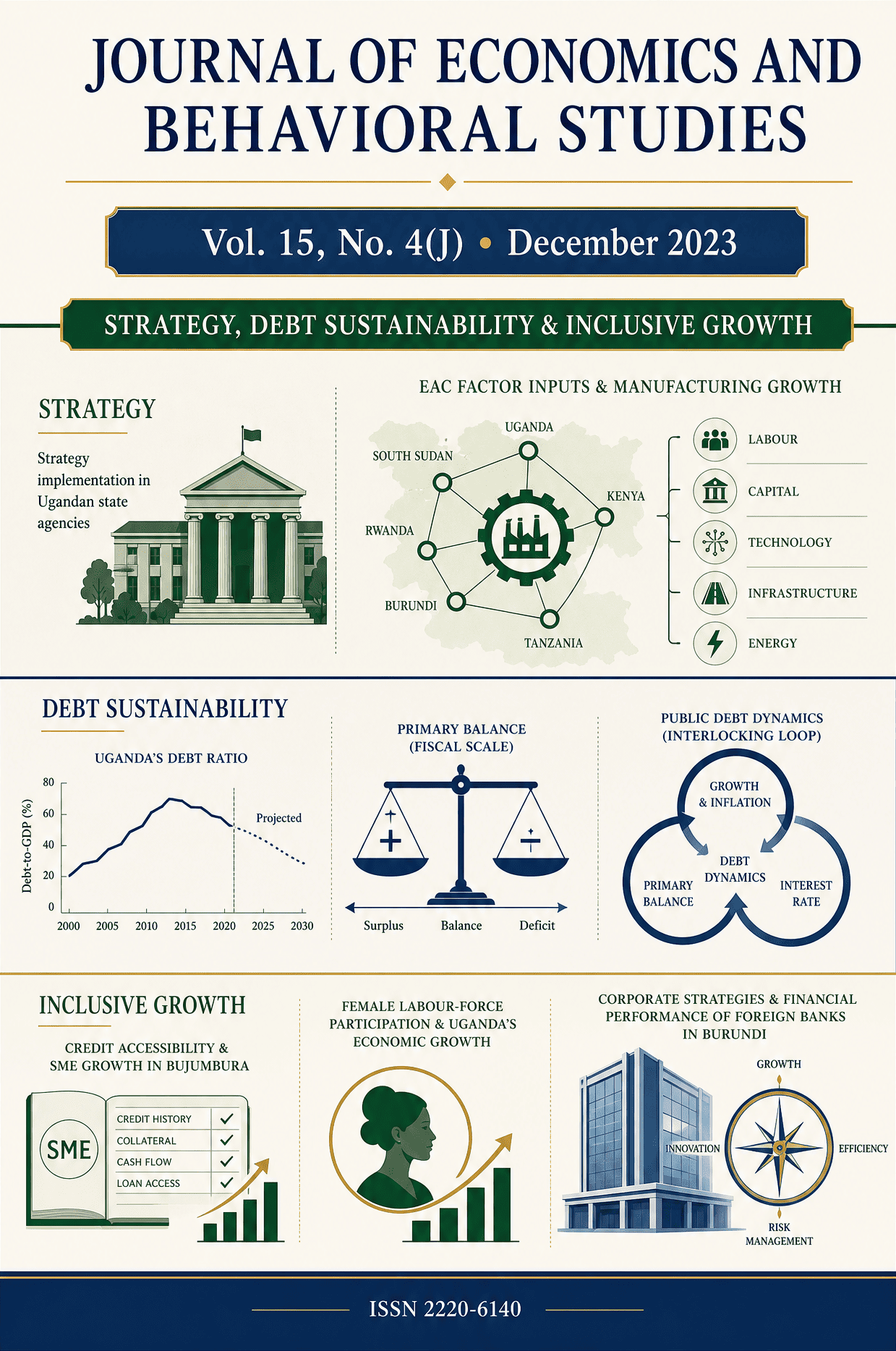
Articles

  • Article 1 in this issue

    Factor Inputs and the Growth of the Manufacturing Sector among the East African Community Member States: Testing the Efficacy of the Extended Neoclassical Growth Hypothesis

    • Author: Benjamin Musiita, Leward Jeke

    The study aims to examine the relationship between input factors and growth rates in the output of the manufacturing sector in the five East African Community (EAC) member states. The relatively small manufacturing sector's GDP contribution to the combined GDP of the EAC member nations is the driving force behind this inquiry. We evaluate the applicability of the 1992 Mankiw, Romer, and Weil neoclassical growth framework and its subsequent developments in this study. Using a linear dynamic panel model, we utilize this methodology to obtain estimations using the first difference generalized method of moments (D-GMM. The study's findings make it clear that the gross capital formation input component is essential for forecasting changes in the rate of expansion of the manufacturing sector's output. Conversely, the East African Community's member states' manufacturing sector output growth does not seem to be much impacted by variables such as adjusted population growth and human capital. Based on our research, the East African Community (EAC) member states' output fluctuations in the manufacturing sector may be partially explained by the neoclassical growth model and its expansions. This shows that the growth framework that has been chosen might not be thorough enough to provide a thorough assessment of the variables influencing the expansion of the manufacturing sector output in the EAC member nations. The findings of our study indicate that the manufacturing sector’s output growth in the EAC member states could be enhanced through the implementation of policies and programs that provide incentives for augmenting capital stocks. This can be accomplished by increasing investments from the domestic private sector as well as foreign direct investments.

    Pages 1-12

    PDF - Factor Inputs and the Growth of the Manufacturing Sector among the East African Community Member States: Testing the Efficacy of the Extended Neoclassical Growth Hypothesis (opens in a new tab)
  • Article 2 in this issue

    Credit Accessibility and Growth of Small and Medium Enterprises in Bujumbura, Burundi

    • Author: Bariko Delphin, Olawumi Dele Awolusi

    The purpose of this study was to investigate the effect of credit accessibility on the growth of small and medium enterprises in Bujumbura, Burundi. The study was guided by the following objectives: i) to determine the effect of creditworthiness to credit accessibility on the growth of SMEs in Bujumbura; ii) to establish the effect of business characteristics to credit accessibility on the growth of SMEs in Bujumbura, and iii) to examine the effect of information available to credit accessibility on the growth of SMEs in Bujumbura. The study employed a descriptive survey research design. The target population was 347 and the sample size determined using the Slovenes formula was 186, but 167 respondents participated successfully in the study. The research instrument was a questionnaire and data were analyzed using frequency and percentage tables, mean and standard deviations, and linear and multiple regression analyses. The study found that creditworthiness to access credit had a significant effect on the growth of SMEs (Adjusted R2 =0.059, p =0.001). In addition, the study revealed that business characteristics to access credit had a significant effect on the growth of SMEs (Adjusted R2 =0.242, p =0.000). Furthermore, the study revealed that information available to access credit had a significant effect on the growth of SMEs (Adjusted R2 =0.116, p =0.000). The study concluded that credit accessibility significantly affects the growth of SMEs. Thus, the study recommended that the owners of SMEs should strive to ensure that they have collateral security and proper documentation before they seek credit from financial institutions, SMEs should also form and register an association that is recognizable by law in Burundi. Likewise, the owners of SMEs should seek the support of professional auditors to audit their books of accounts at least every year.

    Pages 13-36

    PDF - Credit Accessibility and Growth of Small and Medium Enterprises in Bujumbura, Burundi (opens in a new tab)
  • Article 3 in this issue

    Uganda’s Debt Sustainability: Testing The Efficacy of Debt Overhang Theory

    • Author: Benjamin Musiita, Fredrick Nsambu Kijjambu, Asaph Kabuura Katarangi, Geoffrey Kahangane, Sheilla Akampwera

    The primary objective of this paper is to discern the impact of key economic variables, including primary balance, real interest rate, GDP growth rate, real effective exchange rate, and current account balance, on the long-term and short-term sustainability of the country's debt. Drawing on an array of econometric analyses within the Auto Regressive Distributed Lag framework, the study establishes that a fiscal surplus and sound management positively influence debt sustainability in the long run. However, it reveals that higher real interest rates pose challenges, leading to increased debt loads. While GDP growth's impact remains inconclusive, a fluctuating real effective exchange rate and the influence of the current account balance on debt dynamics emerge as crucial determinants. The study recommends a cautious fiscal approach, interest rate management, economic growth stimulation, exchange rate stability, and a focus on achieving and maintaining current account surpluses as pivotal strategies for ensuring Uganda's long-term debt sustainability. Nonetheless, the study acknowledges limitations related to sample size and endogeneity, encouraging further research to enhance generalizability and address potential omitted variables.

    Pages 37-54

    PDF - Uganda’s Debt Sustainability: Testing The Efficacy of Debt Overhang Theory (opens in a new tab)
  • Article 4 in this issue

    Female Labor Force Participation and Uganda’s Economic Growth

    • Author: John Paul Apire, Dickson Turyareeba, Moni Anthony Olyanga, Vincent Patsy Katutsi, Benjamin Musiita, Anthony Wamala

    This comprehensive study explores the impact of various female labor force participation indicators on Uganda's economic growth, encompassing participation rate, educational levels, and fertility rate while considering confounding factors like capital formation and inflation. Utilizing a quantitative approach and a causal relationship research design, the study employs the ARDL (3, 3, 1, 1, 1, 2) model on quarterly data from 1990 to 2021. Results reveal a significant adverse short-term causal impact of the female labor force participation rate on economic growth, with no such effect in the long term. The educational levels and fertility rate exhibit statistically insignificant impacts in both short and long terms. The findings suggest a prevailing trend of female labor contributing predominantly to labor-intensive agriculture and the informal economy, without a noticeable shift to more lucrative sectors over the long run. Additionally, the study underscores the potential for short-term economic growth through birth control measures and policies enhancing physical capital stocks, contributing to our understanding of Uganda's economic progress within the neoclassical and U-shape development frameworks.

    Pages 55-68

    PDF - Female Labor Force Participation and Uganda’s Economic Growth (opens in a new tab)
  • Article 5 in this issue

    The Impact of Strategy Implementation on the Performance of Ugandan State Agencies: A Quantitative Study

    • Author: Arthur Nuwagaba, Caren Angima, Lydia Kisekka Namateefu, Tom Mugizi

    This study examines how strategy implementation affects the performance of Ugandan state agencies. It conceptualizes strategy implementation as operationalization and institutionalization and measures performance by efficiency and effectiveness. This study used a cross-sectional design with a standardized questionnaire to interview 160 state agencies. Respondents included the CEO/Managing Director, Deputy/Assistant CEO, Corporation Secretary, and Heads of Department from each agency's top management team (TMT). Each agency had at least three TMT members participate in the online survey, which was chosen because of COVID-19 restrictions. The data analysis methods were factor, descriptive, and multilinear regression analyses. This study adhered to the ethical principles of informed consent, confidentiality, and anonymity. Ugandan state agencies perform better when implementing their strategies effectively. Statistical analysis reveals that institutionalization is a key driver of performance outcomes, with a positive and highly significant coefficient (p = 0.000). Conversely, operationalization exhibits a limited correlation with performance, with a positive but negligible coefficient (p = 0.140). These results emphasize the importance of matching the strategy to the internal climate of a company. This study makes a significant contribution to the field of strategic management, especially in the public sector, with a primary focus on the operations of Ugandan state agencies. This groundbreaking research explores this relationship in a developing country. It methodically examines the profound effects of executing various strategies on these entities. This study contributes to the literature on strategic management in the public domain. The insights and recommendations derived from this study are valuable for professionals and policymakers involved in creating and implementing strategic plans in the public sector. This study offers practical and theoretical contributions to strategy implementation and performance in the public sector context. This finding suggests that state agency managers and policymakers should foster a supportive culture, enhance leadership skills, facilitate communication channels, allocate adequate resources, and adapt to environmental changes to improve strategy execution and outcomes. It also adds to the literature on strategic management in the public sector context, especially in developing countries.

    Pages 69-86

    PDF - The Impact of Strategy Implementation on the Performance of Ugandan State Agencies: A Quantitative Study (opens in a new tab)
  • Article 6 in this issue

    Corporate Strategies and Financial Performance among Foreign Commercial Banks in Bujumbura, Burundi

    • Author: Jean Oxas Shingiro, Olawumi Dele Awolusi

    This study investigated the relationship between corporate strategies and financial performance among foreign commercial banks in Burundi. The study used cross-sectional descriptive research design using a quantitative approach. The target population was 219 employees including technical staff and management. A sample size of 142 respondents was determined and simple random sampling was used to select the respondents. The questionnaire was used as the main data collection instrument and data was analyzed using linear and multiple regression analysis. The study revealed that corporate strategy significantly affects the financial performance of foreign commercial banks in Bujumbura (Adjusted R2 =0.281, p=0.000). In addition, it was found that competitive strategy significantly affects the financial performance of foreign commercial banks in Bujumbura (Adjusted R2 =0.147, p=0.000). Similarly, the study revealed that operational strategy significantly affects the financial performance of foreign commercial banks in Bujumbura (Adjusted R2 =0.229, p=0.000). The study concluded that corporate strategies significantly affect financial performance. The study made the following recommendations: management of foreign commercial banks should employ the use of a total quality management system, should make use of a customer relationship management system, should employ advanced and constant methods of market research, and continuously develop new processes of delivering quality services to their customers.

    Pages 87-105

    PDF - Corporate Strategies and Financial Performance among Foreign Commercial Banks in Bujumbura, Burundi (opens in a new tab)
  • Article 7 in this issue

    Determinants of Uganda’s Debt Sustainability: The Public Debt Dynamics Model in Perspective

    • Author: Frederick Nsambu Kijjambu, Benjamin Musiita, Asaph Kaburura Katarangi, Geoffrey Kahangane, Sheilla Akampwera

    To investigate Uganda's debt sustainability determinants. The fundamental framework for this study is the public debt dynamics model, which looks at connections between changes in public debt and important macroeconomic factors such as real GDP, primary balance, currency rate, real interest rate, and trade openness. While acknowledging the significance of the primary variables identified by Mupunga and Le Roux, our empirical analysis of a country's debt dynamics extends beyond these factors. Additional considerations include the incorporation of controls such as the production gap and the non-interest current account balance. Tailored to Uganda's economic context, our comprehensive empirical model aims to provide a nuanced understanding of the diverse determinants influencing debt dynamics in the region. The major conclusions indicate that the Primary Balance, Real Interest Rate, and Real Effective Exchange Rate all positively and significantly affect the debt ratio, suggesting that fiscal surplus, low-interest rates, and currency appreciation are favorable to debt reduction and sustainability. The paper also finds that the debt ratio is negatively and significantly influenced by the Current Account Balance, indicating that trade surplus is beneficial for debt management. The paper further finds that the debt ratio is not significantly influenced by GDP growth, suggesting that economic growth may not have a strong effect on debt dynamics in Uganda. Given the significant impact of the "Primary Balance" on the "Debt-to-GDP ratio in the long run, policymakers should prioritize maintaining a fiscal surplus and prudent fiscal management. Implementing measures to enhance revenue generation, control government expenditures, and reduce budget deficits can contribute to reducing the debt burden and ensuring long-term debt sustainability. To keep the debt-to-GDP ratio in good shape, fiscal policies and long-term restraint are crucial.

    Pages 106-124

    PDF - Determinants of Uganda’s Debt Sustainability: The Public Debt Dynamics Model in Perspective (opens in a new tab)