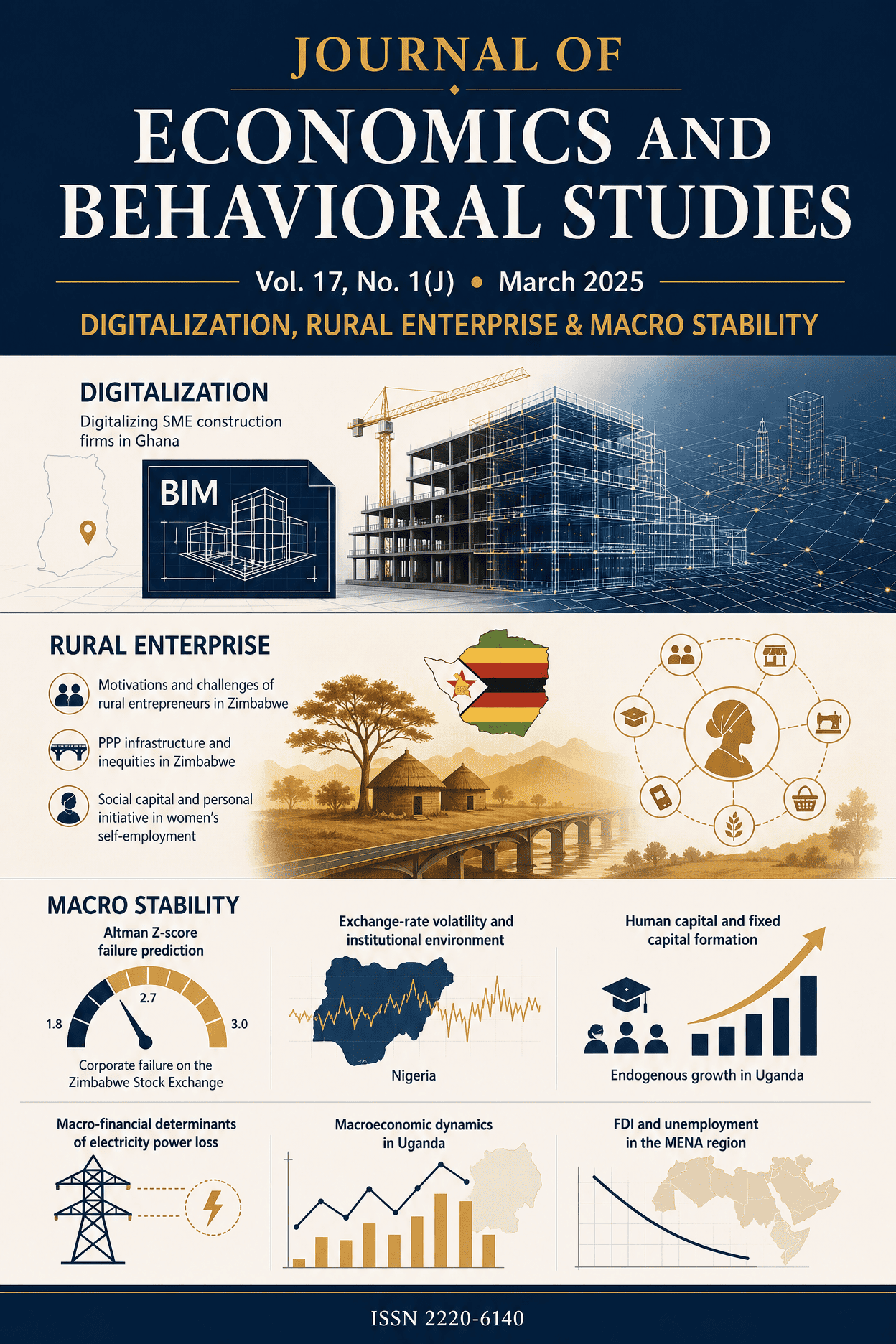
Articles

  • Article 1 in this issue

    Digitalizing the Activities of Small-Medium-Size Construction Firms

    • Author: Bernard Martin Arthur-Aidoo, Samuel Mensah Plange, Belinda Dodoo

    Ghana's construction sector faces many obstacles, such as modernization, inefficiency, and safety hazards. Small and medium-sized businesses (SMEs) are pivotal in job creation, economic expansion, and infrastructure development. To stay competitive, SMEs must embrace digital transformation as the industry experiences a digital revolution. This study examines the digital transformation of Ghanaian SME construction firms between 2018 and 2023, focusing on safety concerns, inefficiencies, and regulatory barriers, as well as the advantages of digitalization, such as improved communication and project management. A mixed-methods approach was used, combining structured surveys for SME employees with in-depth interviews with key stakeholders to gather both quantitative and qualitative data. The study investigates the use of digital technologies such as building information modeling (BIM), wearable technology, and real-time monitoring to address operational and safety issues. It also examines how digitization affects communication, resource allocation, project efficiency, and regulatory compliance. Factors such as government programs, technology adoption, and safety training are evaluated to determine their contribution to improving safety and productivity in the construction industry. The findings reveal that digital technologies significantly enhance project outcomes, safety management, and resource utilization. Government regulations also play a crucial role in supporting digitization initiatives. The study provides practical insights for policymakers, industry stakeholders, and researchers seeking to promote innovation and growth among SMEs in Ghana's construction sector.

    Pages 1-8

    PDF - Digitalizing the Activities of Small-Medium-Size Construction Firms (opens in a new tab)
  • Article 2 in this issue

    The Impact of Foreign Direct Investment on Unemployment in Mena Region

    • Author: Abdulkadir Muktar Nur, Jimoh Olajide Raji

    This paper examines the impact of foreign direct investment on unemployment in the MENA (Middle East and North Africa) region from 2011 to 2021. To achieve this, the study employed fixed effect and random effect estimators. The findings reveal that FDI, GDP growth, and population growth have negative coefficients and a significant impact on unemployment, whereas government expenditures and exports have negative coefficients but no significant impact on unemployment. This suggests that FDI, GDP growth and population growth reduce unemployment in the MENA region. Since the countries in this region have experienced high concentrations of unemployment, the government should focus on implementing policies that develop the skills and training of the people to prevent mismatches and encourage the private sector to create new jobs. In addition, the government should develop policies that facilitate the access and operation of FDI investors, as this will further assist in lessening unemployment in the MENA region.

    Pages 9-20

    PDF - The Impact of Foreign Direct Investment on Unemployment in Mena Region (opens in a new tab)
  • Article 3 in this issue

    Exploring the Perceived Inequities and Potential Reforms in Public-Private Partnerships for Infrastructure Development: A Qualitative Study of Stakeholder Perspectives in Zimbabwe

    • Author: Nhlanhla Moyamoya, Julius Tapera

    Public-private partnerships (PPPs) are an essential tool for mobilizing private investment and expertise to address infrastructure shortfalls globally, especially in developing countries such as Zimbabwe. However, the public sector is frequently harmed and citizens are burdened by Zimbabwe's current PPP frameworks, which calls for an analysis of the financial dynamics and consequences for equity. The purpose of this study is to investigate perceived inequities in Zimbabwe's PPP arrangements. Research gaps include inadequate attention to comprehensively explore perceived inequities and socio-economic impacts across sectors beyond transport, such as energy and healthcare, and a lack of focused, in-depth qualitative analysis of stakeholder perspectives specific to Zimbabwe, particularly from affected communities and local officials. The study adopts a descriptive and exploratory design, semi-structured interviews, and focus group discussions with a range of stakeholders. The data was analyzed using NVivo software and thematic analysis. The findings highlight the need for an in-depth qualitative understanding of stakeholder difficulties, demographic variety, and effects on development and financial well-being. While Public-Private Partnerships (PPPs) have improved infrastructure and local economic prospects, worries about financial strain on local governments, socioeconomic inequality, and environmental sustainability still exist. To promote transparency, justice, and more public benefit, recommendations for restructuring PPPs include equal risk sharing, more robust accountability systems, greater stakeholder participation, and giving priority to initiatives that benefit communities. These changes are necessary to guarantee that PPPs properly support Zimbabwe's aims for sustainable development and cater to the wide range of requirements of its populace.

    Pages 21-42

    PDF - Exploring the Perceived Inequities and Potential Reforms in Public-Private Partnerships for Infrastructure Development: A Qualitative Study of Stakeholder Perspectives in Zimbabwe (opens in a new tab)
  • Article 4 in this issue

    Institutional Environment and the Quest for Stable Exchange Rate in Nigeria

    • Author: Lawal Wasiu Omotayo, Zainab Abubakar, Zainab Said Suwaid

    This research empirically investigates the influence of Nigeria's institutional environment on exchange rate stability using annual data from 1981 to 2023. The study uses co-integration analysis to find a co-movement between exchange rate volatility and the institutional environment measures (measured by political risk and the unpredictability of revenue sources), with the expansion of the financial sector and adjustments to exchange rate policy serving as control variables. Political risk and the unpredictability of revenue sources have a positive and substantial short- and long-term impact on Nigeria's exchange rate volatility. The results suggest that exchange rate policy only has a negative and significant impact on exchange rate volatility over the long period, while financial sector expansion has a positive but insignificant influence in both periods. The causation test reveals a unidirectional correlation between the volatility of revenue sources and the volatility of currency rates, even though there is a bidirectional association between exchange rate volatility and both political risk and revenue source volatility. This suggests that the institutional environment is endogenous to the volatility of Nigeria's currency rate. The findings suggest that restructuring Nigeria's political system and diversifying its economy away from its reliance on oil could stabilize currency rate volatility and mitigate the effects of demand fluctuations and global oil price fluctuations.

    Pages 43-54

    PDF - Institutional Environment and the Quest for Stable Exchange Rate in Nigeria (opens in a new tab)
  • Article 5 in this issue

    An assessment of the Altman Z Score on predicting corporate failure. A case of insolvent financial companies listed on the Zimbabwe Stock Exchange

    • Author: Lorraine S Sibanda, Julius Tapera

    The study explored the causes of corporate failure among financial institutions using the Altman Z- scores. Traditionally, most finance professionals and firms depend on ratio analysis to determine performance, but the application of models like the Altman Z-Scores has hardly been utilized to analyze firm performance and predict potential failure. The major objective of this study was to assess the level to which Altman Z-scores can be used in determining corporate failures a year or two years before insolvency. The research used a mixed methods approach in gathering data. Financial data from annual reports and statements were quantitatively analyzed to compute key financial ratios essential for deriving the Altman Z-Score. Qualitative methods were also employed to explore best financial practices that can mitigate corporate failure risks in Zimbabwean financial institutions. A total of 20 industry experts, including financial analysts, regulators, and financial institution executives, were purposively selected based on their qualifications and experience, for interviews to gather qualitative data. The findings of the study highlight the Altman Z-Score model’s effectiveness in predicting financial distress well in advance while also highlighting governance, risk management, regulatory compliance, and operational efficiency as critical areas for mitigating corporate failure. The effectiveness of the Altman Z-Score model and its reliability in identifying at-risk companies both two years and one year before failure was confirmed and the findings give pointers to consider in developing policies that promote financial stability and resilience in the corporate sector.

    Pages 55-71

    PDF - An assessment of the Altman Z Score on predicting corporate failure. A case of insolvent financial companies listed on the Zimbabwe Stock Exchange (opens in a new tab)
  • Article 6 in this issue

    Exploring the Motivations, Challenges and Support Needs of Rural Entrepreneurs in Zimbabwe

    • Author: Bukhosi Dumoluhle Mpofu, Melissa Sibonginkosi Ncube

    Rural entrepreneurship has gained increasing attention as a crucial driver of sustainable development in Zimbabwe, with the potential to create jobs, foster inclusive economic growth, and improve livelihoods in marginalized communities. However, rural entrepreneurs in the country face unique challenges that often inhibit their ability to thrive and scale their ventures. This study aims to explore the experiences and support needs of rural entrepreneurs in Zimbabwe, to inform the design of more effective, context-specific interventions. Through in-depth interviews with 30 rural entrepreneurs across various sectors in three rural development councils, the research delves into the key barriers they encounter, including limited access to finance, skills gaps, underdeveloped infrastructure, and fragmented entrepreneurial ecosystems. The findings reveal that rural entrepreneurs in Zimbabwe require a multidimensional support system that addresses their complex, interrelated needs. Tailored access to credit, business development services, and entrepreneurial training emerge as crucial components of this support structure. Additionally, the study underscores the importance of investing in rural infrastructure, fostering entrepreneurial networks and clusters, and leveraging the expertise of development organizations, private sector partners, and academic institutions. By adopting a holistic, collaborative approach to supporting rural entrepreneurs, Zimbabwe can harness the transformative potential of rural entrepreneurship to drive inclusive economic growth, create jobs, and improve livelihoods in marginalized communities. The insights from this study provide a valuable roadmap for policymakers, practitioners, and stakeholders to develop impactful, context-relevant interventions that unlock the full potential of rural entrepreneurship in the country.

    Pages 72-81

    PDF - Exploring the Motivations, Challenges and Support Needs of Rural Entrepreneurs in Zimbabwe (opens in a new tab)
  • Article 7 in this issue

    Human Capital, Fixed Capital Formation and Economic Growth: An Empirical Analysis of Endogenous Growth Drivers in Uganda

    • Author: Benjamin Musiita, Frederick Nsambu Kijjambu, Ruth Nyiramahoro

    This research aimed to look at the effect of key endogenous variables such as GNI, Human Capital, FDI, Inflation, and GCF, which have impacted the economic growth in Uganda. This study adopted a time-series research design. Data from the study were obtained through secondary sources, including government publications, international financial databases, and reports obtained from UBOS. The econometric methods the study adopted included the ADF test for stationarity, the VIF test for multicollinearity, and the ARDL model in testing both the short-run and long-run relationships. The study found that in the long run, human capital, GCF, and inflation significantly contributed to economic growth at favorable rates, while FDI negatively influenced economic growth. In the short run, GNI, Human Capital, FDI, and Capital are significant determinants of economic growth, with an adverse short-run effect for GNI and FDI. The results emphasize that capital formation and human capital development are important for sustainable economic growth in Uganda. The study concludes that different aspects of fashion affect Uganda's economic performance, indicating the need to stabilize major macroeconomic indicators to achieve long-term growth, focusing on human capital, capital formation, and managing inflation.

    Pages 82-95

    PDF - Human Capital, Fixed Capital Formation and Economic Growth: An Empirical Analysis of Endogenous Growth Drivers in Uganda (opens in a new tab)
  • Article 8 in this issue

    Macro-Financial Determinants of Electricity Power Loss in Uganda

    • Author: Alex Twinomuhwezi, Benjamin Musiita, Frederick Nsambu Kijjambu

    This study examined the macro-financial determinants of electricity power loss in Uganda, with objectives that looked at GDP per capita, inflation, lending rates, the real effective exchange rate, and energy investment in electricity power loss. This study adopted a time series quantitative methodology. The secondary data was collected from reliable sources such as the World Bank, the Bank of Uganda, and the Electricity Regulatory Authority, spanning 20 years. The research applied a VAR model to analyze the short-run dynamics of the variables under consideration. The data were first cleaned to handle heteroscedasticity issues and missing values. The study found some of Uganda's most significant determinants of electricity losses to be macro-financial factors such as inflation, GDP per capita differences, and energy investment. Inflation volatility increased power losses, as did differences in GDP per capita, while low investment in energy translated to inefficiency within the electricity sector. Lending rates inhibited the infrastructural development of energy and, hence, power distribution and transmission efficiency. Therefore, the study concludes that addressing these macro-financial factors- inflation control, efficient energy investment, and economic policies- minimizes losses of electricity power in Uganda. This study suggests focusing on inflation stabilization, attracting investment in the energy sector, controlling the lending rate, and upgrading energy infrastructure management for better efficiency in the overall Ugandan electricity system. In addition, addressing issues of exchange rates and modern energy distribution technologies is central to minimizing losses and promoting an efficient energy sector.

    Pages 96-107

    PDF - Macro-Financial Determinants of Electricity Power Loss in Uganda (opens in a new tab)
  • Article 9 in this issue

    Macroeconomic Dynamics in Uganda: Investigating the Relationships among GDP Growth, Gross Capital Formation, Population Growth and FDI

    • Author: Ruth Nyiramahoro, Frederick Nsambu Kijjambu, Benjamin Musiita

    This paper sought to investigate Uganda's macroeconomic dynamics, informed by the objective of studying relationships among GDP growth, Gross Capital Formation (GCF), population growth, and net inflows of Foreign Direct Investment (FDI) by applying the endogenous growth theory. These key variables include GDP growth, GCF, population growth, and FDI net inflows; secondary data from national databases and international organizations were collected from 2000 to 2022. In this regard, the study follows a quantitative approach by adopting a descriptive and econometric design to investigate the relationship among the aforementioned variables. The methodological tools were Descriptive statistics, stationarity tests, multicollinearity testing, cointegration testing, and ARDL model estimation. These range from relative stability in GDP growth to the highly volatile GCF growth and smooth population growth trends to negative net inflows indicated by FDI. This confirms the long-run cointegration between the variables, whereby GCF proves to be firmly and positively related to GDP through an ARDL model. In contrast, variables FDI and population growth become influential after due lags. The results show that Uganda needs domestic and foreign investment to maintain economic growth; however, it has to deal with disinvestment challenges and an increasing population for long-term stability. This study finds that capital formation and foreign investment are integral to the Ugandan economy and can, if managed appropriately, ensure continued growth by overcoming these challenges in demography and investment.

    Pages 108-118

    PDF - Macroeconomic Dynamics in Uganda: Investigating the Relationships among GDP Growth, Gross Capital Formation, Population Growth and FDI (opens in a new tab)
  • Article 10 in this issue

    The Combined Effect of Social Capital and Personal Initiative on Women's Self-Employment in Mbarara City

    • Author: Asaph Kabubura Katarangi, Benjamin Musiita, Atwine Daniel Wanito, Sheila Akampwera

    The research investigated the impact of social capital and personal initiative on women who start businesses in Mbarara City, Uganda. The research focused on women's low entrepreneurial participation because self-employment has become recognized as a tool for economic empowerment. The research employed a cross-sectional quantitative survey design to gather data from 382 women entrepreneurs through selfadministered structured questionnaires. The research used stratified random sampling to achieve business sector and geographical area representation. SPSS analyzed the data through Pearson correlation and regression models, which tested the study hypotheses. The analysis showed that social capital demonstrated a positive and statistically significant relationship with women's self-employment (r =.478, p <.01) and personal initiative showed a similar positive relationship (r =.563, p <.01). The combined impact of social capital and personal initiative explained 33.3% of the self-employment variations among women in Mbarara City (Adjusted R² =.333). The research indicates that women’s economic success depends on developing social connections and promoting proactive entrepreneurial behaviors through targeted interventions. The research demonstrates through empirical evidence that specific policies and programs must develop social networks and promote personal initiative while eliminating barriers to women’s self-employment in urban Uganda.

    Pages 119-130

    PDF - The Combined Effect of Social Capital and Personal Initiative on Women's Self-Employment in Mbarara City (opens in a new tab)