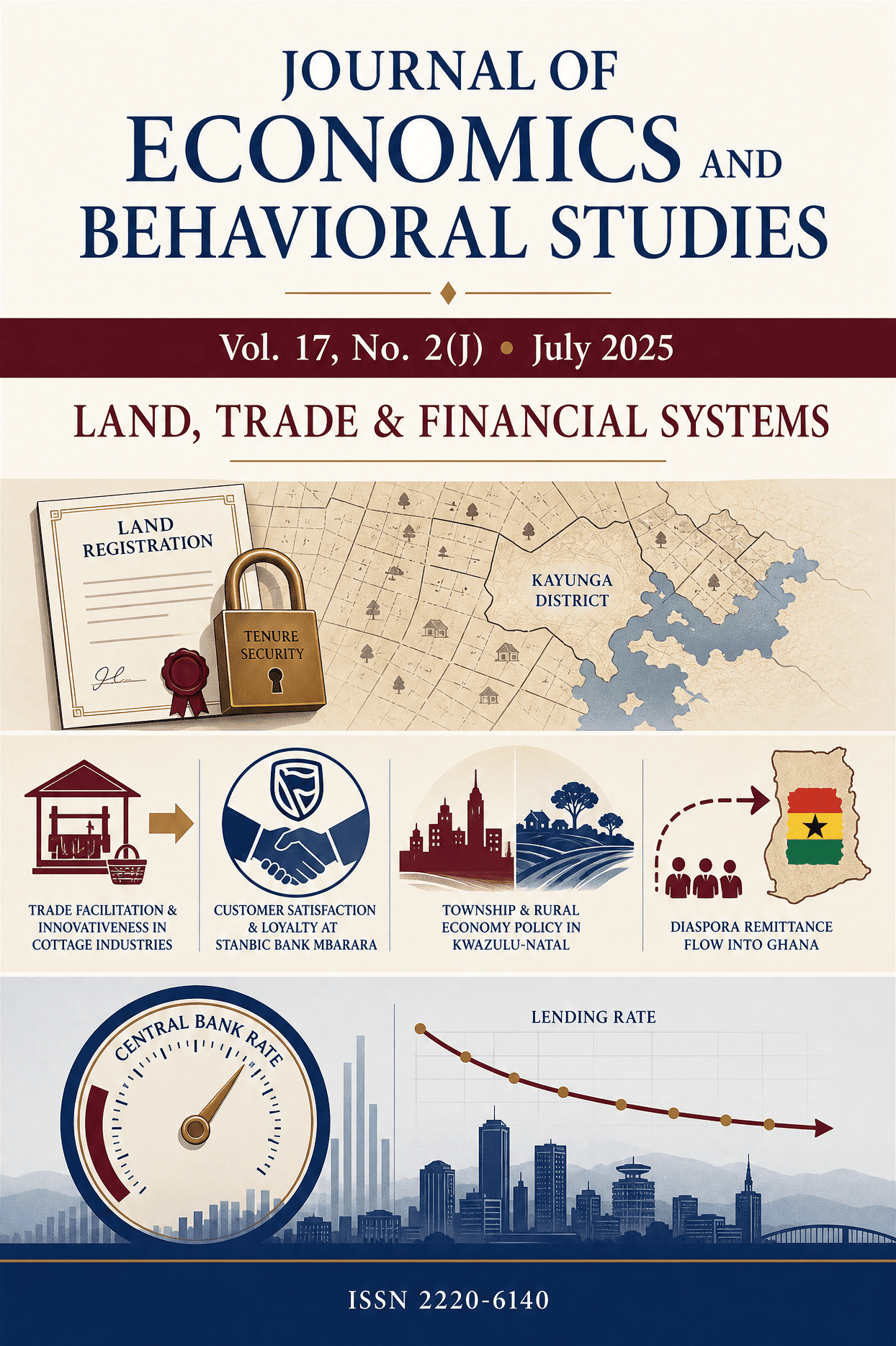
Articles

  • Article 1 in this issue

    Trade Facilitation and Innovativeness: Cottage Industry Development in Uganda

    • Author: Anthony Moni Olyanga, Proscovia Mukundane, Benjamin Musiita, Gladys Rochelle Kemitare, Darious Mugabe

    This study investigates the combined effects of trade facilitation and innovativeness on the development of cottage industries in Kampala City, Uganda. The research was motivated by the increasing relevance of cottage industries as engines of inclusive growth and the need to enhance their competitiveness and sustainability in developing economies. Anchored in the Resource-Based View (RBV) and New Institutional Economics (NIE) theories, the study conceptualizes trade facilitation and innovation as strategic and institutional enablers of firm performance. A cross-sectional mixed-methods design was employed, utilizing both quantitative and qualitative data collected from 250 cottage industry operators using stratified random and purposive sampling techniques. Results from Pearson correlation and regression analyses revealed significant and positive relationships between both trade facilitation (β = .41, p < .01) and innovativeness (β = .361, p < .01) with cottage industry development, jointly explaining 51.4% of the variation. Thematic analysis of qualitative data reinforced these findings, with participants highlighting how improved logistics, streamlined trade processes, and innovation in product development drive expansion, market access, and competitiveness. The study underscores the need for integrated policies that promote innovation ecosystems and remove institutional barriers to trade. Recommendations include investment in infrastructure, digital trade platforms, training in innovation practices, and stronger linkages between industry and support institutions to realize sustainable cottage industry growth.

    Pages 1-10

    PDF - Trade Facilitation and Innovativeness: Cottage Industry Development in Uganda (opens in a new tab)
  • Article 2 in this issue

    Customer Satisfaction and Customer Loyalty in the Banking Sector in Mbarara City: A Case of Stanbic Bank

    • Author: Nkamuhayo Denis, Matthew Akinwande, Nomugisha Mary, Mugabi Alexis Carboni, Nabaasa Medard, Namanya Joshua, Musiime Justus, Natukunda Moreen, Nuwamanya Allen, Kakuba Dennis

    Customer loyalty is a crucial aspect for organizations, especially in the banking sector, due to its significant financial benefits. Banks, being high-involvement service providers, maintain long-term relationships with customers, making customer satisfaction vital. While customer loyalty is a well-explored topic globally, limited research has been conducted in developing countries, particularly Uganda. This study aims to assess the influence of customer satisfaction on customer loyalty in the banking industry in Mbarara City, Uganda, with Stanbic Bank's Mbarara Branch as a case study. The study's objectives include evaluating customer satisfaction and loyalty levels and determining their correlation. The methodology involved a descriptive cross-sectional survey of 50 respondents, including management, employees, and customers, using both quantitative and qualitative approaches. Data analysis was performed using SPSS to test the correlation between satisfaction and loyalty. Findings indicated a positive relationship between service quality, trust, and long-term relationships with customer satisfaction. Similarly, trust and repeat purchases were linked to customer loyalty. Recommendations suggest banks should enhance customer follow-ups, innovate banking services, and host customer feedback events. Further studies could explore factors hindering customer satisfaction, the role of technology, and the impact of savings and credit societies on loyalty to commercial banks.

    Pages 11-26

    PDF - Customer Satisfaction and Customer Loyalty in the Banking Sector in Mbarara City: A Case of Stanbic Bank (opens in a new tab)
  • Article 3 in this issue

    An Analysis of Local Community Perspectives on How Land Registration Frameworks Influence Land Tenure Security and Contribute to Land Grabbing in Kayunga District

    • Author: Lydia Kisekka Namateefu, Mark Mugasha

    This study explores local community perspectives on how land registration frameworks influence land tenure security and contribute to land grabbing in Kayunga District. Guided by Conflict Theory, Property Theory, and Production Theory, the study analyses the interaction between formal land registration processes and customary landholding systems. The findings reveal that although land registration promotes legal recognition and improves access to financial services, it also contributes to land grabbing due to high registration fees, limited institutional accountability, and procedural gaps. Respondents perceived the process as favouring elites while marginalizing customary landowners and smallholder farmers. The study concludes that the current land registration system in Kayunga District, while offering potential for tenure security and economic empowerment, has exacerbated land-related conflicts and socio-economic inequalities due to corruption, procedural barriers, and exclusion of customary tenure systems. The study recommends integrating customary tenure into statutory law, establishing transparent and accountable governance structures, enhancing legal protections against land grabbing, and promoting community participation and legal awareness to ensure equitable and culturally appropriate land administration.

    Pages 27-39

    PDF - An Analysis of Local Community Perspectives on How Land Registration Frameworks Influence Land Tenure Security and Contribute to Land Grabbing in Kayunga District (opens in a new tab)
  • Article 4 in this issue

    A Policy Review of Rural and Township Economies in Local Economic Development in KwaZulu-Natal, South Africa

    • Author: Londeka Thandokuhle Mimi Nxumalo

    The South African government has shifted socioeconomic policy paradigms from focusing solely on attracting Foreign Direct Investment to Small and Medium Enterprises’ development since they promise to provide a base for the emergence of dynamic and efficient large-scale firms and, consequently, a more flexible and competitive domestic economy. The newly adopted KwaZulu-Natal Township and Rural Economies Revitalization Strategy (2022) is an application of the popular acclaim that Small and Medium Enterprises are engines of economic development. Therefore, there is a need for policies and strategies geared towards promoting local economic development that corresponds with the socioeconomic climate of host communities. The main objective of this paper was to explore the role of rural and township enterprises in implementing Local Economic Development in KwaZulu-Natal. The study utilised a systematic research approach in which data was gathered from journal articles, conference papers, reports, and all the relevant research material was managed. Findings indicate that Small and Medium Enterprises are a characteristic of successful economies. Despite the theoretical shift in economic policies, poverty, inequality, and unemployment plague South Africa. Rural and township areas are still behind urban areas in terms of structural capacity, technology, and economic development. This study highlights the need for the provincial government to revise policies specific to the host area because issues faced by rural economies are peculiar to township economies.

    Pages 40-57

    PDF - A Policy Review of Rural and Township Economies in Local Economic Development in KwaZulu-Natal, South Africa (opens in a new tab)
  • Article 5 in this issue

    ‘‘Ogya’’ Syndrome: Exploring Impacts of Ghanaians' Admiration for International Migration on Sustainable Economic Development

    • Author: Lawrence Vorvornator

    ‘‘Ogya’’ syndrome jargon is a synonym for international migration. The study examines the impact of Ogya syndrome on Ghana’s sustainable economic development to determine whether it has positive or negative effects on the economy. The study is grounded in Haas’ structural functionalism theory and relates the topic in practical terms, which makes this study distinct from existing research. The paper employs a literature review method, also known as a ‘meta-study’. The study’s findings reveal that Ogya syndrome enhances significant benefits to Ghana’s economic development through rewards and remittances sent into the country, Ghanaian migrants upskill themselves, and on migrants' return, they transfer knowledge acquired internationally to nonmigrants. Further, migrants undertake investments, developmental projects, and entrepreneurship ventures in Ghana’s economy, which have positive impacts on economic development. The negative findings reveal brain drain, remittances’ high dependency, and social impacts (loved ones’ separation and divorce). The paper argues that good government of Ghana’s (GoG) foreign policies will attract international migrants to contribute to sustainable economic development, whereas bad foreign policies will push them away. Therefore, effective foreign policies must be developed with strategies to harness the positive effects of international migration. However, negative effects such as brain drain and dependency need management and social intervention policies to curb them. The paper recommends good governance, stewardship, probity and accountability from all institutions. Further, Ghanaian immigrants’ remittances, investments into businesses, and other developmental projects should be charged less tax to encourage Ghanaian Diaspora’s remittances flow and migrants' return to contribute to economic growth and development.

    Pages 58-67

    PDF - ‘‘Ogya’’ Syndrome: Exploring Impacts of Ghanaians' Admiration for International Migration on Sustainable Economic Development (opens in a new tab)
  • Article 6 in this issue

    Monetary Policy Tools and Lending Rates in Uganda: A Quantitative Analysis

    • Author: Hanns Ariho, Benjamin Musiita, Arthur Nuwagaba

    This study examines the impact of key monetary policy instruments on Uganda's lending rates over the period from 1994-2024. Specifically, it examines the impact of the Central Bank Rate (CBR), Open Market Operations (OMO), Standing Lending Facilities (SLF), and the Cash Reserve Requirement (CRR) on commercial lending rates. With the Autoregressive Distributed Lag (ARDL) methodology, the study accommodates variables of mixed orders of integration and accounts for both short-run dynamics and long-run relationships. After overcoming multicollinearity problems, which resulted in CRR (being utilized as a proxy for demand deposits) being eliminated from the study, the study determines that CBR and the rediscount rate (being utilized as a proxy for SLF) have positive influences on lending rates in both the long run and short run. On the other hand, base money (proxy for OMO) is not statistically significant, and this reflects structural inefficiencies in the channel of passing through liquidity. Since diagnostic tests confirm the model under stability, normality of residuals, homoscedasticity, and no serial correlation, these findings confirm interest rate-based instruments in Uganda's monetary policy arsenal and simultaneously highlight indirect instrument weaknesses, such as OMO. These policy recommendations drawing from the research focus on reinforcing CBR signaling transparency, upgrading SLF mechanisms, and further deepening financial markets to improve policy transmission. This should be accompanied by further research into the wider macroeconomic effects of these instruments as well as further policy levers in Uganda's monetary framework.

    Pages 68-80

    PDF - Monetary Policy Tools and Lending Rates in Uganda: A Quantitative Analysis (opens in a new tab)