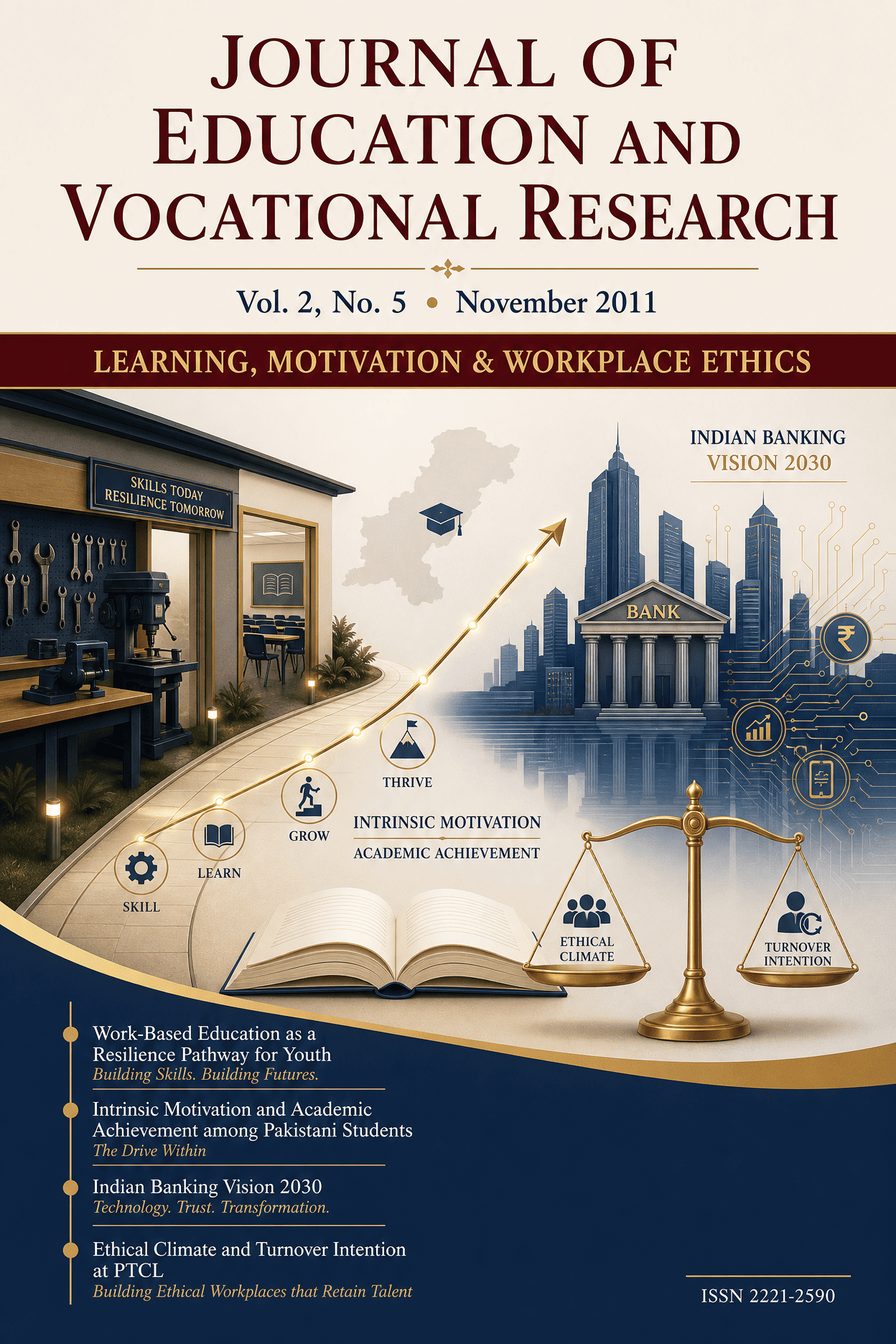
Articles

  • Article 1 in this issue

    Work-Based Education as a Pathway to Resilience

    • Author: Joan Versnel, Christopher DeLuca, Jennifer de Lugt, Nancy L. Hutchinson, Peter Chin

    The purpose of this study was to explore the potential of work-based education (WBE) as a pathway for enhancing resilience among youth-at-risk for disengaging from school. For students who have experienced traditional academic school as an adverse context, the decision to pursue an alternative path to high school completion, for example WBE, can be interpreted as agentic. We propose that WBE may have the requisite features of an educational context that fosters resilience in at-risk youth. We used a multipleperspective case study method involving three young people in their final stages of secondary school. The students were the focal participants in each case. Each was interviewed and observed on multiple occasions. We interviewed teachers and workplace supervisors associated with each student for additional perspectives. Cases were analyzed individually, followed by cross-case analyses utilizing a resilience framework. Our study revealed evidence that for the three youth we studied, WBE had many elements that appear to enhance resilience in a way that academic programs did not. WBE kept these students engaged in the school context and contributed to the eventual successful completion of secondary school for all three. Choosing WBE as a pathway to secondary school completion can be an agentic act by at-risk youth to achieve graduation. Engagement in WBE also appears to enhance resilience. WBE may foster resilience in at-risk youth, who despite academic adversity, progress to completion. Graduation from secondary school is frequently identified as a positive outcome and a predictor of success in productive occupation and adult life .

    Pages 143-153

    PDF - Work-Based Education as a Pathway to Resilience (opens in a new tab)
  • Article 2 in this issue

    The Relationship between Intrinsic Motivation and Academic Achievement of Male and Female Students at University Level in Pakistan: A Case Study

    • Author: Sadaf Tariq, Shafqat Hussain, Sumaera Mahmood, Sarwat Mubeen

    Psychologists and educators believe motivation as a significant factor that has an effect on student learning and accomplishment. It is a general argument that suitable motivational orientations make learning easy while unsuitable ones obstruct it. Intrinsic motivation is a kind of motivation that approach from individual factors within a person rather than merely from some outside motives. Intrinsic motivation shows learners commitment in learning for its personal interest. In Pakistan, perhaps little research has yet been done in this field. The study was conducted to find the relationship between intrinsic motivation and academic achievement of students at university level in province Punjab, Pakistan. The main objectives of study were, to finds out profiles of students with respect to intrinsic motivation and academic achievement, to find out difference among male and female students on intrinsic motivation and academic achievement. The population of the study comprised of 600 male and female students studying in universities of Punjab, Pakistan. The sample consisted of 300 male and 300 female students of universities selected through multistage sampling procedure. In order to measure intrinsic motivation of students, an adapted version of Harter’s (1981) intrinsic motivation scale was used. Academic achievement of students was measured through their university results. The scores on each variable were calculated and summarized through mean and standard deviation scores. The significance of difference between mean scores of male and female and BA and B.Sc students on the study variables were calculated by t-test (two-tailed). The relationship between intrinsic motivation and academic achievement was computed by using Person ‘r’. The results of the study revealed no gender difference. Both male and female were found to be equal in intrinsic motivation and academic achievement.

    Pages 154-161

    PDF - The Relationship between Intrinsic Motivation and Academic Achievement of Male and Female Students at University Level in Pakistan: A Case Study (opens in a new tab)
  • Article 3 in this issue

    Indian Banking – NEW Vision 2030

    • Author: R. K. Uppal

    Dynamic changes are taking place in the Indian banking industry .The purpose of this paper is to access and analyze the future of Indian banking in the coming competitive era. With the help of ratio analysis method and various statistical techniques ,evaluates the performance of banking industry .In the post – second banking reforms era, Indian banks are very fastly changing and ready to face the global challenges. The paper has been divided into two parts, i.e pre-ebanking period and post -ebanking period. The paper concludes that the performance of banks much better in the post ebanking period. Only those banks will survive in future, which are intensively using information technology in day-to-day activities. The present paper highlights the changing face of Indian banks and predicts the future for 2030. Information technology has altered the face of Indian banks and it has positively affected the productivity and profitability of banks. The presence of Indian banks in the global market is continuously increasing.

    Pages 162-182

    PDF - Indian Banking – NEW Vision 2030 (opens in a new tab)
  • Article 4 in this issue

    Issues and Solution of Ethical Climate and Turnover Intention in PTCL

    • Author: Sayed Fayaz Ahmed, Zahid Mehmood Awan, Muhammad Khalil Shahid

    This study makes significant payment to our beliefs about issues and solution of ethical climate and turnover intention. This research is not only discusses how ethical climate creates trust in supervisor, emotional exhaustion, and organizational commitment but also explains how these parameters affect job satisfaction, which relates to turnover intention. All the parameter, we use in our research is well tested and exercised. To explain our point of view in well understandable manner, a structured model is derived from the literature on the subject. More over this research brings the issue of ethical climate to the discussion table and provides a well-established path to other researchers. The research will make the managers able to lessen the turnover intention in the organization. As the study linking various variables and theories, it suggests the main affects and causes of their interdependences. It also helps managers to maintain such an ethical climate, which leads to job satisfaction and less turnover rate.

    Pages 183-196

    PDF - Issues and Solution of Ethical Climate and Turnover Intention in PTCL (opens in a new tab)