Articles

  • Article 1 in this issue

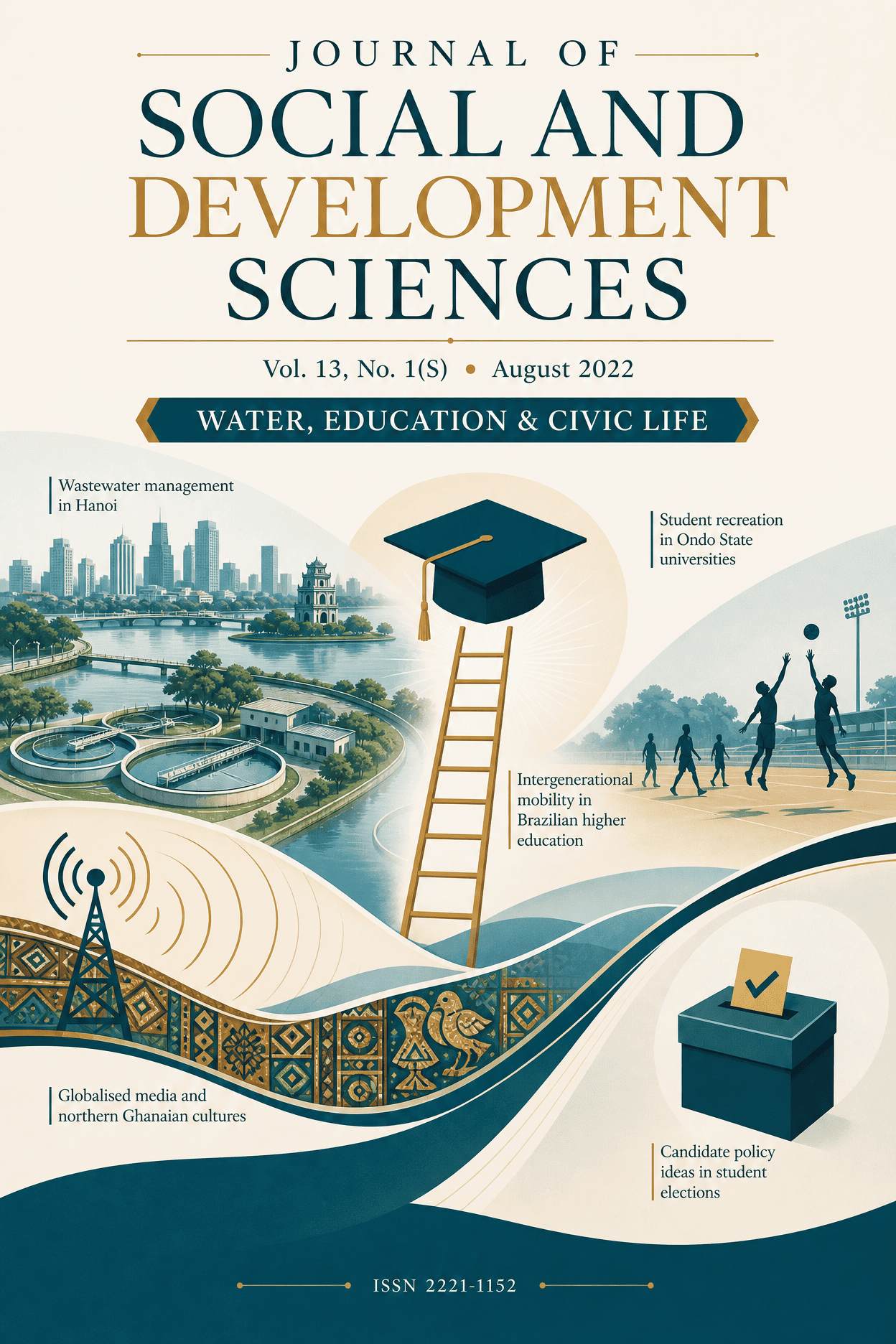
    Participation and Hindrances to Students’ Recreation at Selected Universities in Ondo State, Nigeria

    • Author: Moronkeji Damilola B., Ayeni Dorcas A., Emmanuel Adebayo A.

    Recreation has several benefits, one of which is the health advantage that it brings to those who engage in it. Apart from being beneficial to health, one of the other benefits is in connection with good academic performance that it stimulates. This study focused on three selected public universities in Ondo State, Nigeria. It investigates the availability of recreational facilities, students' level of participation in recreational activities, and hindrances to students’ recreational participation in the selected universities. A purposive sample of 300 students was adopted and disaggregated into 106, 139 and 55 for the Federal University of Technology, Akure (FUTA), Adekunle Ajasin University, Akungba-Akoko (AAUA), and Ondo State University of Science and Technology, Okitipupa (OSUSTECH) respectively, using the relative population of students in the three universities. Data acquisition instruments included a questionnaire, interview and observation. The questionnaire administration involved a multi-stage sampling procedure that cumulated in obtaining data from the final-year students of each university's faculties and departments. Findings revealed that students' participation in recreation was at low ebb in the three universities with varying degrees of hindrances to participation across the institutions. Poor or absent facilities were the most dominant hindrance to recreation. The worst case was in OSUSTECH where the school authority did not provide any recreational facility on campus. Recommendations include sensitization programmes to enlighten students on the need for recreation and the benefits of same to their health and educational pursuit; and upscaling of recreational facilities in the studied institutions.

    Pages 1-14

    PDF - Participation and Hindrances to Students’ Recreation at Selected Universities in Ondo State, Nigeria (opens in a new tab)
  • Article 2 in this issue

    The Effects of Globalized Media on Northern Cultures: A Case Study of DAGOMBA, FRAFRA and Wala Ethnic Groups in Tamale Metropolis

    • Author: Andy Anim, Stephen Oppong, Sarah Geraldo, Mohammed Suruju Gariba, Richard Obeng, Prince Ampiah Ocran, Shormei Naa Odonkor

    The existence of globalized media has influenced most people's ways of living, causing significant changes in Ghana's northern culture. Accepting different civilizations, such as Christian and Islamic civilizations, results in a hybridization of culture, which is shown in their way of life and attitudes regarding issues. This study uses the ethnic groupings of the Dagomba, Frafra, and Wala in Tamale to investigate the effects of globalized media. The study used both quantitative and qualitative research methods to collect relevant data. Using SPSS version 22, it also used descriptive statistics for descriptive analysis and crosstabulations, as well as the Kendall Coefficient of Concordance to examine the amount of agreement for some specific variables. Out of the ninety people polled, 54 had a television, which they usually used to watch Telenovelas (42.2 %). The outcomes of this study imply that there is a favorable impact on Ghana's northern culture, as seen by their attitude toward social issues (65.6 %) and clothing style (23.3 %). This indicates that while there may be favorable cultural changes, there may also be bad changes. Globalized media, which has the highest rank of 1.73 in the Kendall Coefficient of Concordance, is at the center of it all, playing a vital role in interweaving cultures across time and place. The study suggests that, because the media has a favorable impact on people's attitudes toward social concerns in the north, media houses should promote more social programs.

    Pages 15-35

    PDF - The Effects of Globalized Media on Northern Cultures: A Case Study of DAGOMBA, FRAFRA and Wala Ethnic Groups in Tamale Metropolis (opens in a new tab)
  • Article 3 in this issue

    Wastewater Management in Hanoi: The Possibility of Using a Soft Path Approach

    • Author: Nguyen Thi Thu Trang, John Walsh, Robert McClelland

    Hanoi is known as the City of Lakes because there are some one hundred natural or manmade watercourses within its territory. However, in common with all of Vietnam, more than 60% of the city’s water resources derive from beyond the country’s borders. Much of that water is polluted, both within Hanoi and downstream because wastewater is discharged directly into the Nhue and Day rivers via the Nhat Tuu and Ba sewers, among other channels. International attempts to revive the To Lich River in the city, notorious for its black color and unwholesome smell, have proved to have only limited success. There is some scope for new materials to improve filtration effects and experiments in this area continue. Rapid urbanization in Hanoi has been intensified by the sudden decision to increase the city’s size so that it became comparable to the southern capital of Ho Chi Minh City. This has led to large areas of industrial land being incorporated into municipal water management systems. One possible means of relieving the pressure on these systems would be to employ approaches derived from the soft path of water management. To date, most scientific investigation of these issues depends almost entirely on technocratic approaches to water management issues and the attempt to force technical solutions to deal with social issues. Consequently, this paper investigates the possibility of understanding how Hanoi residents interact with current wastewater management approaches and how their needs might be better met in the future.

    Pages 36-43

    PDF - Wastewater Management in Hanoi: The Possibility of Using a Soft Path Approach (opens in a new tab)
  • Article 4 in this issue

    Candidate Policy Ideas and Other Factors that Affect Election Results: A Case Study of Kwame Nkrumah University of Science and Technology

    • Author: Andy Anim, John Obeng Addai, Ernest Osei Akuoko, Hammond Rebecca, Casey Esaa Sey

    Politics primarily focuses on decision-making and resource allocation. This resource allocation may emerge from political parties and candidates' policy proposals. Numerous studies have explored the impact of candidate policy proposals on election outcomes, but less attention has been paid to the impact of other factors. Using Kwame Nkrumah University of Science and Technology (KNUST) as a case study, the study examines the impact of candidate policy proposals and other factors such as ethnicity, gender, and party affiliation on election outcomes. Kwame Nkrumah University of Science and Technology (KNUST) is located in Kumasi, in the Ashanti Region of Ghana. The sample size of 255 people came from the Department of History and Political Studies and the Department of English, both of which are part of the Faculty of Social Sciences. The third and fourth-year students in these departments were given online Google-style questionnaires. In addition, journal, article, and book data were used to support the analysis. The majority of survey respondents stated that politicians' policy opinions have a considerable impact on elections, which was a significant conclusion. In order to provide equal opportunity for all, the laws governing gender discrimination and ethnic politics must be properly enforced and followed. Possession of a party card should not be a prerequisite for receiving benefits in the country. Everyone should have equal access to opportunities.

    Pages 44-58

    PDF - Candidate Policy Ideas and Other Factors that Affect Election Results: A Case Study of Kwame Nkrumah University of Science and Technology (opens in a new tab)
  • Article 5 in this issue

    The Factors Influencing Intergenerational Mobility Levels among Higher Education Graduates in Brazil: A Comparison of the Years 2004 and 2018

    • Author: Luana dos Santos Fraga, Tatiane Pelegrini, Izete Pengo Bagolin

    The paper aims to analyze the levels of educational intergenerational mobility of students graduating from higher education in the years 2004 and 2018 and to identify the characteristics associated with the chances of higher levels of educational intergenerational mobility. The paper's main contribution is to provide evidence regarding how public policies contributed to intergenerational mobility. Moreover, the results highlight the persistent inequalities, which are often veiled by apparently positive results that do not conform to the real conditions necessary to break the cycle of poverty between generations. We use data from the Brazilian National Student Performance Exam (ENADE) and estimate an Ordered Probit. The study innovates in the use of data from university graduates, construction of mobility levels, calculation of mobility in relation to the father and the mother separately and controlling for the effect of higher education expansion policies. The results show that greater chances of intergenerational mobility in relation to parents are linked to the following conditions: being a woman; being over 24; a lower income family; not white or yellow; financially helping the family; studying in private institutions; having a scholarship or a Fies loan; being a ‘quota student’ and being a distance learning.

    Pages 59-71

    PDF - The Factors Influencing Intergenerational Mobility Levels among Higher Education Graduates in Brazil: A Comparison of the Years 2004 and 2018 (opens in a new tab)