Abstract
The purpose of the study was to examine the effect of total quality management on organizational performance among selected banks in Bamako, Mali. This study adopted a cross-sectional survey design. The target population was 160 respondents and the sample size was 114 respondents. The study questionnaire was the main instrument of data collection. Frequency and percentage distribution were used to determine the profile of the respondents. Mean and Standard deviations were used as descriptive statistics for the independent (total quality management constructs) and dependent variables (organizational performance). Linear and multiple regression analyses were used to determine the effect. The study found a significant effect of total quality management on organizational performance (R2 =0.832, p<0.01). Specifically, the study found a significant effect of all the measures of total quality management on organizational performance. Lastly, the study found that there was a positive significant correlation between total quality management and organizational performance among banks in Bamako, Mali. The study concluded that the promotion of total quality management principles is relevant in enhancing organizational performance in the Malian Banking Industry. The study recommended that: the management of the banks should enhance human resource focus to increase reliability and timely delivery of the products/services. Moreover, effective human resources focus during the process of total quality management thus enhancing banks' performance. The management of banks should focus on the improvement of market target blend and customer care. The banks should also focus on the provision of quality services to the customer and promoting their brand.
Keywords
- Total Quality Management Search this journal for Total Quality Management (opens in a new tab)
- Organizational Performance Search this journal for Organizational Performance (opens in a new tab)
- Multiple Regression Analysis Search this journal for Multiple Regression Analysis (opens in a new tab)
- Banks Search this journal for Banks (opens in a new tab)
- Mali Search this journal for Mali (opens in a new tab)
References
- Adam, E.E., Flores, B.E. & Macias, A. (2017) Quality Improvement Practices and the effect on Manufacturing Firm Performance: Evidence from Mexico and the USA, International Journal of Production Research, 39 (1), pp. 43-63.
- Adeoti. M. (2018). “Links between Organizational Learning and Total Quality: a critical review”, Journal of European Industrial Training, 22(2), 47-56.
- Agus, A and Hassan, (2015) “Exploring the relationship between the length of Total Quality Management Adoption and financial performance. An empirical study in Malaysia, Production and inventory management journal” 28(2), 47-76
- Ahire, S.L. & Dreyfus, P. (2017) “The impact of design management and process management on quality: an empirical examination”, Journal of Operations Management, 18 (1), 549-575.
- Allan, T. (2017)."Exploring the relationship between the length of total quality management adoption and financial performance: an empirical study in Malaysia, International Journal of Management., 2(1), 323-33.
- Argote, L. (2018). Organizational Learning: Creating, Retaining, and Transferring Knowledge. New York: Springer. Gonzalez.
- Awolusi, O.D. (2013),“ The effects of total quality management on customer service management in the Nigerian banking industry: an empirical analysis”, International Journal of Management and Network Economics, 3(1), 57–77
- Awolusi, O.D. (2021), “Economic Growth and Socioeconomic Sustainability in BRICS Countries: A Vector Error Correction Modeling Approach ", Journal of Economics and Behavioral Studies, 13(3), 1-23
- Awolusi, O.D. (2012), "The effects of mergers and acquisitions on business Performance in the Nigerian banking industry: an empirical analysis”, International Journal of Business Performance Management, 13(3/4), 366–385
- Awolusi, O.D. (2012b),“ Effectiveness of Total Quality Management on Business Performance in Nigerian Manufacturing Firms: an empirical analysis”, International Journal of Enterprise Network Management, 5(3), 254–271
- Beamon, T. (2018). “Performance measurement in humanitarian relief chains” International Journal of Public Sector Management, 22(2), 1-25
- Bergquist, B., Fredriksson, M., & Svensson, M. (2019), "TQM: terrific quality marvel or tragic quality malpractice?", The TQM Magazine, 17(4), 309-321.
- Blas, T. and Limbambala, H. (2017). “Comparing three signals of Service Quality”, A journal of Services Marketing, 23(1), 23-34
- Boddy, G. & Paton, T. (2018) The use of quality management techniques and tools: an examination of some key issues, International Journal of Technology Management, 16(1), 305-325.
- Brah A.S, Tee, L.S, Rao M.B (2019), “Relationship between total quality management and performance of Singapore companies”, International journal of quality and reliability”, 22(2), 47-56
- Brah, S. (2018) “Relationship between TQM and performance of Singapore companies,” International Journal of Quality and Reliability Management, 19(4), 356–379
- Douglas, T. and Judge, W.Q. (2017) “Total quality management implementation and competitive advantage: the role of structural control and exploration,” Academy of Management Journal, 44(1), 158–169
- Easton (2018) “The effects of total quality management on corporate performance: an empirical investigation,” Journal of Business, 71(2), 253–307
- Eze, T.O. & Awolusi, O.D. (2018) ‘Effect of Critical Factors on Expatriate Assignment Performance in the Nigerian Oil and Gas Sector, Global Journal of Interdisciplinary Social Sciences, 7(2), 6-19
- Forza, C. & Filippini, R. (2018)“TQM impact on quality conformance and customer satisfaction: a causal model,” International Journal of Production Economics, 55(1), 1–20
- Fredendall, and T. J. Douglas (2018), “The evolving theory of quality management: the role of Six Sigma,” Journal of Operations Management, 26(5), 630–650
- Hendricks R, (2017) “Quality awards and the market value of the firm: an empirical investigation,” Management Science, 42(3), 415–436
- Kaynak and J. L. Hartley, (2017)“A replication and extension of quality management into the supply chain,” Journal of Operations Management, 26(4), 468–489
- Kaynak, H. (2017), “The relationship between total quality management practices and their effects on firm performance,” Journal of Operations Management, 21(4), 405–435
- Masters R. J. (1996), “Overcoming the barriers to TQMs success,(2017)” Quality Progress, 29(5), 53–55
- Merino-Díaz de Cerio, T. (2018) “Quality management practices and operational performance: empirical evidence for Spanish industry,” International Journal of Production Research, 41(12), 2763–2786
- Mohrman, R. V. & Tenkasi, E. (2016), “Total quality management: practice and outcomes in the largest US firms,” Employee Relations, 17(3), 26–41
- Mekong, L.M. & Awolusi, O.D. (2019) ‘Strategic Leadership in the Post-Conflict States: A Study of the Democratic Republic of Congo (DRC)’, Journal of Social and Development Sciences, 10(4), 36–51
- Nair, M. (2016), “Meta-analysis of the relationship between quality management practices and firm performance-implications for quality management theory development,” Journal of Operations Management, 24(6), 948–975
- Onikoyi, I. A., Awolusi, O.D. and Boyede, M.A. (2014), "Effect of Absenteeism on corporate performance: a case study of Cadbury Nigeria plc., Ikeja, Lagos State, Nigeria”, British Journal of Marketing Studies, 3(2), 58–71
- Powell, R. (2018)“Total quality management as competitive advantage: a review and empirical study,” Strategic Management Journal, 16(1), 15–37
- Sadikoglu and T. Temur, (2015) “The relationship between ISO 17025 quality management system accreditation and laboratory performance,” in Quality Management and Practices, K. S. Ng, Ed., chapter 13, pp. 221–230, InTech, Croatia, Rijeka
- Sadikoglu E. and C. Zehir, (2018) Investigating the effects of innovation and employee performance on the relationship between total quality management practices and firm performance: an empirical study of Turkish firms,” International Journal of Production Economics, 127(1), 13–26
- Sadikoglu, “Total quality management: context and performance,” The Journal of American Academy of Business, 5(1-2), 364–366
- Samson and M. Terziovski, “Relationship between total quality management practices and operational performance,” Journal of Operations Management, 17(4), 393–409
- Saraph, P. G. Benson J. V., and R. G. Schroeder,(2012) “An instrument for measuring the critical factors of quality management,” Decision Sciences, 20(1), 810–829
- Sharma, T. (2017) “Quality management dimensions, contextual factors and performance: an empirical investigation,” Total Quality Management and Business Excellence, 17(9), 1231–1244
- Taveira, D. C. A. James, B.-T. Karsh, and F. Sainfort (2012), “Quality management and the work environment: an empirical investigation in a public sector organization,” Applied Ergonomics, 34(4), 281–291
- Terziovski,(2018), “The business value of quality management systems certification evidence from Australia and New Zealand,” Journal of Operations Management, 15(1), 1–18
Downloads
No downloads have been recorded for this article yet. Figures appear here once readers begin downloading the full text.
How to Cite
Share this article
License
Copyright (c) 2023 Mbalalufu Mukenga, Olawumi Dele Awolusi (Author)

This work is licensed under a Creative Commons Attribution 4.0 International License.
Author (s) should affirm that the material has not been published previously. It has not been submitted and it is not under consideration by any other journal. At the same time author (s) need to execute a publication permission agreement to assume the responsibility of the submitted content and any omissions and errors therein. After submission of revised paper in the light of suggestions of the reviewers, the editorial team edits and formats manuscripts to bring uniformity and standardization in published material.
This work will be licensed under Creative Commons Attribution 4.0 International (CC BY 4.0) and under condition of the license, users are free to read, copy, remix, transform, redistribute, download, print, search or link to the full texts of articles and even build upon their work as long as they credit the author for the original work. Moreover, as per journal policy author (s) hold and retain copyrights without any restrictions.
Keywords
- Total Quality Management Search this journal for Total Quality Management (opens in a new tab)
- Organizational Performance Search this journal for Organizational Performance (opens in a new tab)
- Multiple Regression Analysis Search this journal for Multiple Regression Analysis (opens in a new tab)
- Banks Search this journal for Banks (opens in a new tab)
- Mali Search this journal for Mali (opens in a new tab)
Section
Published in
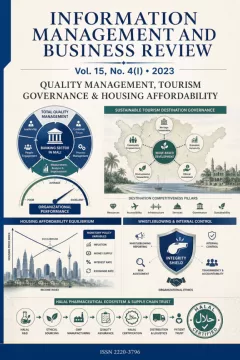 Vol. 15 No. 4(I) (2023)
Quality Management, Tourism Governance & Housing Affordability
View issue contents
Published
Submissions
Have research to publish? Information Management and Business Review welcomes submissions.
Make a Submission