Articles

  • Article 1 in this issue

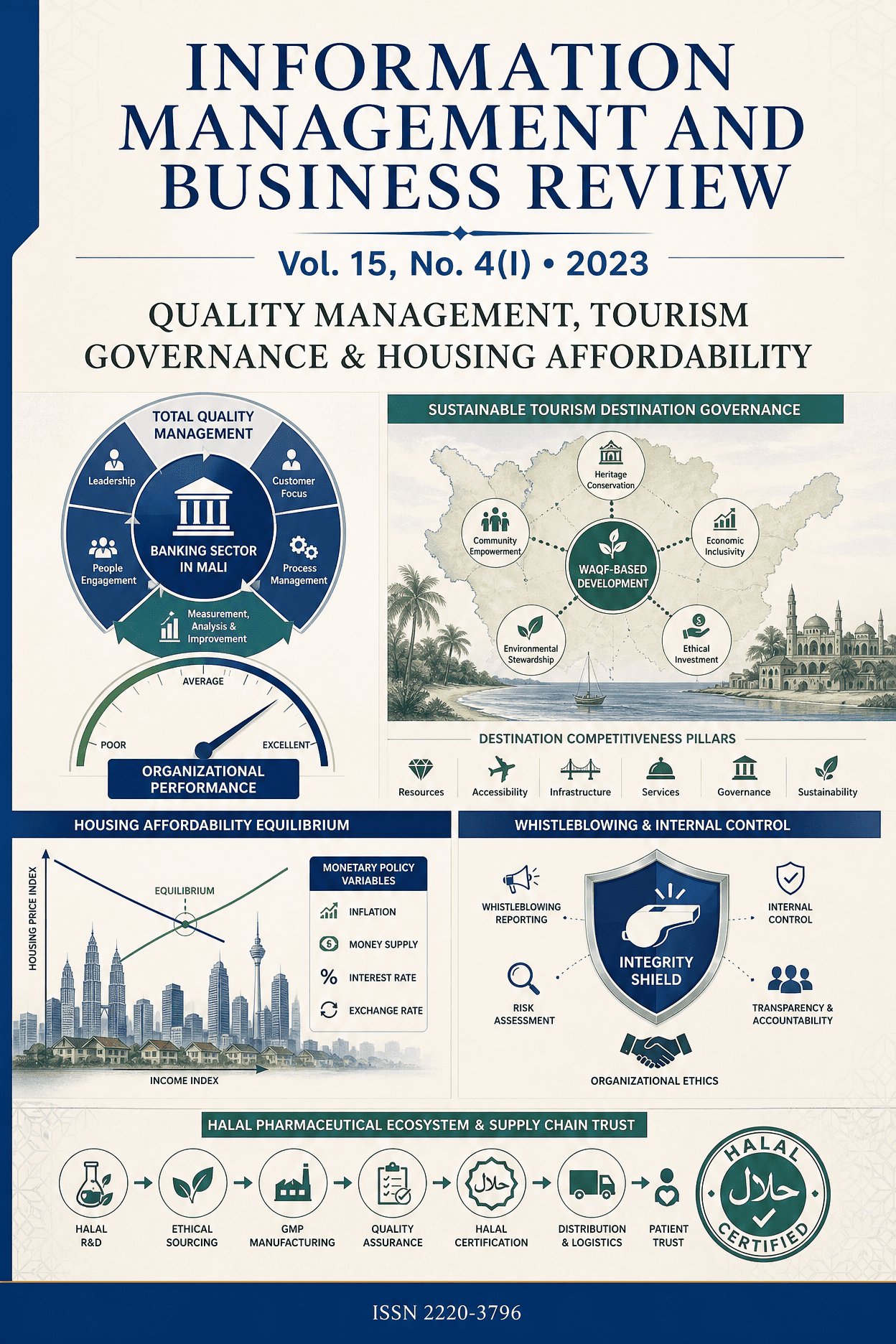
    Total Quality Management and Organizational Performance: A Study of Commercial Banks in Bamako, Mali

    • Author: Mbalalufu Mukenga, Olawumi Dele Awolusi

    The purpose of the study was to examine the effect of total quality management on organizational performance among selected banks in Bamako, Mali. This study adopted a cross-sectional survey design. The target population was 160 respondents and the sample size was 114 respondents. The study questionnaire was the main instrument of data collection. Frequency and percentage distribution were used to determine the profile of the respondents. Mean and Standard deviations were used as descriptive statistics for the independent (total quality management constructs) and dependent variables (organizational performance). Linear and multiple regression analyses were used to determine the effect. The study found a significant effect of total quality management on organizational performance (R2 =0.832, p<0.01). Specifically, the study found a significant effect of all the measures of total quality management on organizational performance. Lastly, the study found that there was a positive significant correlation between total quality management and organizational performance among banks in Bamako, Mali. The study concluded that the promotion of total quality management principles is relevant in enhancing organizational performance in the Malian Banking Industry. The study recommended that: the management of the banks should enhance human resource focus to increase reliability and timely delivery of the products/services. Moreover, effective human resources focus during the process of total quality management thus enhancing banks' performance. The management of banks should focus on the improvement of market target blend and customer care. The banks should also focus on the provision of quality services to the customer and promoting their brand.

    Pages 1-15

    PDF - Total Quality Management and Organizational Performance: A Study of Commercial Banks in Bamako, Mali (opens in a new tab)
  • Article 2 in this issue

    Moderating Effect of WAQF for Tourism Sustainability in Malaysia: A Mixed-Method Approach

    • Author: Shafinar Ismail, Mohammed Izzudin Ismail, Putri Aliah Mohd Hidzir, Suharni Rahmat, Suzila Ismail

    Due to its substantial contributions to the economy, society, environment, and other sectors, tourism is vital. To keep the tourism business sustainable, the government and other relevant stakeholders must allocate a sizable budget. Consequently, waqf is one way to lessen reliance on government funding. Waqf, in general, refers to assets that Muslims willingly donate and plan to use or grow for the good of the community. The purpose of this study is to determine whether the tourism industry and the economic, social-cultural, environmental, and transversal pillars are significantly correlated. It also looks at how waqf moderates the relationship between the tourism sector's sustainability and the economic pillar. Both quantitative and qualitative methods are used in this methodology. Quantitative data were obtained from 150 respondents, and qualitative data were collected through interviews to verify the quantitative findings. The results show significant positive relationships between economic, social-cultural, environmental, and transversal pillars with tourism industry sustainability. The result also demonstrates that waqf moderates the relationship between the economic pillar and tourism industry sustainability. The implications of waqf would contribute to essential services to the community. This had many significant impacts on the economy as a whole and the sustainability of the tourism industry itself. Waqf can reduce the budget deficit, decrease the need for government borrowing, and decrease the interest rate, thereby removing a significant impediment to private and investment growth.

    Pages 16-30

    PDF - Moderating Effect of WAQF for Tourism Sustainability in Malaysia: A Mixed-Method Approach (opens in a new tab)
  • Article 3 in this issue

    Evaluating the Nexus between Monetary Sector Variables and Housing Affordability in Malaysia

    • Author: Zarul Azhar Nasir, Noormahayu Mohd Nasir, Muhammad Adidinizar Zia Ahmad Kusairee, Siti Nur’Amalina Syeddin, Nor Zarina Mohd Salim

    Housing affordability is a globally recognized and pressing issue that has prompted extensive discussions in the realms of societal discourse, academic research, and policy development. In the context of Malaysia, this issue persists, despite the government implementing a diverse array of initiatives aimed at alleviating housing affordability challenges. This study aims to explore the nexus between housing affordability and key monetary sector variables, including money supply, interest rates, inflation rates, and foreign exchange rates in Malaysia. The study employed Autoregressive Distributed Lag (ARDL) estimation techniques on a dataset comprising 52 quarterly observations from the years 2010 to 2022. The findings demonstrate the existence of a long-term cointegration relationship between money supply, inflation rates, interest rates and housing affordability. Conversely, in the short term, the analysis reveals that only money supply and inflation rates exert a statistically significant influence on housing affordability. The long-term cointegration of money supply and inflation rates with housing affordability, along with their significant short-term relationship, highlights these two monetary variables as primary drivers of housing affordability. These results underscore the critical role of monetary sector variables in determining housing affordability in Malaysia. Consequently, policymakers are encouraged to prioritize the regulation of monetary sector variables, particularly focusing on money supply and inflation rates, to effectively promote housing affordability in Malaysia.

    Pages 31-40

    PDF - Evaluating the Nexus between Monetary Sector Variables and Housing Affordability in Malaysia (opens in a new tab)
  • Article 4 in this issue

    Engaging Tertiary Students: A Comparative Study of Online Learning Tools with Arcs Motivation Model Integration

    • Author: Hafini Suhana Ithnin, Noormahayu Mohd Nasir, Khalijah Ramli

    In recent times, the adoption of online teaching methods has become a noteworthy development. This trend gained momentum during the Covid-19 pandemic, as education transitioned entirely to online platforms. Even though our country has now entered an endemic phase, online learning remains pertinent. Many educational institutions continue to embrace online learning, but its success depends on collaboration with students. Several factors influence students' ability to adapt to this new teaching and learning approach. In this research, the aim is to investigate the motivational factors that affect the use of online learning tools. This study utilizes the ARCS Motivation model, which encompasses attention, relevance, confidence, and satisfaction, to explore the relationship between these factors with online learning tools. Data will be gathered from part five students enrolled in entrepreneurship and management courses at the UiTM Perak Branch. Questionnaires, divided into Parts A, B, and C, will be distributed and analyzed using the SPSS software. Consequently, this research has the potential to positively impact the education sector and government policies by promoting the integration of technology into the teaching and learning process. It also sheds light on the evolving landscape of education in the digital age and its implications for both students and educators.

    Pages 41-48

    PDF - Engaging Tertiary Students: A Comparative Study of Online Learning Tools with Arcs Motivation Model Integration (opens in a new tab)
  • Article 5 in this issue

    Examining Relationships between Employees’ Attributes and Act of Whistleblowing

    • Author: Irzan Bin Ismail, Noorazura Durani, Wan Azfarozza Wan Athmar, Mohamad Idham Md Razak, Helmy Fadlisham Abu Hassan

    The purpose of this study is to examine the connection between employees’ attributes and the act of whistleblowing. The study was conducted at Penang Port Sdn Bhd by using quantitative method and purposive sampling data gathering. A total of 117 employees from Penang Port Sdn Bhd participated in the survey. The data gathered was processed using Statistical Package for Social Science (SPSS) version 25. The results indicate a positive correlation between all variables of whistleblowing. The findings highlight that only two characteristic which is attitudes towards whistleblowing and internal control, have a meaningful association with the act of whistleblowing. Alternate hypotheses (H1) are accepted for hypotheses 1 and 2 but rejected for hypotheses 3. The implications of the findings for the organization are examined, as well as future study directions.

    Pages 49-58

    PDF - Examining Relationships between Employees’ Attributes and Act of Whistleblowing (opens in a new tab)
  • Article 6 in this issue

    A Bibliometric Review of Halal Tourism and Sustainability Research: Trends and Prospects

    • Author: Fatihah Norazami Abdullah, Azyyati Anuar, Rosliza Md Zani, Yong Azrina Ali Akbar

    This study explores the discussion around Halal tourism and sustainability using bibliometric approaches. It focuses on authors, important institutions, document formats, patterns of worldwide involvement, and multidisciplinary research regions. Examining the cited literature, the research finds important data influencing this field's future. Rigid bibliometric analyses gather a heterogeneous set of academic papers and use quantitative techniques to classify texts, evaluate worldwide involvement, and identify patterns of citation. The results, which acknowledge the limitations of the dataset, show a vibrant academic environment where research publications are the main source of scholarly output and demonstrate scholars' commitment to thorough examination. English-language publications from many nations that demonstrate an interdisciplinary approach spanning the fields of business, management, environmental science and social sciences demonstrate the worldwide significance of this work. This study emphasizes how closely related economic, cultural, and environmental factors are. Academic articles that receive many citations act as cornerstones that direct subsequent study. In conclusion, this bibliometric analysis offers crucial insights into the field of halal tourism and sustainability research, with the goals of advancing knowledge, encouraging moral behavior, and stressing the importance of diversified viewpoints for scholars, practitioners, and decision-makers.

    Pages 59-72

    PDF - A Bibliometric Review of Halal Tourism and Sustainability Research: Trends and Prospects (opens in a new tab)
  • Article 7 in this issue

    Challenges and Opportunities in the Halal Pharmaceutical Industry in Malaysia

    • Author: Nasihah Naimat, Mimi Sofiah Ahmad Mustafa, Nasreen Miza Hilmy Nasrijal, Ida Rahayu Mahat

    Following the global significance of halal pharmaceutical products, Malaysia has positioned itself as a key manufacturer to increase industrial demand. This study examines Malaysia's halal pharmaceutical industry by internalizing consumer preferences for halal pharmaceuticals and the associated complexities. The data derived from literature reviews were subjected to documentation analysis. Consumer preference was substantially influenced by religious beliefs, product quality, and health concerns. Halal certification, crosscontamination concerns, and regulatory compliance were the key issues underlying halal pharmaceutical products. Overall, this empirical work expanded the current literature with pivotal insights into the future developments of halal pharmaceuticals in Malaysia. Industry players, policymakers, and stakeholders can utilize such knowledge to develop strategies that enhance the halal pharmaceutical industry and meet Muslim consumers’ preferences.

    Pages 73-78

    PDF - Challenges and Opportunities in the Halal Pharmaceutical Industry in Malaysia (opens in a new tab)