Abstract
This study aims to assess the reliability and validity of a questionnaire designed to measure the impact of social trust, social networks, and financial innovation on the financial well-being of microentrepreneurs in Malaysia. Employing a descriptive research design and a cross-sectional approach, data were collected from 140 micro-entrepreneurs, with the questionnaire serving as the primary research instrument. The findings reveal strong internal consistency within the factors under investigation, underscoring the robustness of the questionnaire. Additionally, insights into the demographic profile of micro-entrepreneurs offer a valuable understanding of their characteristics and operational dynamics. The implications of this study extend to policymakers, industry stakeholders, and researchers, providing actionable insights to support the sustainability and resilience of micro-entrepreneurs. Overall, this research contributes to advancing knowledge in the areas of social trust, social networks, and financial innovation concerning the financial wellbeing of micro-enterprises. It holds significant implications for fostering economic growth, reducing inequalities, and promoting inclusive development in Malaysia.
Keywords
- Financial Well-Being Search this journal for Financial Well-Being (opens in a new tab)
- Micro-Entrepreneurs Search this journal for Micro-Entrepreneurs (opens in a new tab)
- Pilot Study Search this journal for Pilot Study (opens in a new tab)
- Questionnaire Search this journal for Questionnaire (opens in a new tab)
- Malaysia Search this journal for Malaysia (opens in a new tab)
References
- Adler, P. S., & Kwon, S.-W. (2002). Social Capital: Prospects for a New Concept. The Academy of Management Review, 27(1), 17-40.
- Alfred, M. V. (2009). Social capital theory: Implications for women's networking and learning. New Dir Adult Contin Educ, 3-12. doi: 10.1002/ace.329
- Ana T. Ejarque1, V. C. (2020). Assessing the Economy for the Common Good Measurement Theory Ability to Integrate the SDGs into MSMEs. Sustainability, 12(24), 10305. doi: 10.3390/su122410305
- Ayyagari, M., Beck, T., & Demirgüç-Kunt, A. (2007). Small and medium enterprises across the globe. Small Business Economics, 29(4), 415-434.
- Bernier, M., & Plouffe, M. (2019). Financial innovation, economic growth, and the consequences of macroprudential policies. Research in Economics, 73(2), 162-173.
- Bongomin, G. O., Munene, J. C., Ntayi, J. M., & Malinga, C. (2018). Social network. African Journal of Economic and Management Studies, 9(3), 388-406. doi: 10.1108/ajems-07-2017-0157
- Bougie, R., & Sekaran, U. (2020). Research Methods for Business: A Skill-building Approach. Wiley.
- Brown, E. J., & Kasztelnik, K. (2020). The Observational Microeconomics Study of the Phenomenon of Entrepreneur Resilience and Collaborative Innovative Financial Leadership in the United States. Financial Markets Institutions and Risks, 4(3), 24-41.
- Brüggen, E., Hogreve, J., Holmlund, M., Kabadayi, S., & Löfgren, M. (2017). Financial well-being: A conceptualization and research agenda. Journal of Business Research, 228-237. doi: 10.1016/j.jbusres.2017.03.013
- Chow, W. S., & Chan, L. S. (2008). Social network, social trust and shared goals in organizational knowledge sharing. Information & Management, 458-465.
- Dare, S. E., Dijk, W. W., Dijk, E. v., Dillen, L. F., Gallucci, M., & Simonse, O. (2022). How Executive Functioning and Financial Self Efficacy Predict Subjective Financial Well-being via Positive Financial Behaviors. Journal of Family and Economic Issues, 1-17. doi: 10.1007/s10834-022-09845-0
- Fauziah, N. N., & Kassim, S. (2022). Cash Waqf Model for Social Enterprise to Achieve Sustainable Development Goals in Indonesia. Al-Muzara, 95-105. doi: 10.29244/jam.specialissue2022.95-105
- Helliwell, J. F., & Putnam, R. D. (2005). The social context of well-being. In F. A. Huppert, N. Baylis, & B. Keverne, The Science of Well-Being (pp. 434-459). Oxford University Press. doi: 10.1093/acprof:oso/9780198567523.003.0017
- Jack, W., & Suri, T. (2014). Risk Sharing and Transactions Costs: Evidence from Kenya's Mobile Money Revolution. American Economic Review, 104(1), 183-223. doi: 10.1257/aer.104.1.183
- Jiang, H., & Liu, Z. (2023). Does New Rural Pension Scheme Improve the Agricultural Migrants Social Trust: Evidence from a Quasi-Natural Experiment. Academic Journal of Humanities & Social Sciences, 6(1), 114-130. doi: 10.25236/AJHSS.2023.060115.
- Joanis, S., Burnley, J., & Mohundro, J. (2020). Social Capital’s Impact on College Graduation Rates, Debt, and Student Loan Defaults. Journal of College Student Retention: Research, Theory & Pr, 366-385.
- Jonah, J. N., Egbe, I. S., & Richard, E. B. (2021). Financial Innovation and Demand for Money in Nigeria. International Journal of Business Management and Finance Research, 4(1), 41-54.
- Jovanovi?, V., Sarracino, F., & Lazi?, M. (2021). Well-Being and the Pandemic: Trust in People Matters More Than Trust in Institutions. Psychological Reports, 126(2), 674-687. doi: 10.1177/00332941211061692
- Kamaruddin, M. A., & Shamsudin, M. F. (2021). An Overview of Service Sector in Malaysian Economy: Survival of SMEs. Journal of Postgraduate Current Business Research, 6(1), 1-8.
- Kistyanto, A. (2021). The Digital Social Capital to Career Success and Its Implications to Industrial Revolution 4.0. 2nd International Conference on Business and Management of Technology (pp. 97-101). Atlantis Press.
- Korneeva, E., Skornichenko, N., & Oruch, T. (2021). Small business and its place in promoting sustainable development. E3s Web of Conferences. doi: 10.1051/e3sconf/202125006007
- Kusuma, C. S., Pradhanawati, A., Ngatno, N., & Dewi, R. (2022). Developing Economic and Environment on Innovation Practice of Sustainable Product in MSME Temanggung Arabica Coffee. 6th International Conference on Social and Political Enquiries. Semarang, Indonesia: EAI.
- Lee, S., Park, J.-G., & Lee, J. (2015). Explaining knowledge sharing with social capital theory in information systems development projects. Industrial Management & Data Systems, 115(5), 883-900.
- Mohamed, M. A., Jaffar, N., & Faizal, S. M. (2023). A Systematic Review of the Literature on Financial Well-Being of SMEs’Owners. In M. N. Yusoff, Industry Forward and Technology Transformation in Business and Entrepreneurship (pp. 645-655). Singapore: Springer.
- Muñoz-Pascual, L., Curado, C., & Galende, J. (2019). The Triple Bottom Line on Sustainable Product Innovation Performance in SMEs: A Mixed Methods Approach. Sustainability, 11(6), 1689.
- Nakhaie, M. R., Smylie, L., & Arnold, R. W. (2007). Social Inequalities, Social Capital, and Health of Canadians. Review of Radical Political Economics, 39(4), 562-585. doi: 10.1177/0486613407306823
- Nguyen, S. M. (2022). Visualization and bibliometric analysis on the research of financial well-being. international Journal of Advanced and Applied Sciences, 10-18.
- Ni?oi, M., Clichici, D., Zeldea, C., Pochea, M., & Ciocîrlan, C. (2022). Financial well-being and financial literacy in Romania: A survey dataset. Data in Brief, 1-7.
- Njogu, T. W. (2014, October). The effect of innovation on the financial performance of small and medium enterprises in Nairobi County, Kenya. Nairobi, Kenya, Kenya: University of Nairobi.
- Oquaye, M., Owusu, G. M., & Bokpin, G. A. (2022). The antecedents and consequence of financial well-being: a survey of parliamentarians in Ghana. Review of Behavioral Finance, 68-90.
- Pompeia, M. (2021). Assessing the suitability of a single brand of MSMEs in the hospitality sector to boost sustainable development: the case of Mauritius. Worldwide Hospitality and Tourism Themes, 13(1), 109-123.
- Ponchio, M. C., Cordeiro, R. A., & Gonçalves, V. N. (2019). Personal factors as antecedents of perceived financial well-being: evidence from Brazil. The International Journal of Bank Marketing, 37(4), 1004-1024. doi: 10.1108/ijbm-03-2018-0077
- Prevetta, P. S., Pampaka, M., Farnsworth, V. L., Kalambouka, A., & Shi, X. (2020). A Situated Learning Approach to Measuring Financial Literacy Self-Efficacy of Youth. Journal of Financial Counseling and Planning, 229-250.
- Raffar, A. E. (2022). The Economic and Financial Context of Well-being: An Integrated Explanation of the Social Capital. Social Empowerment Journal, 4(1), 96-115. doi: 10.34118/sej.v4i1.1979
- Sabri, M. F., Anthony, M., Wijekoon, R., Suhaim, S. S., Rahim, H. A., Magli, A. S., & Isa, M. P. (2021). The Influence of Financial Knowledge, Financial Socialization, Financial Behaviour, and Financial Strain on Young Adults’ Financial Well-Being. International Journal of Academic Research in Business and Social Sciences, 11(12), 567-586.
- Santoso, B. (2020). The Role of Micro, Small, and Medium Enterprises Toward Sustainable Development Goals Through Islamic Financial Institutions. 2nd Social and Humaniora Research Symposium. Atlantis Press. doi: 10.2991/assehr.k.200225.127
- Saunders, M., Lewis, P., & Thornhill, A. (2009). Research Methods for Business Students. Prentice Hall.
- Shankar, A., & Steptoe, A. (2015). Longitudinal Influences of Social Network Characteristics on Subjective Well-Being of Older Adults. Journal of Aging and Health, 27(5), 919-934. doi: 10.1177/0898264315572111
- Singh, P. R. (2022). The impact of computer networking in society: social network searching approach. International Journal of Scientific Research in Engineering and Management, 6(5). doi: 10.55041/ijsrem13465
- SME Corp. (2021). SME Definition. Retrieved January 20, 2023, from SME Info: https://www.smeinfo.com.my/official-definition-of-sme/#:~:text=Microenterprises%20across%20all%20sectors%3A%20Sales,categories%20for%20the%20respective%20sectors.
- SME Corp. (2021). Micro, Small & Medium Enterprises (MSMEs) Performance 2021. Retrieved from Department of Statistics, Malaysia: https://www.dosm.gov.my/v1/index.php?r=column/cthemeByCat&cat=159&bul_id=aFRNc2Zid295Tm1yczN5dWJNS1NwQT09&menu_id=TE5CRUZCblh4ZTZMODZIbmk2aWRRQT09#:~:text=PERFORMANCE%20OF%20MSMEs'%20EXPORTS%202021&text=3%20billion%20in%202021%2C%20consequently,%25)%20as%
- SME Corp. (2021). MSME Insights: MSMEs Towards Sustainable Recovery. Kuala Lumpur: SME Corp.
- Svendsen, G. L., & Svendsen, G. T. (2016). How did trade norms evolve in Scandinavia? Long-distance trade and social trust in the Viking Age. Economic Systems, 40(2), 198-205.
- Wang, X. (2014). Subjective well-being is associated with the size of social networks and social support of the elderly. Journal of Health Psychology, 21(6), 1037-1042. doi: 10.1177/1359105314544136
- Yamagishi, T., & Yamagishi, M. (1994). Trust and commitment in the United States and Japan. Motivation and Emotion, 18(2), 129–166.
- Yin, W., Kirkulak-Uludag, B., & Matthews, K. (2020). Financialization, religion, and social trust in rural China. PLoS ONE, 15(10). doi: 10.1371/journal.pone.0240114
- Zhao, H., & Zhang, L. (2020). Talking money at home: the value of family financial socialization. The International Journal of Bank Marketing, 16171634.
- Zheng, Z., & Chen, H. (2020). Age sequences of the elderly’ social network and its efficacies on well-being: an urban-rural comparison in China. BMC Geriatrics, 20(1). doi: 10.1186/s12877-020-01773-8.
Downloads
No downloads have been recorded for this article yet. Figures appear here once readers begin downloading the full text.
How to Cite
Share this article
License
Copyright (c) 2024 Putri Aliah Mohd Hidzir, Shafinar Ismail, Sharifah Heryati Syed Nor, Aqilah Nadiah Md Sahiq (Author)

This work is licensed under a Creative Commons Attribution 4.0 International License.
Author (s) should affirm that the material has not been published previously. It has not been submitted and it is not under consideration by any other journal. At the same time author (s) need to execute a publication permission agreement to assume the responsibility of the submitted content and any omissions and errors therein. After submission of revised paper in the light of suggestions of the reviewers, the editorial team edits and formats manuscripts to bring uniformity and standardization in published material.
This work will be licensed under Creative Commons Attribution 4.0 International (CC BY 4.0) and under condition of the license, users are free to read, copy, remix, transform, redistribute, download, print, search or link to the full texts of articles and even build upon their work as long as they credit the author for the original work. Moreover, as per journal policy author (s) hold and retain copyrights without any restrictions.
Keywords
- Financial Well-Being Search this journal for Financial Well-Being (opens in a new tab)
- Micro-Entrepreneurs Search this journal for Micro-Entrepreneurs (opens in a new tab)
- Pilot Study Search this journal for Pilot Study (opens in a new tab)
- Questionnaire Search this journal for Questionnaire (opens in a new tab)
- Malaysia Search this journal for Malaysia (opens in a new tab)
Section
Published in
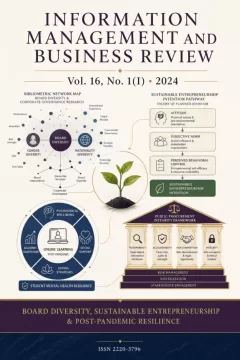 Vol. 16 No. 1(I) (2024)
Board Diversity, Sustainable Entrepreneurship & Post-Pandemic Resilience
View issue contents
Published
Submissions
Have research to publish? Information Management and Business Review welcomes submissions.
Make a Submission