Abstract
According to the recent Malaysian MADANI Budget 2023 which has been declared by Prime Minister Datuk Seri Anwar Ibrahim, it is notable that 7 billion was allocated to help micro-entrepreneurs, women and youth. Therefore, it is crucial to ensure that the clients have appropriate financial literacy to ensure that the loans can be repaid accordingly. For microcredit clients to have this ability, they should have sound financial literacy to be able to manage their money, make wise decisions, and maintain vigorous spending. Thus, to promote sustainable financial sustainability, the objective of this study is to assess the level of microcredit financial literacy of microcredit clients in enhancing their knowledge, skills and transparency that can lead to financial sustainability. Further, it will also test empirically whether microcredit financial literacy can integrate the cognitive comprehension of financial knowledge, skills and responsibility with respect to financial sustainability. This study will use an exploratory sequential mixed-method research design that combines quantitative (questionnaires) and qualitative (interviews) data. The data-gathering method then continues with concentrated group interviews on selected microcredit clients. This covers clients from TEKUN Nasional Melaka to deliberate on related problems. Data analysis in qualitative research focuses on the systematic search and arrangement of interview transcripts. Interviews are necessary to gain a thorough understanding of issues with financial knowledge and skills among clients. It is expected that the study will benefit the policy maker, microcredit clients and the government in enhancing financial inclusion and sustainability. Thus, the government's slogan "Developing Malaysia MADANI" can be achieved.
Keywords
- Microcredit Clients Search this journal for Microcredit Clients (opens in a new tab)
- Financial Literacy Search this journal for Financial Literacy (opens in a new tab)
- Financial Inclusion Search this journal for Financial Inclusion (opens in a new tab)
- Sustainability Search this journal for Sustainability (opens in a new tab)
- TEKUN Search this journal for TEKUN (opens in a new tab)
References
- Ajibola, M. I., Saheed, O. D., and Adedoyin, L. (2020). Impact of microfinance institutions on financial literacy in north central geo-political zone Nigeria. Copernican Journal of Finance & Accounting, 9(4), 9-25
- Central Bank of Malaysia. Financial Stability and Payment Systems Report; Central Bank of Malaysia: Kuala Lumpur, Malaysia, 2019.
- Lusardi, A. (2019). Financial literacy and the need for financial education: evidence and implications. Swiss Journal of Economics and Statistics, 155(1), 1-8.
- Lusardi, A. and Olivia S. M. (2014). The Economic Importance of Financial Literacy: Theory and Evidence. Journal of Economic Literature, 52 (1), 5-44.
- Ledgerwood, J., Earne, J., & Nelson, C. (2013). The new microfinance handbook: A financial market system perspective: The World Bank.
- Maeenuddin, S. A., Mochammad, F., Annuar, M. N. & Padzil, M. H. (2023). Predictors of microfinance sustainability: Empirical evidence from Bangladesh, Cogent Economics & Finance, 11, 2202964.
- Malaysia's Financial Literacy Month. (2020).
- Marwa, N. & Aziakpono, M. (2015). Financial sustainability of Tanzanian saving and credit cooperatives. International Journal of Social Economics, 42(10), 870–887.
- Mitra, S. K. (2017). Does the number of borrowers per loan officer influence microfinance institution asset quality? A stochastic frontier analysis. Investigación económica, 76(300), 81–103.
- Mokhtar, S. H. & Ashhari, Z. M. (2015). Issues and challenges of microcredit programs in Malaysia. Asian Social Science, 11(26), 191-195.
- National Strategy for Financial Literacy. (2019-2023).
- Nazrie Mohd Nor, A., & Kumar T., S. (2019). The Chronology of Microfinance Development in Malaysia: A Review. KnE Social Sciences, 3(22), 1271–1284.
- Nor Izzati, M. A. and Salina, K. (2020). Does Financial Literacy Really Matter for Malaysians? A Review. Advanced International Journal of Banking, Accounting and Finance (AIJBAF), 2(2), 13-20 DOI 10.35631/AIJBAF.22002
- Paiella, M. (2016). Financial literacy and subjective expectations questions: A validation exercise. Research in Economics 70 (2): 360–374.
- Rastogi, S., Tripathi, V. & Kuknor, S. (2021). Informational role of futures volume for spot volatility. Pacific Accounting Review.
- Sayankar, V. & Mali, V. (2022). Financial Literacy for Microfinance Clients: A Step Towards Financial Inclusion, Journal of Maharaja Sayajiao University of Baroda, 56(2), 110-115.
- Shu-Teng, L., Mohd Ashhari, Z., Suraya-Hanim, M., & Nassir, A. (2015). Determinants of Microfinance Repayment Performance: Evidence from Small Medium Enterprises in Malaysia (Vol. 7).
- Singh, A. B. & Tandon, P. (2012). Financial inclusion in India: an analysis. International Journal of Marketing, Financial Services and Management Research, 1(6), 41-54.
- The Economic Importance of Financial Literacy: Theory and Evidence Annamaria Lusardi and Olivia S. Mitchell NBER Working Paper No. 18952 April 2013 JEL No. D91
- Yamamoto, K., Ota, K., Akiya, I., & Shintani, A. (2017). A pragmatic method for transforming clinical research data from the research electronic data capture “REDCap” to Clinical Data Interchange Standards Consortium (CDISC) Study Data Tabulation Model (SDTM): Development and evaluation of REDCap2SDTM. Journal of Biomedical Informatics, 70, 65-76.
Downloads
No downloads have been recorded for this article yet. Figures appear here once readers begin downloading the full text.
How to Cite
Share this article
License
Copyright (c) 2024 Azlina Rahim, Vani Tanggamani, Hamidah Bani, Nor Ashikin Alias (Author)

This work is licensed under a Creative Commons Attribution 4.0 International License.
Author (s) should affirm that the material has not been published previously. It has not been submitted and it is not under consideration by any other journal. At the same time author (s) need to execute a publication permission agreement to assume the responsibility of the submitted content and any omissions and errors therein. After submission of revised paper in the light of suggestions of the reviewers, the editorial team edits and formats manuscripts to bring uniformity and standardization in published material.
This work will be licensed under Creative Commons Attribution 4.0 International (CC BY 4.0) and under condition of the license, users are free to read, copy, remix, transform, redistribute, download, print, search or link to the full texts of articles and even build upon their work as long as they credit the author for the original work. Moreover, as per journal policy author (s) hold and retain copyrights without any restrictions.
Keywords
- Microcredit Clients Search this journal for Microcredit Clients (opens in a new tab)
- Financial Literacy Search this journal for Financial Literacy (opens in a new tab)
- Financial Inclusion Search this journal for Financial Inclusion (opens in a new tab)
- Sustainability Search this journal for Sustainability (opens in a new tab)
- TEKUN Search this journal for TEKUN (opens in a new tab)
Section
Published in
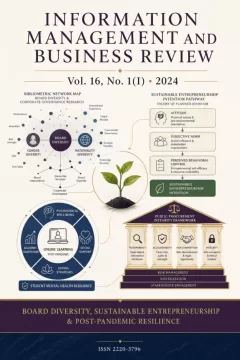 Vol. 16 No. 1(I) (2024)
Board Diversity, Sustainable Entrepreneurship & Post-Pandemic Resilience
View issue contents
Published
Submissions
Have research to publish? Information Management and Business Review welcomes submissions.
Make a Submission