Abstract
A notable challenge for Malaysian women entrepreneurs is the lack of adequate financial literacy, which leads to a major setback in their business growth. According to the National Strategy for Financial Literacy 2019 – 2024, the significant objective of Malaysia’s Strategic Plans, is to educate women entrepreneurs in engaging in good financial management systems, by actively focusing on vulnerable parts of society. This comprises nurturing money management knowledge and skills via community-based and instilling encouraging behavior toward financial plans. However, it was discovered that women entrepreneurs have poor financial knowledge and a narrow-minded "just live for today" mindset when it comes to financial planning. The FOMCA fully supports Bank Negara Malaysia’s anxious, absence of financial knowledge in the year 20222023. Failure to hold the values of appropriate financial management systems is a key problem for community development. Thus, the purpose of this study is to raise financial literacy among Malaysian women entrepreneurs to encourage accountable behavior and rational thinking to improve financial knowledge, financial skills and financial responsibility. Women entrepreneurs play a vital role in creating a sustainable, viable and wealthy community. In sum, it may decrease poverty among those in the category of B40 community. Thus, this study is extremely referred to in the cognitive approach of strong financial knowledge, financial skills and financial responsibility of the group to be considered, giving importance to the development of the community economic activities and program. This study adopts the theory of resource-based view and uses a mixed-method design that combines the quantitative research methods of questionnaires and qualitative research method of semistructured in-depth interviews to improve the level of financial literacy that is anticipated to advance financially literate women entrepreneurs for sustainable economic wellbeing. The outcome of this study is expected to alleviate women entrepreneurs’ economic well-being since there is no specific benchmark of financial literacy for women-based entrepreneurship currently. Integrating the standpoints of women entrepreneurs is recognized as the mission of the Ministry of Women, Family, and Community Development to increase the number of participants and raise the status of women entrepreneurs in this country as well as towards "Developing Malaysia MADANI", support the principles of Shared Prosperity Vision and the mission of SDG2030.
Keywords
- Strong Financial Literacy Search this journal for Strong Financial Literacy (opens in a new tab)
- Women Entrepreneur Search this journal for Women Entrepreneur (opens in a new tab)
- Financial Knowledge Search this journal for Financial Knowledge (opens in a new tab)
- Financial Responsibility Search this journal for Financial Responsibility (opens in a new tab)
- Financial Skills Search this journal for Financial Skills (opens in a new tab)
References
- Adam, A., Abdullah, W. R. W., Maruhun, E. N. S., Anwar, I. S. K. & Salin, A. S. A. P. (2022). The Resource-Based View Theory and Women Microbusiness Entrepreneurs: A Contribution to Business Sustainability. International Journal of Academic Research in Business and Social Sciences, 12(10), 2915-2932.
- Artavanis, N. & Kara, S. (2020). Financial Literacy and Student Debt. European Journal of Finance, 26(4–5), 382–401.
- Agnew, S. (2018). Empirical measurement of the financial socialization of children by parents. Young Consumers, 19(4), 421–431.
- Aydin, A. E. & Selcuk, E. A. (2018). An investigation of financial literacy, money ethics and time preferences among college students, 2017(113).
- Bottazzi, L. & Lusardi, A. (2021). Stereotypes in financial literacy: Evidence from PISA. Journal of Corporate Finance, 71(5), 101831.
- Boisclair, D., Lusardi, A. & Michaud, P. C. (2017). Financial literacy and retirement planning in Canada. Journal of Pension Economics & Finance,16(3), 277–296.
- Brilianti, T. R. & Lutfi, L. (2020). Pengaruh pendapatan, pengalaman kewangan dan pengetahuan kewangan terhadap perilaku kewangan keluarga di Kota Maidun. Journal of Business and Banking, 9(2).
- Engels, C., Kamlesh, K. & Philip, D. (2020). Financial Literacy and Fraud Detection. European Journal of Finance, 26 (4–5), 420–442.
- Erokhin, V. & Gao, T. (2020). Impacts of COVID-19 on trade and economic aspects of food security: Evidence from 45 developing countries. International Journal of Environmental Research and Public Health, 17(16), 5775.
- Fan, L. & Henager, R. (2023). A structural determinants framework for financial well-being. Journal of Family and Economic Issues, 43(2), 415-428.
- Fan, L. & Chatterjee, S. (2018). Application of situational stimuli for examining the effectiveness of financial education: A behavioral finance perspective. Journal of Behavioural and Experimental Finance, 17, 68–75.
- Frisancho, V. (2019a). The impact of financial education for youth. Economics of Education Review, 10, 1918.
- Ghazali, M. S., Alwi, S. F. S., Othman, I., Sabri, M. F. & Aziz, N. N. A. (2022). The Relationship between Subjective Financial Knowledge and Financial Well-Being among Emerging Adults in Malaysia, 12(4), 1263–1284.
- Gomez, G. M. & Helmsing, A. B. (2020). Social entrepreneurship: A convergence of NGOs and the market economy? NGO Management (pp. 391-402), Routledge
- Hasan, R., Ashfaq, M., Parveen, T. & Gunardi, A. (2022). Financial inclusion – does digital financial literacy matter for women entrepreneurs? International Journal of Social Economics
- Ibn-Mohammed, T., Mustapha, K. B., Godsell, J. M., Adamu, Z., Babatunde, K. A., Akintade, D. D., Acquaye, A., Fujii, H., Ndiaye, M. M., Yamoah, F. A. & Koh, S. C. L. (2020). A critical review of the impacts of COVID-19 on the global economy and ecosystems and opportunities for circular economy strategies, Resources, Conservation and Recycling, 105169, DOI: 10.1016/j.resconrec.2020.105169.
- Indriaswari, I., Ulupui, I. G. K. A. & Warokka, A. (2022). Financial knowledge, financial attitude, and locus of control: Reviewing, influence on financial management behavior using financial literacy as moderation variable. The International Journal of Social Sciences World (TIJOSSW), 4(2), 431-443.
- Lyons, A. C. & Kass-Hanna, J. (2021). A methodological overview to defining and measuring ‘digital’ financial literacy. Financial Planning Review, 42(2), 1113.
- Ministry of Women, Family and Community Development. (2022).
- Malaysia Department of Insolvency. (2022). https://www.mdi.gov.my/index.php/ms/.
- Malaysia's Financial Literacy Month. (2022)
- Mohamed, N. A. (2017). Financial socialization: a cornerstone for young employees’ financial well-being. Reports on Economics and Finance, 3(1), 15–35.
- Odetayo, T. A., Sajuyigbe, A. S. & Adeyemi, A. Z. (2020). Financial Literacy and Financial Inclusion as Tools to Enhance Small Scale Businesses’ Performance in Southwest, Nigeria, Finance & Economics Review, 2(3), 1-13.
- Paskelian, O., Jones, K., Bell, S. & Kao, R. (2019). Financial Literacy and Behavioural Biases among Tradition al Age College Students. Accounting and Finance Research, 8(1).
- Prakash, N., Alagarsamy, S. & Hawaldar, A. (2022). Demographic characteristics influencing financial wellbeing: a multigroup analysis. Managerial Finance. https://doi.org/10.1108/MF-09-2021-0466
- Rashid, M. F., Misnan, S. H. & Samsudin, N. A. (2019). Measuring The Determinants for Differentiation in Vill age Economic Performance in Rural Malaysia. 4th International Conference on Rebuilding Place. The European Proceedings of Multidisciplinary Sciences
- Ricciuti, E. & Calo, F. (2018). NGOs and governance, In Global Encyclopaedia of Public Administration, Public Policy, and Governance, Springer.
- The Organization for Economic Co-operation and Development (OECD), OECD/Info Toolkit to Measure Financial Literacy and Financial Inclusion: Guidance, Core Questionnaire and Supplementary Questions. Available online: http://www.oecd.org/finance/financial-education/Toolkit-to-measure-fin-lit.pdf
- The Organization for Economic Co-operation and Development (OECD). (2022).
- Wagner, J. (2015). An Analysis of The Effects of Financial Education on Financial Literacy and Financial Behaviours.
- Younas, K. & Rafay, A. (2021). Women entrepreneurship and financial literacy - Case of female borrowers in Pakistan. Iranian Economic Review, 25(3), 525-534
- Zhang, H. (2020). The influence of the ongoing COVID-19 pandemic on family violence in China. Journal of Family Violence, 1-11, doi.org/10.1007/s10896-020-00196-8.
Downloads
No downloads have been recorded for this article yet. Figures appear here once readers begin downloading the full text.
How to Cite
Share this article
License
Copyright (c) 2024 Vani Tanggamani, Azlina Rahim, Hamidah Bani, Nor Ashikin Alias (Author)

This work is licensed under a Creative Commons Attribution 4.0 International License.
Author (s) should affirm that the material has not been published previously. It has not been submitted and it is not under consideration by any other journal. At the same time author (s) need to execute a publication permission agreement to assume the responsibility of the submitted content and any omissions and errors therein. After submission of revised paper in the light of suggestions of the reviewers, the editorial team edits and formats manuscripts to bring uniformity and standardization in published material.
This work will be licensed under Creative Commons Attribution 4.0 International (CC BY 4.0) and under condition of the license, users are free to read, copy, remix, transform, redistribute, download, print, search or link to the full texts of articles and even build upon their work as long as they credit the author for the original work. Moreover, as per journal policy author (s) hold and retain copyrights without any restrictions.
Keywords
- Strong Financial Literacy Search this journal for Strong Financial Literacy (opens in a new tab)
- Women Entrepreneur Search this journal for Women Entrepreneur (opens in a new tab)
- Financial Knowledge Search this journal for Financial Knowledge (opens in a new tab)
- Financial Responsibility Search this journal for Financial Responsibility (opens in a new tab)
- Financial Skills Search this journal for Financial Skills (opens in a new tab)
Section
Published in
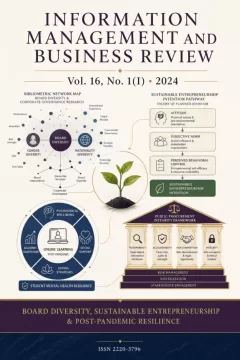 Vol. 16 No. 1(I) (2024)
Board Diversity, Sustainable Entrepreneurship & Post-Pandemic Resilience
View issue contents
Published
Submissions
Have research to publish? Information Management and Business Review welcomes submissions.
Make a Submission