Abstract
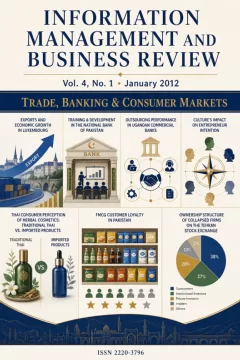
The main purpose of this study is to identify the role of entrepreneurship in Pakistan. After reviewing the literature, researchers identify those predictors who influence the entrepreneur’s intention with the help of socio cognitive model. National culture of a country influences the entrepreneur’s intention to start new business. Perceived feasibility, perceived desirability and entrepreneurs experience has a direct impact on entrepreneur’s intention. The study finds out the impact of culture on entrepreneur intention, different cultures have different ways to influence the entrepreneur intention and different ways to impact on intentions towards perceived feasibility and perceived desirability .The study helps entrepreneur’s decision making process and also helps out the development of further new business in Pakistan, motivates students to become entrepreneurs and analyzes their feasibility and desirability. Culture varies from country to country, within country different provinces, how different cultures, different traditions, norms and values. So in future, it helps to analyze entrepreneur’s intention in different cultures.
Keywords
- Pakistan’s Society Search this journal for Pakistan’s Society (opens in a new tab)
- Entrepreneurship Search this journal for Entrepreneurship (opens in a new tab)
- Entrepreneur’s Experience Search this journal for Entrepreneur’s Experience (opens in a new tab)
- Culture Search this journal for Culture (opens in a new tab)
References
- Ajzen, I. (1991). Theory of planned behavior. Organizational Behavior and Human Decision Processes , 50(1), 179-211.
- Bandura, A. (1994). Self-efficacy, in Ramachaudran, V.S. (Ed.). Encyclopedia of Human Behavior Academic Press, 4, 71-81.
- Bird, B. (1988). Implementing entrepreneurial ideas: the case for intentions. Academy of Management Review , 13, 442-449.
- Cristina, J. & Dwayne, D. (2009). An exploratory study of competitive strategies among hotels in a small developing Caribbean state. International Journal of Contemporary Hospitality Management , 21(4), 491 – 500.
- Danns, G. K. & Mentore, M. M. (1995). Race and economic power in Guyana: a study of the East Indians, in Ryan, S. and Stewart, T. (Eds), Entrepreneurship in the Caribbean: Culture, Structure, Conjuncture, University of the West Indies, Institute of Social and Economic Research, Trinidad and Tobago.
- Fernandez, D. R., Carlson, D. S., Stepina, L. P. & Nicholson, J. D. (1997). Hofstede’s country classification 25 years later. Journal of Social Psychology , 137(1), 43-54.
- Frese, M. & Zapf, D. (1994). Action as the core of work psychology, in Trandis, H. C., Dunnette, M. D. and Hough, L. (Eds), Handbook of Industrial and Organ.
- George, G. & Prabhu, G. (2000). Developmental financial institutions as catalysts of Entrepreneurship in emerging economies. Academy of Management Review , 25, 620-30.
- Hayton, J. C., George, G. & Zahara, S. A. (2002). National culture and entrepreneurship: a review of behavioral research. Entrepreneurship Theory and Practice , 26(4), 33-53.
- Hofstede, G. (1980). Culture’s Consequences: International Differences in Work Related Values, Sage, Beverly Hills, CA.
- Krueger, N. & Dickson, P. R. (1994). How believing in ourselves increases risk taking: perceived self-efficacy and opportunity recognition. Decision Sciences , 25(3), 385-400.
- Krueger, N. (1993). The impact of prior entrepreneurial exposure on perceptions of new venture feasibility and desirability. Entrepreneurship Theory and Practice , 3, 5-21.
- Krueger, N., Reilly, M. & Carsrud, A. (2000). Competing models of entrepreneurial intentions. Journal of Business Venturing , 15(2), 411-32.
- Mark-Pruett, R., Bryan, T., Francisco, L. & Jerry, F. (2008). International Journal of Entrepreneurial Behaviour & Research , 15(6), 571-594.
- Mitchell, R., Smith, J. B., Morsem, E. A., Seawright, K., Peredo, A. M. & McKenzie, B. (2002). Are entrepreneurial cognitions universal? Assessing entrepreneurial cognitions across cultures. Entrepreneurship Theory and Practice , 26(4), 9-32.
- Reardon, T., Crawford, E. & Kelly, V. (1989). Link between nonfarm income and farm investment in Africa households: Adding the capital marketing perspective. American journal of Agriculture Economics, 76 (5), 172-179.
- Romer, P. (1994). The origins of endogenous growth. Journal of Economic Perspectives , 8(1), 3-22.
- Shane, S. (2003). A General Theory of Entrepreneurship, Edward Elgar, Cheltenham.
- Shapero, A. (1975). The displaced, uncomfortable entrepreneur, Psychology Today , 9(11), 83-8.
- Shapero, A. & Sokol, L. (1982). Some social dimensions of entrepreneurship in Kent, C. (Ed.), Encyclopedia of Entrepreneurship, Prentice-Hall, Englewood Cliffs, NJ, 72-90.
- Zhao, H., Hills, G. E. & Siebert, S. E. (2005). The mediating role of self-efficacy in the development of entrepreneurial intentions. Journal of Applied Psychology , 90(6), 1265-1272.
Downloads
No downloads have been recorded for this article yet. Figures appear here once readers begin downloading the full text.
How to Cite
Share this article
License
Copyright (c) 2012 Syed Imran Sajjad, Haroon Shafi, Aasim Munir Dad (Author)

This work is licensed under a Creative Commons Attribution 4.0 International License.
Author (s) should affirm that the material has not been published previously. It has not been submitted and it is not under consideration by any other journal. At the same time author (s) need to execute a publication permission agreement to assume the responsibility of the submitted content and any omissions and errors therein. After submission of revised paper in the light of suggestions of the reviewers, the editorial team edits and formats manuscripts to bring uniformity and standardization in published material.
This work will be licensed under Creative Commons Attribution 4.0 International (CC BY 4.0) and under condition of the license, users are free to read, copy, remix, transform, redistribute, download, print, search or link to the full texts of articles and even build upon their work as long as they credit the author for the original work. Moreover, as per journal policy author (s) hold and retain copyrights without any restrictions.
Keywords
- Pakistan’s Society Search this journal for Pakistan’s Society (opens in a new tab)
- Entrepreneurship Search this journal for Entrepreneurship (opens in a new tab)
- Entrepreneur’s Experience Search this journal for Entrepreneur’s Experience (opens in a new tab)
- Culture Search this journal for Culture (opens in a new tab)
Section
Published
Submissions
Have research to publish? Information Management and Business Review welcomes submissions.
Make a Submission