Articles

  • Article 1 in this issue

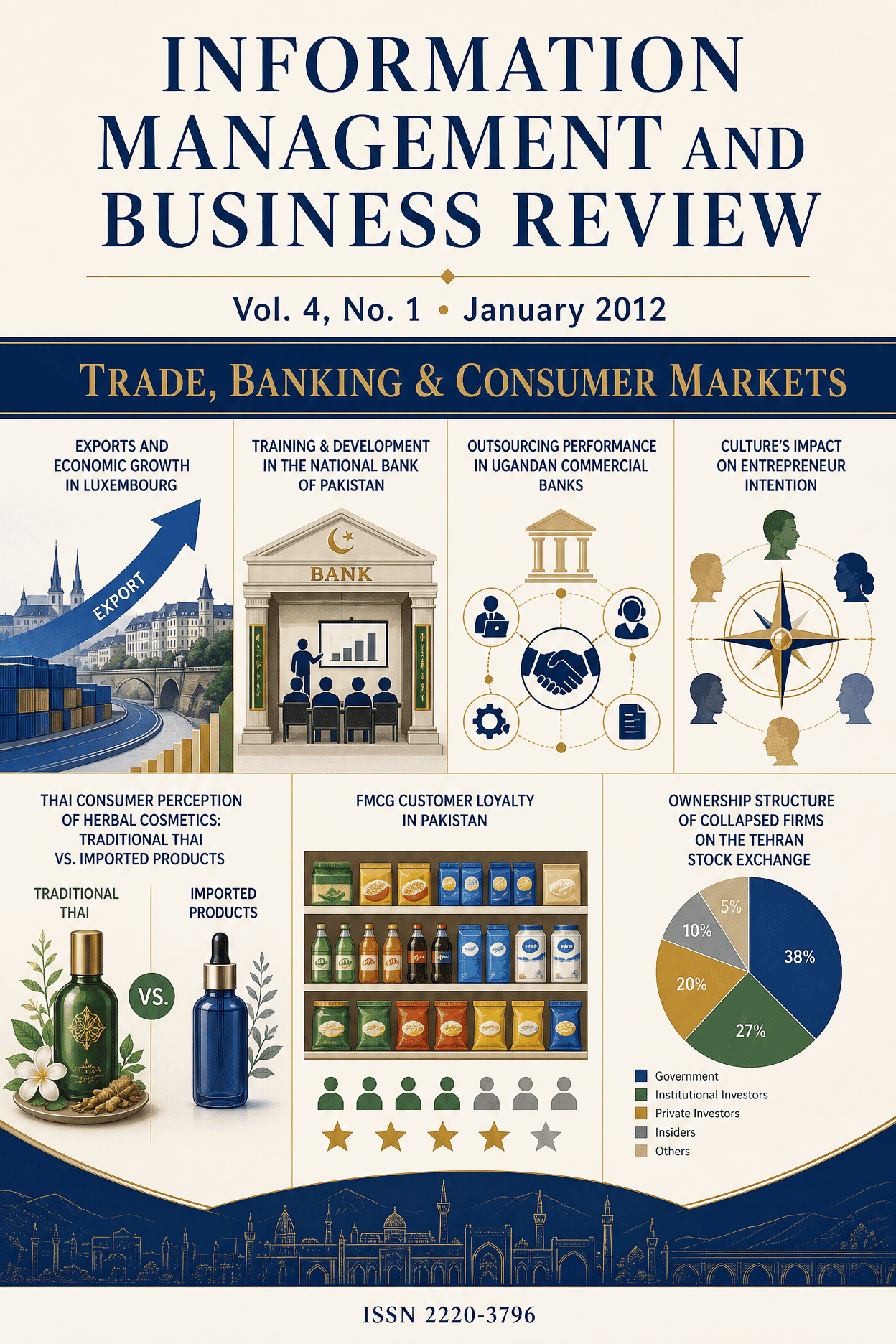
    Impact of Exports on Economic Growth - A Case of Luxemburg

    • Author: Muhammad Usman, Muzaffar Ali, Hafiz Waqas Kamran, Hassan Khalid

    The key purpose of this article is to analyze the significant impact of Exports, Government expenditures and Education expenditures on the economic growth of the developed economy of the Luxemburg, which is the member state of the EU: the biggest exporter in the world. The span of time is from the year 1975 to 2009 on yearly basis with total no. of observations of 35. Present analysis is based on the simple ordinary least square method to indentify the important linkage between the export and the growth considering the economy of Luxemburg. Experimental results reveal a significant positive relationship of exports, government spending, educational expenditure, on growth of the economy. Export shows that one unit increase in the export cause a positive change of .17 in the economic growth. In the same way government, exp. and education exp. show a coefficient of 2.67 and 9.93 with positive sign. This article identifies the association between the export and the economic growth with respect to Luxemburg.

    Pages 1-7

    PDF - Impact of Exports on Economic Growth - A Case of Luxemburg (opens in a new tab)
  • Article 2 in this issue

    Training & Development Practices in National Bank of Pakistan

    • Author: Abdul Qayyum, Muhammad Tariq Sharif, Awais Ahmad, Murad Shuaib Khan, Kashif-Ur-Rehman

    The purpose of this study is to explore the training & development practices in National Bank of Pakistan (NBP). Different levels of officers are providing training & development opportunities in NBP. Data collected from different staff colleges of NBP. Result of this study shows, bank is providing training & development opportunities to its employees, but there is still gap which should be addressed. Training need analysis is not sufficient. Most of the trainers belong to operational background and they are unable to provide the sufficient training to develop the good employees. Bank does not have sufficient T&D plan for the top-level management.

    Pages 8-17

    PDF - Training & Development Practices in National Bank of Pakistan (opens in a new tab)
  • Article 3 in this issue

    Explaining Outsourcing Performance in Uganda’s Commercial Banks

    • Author: Benjamin. R. Tukamuhabwa, Joseph Ntayi, Moses Muhwezi, Sarah Eyaa, John Saturday

    This study aimed at investigating outsourcing performance in Uganda’s commercial banks basing on the variables of contract, relational norms, trust and commitment. It was motivated by the fact that where as outsourcing has been identified as a global trend in this millennium and a competitive strategy for the contemporary business, there were limited (if any) empirical studies on outsourcing performance in Uganda. Besides, previous studies conducted outside Uganda have provided conflicting views on whether or not contract and relational norms can be used concurrently to enhance outsourcing performance. The study was also intended to contribute to this debate by establishing the extent to which the variation in outsourcing performance was explained by the model that was developed. Findings revealed that the only significant predictor of outsourcing performance was contract and the model accounted for 40.1% of the variation in outsourcing performance. The findings present implications for commercial bank management in the area of contracting and contract management, which have to be addressed if outsourcing performance is to be enhanced and competitiveness in the banking sector improved.

    Pages 18-29

    PDF - Explaining Outsourcing Performance in Uganda’s Commercial Banks (opens in a new tab)
  • Article 4 in this issue

    Impact of Culture on Entrepreneur Intention

    • Author: Syed Imran Sajjad, Haroon Shafi, Aasim Munir Dad

    The main purpose of this study is to identify the role of entrepreneurship in Pakistan. After reviewing the literature, researchers identify those predictors who influence the entrepreneur’s intention with the help of socio cognitive model. National culture of a country influences the entrepreneur’s intention to start new business. Perceived feasibility, perceived desirability and entrepreneurs experience has a direct impact on entrepreneur’s intention. The study finds out the impact of culture on entrepreneur intention, different cultures have different ways to influence the entrepreneur intention and different ways to impact on intentions towards perceived feasibility and perceived desirability .The study helps entrepreneur’s decision making process and also helps out the development of further new business in Pakistan, motivates students to become entrepreneurs and analyzes their feasibility and desirability. Culture varies from country to country, within country different provinces, how different cultures, different traditions, norms and values. So in future, it helps to analyze entrepreneur’s intention in different cultures.

    Pages 30-34

    PDF - Impact of Culture on Entrepreneur Intention (opens in a new tab)
  • Article 5 in this issue

    Thai Consumers’ Perception on Herbal Cosmetic Products: A Comparative Study of Thai and Imported Products

    • Author: Rojanadilok Thanisorn, Nanagara Byaporn, Bunchapattanasakda Chanchai

    This research investigated the factors that influence perception of Thai consumers on facial herbal cosmetic products in Thailand. In- depth interview the perception of Thai consumers was utilized in data collection, while content analysis was employed in data analysis. The facial herbal cosmetics products are moisturizer, whitening lotions, creams, powder, toner, make up cleansing, mask, cleansing oil, soap bar, anti-aging lotions and creams. This study revealed that most of the interviewees were female with age between 26-30 years, casual worker ,bachelor degree being the highest education and salary from 10,000 -15,000 baht ($285-430) per month. The marketing mix (4Ps: product, price, place and promotion) were the key factors influencing Thai consumers’ perception on facial herbal cosmetic products. The result found that Thai consumers were satisfied with physical appearance of products; texture, odor, penetration- characteristic and viscosity. Thai consumers trust in the safety of the Thai and imported products. The imported products have new manufacturing technologies of production compare with the Thai products but imported products are more expensive than Thai products. Thai consumers were satisfied with packaging design and pump bottle shape of imported products. Thai consumers found it was convenience to purchasing both herbal products from department store. The direct sale is popular only for Thai products. The imported products had more interesting marketing promotion than the Thai products. The marketing promotions are new product premium, promotion campaign eg. Cash discount, gift premium, fortune, tarot horoscope, makes up and massage workshop. Thai consumers were satisfied with advertisement of both herbal products; brochure, leaflet, beauty information from general magazine, fashion magazine, general book, television and radio. The economic situation, such as inflation situation, is the majority factor of purchasing decision. The average cosmetic budget per each purchase is 1,800 baht (about $50) at the rate of eight purchases per year.

    Pages 35-40

    PDF - Thai Consumers’ Perception on Herbal Cosmetic Products: A Comparative Study of Thai and Imported Products (opens in a new tab)
  • Article 6 in this issue

    Customer Loyalty in FMCG Sector of Pakistan

    • Author: Khansa Zaman, Samina Bibi, Asma Arshad, Aqeel Shahzad

    The purpose of this study is to find an empirical relationship of proposed variables and to find the impact of customer satisfaction, trust, and corporate reputation on customer loyalty. This study attempts to contribute to the knowledge how FMCG companies of Pakistan can retain their customers by making them loyal through satisfaction, trust, and corporate reputation. A theoretical framework is proposed to suggest links among variables. The sample size selected for research constitutes 200 respondents, and these respondents belong to the cities of Rawalpindi and Islamabad, Pakistan. Multiple regression and correlation coefficient was used to examine hypothesized relationship. Regression analysis reveals that customer satisfaction, trust, and corporate reputation bring 79.0% change in customer loyalty. There is a strong positive yet significant relationship of trust and customer loyalty. Customer satisfaction & corporate image also posit a positive and significant impact on customer loyalty. The results indicate that FMCG companies in Pakistan should pay more attention toward the reputation of their company, satisfaction of their customers, and trust in order to build loyalty of customers. Generalizability and time constraint are the limitations of the study.

    Pages 41-48

    PDF - Customer Loyalty in FMCG Sector of Pakistan (opens in a new tab)
  • Article 7 in this issue

    The Comparison of the Ownership Structure at Different Level of the Financial Collapse in Listed Firms of Tehran Stock Exchange

    • Author: Saeid Jabbarzadeh Kangarlouei, Vida Fattahi, Morteza Motavassel

    The main objective of this study is to compare ownership structure of different levels of collapse in listed companies of Tehran Stock Exchange (TSE). Study variables are the ownership structure that includes governmental ownership, private ownership (corporate ownership and individual ownership) and the different levels of collapse including latency stage, the stage of cash deficits and commercial and financial insolvency and complete collapse. Altman model (Z´- Score) is used to predict the collapse of firm and Chi-Square test is used to test the research hypothesis. The study is the applied research and statistical population of study includes 96 collapse firms that are active in the TSE (subject to Business Law Article 141). Given the availability of financial information of distressed companies in 7 years between 2004-2010 years, a sample of 81 members was selected. The results show that the ownership structure of collapsed firms is independent from their different levels of collapse.

    Pages 49-55

    PDF - The Comparison of the Ownership Structure at Different Level of the Financial Collapse in Listed Firms of Tehran Stock Exchange (opens in a new tab)