Abstract
A Management Control System (MCS) is a comprehensive mechanism organizations can use to ensure that their strategies and plans are effectively implemented to achieve their objectives. This concept paper explores the application of Management Control Systems (MCS), specifically concerning levers of control (LOC), for behavioral control. Based on the comprehensive literature review, it is expected that LOC will be able to provide a pathway to mitigate corruption not only from the perspective of fraud diamond theory but also from the perspective of agency theory. Agency theory highlights the inherent conflict of interest between agents, who have more information about their actions and intentions, and principals, who rely on agents to act in their best interest. This information asymmetry creates opportunities for agents to engage in corrupt practices, such as embezzlement, bribery, or fraud, including unethical behavior that may undermine organizational goals and trust. Effective control mechanisms are essential to mitigate these risks and ensure alignment between agents' actions and principals' objectives. Furthermore, organizations can apply the principles of fraud diamond theory when creating an effective control framework to deter corruption .
Keywords
- Management Control System Search this journal for Management Control System (opens in a new tab)
- Levers of Control Search this journal for Levers of Control (opens in a new tab)
- Agency Theory Search this journal for Agency Theory (opens in a new tab)
- Corruption Search this journal for Corruption (opens in a new tab)
References
- Anthony, R. (1965). Planning and control systems: a framework for analysis. Division of Research, Harvard University Graduate Business School of Business Administration, Boston.
- Aktan, C. C. (2015). Ethics in government: anti-corruption measures. International Journal of Social Sciences And Humanity Studies, 7(2). 63–89.
- Alhekail, N. A. (2019). The dynamic of normalizing corruption in government institutions. (Doctoral dissertation, University of Kansas). ProQuest Dissertations and Theses Global.
- Bukh, P. N., & Svanholt, A. K. (2020). Empowering middle managers in social services using management control systems. Journal of Public Budgeting Accounting and Financial Management, 32(2), 267-289. https://doi.org/10.1108/jpbafm-06-2019-0096
- Challagalla, G. N., & Shervani, T. A. (1997). A measurement model of the dimensions and types of output and behavior control: an empirical test in a salesforce context. Journal of Business Research, 39, 159-172. https://doi.org/10.1016/s0148-2963(96)00195-6
- Fagbemi, T. O. (2012). Influence of institutional and contingency factors on managerial dysfunctional behavior outcome of management control systems in Nigerian companies. (Doctoral dissertation, University of Lagos). Available at https://api-ir.unilag.edu.ng/server/api/core/bitstreams/3498af52-6a4d-4130-b120-c5ae486cb3d4/content
- Fisher, J. (1995). Contingency-based research on management control systems: categorization by level of complexity. Journal of Accounting Literature, 14, 24-53.
- Free, C., Macintosh, N., & Stein, M. (2007). Management controls: the organizational fraud triangle of leadership, culture, and control in Enron. Ivey Business Journal. Available at: https://iveybusinessjournal.com/publication/management-controls-the-organizational-fraud-triangle-of-leadership-culture-and-control-in-enron/
- Haron, N. H., Alias, N., Tuan Zainun, T. M., & Ali, M.M. (2023). Developing pathway towards fraud prevention in an organization: the application of levers of control and fraud diamond theory. Econ. Aff., 68(02), 1227-1233. https://doi.org/10.46852/0424-2513.2.2023.28
- Jones, D. S. (2020). 1MDB corruption scandal in Malaysia: a study of failings in control and accountability. Public Administration and Policy, 23, 59-72. https://doi.org/10.1108/pap-11-2019-0032
- Kerr, L. (1985). Diversification strategies and managerial rewards: an empirical study. Academy of Management Journal, 28: 155–179. doi: 10.2307/256066
- Klein, L., Beuren, I. M., & Vesco, D. D. (2019). Effects of the management control system on unethical behaviors. RAUSP Management Journal, 54(1), 54-76. doi: 10.1108/rausp-06-2018-003
- Kober, R., Ng, J., & Paul, B. J. (2007). The interrelationship between management control mechanisms and strategy. Management Accounting Research, 18, 425–452. https://doi.org/10.1016/j.mar.2007.01.002
- Laguecir, A. & Leca, B. (2022). Organized decoupling of management control systems: an exploratory study of traders’ unethical behavior. J Bus Ethics, 181, 153–169. https://doi.org/10.1007/s10551-021-04741
- Langevin, P., & Mendoza, C. (2013). How can management control system fairness reduce managers’ unethical behaviors? European Management Journal, 31, 209-222. https://doi.org/10.1016/j.emj.2012.12.001
- Langseth, A. (2006). Measuring Corruption. In Sampford, C. Shacklock, A. & Connors, C. (Ed), Measuring Corruption (pp. 8–45). Ashgate Publishing Limited.
- Lawler, E. E., & Rhode, J. G. (1976). Information and control in organizations. Pacific Palisades, CA: Goodyear.
- Lopez-Valeiras, E., Gomez-Conde, J., Naranjo-Gil, D., & Malagueño, R. (2022). Employees’ perception of management control systems as a threat: effects on deliberate ignorance and workplace deviance. Accounting Forum, 1–28. https://doi.org/10.1080/01559982.2022.2140500
- Martyn, P., Sweeney, B., & Curtis, E. (2016). Strategy and control: 25 years of empirical use of Simons’ levers of control framework. Journal of Accounting & Organizational Change, 12(3), 281–324.
- Martínez Ramos, M. & Gutiérrez Hidalgo, F. (2003). From diagnostic to interactive style of management control. Management Research News, 26(5), 21-31. https://doi.org/10.1108/01409170310783448
- Oatley, D. (1999). Performance management: a framework for management control systems research. Management Accounting Research, 10, 363–382. https://doi.org/10.1006/mare.1999.0115
- Ouchi, W.G. (1977). The relationship between organizational structure and organizational control. Administrative Science Quarterly, 20: 95–113. https://doi.org/10.2307/2391748
- Ouchi, W.G. (1979). A conceptual framework for the design of organizational control mechanisms. Management Science, 25: 833–848. https://doi.org/10.1007/978-1-4899-7138-8_4
- Pletsch, C. S., & Lavarda, C. E. F. (2016). The use of Simons’ levers of control (1995) in the management of an agro-industrial cooperative. Rev. Cont Org, 28, 18-31.
- Rosanas, J. M., & Velilla, M. (2004). The ethics of management control systems: developing technical and moral values. Journal of Business Ethics. 1-17.
- Sherif, K., Pitre, R., & Kamara, M. (2016). Why do information system controls fail to prevent unethical behavior? VINE Journal of Information and Knowledge Management Systems,46 (2), 251-266. https://doi.org/10.1108/vjikms-04-2015-0028
- Simons, R. (1994). How new top managers use control systems as levers of strategic renewal. Strategic Management Journal, 15, 169-189
- Simons, R. (1995). Control in an age of empowerment. Harvard Business Review, 73(2), 80–89. Available at: https://hbr.org/1995/03/control-in-an-age-of-empowerment
- Snell, S. A. (1992). Control theory in strategic human resource management: the mediating effect of administrative information. Academy of Management Journal, 35(2), 292–327. https://doi.org/10.5465/256375
- Soobaroyen, T. (2005). Management control systems and dysfunctional behavior: an empirical investigation. Available at SSRN: https://ssrn.com/abstract=771304
- Srirejeki, K. (2023). A review of organizations’ cultural controls on corrupt behavior. Management Accounting Frontiers, 5-6, 7-50.
- Tanzi, V. (1998). Corruption around the world: causes, consequences, scope, and cures. Staff Papers – International Monetary Fund, 45(4), 559–594.
- Tucker, B., Parker, L. D., & Scully, G. E. M. (2024). Dysfunctional behavior in university accounting schools: a tale of management control. Journal of Accounting & Organizational Change, 20(1), 21–57. https://doi.org/10.1108/JAOC-10-2022-0166
- Williamson, O. E. (1975). Markets and hierarchies. New York. Free Press.
Downloads
No downloads have been recorded for this article yet. Figures appear here once readers begin downloading the full text.
How to Cite
Share this article
License
Copyright (c) 2024 Noor Hasniza Haron, Norhayati Alias, Tuan Zainun Tuan Mat, Mazurina Mohd Ali, Noraini Johan (Author)

This work is licensed under a Creative Commons Attribution 4.0 International License.
Author (s) should affirm that the material has not been published previously. It has not been submitted and it is not under consideration by any other journal. At the same time author (s) need to execute a publication permission agreement to assume the responsibility of the submitted content and any omissions and errors therein. After submission of revised paper in the light of suggestions of the reviewers, the editorial team edits and formats manuscripts to bring uniformity and standardization in published material.
This work will be licensed under Creative Commons Attribution 4.0 International (CC BY 4.0) and under condition of the license, users are free to read, copy, remix, transform, redistribute, download, print, search or link to the full texts of articles and even build upon their work as long as they credit the author for the original work. Moreover, as per journal policy author (s) hold and retain copyrights without any restrictions.
Keywords
- Management Control System Search this journal for Management Control System (opens in a new tab)
- Levers of Control Search this journal for Levers of Control (opens in a new tab)
- Agency Theory Search this journal for Agency Theory (opens in a new tab)
- Corruption Search this journal for Corruption (opens in a new tab)
Section
Published in
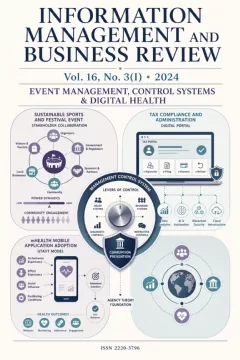 Vol. 16 No. 3(I) (2024)
Event Management, Control Systems & Digital Health
View issue contents
Published
Submissions
Have research to publish? Information Management and Business Review welcomes submissions.
Make a Submission