Abstract
Record management is a crucial profession in organizations, responsible for the efficient and orderly control of records. It involves creating, acquiring, maintaining, using, and disposing of these records, which prove an organization's operations and business. Many higher institutions in Malaysia offer courses related to records management. This paper explores factors influencing undergraduate students' employability in the field, investigates the required qualifications and skills, and identifies strategies to increase employability among record management students. The research will use a quantitative approach, including online surveys and questionnaires, with respondents graduating from records management courses. The expected findings will provide insights into the factors influencing undergraduate students' employability and strategies to overcome these issues.
Keywords
- Records Management Search this journal for Records Management (opens in a new tab)
- Employability Search this journal for Employability (opens in a new tab)
- Graduate Search this journal for Graduate (opens in a new tab)
- UiTM Search this journal for UiTM (opens in a new tab)
- University Search this journal for University (opens in a new tab)
References
- Al Nejam, A., Chong, A. T., Ahmed, M. S., & Al-Masri, O. (2017). A conceptual framework for mitigating graduate employment problems. Journal Of ICT In Education, 4, 81–87. https://doi.org/10.37134/jictie.vol4.8.2017
- Al Shanfari, S. A. (2024). Exploration on job mismatch with job placement: employers perspective in sultanate of Oman. International Journal of Academic Research in Business and Social Sciences, 14(1). https://doi.org/10.6007/ijarbss/v14-i1/20471
- Aliu, J., & Aigbavboa, C. O. (2021). Structural determinants of graduate employability: impact of university and industry collaborations. Journal of Engineering, Design and Technology, 19(5), 1080-1100.
- Aliza, I., & Adnan, J. (2011). Records professionals: an invisible profession in Malaysia. Records Management Journal, 21(1), 69–75. https://doi.org/10.1108/09565691111125116
- Andrews, J., & Higson, H. (2008). Graduate Employability, “Soft Skills” Versus “Hard” Business Knowledge: A European Study. Higher Education in Europe, 33(4), 411–422. https://doi.org/10.1080/03797720802522627
- Aniza, J. (2010). Medical records officer competency in Malaysia. [Master’s thesis]. Universiti Teknologi MARA]. UiTM Institutional Repository. https://ir.uitm.edu.my/id/eprint/18288
- Asmadi, M. G. (2012). Development of competencies profile for records managers in the Malaysian federal government. PhD thesis. Faculty of Information Management, Universiti Teknologi MARA (UiTM), Malaysia.
- Basir, N. M., Zubairi, Y. Z., Jani, R., & Wahab, D. A. (2022). Soft skills and graduate employability: Evidence from Malaysian tracer study. Pertanika Journal of Social Sciences & Humanities, 30(4).
- Bindawas, A. (2024). Employability skills of business graduates in Saudi Arabia: do academia and employers speak the same language? Journal of Management and Business Education, 7(2), 194-206. https://doi.org/10.35564/jmbe.2024.0011
- Carnevale, A. P., & Cheah, B. (2013). Hard Times 2013: College Majors, Unemployment, and Earnings.
- Chen, J., Kannan, P., Trehan, B., & Loungani, P. (2011). New evidence on cyclical and structural sources of unemployment. (Working Paper No. 2011/106). International Monetary Fund. https://www.imf.org/en/Publications/WP/Issues/2016/12/31/New-Evidenceon-Cyclical-and-Structural-Sources-of-Unemployment-24832
- Collet, C., Hine, D., & Du Plessis, K. (2015). Employability skills: perspectives from a knowledge-intensive industry. Education+ Training, 57(5), 532-559.
- Creed, P. A., & Hughes, T. (2012). Career Development Strategies as moderators between career compromise and career outcomes in emerging adults. Journal of Career Development, 40(2), 146–163. https://doi.org/10.1177/0894845312437207
- Dacre Pool, L., Qualter, P., & J. Sewell, P. (2014). Exploring the factor structure of the Career EDGE employability development profile. Education + Training, 56(4), 303–313. https://doi.org/10.1108/et-01-2013-0009
- Department of Statistics of Malaysia. (2022). Media statement graduate statistics 2021. Jabatan Perangkaan Malaysia. (27 July 2022). Retrieved December 9, 2022. https://www.dosm.gov.my/v1/uploads/files/5_Gallery/2_Media/4_Stats%40media/4- Press_Statement/2022/07.%20JULAI/GRADUATES%20STATISTICS%2C%202021.pdf
- Duffus, K. (2017). Recruitment of Records Management Practitioners in Jamaica’s public sector and its implications for professional practice. Records Management Journal, 27(2), 205–222. https://doi.org/10.1108/rmj-10-2016-0039
- Ekwoaba, J. O., Ikeije, U. U., & Ufoma, N. (2015). The Impact of Recruitment and Selection Criteria on Organisational Performance. Global Journal of Human Resource Management, 3(2), 22-33.
- Fugate, M., Kinicki, A. J., & Ashforth, B. E. (2004). Employability: A psycho-social construct, its dimensions, and applications. Journal of Vocational Behavior, 65(1), 14–38. https://doi.org/10.1016/j.jvb.2003.10.005
- Gamage, A. S. (2014). Recruitment and selection practices in manufacturing SMEs in Japan: An analysis of the link with business performance. Ruhuna Journal of Management and Finance, 1(1), 37-52.
- Gedye, S., & Beaumont, E. (2018). “The ability to get a job”: student understandings and definitions of employability. Education+ Training, 60(5), 406-420.
- Heijde, C. M. V. D., & Van Der Heijden, B. I. J. M. (2006). A competence-based and multidimensional operationalization and measurement of employability. Human Resource Management, 45(3), 449–476. https://doi.org/10.1002/hrm.20119
- Husain, M. Y., Mokhtar, S. B., Ahmad, A. A., & Mustapha, R. (2010). Importance of Employability Skills from Employers’ Perspective. Procedia-Social and Behavioral Sciences, 7, 430-438. https://doi.org/10.1016/j.sbspro.2010.10.059
- Ibrahim, Z. M., Joesri, M. S., Raja, I. P. M., Najikha, O. and Azlan, S. (2020). Factor affecting university undergraduates students perception’s toward career enhancement in the hospitality industry: a case of UiTM Penang/ Mohd Zool Fadli Ibrahim. ESTEEM Journal of Social Sciences and Humanities, 4(19-26). https://ir.uitm.edu.my/id/eprint/28796/
- International Records Management Trust (IRMT). (2009). Glossary of Terms: Training in Electronic Records Management. Retrieved 7 August 2024, from: https://www.irmt.org/documents/educ_training/term%20modules/IRMT%20TERM%20Glossary%20of%20Terms.pdf
- Ipinge, A. & Nengomasha, C. (2018). An investigation into the records management profession in the public service of Namibia. Information and Learning Science. 119(7), 377-388. 10.1108/ILS-11-2017-0123.
- Kadir, I.K.A. (2014). Electronic records management (ERM) practices at the Malaysian Federal Ministries: exploring the fundamental organizational and professional issues. [Institute of Graduate Studies, UiTM, Shah Alam]. UiTM Institutional Repository. https://ir.uitm.edu.my/id/eprint/19689
- Kautto, T. & Henttonen, P. (2020). Records management as invisible work: A study of Finnish municipalities, Government Information Quarterly 37(4). DOI: 10.1016/j.giq.2020.101460
- Johare, R., & Masrek, M. N. (2011). Malaysian archival heritage at risk? A survey of archivists' knowledge and skills in managing electronic records. Library Review, 60(8), 685-711.
- Jannah, R. (2023). Audit of web-based electronic documents and record management system (wedrms): oversight efforts to improve administration in higher educational institutions. -bus. econ. entrepre., 5(2), 53. https://doi.org/10.61689/bisecer.v5i2.427
- Kassie, S. A. (2023). Prevention before intervention: introducing mindfulness-based social-emotional learning in higher education institutions across the United Arab Emirates. Frontiers in Education, 8. https://doi.org/10.3389/feduc.2023.1281949
- Marfunizah, M., Imail, T. I., & Sity, D. (2020). Strategies to enhance graduate employability: Insights from Malaysian public university policymakers. Malaysian Journal of Learning and Instruction, 17(2), 137–165. https://doi.org/10.32890/mjli2020.17.2.5
- Martin, T., & Davies, R. (2022). Student Retention and Persistence in University Certificate-First Programs. Education Sciences, 12(8). https://doi.org/10.3390/educsci12080525
- Matlala, M. and Maphoto, A. (2023). Management of electronic records in the South African public sector. Esarbica Journal of the Eastern and Southern Africa Regional Branch of the International Council on Archives, 41, 69-88. https://doi.org/10.4314/esarjo.v41i.6
- McLeod, J., & Hare, C. (2010). Development of rmj. Records Management Journal, 20(1), 9– 40. https://doi.org/10.1108/09565691011036215
- McQuaid, R. W., & Lindsay, C. (2005). The Concept of Employability. Urban Studies, 42(2), 197–219. https://doi.org/10.1080/0042098042000316100
- Ministry of Higher Education (2022). Statistik. Retrieved November 11, 2022. https://www.mohe.gov.my/muat-turun/statistik/2021-1
- Mohd, J., Kadir, A., Naghavi, N., & Abdul, N. A. A. (2020). Unemployment among graduates-Is there a mismatch? AESS Publication, 10(10), 583-592.
- Mokibelo, E., & Seru, L. (2020). Learning for employment: Challenges encountered by students. OALib, 07(07), 1–16. https://doi.org/10.4236/oalib.1106549
- Mseleku, Z., & Nyawo, S. (2024). Local Government Internship: Opportunity or Exploitation? Academic Journal of Interdisciplinary Studies, 13(2), 240. https://doi.org/10.36941/ajis-2024-0046
- Nachmias, S., & Walmsley, A. (2015). Making career decisions in a changing graduate labor market: A hospitality perspective. Journal of Hospitality, Leisure, Sport & Tourism Education, 17, 50-58.
- Nilsson, S. (2010). Enhancing individual employability: the perspective of engineering graduates. Education+ Training, 52(6/7), 540-551.
- Nthomang, K. and Diraditsile, K. (2016) Improving Youth Employment in Botswana: The Need for Evidence-Based Policy and Programmed Development. Mosenodi Journal, 19, 45-55. https://journals.ub.bw/index.php/mosenodi/issue/view/92
- Pauceanu, A. M., Rabie, N., & Moustafa, A. (2020). Employability in the Fourth Industrial Revolution. Economics &Amp; Sociology, 13(3), 269-283. https://doi.org/10.14254/2071-789x.2020/13-3/17
- Pitan, O. S., & Muller, C. (2020). Student Perspectives on Employability Development in Higher Education in South Africa. Education + Training, 63(3), 453–471. https://doi.org/10.1108/et-02-2018-0039
- Razak, R. R. A. (2020, June 15). Kualiti modal insan jamin kejayaan agenda PENJANA. Berita Harian Online. https://www.bharian.com.my/rencana/komentar/2020/06/700563/kualiti-modal-insan-jamin-kejayaan-agenda-penjana
- Robles. (2012). Executive perceptions of the top 10 soft skills needed in today’s workplace. Sage Journal. Retrieved from https://journals.sagepub.com/doi/abs/10.1177/1080569912460400
- Rothwell, A., Herbert, I., & Rothwell, F. (2008). Self-perceived employability: Construction and initial validation of a scale for university students. Journal of Vocational Behavior, 73(1), 1–12. https://doi.org/10.1016/j.jvb.2007.12.001
- Saiful, F. Y., Masron, Z. M., Nurussobah, H., Hasnah, S., Ab Kadir, R. M. & Wah, Y. B. (2017). Graduate Employability and Entrepreneurship in Records Management: Unexplored Potential Business in Commercial Records Center. Journal of Informatics and Mathematical Sciences, 9(4), 1237–1247. https://doi.org/10.26713/jims.v9i4.998
- Salas Velasco, M. (2014). Do higher education institutions make a difference in competence development? A model of competence production at University. Higher Education, 68(4), 503–523. https://doi.org/10.1007/s10734-014-9725-1
- Shuhod, S. F., & Mat Rashid, A. (2023). The Effectiveness of Entrepreneurship Programmes and Collaboration of Institutions-Industry in the Technical and Vocational Training Centres. International Journal of Academic Research in Business and Social Sciences, 13(6), 1893–1913. https://doi.org/10.6007/ijarbss/v13-i6/16626
- Sitompul, N. K., & Athoillah, M. (2023). Indonesia’s Youth Unemployment Rate: Evidence from Sakernas Data. Journal of International Conference Proceedings, 6(1), 347–357. https://doi.org/10.32535/jicp.v6i1.2346
- Graduates Reference Hub for Employment and Training/GREaT (2021). Statistik Kebolehpasaran Graduan (GE). Retrieved December 9, 2022, from https://great.mohe.gov.my/Statistik
- Ting, S., Marzuki, E., Chuah, K., Misieng, J. & Jerome, C. (2017). Employers’ Views On the Importance Of English Proficiency And Communication Skills for Employability In Malaysia. Indonesian Journal of Applied Linguistics. 7. 77. 10.17509/ijal.v7i2.8132.
- Wafa, A., Singh, J., Singh, K., Kaur, D., & Singh, S. (2020). Challenges faced and employability skills that employers seek in fresh graduates in a third world country. International Journal of Psychosocial Rehabilitation, 24(02), 735–748. https://doi.org/10.37200/ijpr/v24i2/pr200387
- Wong, S. P., Samsilah, R., Siaw, Y. L., Sulaiman, T., & Ab Jalil, H. (2018). The employability of undergraduate students in a Malaysian higher educational institution. Educational Leader (Pemimpin Pendidikan), 6, 165-182
- Yoong, D., Don, Z. M., & Foroutan, M. (2016). Prescribing roles in the employability of Malaysian graduates. Journal of Education and Work, 30(4), 432–444. https://doi.org/10.1080/13639080.2016.1191626
- Zawiyah M. Yusof and Chell, R. W. (2005). Issues in records management. Bangi: Penerbit Universiti Kebangsaan Malaysia.
Downloads
No downloads have been recorded for this article yet. Figures appear here once readers begin downloading the full text.
How to Cite
Share this article
License
Copyright (c) 2024 Nurul Huda Md Yatim, Khairunnisa Rahman, Faten Elina Kamaruddin, Raja Adzrin Raja Ahmad (Author)

This work is licensed under a Creative Commons Attribution 4.0 International License.
Author (s) should affirm that the material has not been published previously. It has not been submitted and it is not under consideration by any other journal. At the same time author (s) need to execute a publication permission agreement to assume the responsibility of the submitted content and any omissions and errors therein. After submission of revised paper in the light of suggestions of the reviewers, the editorial team edits and formats manuscripts to bring uniformity and standardization in published material.
This work will be licensed under Creative Commons Attribution 4.0 International (CC BY 4.0) and under condition of the license, users are free to read, copy, remix, transform, redistribute, download, print, search or link to the full texts of articles and even build upon their work as long as they credit the author for the original work. Moreover, as per journal policy author (s) hold and retain copyrights without any restrictions.
Keywords
- Records Management Search this journal for Records Management (opens in a new tab)
- Employability Search this journal for Employability (opens in a new tab)
- Graduate Search this journal for Graduate (opens in a new tab)
- UiTM Search this journal for UiTM (opens in a new tab)
- University Search this journal for University (opens in a new tab)
Section
Published in
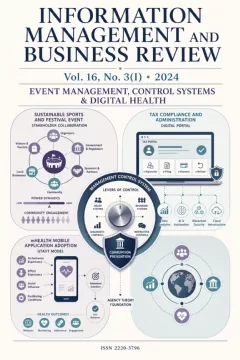 Vol. 16 No. 3(I) (2024)
Event Management, Control Systems & Digital Health
View issue contents
Published
Submissions
Have research to publish? Information Management and Business Review welcomes submissions.
Make a Submission