Abstract
To generate trust inside organizations, administrators with soft skills must build relationships and alliances with their staff, as well as create work conditions that empower employees to carry out their responsibilities. Administrators must essentially boost perceptions of trustworthiness. To solve this shortcoming, educational administrators must be informed and cautious about the notions of soft skills, dependability, and structural empowerment. This article investigates the relationship between each component of leadership soft skills, structural empowerment, and perceived trustworthiness. The mediating function of structural empowerment in the link between leadership soft skills and the perceived trustworthiness of the Head of Faculty was also investigated. This study collects its quantitative data using a survey questionnaire. The survey included 225 respondents who worked as administrative professionals in clerical and office assistant positions at three major campuses of Malaysian public higher education institutions in Malaysia's northern state. The study found that perceived trustworthiness and structural empowerment were substantially connected to all eight components of leadership soft skills. However, structural empowerment did not act as a bridge between leadership soft skills and perceived trustworthiness.
Keywords
- Leadership Soft Skills Search this journal for Leadership Soft Skills (opens in a new tab)
- Perceived Trustworthiness Search this journal for Perceived Trustworthiness (opens in a new tab)
- Structural Empowerment Search this journal for Structural Empowerment (opens in a new tab)
- University Administrators Search this journal for University Administrators (opens in a new tab)
- Malaysian Higher Education Institutions Search this journal for Malaysian Higher Education Institutions (opens in a new tab)
References
- AbuJbara, N.K., & Woley, J. A. (2018). Leading towards new horizons with soft skills. On the Horizon, 26(3), 247-259. https://doi.org/10.1108/oth-10-2017-0085
- Afshan, G., Kashif, M., Khanum, F., Khuhro, M. A., & Akram, U. (2021). High involvement work practices often lead to burnout, but thanks to humble leadership. Journal of Management Development, 40(6), 503-525. https://doi.org/10.1108/jmd-10-2020-0311
- Ahmad, T., Hamid, A. R., Abbas, A., Anwar, A., Ekowati, D., Fenitra, R. M., & Suhariadi, F. (2023). Empowering leadership: role of organizational culture of self-esteem and emotional intelligence on creativity. Journal of Management Development, 42(3), 201-214. https://doi.org/10.1108/jmd-10-2021-0288
- Aldulaimi, S. A. (2018). Leadership soft skills in higher education institutions. Social Science Learning Education Journal, 3, 1-8. https://doi.org/10.15520/sslej.v3i7.2219
- Baron, R. M., & Kenny, D. A. (1986). The moderator-mediator variable distinction in social psychological research: Conceptual, strategic, and statistical considerations. Journal of Personality and Social Psychology, 51(6), 1173- 1182. https://doi.org/10.1037//0022-3514.51.6.1173
- Caldwell, C., & Ndalamba, K.K. (2017). Trust and being worthy – the key to creating wealth. Journal Management Development, 36(8), 1076-1086. https://doi.org/10.1108/jmd-09-2016-0169
- Chiaburu, D. S., & Lim, A. S. (2008). Manager trustworthiness or interactional justice? Predicting organizational citizenship behaviors. Journal of Business Ethics, 83, 453-467. https://doi.org/10.1007/s10551-007-9631-x
- Cochran, W. G. (1977). Sampling techniques (3rd ed.). New York: John Wiley and Sons.
- Crosbie, R. (2005). Learning the soft skills of leadership. Industrial and Commercial Training, 37(1), 45-51. https://doi.org/10.1108/00197850510576484
- Chang, D. W., Abdul Razak, D., & Sirat, M. (2020). Academic governance and leadership in Malaysia: Examining the national higher education strategic initiatives. Journal of International and Comparative Education, 9(2), 91-102. https://doi.org/10.14425/jice.2020.9.2.0913
- Colquitt, J. A., Scott, B. A., & LePine, J. A. (2007). Trust, trustworthiness, and trust propensity: a meta-analytic test of their unique relationships with risk-taking and job performance. Journal of Applied Psychology, 92(4), 909. https://doi.org/10.1037/0021-9010.92.4.909
- Gefen, D. (2002). Reflections on the dimensions of trust and trustworthiness among online consumers. ACM SIGMIS Database: the DATABASE for Advances in Information Systems, 33(3), 38-53. https://doi.org/10.1145/569905.569910
- Harun, S. & Ahmad, I. (2022). University administrators retention: The moderating roles of organizational justice and generational diversity. Environment-Behaviour Proceedings Journal, 7(20), 161-166. https://doi.org/10.21834/ebpj.v7i20.3451
- Institut Penyelidikan Pendidikan Tinggi Negara, (IPPTN, 2008). Executive summary. Retrieved from http://www.usm.my/ipptn/fileup/.
- Longenecker C.O. (2010). Coaching for better results: Key practices of high-performance leaders. Industrial and Commercial Training, 42(1), 32-40. https://doi.org/10.1108/00197851011013698
- Kanter, R.M. (2001). The impact of workplace empowerment, organizational trust on staff nurses’ work satisfaction and organizational commitment. Health Care Management Review, 26(3), 7-23. https://doi.org/10.1097/00004010-200107000-00002
- Kanter, R. M. (1977). Men and women of the corporation. New York: Basic Books.
- Laschinger, H. K. S., Finegan, J., & Shamian, J. (2001). The impact of workplace empowerment, organizational trust on staff nurses’ work satisfaction and organizational commitment. Health Care Management Review, 26(3), 7-23. https://doi.org/10.1097/00004010-200107000-00002
- Mayer, R. C., & Davis, J. H. (1999). The effect of performance appraisal system on trust for management: A field quasi-experiment. Journal of Applied Psychology, 84(1), 123-136. https://doi.org/10.1037//0021-9010.84.1.123
- Mayer, R. C., Davis, J. H., & Schoorman F. D. (1995). An integrative model of organizational trust. The Academy of Management Review, 20(3), 709-734. https://doi.org/10.5465/amr.1995.9508080335
- Md. Shahid, S. A., A Rahman, M. K. B., Naina Mohamed, R., & Yusof, M. A. (2018). Perceived trustworthiness of deans’ leadership soft skills at three Malaysian universities. Journal of Fundamental and Applied Sciences, 10(1S), 1024-1036.
- Md. Shahid, S. A., Harun, S., Othman, A. K., Jani, S. H. M., Rahman, M. K. B. A., & Mohamed, R. N. (2020). Organizational Justice and its Implications on Non-Academic Staff Intention to Stay: Evidence from Private Higher Learning Institutions in Malaysia. Malaysian Journal of Consumer and Family Economics, 24(S1), 153-168.
- Naile, I., & Selesho, J. M. (2014). The role of leadership in employee motivation. Mediterranean Journal of Social Sciences, 5(3), 175-182. https://doi.org/10.5901/mjss.2014.v5n3p175
- Radi Afsouran, N., Charkhabi, M., Mohammadkhani, F., & Seidel, L. (2022). The link between transformational leadership and organizational development: testing the mediating role of employees' maturity. Journal of Management Development, 41(7/8), 417-430. https://doi.org/10.1108/jmd-06-2021-0167
- Sadq, Z. M. (2019). The role of leadership soft skills in promoting the learning entrepreneurship. Journal of Process Management and New Technologies, 7(1), 31-48. https://doi.org/10.5937/jouproman7-20122
- Wilson, J. A., & Cunliffe, A. L. (2022). The development and disruption of relationships between leaders and organizational members and the importance of trust. Leadership, 18(3), 359-382. https://doi.org/10.1177/17427150211056738
- Young-Ritchie, C., Laschinger, H. K. S., & Wong, C. (2009). The effects of emotionally intelligent leadership behavior on emergency staff nurses’ workplace empowerment and organizational commitment. Nursing Leadership, 22(1), 70-85. https://doi.org/10.12927/cjnl.2009.20614
- Zikmund, W. G., Babin, B. J., Carr, J. C., & Griffin, M. (2010). Business Research Methods, South Western. Cengage Learning, 308-594.
Downloads
No downloads have been recorded for this article yet. Figures appear here once readers begin downloading the full text.
How to Cite
Share this article
License
Copyright (c) 2024 Siti Asiah Md Shahid, Shariff Harun (Author)

This work is licensed under a Creative Commons Attribution 4.0 International License.
Author (s) should affirm that the material has not been published previously. It has not been submitted and it is not under consideration by any other journal. At the same time author (s) need to execute a publication permission agreement to assume the responsibility of the submitted content and any omissions and errors therein. After submission of revised paper in the light of suggestions of the reviewers, the editorial team edits and formats manuscripts to bring uniformity and standardization in published material.
This work will be licensed under Creative Commons Attribution 4.0 International (CC BY 4.0) and under condition of the license, users are free to read, copy, remix, transform, redistribute, download, print, search or link to the full texts of articles and even build upon their work as long as they credit the author for the original work. Moreover, as per journal policy author (s) hold and retain copyrights without any restrictions.
Keywords
- Leadership Soft Skills Search this journal for Leadership Soft Skills (opens in a new tab)
- Perceived Trustworthiness Search this journal for Perceived Trustworthiness (opens in a new tab)
- Structural Empowerment Search this journal for Structural Empowerment (opens in a new tab)
- University Administrators Search this journal for University Administrators (opens in a new tab)
- Malaysian Higher Education Institutions Search this journal for Malaysian Higher Education Institutions (opens in a new tab)
Section
Published in
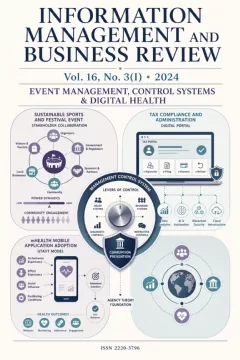 Vol. 16 No. 3(I) (2024)
Event Management, Control Systems & Digital Health
View issue contents
Published
Submissions
Have research to publish? Information Management and Business Review welcomes submissions.
Make a Submission