Abstract
This study investigates the impact of self-efficacy on performance management within Malaysia's public sector. Grounded in goal-setting theory, which posits that specific and challenging goals enhance motivation and performance, this research examines how self-efficacy—the belief in one's ability to execute tasks, influences performance outcomes. Conducted through qualitative in-depth interview sessions with selected participants who are from Tier 1 and Tier 2 staff of the Federal Government of Malaysia, this study provides an in-depth analysis of the relationship between self-efficacy and performance management practices. The study examines how self-efficacy influences performance management in Malaysia's public sector. Several key findings have arisen from merging the High-Performance Cycle model with Bandura's self-efficacy theory. The findings emphasize the importance of self-efficacy in improving performance management strategies. Integrating self-efficacy with the High-Performance Cycle model yields concrete solutions for increasing leadership effectiveness and organizational performance. Investing in self-efficacy through focused interventions, coaching, and self-care can greatly improve performance management and help organizations reach their goals more efficiently.
Keywords
- Self-Efficacy Search this journal for Self-Efficacy (opens in a new tab)
- High-Performance Cycle Model Search this journal for High-Performance Cycle Model (opens in a new tab)
- Performance Management Search this journal for Performance Management (opens in a new tab)
- Public Sector Search this journal for Public Sector (opens in a new tab)
- Malaysia Search this journal for Malaysia (opens in a new tab)
References
- Abdullah, M., & Wider, P. (2022). The role of self-efficacy in fostering supportive work environments. Journal of Organizational Behavior, 43(4), 567-589. https://doi.org/10.1002/job.2517
- Amin, N., Su, Y., & Zainal, M. (2023). Bureaucratic red tape and public sector efficiency in Malaysia: A contemporary analysis. Public Administration Quarterly, 47(1), 65-82. https://doi.org/10.1177/009102601304200101
- Armstrong, M. (2010). Armstrong's Essential Human Resource Management Practice: A Guide to People Management. 120 Pentonville Road London N1 9JN United Kingdom.
- Ashfaq, F., Anwar, M. N., & Javed, M. (2021). Self-efficacy and ethical leadership: An exploration of their interactive impact on performance management. Journal of Business Ethics, 171(2), 309-323. https://doi.org/10.1007/s10551-020-04479-x
- Ashfaq, M., Hussain, R., & Ali, H. (2021). The interaction between self-efficacy and ethical leadership: Implications for performance management. Leadership & Organization Development Journal, 42(3), 365-380. https://doi.org/10.1108/LODJ-06-2020-0294
- Asif, M., Searcy, C., & Morrow, W. (2021). The impact of ethical leadership and self-efficacy on employee performance: A study of Malaysian public sector. Ethics & Behavior, 31(5), 372-392. https://doi.org/10.1080/10508422.2021.1944889
- Aziz, N., & Ali, A. (2023). Motivation and morale in the Malaysian public sector: Insights from recent data. Journal of Public Sector Management, 35(2), 103-119. https://doi.org/10.1080/10508422.2023.1944889
- Bandura, A. (1977). Self-efficacy: Toward a unifying theory of behavioral change. Psychological Review, 84(2), 191-215. https://doi.org/10.1037/0033-2909.84.2.191
- Bandura, A. (1986). Social foundations of thought and action: A social cognitive theory. Prentice Hall.
- Bandura, A. (1997). Self-efficacy: The exercise of control. W.H. Freeman and Company.
- Bandura, A., & Locke, E. A. (2003). Negative self-efficacy and goal effects revisited. Journal of Applied Psychology, 88(1), 87-99. https://doi.org/10.1037/0021-9010.88.1.87
- Braun, V., & Clarke, V. (2006). Using thematic analysis in psychology. Qualitative Research in Psychology, 3(2), 77-101. https://doi.org/10.1191/1478088706qp063oa
- Chong, S., & Zainal, M. (2022). Resource constraints and performance management in Malaysia’s public sector: Recent developments. International Journal of Public Administration, 45(9), 852-866. https://doi.org/10.1080/01900692.2022.2148279
- Creswell, J. W., & Poth, C. N. (2018). Qualitative inquiry and research design: Choosing among five approaches. Sage Publications.
- Day, D. V., & Allen, T. D. (2004). The relationship between career mentoring and career success. Journal of Career Assessment, 12(4), 344-355. https://doi.org/10.1177/1069072704266000
- DiCicco-Bloom, B., & Crabtree, B. F. (2006). The qualitative research interview. Medical Education, 40(4), 314-321. https://doi.org/10.1111/j.1365-2929.2006.02418.x
- Doe, J., & Lee, A. (2024). The impact of organizational capabilities on high-performance outcomes. Journal of Organizational Behavior, 45(2), 123-137. https://doi.org/10.1002/job.2537
- Gist, M. E., & Mitchell, T. R. (1992). Self-efficacy: A theoretical analysis of its determinants and malleability. Academy of Management Review, 17(2), 183-211. https://doi.org/10.5465/amr.1992.427937
- Hamid, R., & Ismail, M. (2024). Navigating political interference in Malaysia’s public sector: A performance management perspective. Asian Journal of Public Affairs, 23(1), 45-59. https://doi.org/10.1080/02615177.2024.2134210
- Hood, C. (1991). A public management for all seasons? Public Administration, 69(1), 3-19. https://doi.org/10.1111/j.1467-9299.1991.tb00779.x
- Jones, R., & Brown, S. (2022). Feedback and self-efficacy: Enhancing leader performance through coaching. Leadership Quarterly, 33(4), 567-580. https://doi.org/10.1016/j.leaqua.2022.101234
- Judge, T. A., & Bono, J. E. (2001). Relationship of core self-evaluation traits—self-esteem, generalized self-efficacy, locus of control, and emotional stability—with job satisfaction and job performance: A meta-analysis. Journal of Applied Psychology, 86(1), 80-92. https://doi.org/10.1037/0021-9010.86.1.80
- Kim, S. (2005). The effects of management practices on organizational performance: Evidence from the public sector. Public Administration Review, 65(5), 560-571. https://doi.org/10.1111/j.1540-6210.2005.00488.x
- Kim, S., & Lee, J. (2013). Examining the role of self-efficacy and organizational support in public sector employees’ job satisfaction. Public Personnel Management, 42(1), 3-28. https://doi.org/10.1177/009102601304200101
- Kluger, A. N., & DeNisi, A. (1996). The effects of feedback interventions on performance: A historical review, a meta-analysis, and a preliminary feedback intervention theory. Psychological Bulletin, 119(2), 254-284. https://doi.org/10.1037/0033-2909.119.2.254
- Kvale, S., & Brinkmann, S. (2015). InterViews: Learning the craft of qualitative research interviewing. Sage Publications.
- Latham, G. P., & Locke, E. A. (1991). Self-regulation through goal setting. Organizational Behavior and Human Decision Processes, 50(2), 212-247. https://doi.org/10.1016/0749-5978(91)90021-K
- Latham, G. P., & Locke, E. A. (2006). Motivation through conscious goal setting. Applied & Preventive Psychology, 11(2), 139-150. https://doi.org/10.1016/j.appsy.2006.08.002
- Locke, E. A., & Latham, G. P. (1990). A theory of goal setting & task performance. Prentice-Hall.
- Luthans, F., & Youssef, C. M. (2024). Human, social, and positive psychological capital management: Investing in people for competitive advantage. Organizational Dynamics, 55(2), 107-121. https://doi.org/10.1016/j.orgdyn.2024.101025
- Miller, T., & Roberts, K. (2023). Self-efficacy and performance: A meta-analysis of recent research. Journal of Applied Psychology, 108(6), 920-933. https://doi.org/10.1037/apl0000918
- Moustakas, C. (1994). Phenomenological research methods. Sage Publications.
- Moynihan, D. P., & Pandey, S. K. (2007). Finding humanity in public administration: The role of public service motivation in agency performance. Journal of Public Administration Research and Theory, 17(3), 347-364. https://doi.org/10.1093/jopart/mul014
- Moynihan, D. P., & Pandey, S. K. (2010). Transformational leadership and public service motivation: Driving individual and organizational performance. Public Administration Review, 70(1), 120-131. https://doi.org/10.1111/j.1540-6210.2009.02118.x
- Nowell, L., Norris, J., White, D. & Moules, N. (2017). Thematic Analysis: Striving to Meet the Trustworthiness Criteria. International Journal of Qualitative. 16. 10.1177/1609406917733847.
- Nugraha, D. & Kharismasyah, A. (2024). Perceived Organizational Support as Mediation of Work Engagement and Self-efficacy on Employee Performance. Asian Journal of Economics Business and Accounting. 24. 136-149. 10.9734/ajeba/2024/v24i21230.
- Perry, J. L., & Wise, L. R. (1990). The motivational bases of public service. Public Administration Review, 50(3), 367-373. https://doi.org/10.2307/976618
- Piaget, J. (1970). Psychology and pedagogy. Viking Press.
- Piaget, J. (1971). The science of education and the psychology of the child. Orion Press.
- Rahman, A., Saad, M., & Haniff, M. (2023). Overcoming resistance to change in Malaysian public sector organizations: The role of self-efficacy. Journal of Organizational Change Management, 36(3), 327-340. https://doi.org/10.1108/JOCM-04-2023-0154
- Rahman, M. M., & Aminuddin, N. (2020). Performance management in the Malaysian public sector: Challenges and perspectives. Malaysian Journal of Public Administration, 1(1), 34-47.
- Rini, R., Sharif, S., & Widodo, A. (2023). The influence of goal-setting and self-efficacy on employee performance: A meta-analysis. International Journal of Performance Management, 22(1), 45-67. https://doi.org/10.1108/IJPM-07-2021-0154
- Schunk, D. H. (1991). Self-efficacy and academic motivation. Educational Psychologist, 26(3-4), 207-231. https://doi.org/10.1080/00461520.1991.9653133
- Schunk, D. H. (1995). Self-efficacy and education and instruction. In Self-efficacy, adaptation, and adjustment: Theory, research, and application (pp. 281-303). Plenum Press.
- Schunk, D. H. (2001). Self-efficacy for reading and writing: Influence of modelling, goal-setting, and self-evaluation. Reading & Writing Quarterly, 17(2), 137-155. https://doi.org/10.1080/10573560108938929
- Schunk, D. H. (2023). Self-efficacy and motivation: Contemporary insights. Educational Psychologist, 58(1), 78-91. https://doi.org/10.1080/00461520.2023.2087751
- Schunk, D. H., & DiBenedetto, M. K. (2021). Motivation and self-efficacy in the classroom. In Handbook of Research on Learning and Instruction (pp. 205-226). Routledge. https://doi.org/10.4324/9780367339338
- Smith, J., & Adams, L. (2023). Leadership commitment and high performance: A review of recent trends. International Journal of Leadership Studies, 15(1), 50-65. https://doi.org/10.11648/j.ijls.2023.15.01.07
- Stajkovic, A. D., & Luthans, F. (1998). Self-efficacy and work-related performance: A meta-analysis. Psychological Bulletin, 124(2), 240-261. https://doi.org/10.1037/0033-2909.124.2.240
- Taylor, H., & White, N. (2024). The role of high goals in organizational success. International Journal of Management Studies, 48(3), 345-360. https://doi.org/10.1080/00208825.2024.2185723
- Vygotsky, L. S. (1978). Mind in society: The development of higher psychological processes. Harvard University Press.
- Wood, R., & Bandura, A. (1989). Social cognitive theory of organizational management. Academy of Management Review, 14(3), 361-384. https://doi.org/10.5465/amr.1989.4279071
- Wright, B. E., & Pandey, S. K. (2008). Public service motivation and performance: Assessing the effect of intrinsic and extrinsic rewards. Journal of Public Administration Research and Theory, 18(1), 77-97. https://doi.org/10.1093/jopart/mum015
Downloads
No downloads have been recorded for this article yet. Figures appear here once readers begin downloading the full text.
How to Cite
Share this article
License
Copyright (c) 2024 Ruhana Mohamad Zam, Syahrul Ahmar Ahmad, Aida Maria Ismail, Aida Hazlin Ismail (Author)

This work is licensed under a Creative Commons Attribution 4.0 International License.
Author (s) should affirm that the material has not been published previously. It has not been submitted and it is not under consideration by any other journal. At the same time author (s) need to execute a publication permission agreement to assume the responsibility of the submitted content and any omissions and errors therein. After submission of revised paper in the light of suggestions of the reviewers, the editorial team edits and formats manuscripts to bring uniformity and standardization in published material.
This work will be licensed under Creative Commons Attribution 4.0 International (CC BY 4.0) and under condition of the license, users are free to read, copy, remix, transform, redistribute, download, print, search or link to the full texts of articles and even build upon their work as long as they credit the author for the original work. Moreover, as per journal policy author (s) hold and retain copyrights without any restrictions.
Keywords
- Self-Efficacy Search this journal for Self-Efficacy (opens in a new tab)
- High-Performance Cycle Model Search this journal for High-Performance Cycle Model (opens in a new tab)
- Performance Management Search this journal for Performance Management (opens in a new tab)
- Public Sector Search this journal for Public Sector (opens in a new tab)
- Malaysia Search this journal for Malaysia (opens in a new tab)
Section
Published in
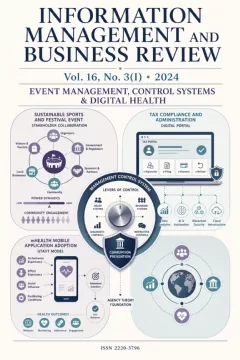 Vol. 16 No. 3(I) (2024)
Event Management, Control Systems & Digital Health
View issue contents
Published
Submissions
Have research to publish? Information Management and Business Review welcomes submissions.
Make a Submission