Abstract
In today’s fast-paced world, maintaining health and personal wellness has become a top priority. Artificial intelligence (AI) has emerged as a powerful tool in this effort, offering innovative solutions through mobile health applications. These applications use AI-driven algorithms to analyze user data, including sleep patterns, food intake, daily activity levels, diet preferences, stress indicators, and meditation, to provide personalized recommendations and insights. Mobile health applications have the potential to improve healthcare systems by enhancing health and disease management, communication, efficiency, treatment adherence, reducing costs, and increasing access to health interventions. This paper aims to provide a better understanding of the use of artificial intelligence in healthcare tools by examining the factors influencing the intention to use mobile health applications in Malaysia. It will discuss the extended UTAUT constructs and the concept of personal health characteristics, such as performance expectancy, effort expectancy, social influence, facilitating conditions, and health consciousness.
Keywords
- Artificial Intelligence Search this journal for Artificial Intelligence (opens in a new tab)
- Mobile Health Search this journal for Mobile Health (opens in a new tab)
- Health Applications Search this journal for Health Applications (opens in a new tab)
- UTAUT Search this journal for UTAUT (opens in a new tab)
- Health Consciousness Search this journal for Health Consciousness (opens in a new tab)
References
- Afrah, I. A., & Kose, U. (2020). mHealth: An Artificial Intelligence Oriented Mobile Application for Personal Healthcare Support. Journal of Multidisciplinary Developments, 5(1). Retrieved from http://www.jomude.com/index.php/jomude/article/view/86
- Ahadzadeh, A. S., Wu, S. L., Ong, F. S., & Deng, R. (2021). The Mediating Influence of the Unified Theory of Acceptance and Use of Technology on the Relationship Between Internal Health Locus of Control and Mobile Health Adoption: Cross-sectional Study. Journal of Medical Internet Research, 23(12). doi: https://doi.org/10.2196/28086
- Alaiad, A., Alsharo, M., & Alnsour, Y. (2019). The Determinants of M-Health Adoption in Developing Countries: An Empirical Investigation. Applied Clinical Informatics, 10(5), 820-840. doi: https://doi.org/10.1055/s-0039-1697906
- Alam, M. Z., Hoque, M. R., Hu, W., & Barua, Z. (2020). Factors influencing the adoption of mHealth services in a developing country: A patient-centric study. International Journal of Information Management.
- Alejandro, G. D., Fabelo, H., Almeida, A. J., Zamorano, G. Z., Fernandez, M. C., Ruano, M. D., . . . Consortium, W. (2023). Quality, Usability, and Effectiveness of mHealth Apps and the role of Artificial Intelligence: Current Scenario and Challenges. Journal of Medical Internet Research, 25. doi: https://doi.org/10.2196/44030
- Alkhalifah, T. (2022). A Structural Equation Modelling of Governing Factors Influencing Patient Acceptance of Mobile Health in Saudi Arabia: A Modified UTAUT Model. International Journal of E-Services and Mobile Applications, 14(1).
- Bao, H., & Lee, E. W. (2023). Examining Theoretical Frameworks and Antecedents of Health Apps and Wearable Use. Health Communication. doi: https://doi.org/10.1080/10410236.2023.2283655
- Becker, D. (2018). Possibilities to Improve Online Mental Health Treatment: Recommendations for Future Research and Developments. Future of Information and Communication Conference (FICC). Singapore. doi: https://www.researchgate.net/publication/324277093
- Binyamin, S., & Zafar, B. A. (2021). Proposing a mobile apps acceptance model for users in the health area: A systematic literature review and meta-analysis. Health Informatics Journal. doi: DOI: 10.1177/1460458220976737
- Castro, P. C., Lorenzi, L. J., Belo, L. F., Frohlich, D. M., Dourado, V. Z., & Gomes, G. A. (2021). Factors related to the adoption and adherence of physical activity mobile applications by older people. Health informatics. doi: https://doi.org/10.1136/bmjopen-2021-052414
- Davenport, T., & Kalakota, R. (2019). The potential for artificial intelligence in healthcare. PMC Healthcare Journal, 6(2), 94-98. doi: https://doi.org/10.7861%2Ffuturehosp.6-2-94
- Delove, M. A., Scott, R. E., & Mars, M. (2020). Review of patients' perspectives of m-health adoption factors in the developing world. Development of a proposed conceptual framework. Informatics in Medicine Unlocked, 21. doi: https://doi.org/10.1016/j.imu.2020.100460
- Garcia, A. D., Fabelo, H., Almeida, A. R., Zamorano, G. Z., Fernandez, M. C., Ruano, M. A., . . . Wagner, A. M. (2023). Quality, Usability, and Effectiveness of mHealth Apps and the Role of Artificial Intelligence: Current Scenario and Challenges. Journal of Medical Internet Research. doi: https://doi.org/10.2196/44030
- Gu, D., Khan, S., Khan, I. U., Khan, S. U., Xie, Y., Li, X., & Zhang, G. (2021). Assessing the adoption of e-health technology in a developing country: an extension of the UTAUT model. SAGE open.
- Halevi, G., Moed, H., & Ilan, J. B. (2017). Sustainability of Google Scholar as a source of scientific information and as a source of data for scientific evaluation- Review of the literature. Journal of Informetrics, 11(3). doi: https://doi.org/10.1016/j.joi.2017.06.005
- Handayani, P. W., Gelshirani, N. B., Azzahro, F., Pinem, A. A., & Hidayanto, A. N. (2020). The influence of argument quality, source credibility, and health consciousness on satisfaction, use intention, and loyalty on mobile health application use. Informatics in Medicine Unlocked.
- Haron, S. A., Koris, R., Orhun, N. M., Nur, A. M., Aljunid, S. M., & Shafie, A. A. (2024). Economic Burden of Healthcare Utilisation by Older Persons Living in the Community in Malaysia. Journal of Health Policy & Outcomes Research, 1. doi: https://www.jhpor.com/home/Article/2356#
- Hernandez, M. G., Adrian, S. W., Ferre, X., & Mora, E. V. (2022). Implicit, Explicit, and Structural Barriers and Facilitators for Information and Communication Technology Access in Older Adults. Frontiers: Humman-Media Interaction, 3. doi: https://doi.org/10.3389/fpsyg.2022.874025
- Intelligence, M. (2024). Malaysia Healthcare Aging Population International Trade Market Intelligence. Retrieved from Market Intelligence: https://www.trade.gov/market-intelligence/malaysia-healthcare-aging-population
- Jaakkola, E. (2020). Designing conceptual articles: Four approaches. Academy of Marketing Science Review, 10(3). doi: http://dx.doi.org/10.1007/s13162-020-00161-0
- Kashive, N., Powale, L., & Kashive, K. (2020). Understanding user perception toward artificial intelligence (AI) enables e-learning. International Journal of Information and Learning Technology. doi: http://dx.doi.org/10.1108/IJILT-05-2020-0090
- Khan, N., Qureshi, M. I., Mustapha, I., Irum, S., & Arshad, R. N. (2020). A Systematic Literature Review Paper on Online Medical Mobile Application in Malaysia. International Journal of Online and Biomedical Engineering. doi: https://doi.org/10.3991/ijoe.v16i01.12263
- Kong, D., Fu, J., Yan, H., Siqi, L., & Yu, L. (2022). The Application and Prospect of Mobile Health (mHealth) in Health Service for Older People Living Alone in Community: A Narrative Review. Iran Journal Public Health. doi: https://doi.org/10.18502/ijph.v51i4.9233
- Koris, R., Haron, S. A., Orhun, N. M., Nur, A. M., Aljunid, S. M., & Shafie, A. A. (2024). Economic Burden of Healthcare Utilisation by Older Persons Living in the Community in Malaysia. Journal of Health Policy and Outcomes Research. doi: DOI: 10.7365/JHPOR.2024.1.1
- Latif, S., Rana, R., Qadir, J., Younis, S., Ali, A., & Imran, M. A. (2017). Mobile Health in the Developing World: Review of Literature and Lessons from A Case Study. Institute of Electrical and Electronics Engineers Inc., 5. doi: https://doi.org/10.1109/ACCESS.2017.2710800
- Lim, H. M., Dunn, A. G., Firdaus Ooi, S. M., Teo, C. H., Abdullah, A., Woo, J. W., & Ng, C. J. (2021). mHealth adoption among primary care physicians in Malaysia and its associated factors: a cross-sectional study. Family Practice. doi: https://doi.org/10.1093/fampra/cmaa103
- Liu, C. (2017). International Competitiveness and the Fourth Industrial Revolution. Entrepreneurial Business and Economics Review. doi: https://doi.org/10.15678/EBER.2017.050405
- Maher, M., Khan, I., & Prikshat, V. (2023). Monetization of digital health data through a GDPR-compliant and blockchain-enabled digital health data marketplace: A proposal to enhance patient's engagement with health data repositories. International Journal of Information Management Data Insight. doi: https://doi.org/10.1016/j.jjimei.2023.100159
- Meigasari, D. A., Handayani, P. W., Ayuningtyas, D., & Hidayanto, A. N. (2020). Do electronic personal health records (E-PHR) influence people behavior to manage their health? 2020 International Conference on Information Management and Technology (ICIMTech).
- Park, Y.-T., Lee, M.-J., & Kim, S. M. (2024). Quality of Care in Hospitals and the Use of Mobile-Based Personal Health Record Applications: An Exploratory Study Using National Hospital Evaluation Data. Healthcare. doi: https://doi.org/10.3390/healthcare12111064
- Ramely, A., Abd. Talib, M. F., Rashid Radha, J. R., & Mokhtar, M. F. (2022). Green Event Practices: Understanding the adaptation of event organizers through a systematic review. Malaysian Journal of Sustainable Environment. doi: https://doi.org/10.24191/myse.v9i1.17295
- Saidon, J., Musa, R., Hashim, H., Atory, N. A., Sohid, F. M., Yusof, N. M., & Omar, S. S. (2023). Devices Features and/or Personality Traits? Disentangling the Determinants of Smartphone Nomophobia and Pathology among Urban Millennials. Information Management and Business Review.
- Samadbeik, M., Garavand, A., Kordi, M., Abtin, A., & Asadi, H. (2020). Factors Affecting the Acceptance of Mobile Health by Medical Sciences Students: A Cross-sectional Study. International Journal of Nursing and Medical Research, 25(6). doi: https://doi.org/10.4103/ijnmr.ijnmr_49_19
- Schwab, K. (2018). The Fourth Industrial Revolution. World Economic Forum. doi: https://www.weforum.org/about/the-fourth-industrial-revolution-by-klaus-schwab/
- Semiz, B. B., & Semiz, T. (2021). Examining consumer use of mobile health applications by the extended UTAUT model. Business Management International Journal.
- Siddharta, A. (2024). Statista. Retrieved from Internet penetration rate in Malaysia 2014-2029: https://www.statista.com/statistics/975058/internet-penetration-rate-in-malaysia/
- Sun, X., Wang, X., Wu, Y., Meng, Z., Li, J., Xu, L., & Zhang, S. (2023). Willingness to Use Mobile Health Devices in the Post–COVID–19 Era: Nationwide Cross-sectional Study in China. Journal of Medical Internet Research, 25. doi: https://doi.org/10.2196/44225
- Thompson, A., Dawson, D., Mulvale, J. L., Chandran, N., Tanchip, C., Niemczyk, V., . . . Nalder, E. (2023). Mobile Technoloogy-Based Interventions for Stroke Self-Management Support: Scoping Review. JMIR mHealth and uHealth.
- To, W. M., Lee, P. K., Lu, J., Wang, J., Yang, Y., & Yu, Q. (2019). What motivates Chinese young adults to use mHealth? Healthcare (MDPI). doi: https://doi.org/10.3390/healthcare7040156
- Venkatesh, V., & Davis, F. D. (2003). User Acceptance of Information Technology: Toward a Unified View. MIS Quarterly. doi: DOI: 10.2307/30036540 ·
- Venkatesh, V., Morris, M. G., Davis, G. B., & Davis, F. D. (2003). User Acceptance of Information Technology: Toward a Unified View. MIS Quarterly. doi: http://dx.doi.org/10.2307/30036540
- Venkatesh, V., Thong, J. Y., & Xu, X. (2016). Unified Theory of Acceptance and Use of Technology: A Synthesis and the Road Ahead. Journal of the Association for Information Systems, 17(5). doi: http://dx.doi.org/10.17705/1jais.00428
- Wahl, B., Gantner, A. C., Germann, S., & Schwalbe, N. (2018). Artificial Intelligence (AI) and global health: how can AI contribute to health in resource-poor settings? BMJ Global Health. doi: https://doi.org/10.1136/bmjgh-2018-000798
- WHO. (2011). MHealth: New horizon for health through mobile technologies. Retrieved from World Health Organization: Global Observatory for eHealth.
- WHO. (2018). Classification of Digital Health Interventions. Retrieved from World Health Organization: http://who.int/reproductivehealth/topics/mhealth/en/.
- Xia, L., Zhou, Z., Liu, F., Xie, Y., Luo, S., Chaoyuan, L., & Zhang, Y. (2019). Exploring Factors Influencing Patients’ Intention to Use Diabetes Management Mobile Apps Based on an Integrated Theoretical Model—a Web-Based Survey in China (Preprint). Journal of Medical Internet Research.
- Zhu, Y., Zhao, Z., Guo, J., Wang, Y., Zhang, C., Zheng, J., & Wei, L. (2023). Understanding Use Intention of mHealth Applications Based on the Unified Theory of Acceptance and Use of Technology 2 (UTATU-2) Model in China. International Journal Environment Research and Public Health, 20(4). doi: https://doi.org/10.3390%2Fijerph20043139
- Zin, K. L., Kim, S., Kim, H.-S., & Feyissa, I. F. (2022). A Study on Technology Acceptance of Digital Healthcare among Older Korean Adults Using Extended Tam (Extended Technology Acceptance Model). MDPI Healthcare.
Downloads
Full-text downloads recorded for this article, by month.
No downloads have been recorded for this article yet. Figures appear here once readers begin downloading the full text.
How to Cite
Share this article
License
Copyright (c) 2024 Che Nur Asmani Amirah Che Mohd Nawi, Zuhal Hussein, Che Nur Asmani Amira Che Mohd Nawi (Author)

This work is licensed under a Creative Commons Attribution 4.0 International License.
Author (s) should affirm that the material has not been published previously. It has not been submitted and it is not under consideration by any other journal. At the same time author (s) need to execute a publication permission agreement to assume the responsibility of the submitted content and any omissions and errors therein. After submission of revised paper in the light of suggestions of the reviewers, the editorial team edits and formats manuscripts to bring uniformity and standardization in published material.
This work will be licensed under Creative Commons Attribution 4.0 International (CC BY 4.0) and under condition of the license, users are free to read, copy, remix, transform, redistribute, download, print, search or link to the full texts of articles and even build upon their work as long as they credit the author for the original work. Moreover, as per journal policy author (s) hold and retain copyrights without any restrictions.
Keywords
- Artificial Intelligence Search this journal for Artificial Intelligence (opens in a new tab)
- Mobile Health Search this journal for Mobile Health (opens in a new tab)
- Health Applications Search this journal for Health Applications (opens in a new tab)
- UTAUT Search this journal for UTAUT (opens in a new tab)
- Health Consciousness Search this journal for Health Consciousness (opens in a new tab)
Section
Published in
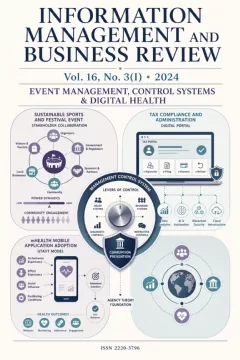 Vol. 16 No. 3(I) (2024)
Event Management, Control Systems & Digital Health
View issue contents
Published
Submissions
Have research to publish? Information Management and Business Review welcomes submissions.
Make a Submission