Abstract
The process of economic evolution from agriculture to manufacturing is now turning to the service industry. Studies in recent years show that the service sector comprises the major share of the developed countries in the last few decades. As an expanding sector, it is inevitable that new services will be introduced to the processes of a company. Moreover, new service design is likely to be influenced by the culture of the organization. In this study, the effects of the culture on new service design are examined. In order to analyze the effects, a detailed literature review on new service design was prepared. Two case studies, which mainly exemplify new service design, were analyzed in-depth, screened, and examined in the study. Based on prior research and field studies, a conceptual framework and a regional study, which merit further research, are offered in this paper.
Keywords
- New Service Design Search this journal for New Service Design (opens in a new tab)
- Organizational Culture Search this journal for Organizational Culture (opens in a new tab)
- Online Education Search this journal for Online Education (opens in a new tab)
- Healthcare Services Search this journal for Healthcare Services (opens in a new tab)
- E-MBA Search this journal for E-MBA (opens in a new tab)
References
- Alvesson, M. (2002). Understanding Organizational Culture, Sage, London.
- Bronikowski, K. (1990). Speeding new products to market. Journal of Business Strategy , 3, 34-7.
- Cameron, K. S. & Quinn, R. E. (1999). Diagnosing and changing organizational culture: Based on the competing values framework, Addison-Wesley.
- Candi, M. (2007). The role of design in the development of technology-based services. Design Studies, 28, 559-583.
- Clark, G., Johnston, R. & Shulver, M. (2000). Exploiting the service concept for service design and development, In: Fitzsimmons, J., Fitzsimmons, M. (Eds.), New Service Design, Sage, Thousand Oaks, CA, 71-91.
- Claver, E., Llopis, D. G. & Molina, H. (1998). Organizational culture for innovation and new technological behavior. Journal of High Technology Management Research , 9, 55-68.
- Cook, L. S., Bowen D. E., Chase R. B., Dasu, S., Steward, D. M. & David, A. T. (2002). Human issues in service design. Journal of Operations Management, 20, 159-174.
- Edvardsson, B., Gustavsson, A., Johnson, M. D. & Sanden, B. (2000). New service development and innovation in the new economy, Student literature, Lund, Sweden .
- Fitzsimmon, J. A. & Fitzsimmon, M. J. (2000). New Service Development, Sage Publications, Thousand Oak, CA.
- Fitzsimmon, J. A. (2003). Is the future of services self-service? Managing Service Quality , 13, 443-444.
- Fitzsimmons, J. A. & Fitzsimmons, M. J. (2008). Service Management - Operations, Strategy, Information Technology, 6. Edition, McGraw-Hill International Edition.
- Goldstein, S. M., Johnston, R., Duffy, J. & Rao, J. (2002). The service concept: The missing link in service design research. Journal of Operations Management, 20 , 121-134.
- Gregory, B. T., Harris, S. G., Armenakis, A. A. & Shook, C. L. (2009). Organizational culture and effectiveness: A study of values, attitudes and organizational outcomes. Journal of Business Research, 62 , 673-679.
- Hofstede, G. H. (1980). Culture’s consequences: international differences in work related values. Sage, Beverly Hills CA.
- Johnson, S. P., Menor, L. J., Roth, A. V. & Chase, R. B. (2000). A critical evaluation of the new service development process. In: Fitzsimmons, J., Fitzsimmons, M. (Eds.), New Service Development, Sage, Thoasand Oaks, CA, 1-32.
- Kemp, S. & Dwyer, L. (2001). An examination of organizational culture – the Regent Hotel, Sydney. Hospitality Management, 20 , 77-93.
- Lund, D. B. (2003). Organizational culture and job satisfaction. Journal of Business and Industrial Marketing , 18, 219-236.
- Martin, C. R. & Horne, D. A. (1993). Service innovations: successful versus unsuccessful firms. International Journal of Service Industry Management , 4 , 49-65.
- Morelli, N. (2006). Developing new PPS, methodologies and operational tools. Journal of Cleaner Production, 14 , 1495-1501.
- Naor, M., Linderman, K. & Schroeder, R. (2010). The globalization of operations in Eastern and Western countries: Unpacking the relationship between national and organizational culture and its impact on manufacturing performance. Journal of Operations Management , 28, 194-205.
- Noori, H. (1990). Managing the Dynamics of New Technology: Issues in Manufacturing Management. Prentice Hall Inc. New Jersey.
- Norman, R. (1991). Service management. John Wiley, New York.
- Peters, T. (1990). Time-obsessed competition. Management Review, 79 , 16-20.
- Russel, R. D. (1988). How organisational culture can help to institutionalize the spirit of innovation in entrepreneurial ventures. Journal of Organizational Change Management , 2, 7-15.
- Schein, E. H. (1985). Organizational culture and leadership. Josey- Bass San Francisco
- Schneider, B. (1980). The service organization: climate is crucial. Organizational Dynamic, 9 , 52-65.
- Schneider, B. (1973). The perception of organizational climate: the customer’s view. Journal of Applied Psychology, 57, 248-56.
- Schoonhoven, C. B. & Jelinek, M. (1990). Dynamic tension in innovative, high technology firms. Managing rapid technology change through organization structure. : In von Glinow, M.A., & Mohrman, S.A. (Eds). Developing new services. American Marketing Associaiton, Chicago, IL, p.27-43.
- Shostack, G. L. (1982). How to design a service. European Journal of Marketing , 16, 49-63.
- Stuart, F. I. (1998). The influence of organizational culture and internal politics on new service design and introduction. International Journal of Service Industry Management, 9, 469-485.
- Swan, J. E. & Comb, L. J. (1976). Product performance and consumer satisfaction. Journal of Marketing, 40 , 17-30.
- Tax, S. & Stuart, F. I. (1997). Designing and implementing new services: the challenges of integrating service systems. Journal of Retailing, 73, 105-134.
- Wong, N. Y. (2004). The role of culture in the perception of service recovery. Journal of Business Research, 57, 957-963.
Downloads
No downloads have been recorded for this article yet. Figures appear here once readers begin downloading the full text.
How to Cite
Share this article
License
Copyright (c) 2012 Hatice Calipinar, A. Gozde Iyicil Gozum (Author)

This work is licensed under a Creative Commons Attribution 4.0 International License.
Author (s) should affirm that the material has not been published previously. It has not been submitted and it is not under consideration by any other journal. At the same time author (s) need to execute a publication permission agreement to assume the responsibility of the submitted content and any omissions and errors therein. After submission of revised paper in the light of suggestions of the reviewers, the editorial team edits and formats manuscripts to bring uniformity and standardization in published material.
This work will be licensed under Creative Commons Attribution 4.0 International (CC BY 4.0) and under condition of the license, users are free to read, copy, remix, transform, redistribute, download, print, search or link to the full texts of articles and even build upon their work as long as they credit the author for the original work. Moreover, as per journal policy author (s) hold and retain copyrights without any restrictions.
Keywords
- New Service Design Search this journal for New Service Design (opens in a new tab)
- Organizational Culture Search this journal for Organizational Culture (opens in a new tab)
- Online Education Search this journal for Online Education (opens in a new tab)
- Healthcare Services Search this journal for Healthcare Services (opens in a new tab)
- E-MBA Search this journal for E-MBA (opens in a new tab)
Section
Published in
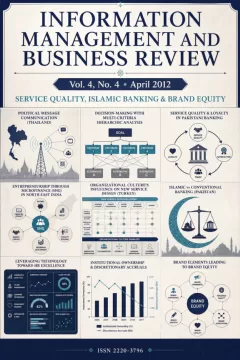 Vol. 4 No. 4 (2012)
Service Quality, Islamic Banking & Brand Equity
View issue contents
Published
Submissions
Have research to publish? Information Management and Business Review welcomes submissions.
Make a Submission