Articles

  • Article 1 in this issue

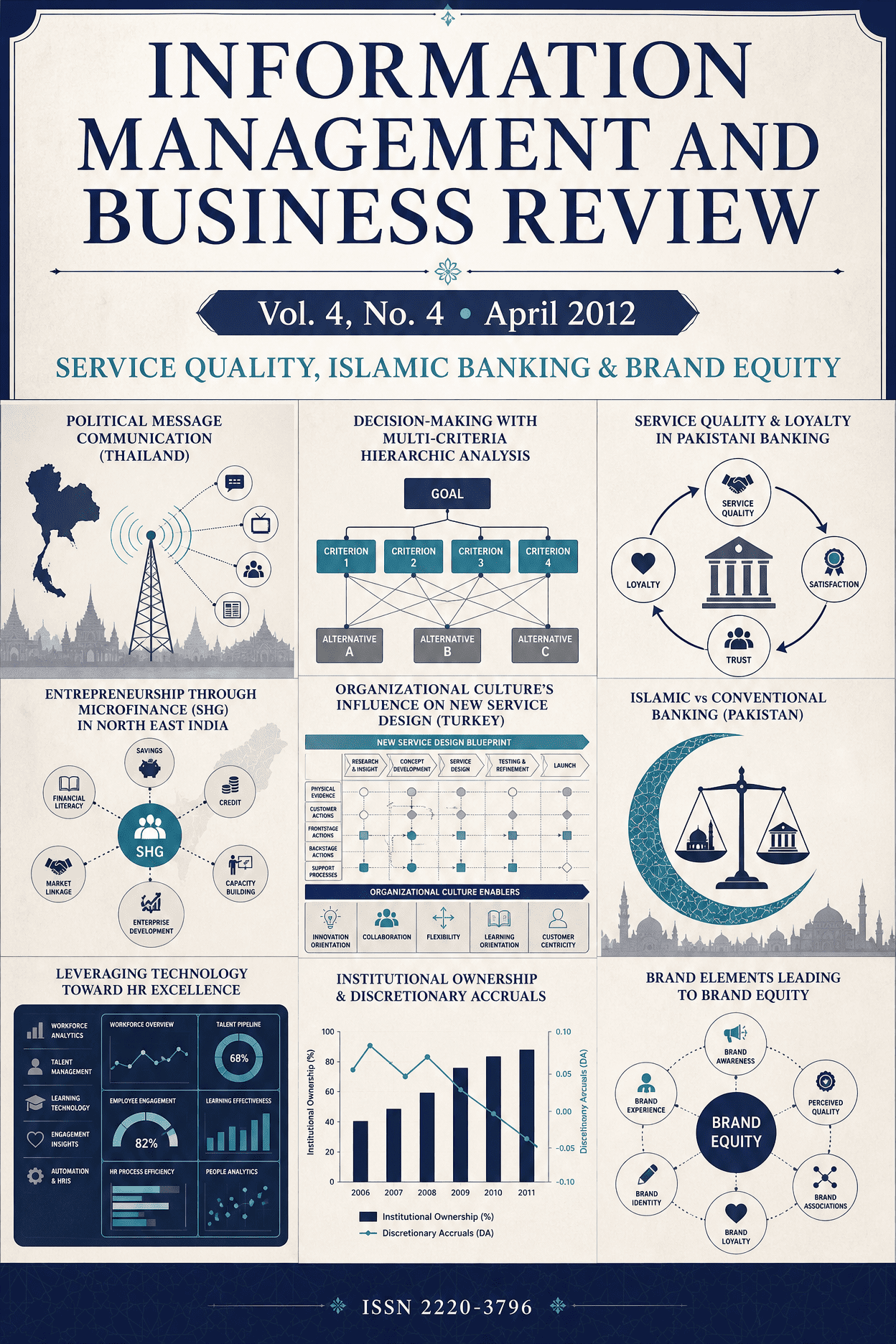
    Towards the Efficient Communication of Political Messages in Thailand: An Empirical Investigation

    • Author: Wilaiporn Laohakosol, John Walsh

    Models of consumer behavior generally posit an eclectic paradigm in which diverse elements may have an influence on an individual consumption decision. These elements might include personal experience, bias, the influence of family members and peer groups. This understanding of human behavior has been relocated from the commercial realm to the political realm with a view to helping to understand how the formation of people is voting intentions might take place and how it might be influenced. Since politics consists of a series of competing ideologies contending for the scarce resource of votes with a view to aligning state policies and the distribution of state resources along the lines of the manifesto on which a party is fighting, it follows that politicians will wish to use communication strategies to encourage as many eligible individuals as possible to vote for their policies. To date, in Thailand, most forms of political communication have been based on establishing personal contact and, hence, a form of personal relationship based on personality rather than policies. This situation is beginning to change, there is a need for those involved in determining the nature, and extent of political communications to understand which channels are appropriate for which groups of voters and which voters will not be influenced by any medium or message. Using a quantitative sample of 400 voters in four provinces of Thailand, this paper provides evidence to show that the degree to which people pay attention to political communications and to different channels varies in reasonably predictable fashions. This will enable political institutions and parties to work together to determine good and effective means of communicating their policies to the public in ways which will strengthen democratization in the country.

    Pages 145-152

    PDF - Towards the Efficient Communication of Political Messages in Thailand: An Empirical Investigation (opens in a new tab)
  • Article 2 in this issue

    Decision Making with Multi Criteria through Hierarchic Analysis Technique and its Effect on Customer Decision Procedure

    • Author: Alireza Shahraki, Hadi Zarea, Abbas Jannesari

    Today, world competition situation is in a way that organizations need to increase the quality and increase the customer satisfaction, increase the benefit and decrease in outgoings, all at the sometime together. One side, goods prices increase and sever competition in market between goods, and on the other side, complexity in customers attitude and their vary expectations made disaster in management and share increase of the market. So, increase of effects on customer decision procedure as a new attitude in these situations born. Customer decision procedure is a kind of decision- making that is mode by the users. In general, decision-making is recognition processes through selection among different choices. How many criteria are used to analysis by the users? In addition, what kind of criteria do they consider? In addition, to what extent do they emphasize according to their favorites or goods importance. Hierarchic analysis procedure (AHP) is a decision-making with multi criteria that is suitable complex decisions, and consist of decision elements compare in where recognition of quality has encountered with problem. Ranking in decision choices of AHP is to solve the puzzle complexity AHP procedure by finding the specification through different choices, declare good buying decision.

    Pages 153-158

    PDF - Decision Making with Multi Criteria through Hierarchic Analysis Technique and its Effect on Customer Decision Procedure (opens in a new tab)
  • Article 3 in this issue

    Service Quality, Customer Satisfaction and Loyalty: An Empirical Analysis of Banking Sector in Pakistan

    • Author: Mohsin Zafar, Sana Zafar, Aasia Asif, Ahmed Imran Hunjra, H. Mushtaq Ahmad

    The basic aim of this study is to explore most common constructs for quality of banking services, which influence customer satisfaction and examine the impact of customer satisfaction on customer loyalty in the context of banking relationships. The questionnaire was used to collect the data from 192 valid respondents by convenience sampling method. SPSS was used to analyze the data and AMOS was used to test the model. The results of the study show that there is a positive and significant link between customer satisfaction and constructs of service quality like tangibility, reliability, competence conflict handling and further study inferred that customer satisfaction is positively significant related to customer loyalty.

    Pages 159-167

    PDF - Service Quality, Customer Satisfaction and Loyalty: An Empirical Analysis of Banking Sector in Pakistan (opens in a new tab)
  • Article 4 in this issue

    Entrepreneurship through Micro Finance in North East India: A Comprehensive Review ofExisting Literature

    • Author: Sanjay Kanti Das

    Entrepreneurship on small scale is the only solution to the problems of unemployment and proper utilization of both human and non-human resources and improving the living conditions of the poor masses. The basic rationale of developing these industries are that they provide immediate large scale employment, ensure more equitable distribution of income, encourage decentralization of industries and eradicate poverty and unemployment. During the last three decades, many countries of the world have experienced the need and importance of entrepreneurship has been accepted as a strategy to achieve the twin objectives of promotion of entrepreneurship, particularly among the educated unemployed youth and also for rapid industrialization in the economy. The main object of this paper is to study the existing literature on entrepreneurship through Micro finance-SHG linkage in India in general and NER in particular. The analysis of this study is based on secondary sources. Efforts are also made in this paper to analyze the role of micro finance through SHGs in the promotion and development of entrepreneurship. This paper examines the different approaches of entrepreneurship and also explains the different key areas of micro enterprise development. Finally, this paper highlights the problems of micro, rural and women entrepreneurs and also suggested some specific measures based on the survey of existing literature, for the promotion of these industries in the country.

    Pages 168-184

    PDF - Entrepreneurship through Micro Finance in North East India: A Comprehensive Review ofExisting Literature (opens in a new tab)
  • Article 5 in this issue

    Analyzing the Influence of Organizational Culture on New Service Design: Case Studies from Turkey

    • Author: Hatice Calipinar, A. Gozde Iyicil Gozum

    The process of economic evolution from agriculture to manufacturing is now turning to the service industry. Studies in recent years show that the service sector comprises the major share of the developed countries in the last few decades. As an expanding sector, it is inevitable that new services will be introduced to the processes of a company. Moreover, new service design is likely to be influenced by the culture of the organization. In this study, the effects of the culture on new service design are examined. In order to analyze the effects, a detailed literature review on new service design was prepared. Two case studies, which mainly exemplify new service design, were analyzed in-depth, screened, and examined in the study. Based on prior research and field studies, a conceptual framework and a regional study, which merit further research, are offered in this paper.

    Pages 185-194

    PDF - Analyzing the Influence of Organizational Culture on New Service Design: Case Studies from Turkey (opens in a new tab)
  • Article 6 in this issue

    A Comparison between Islamic Banking and Conventional Banking Sector in Pakistan

    • Author: Abdul Hafeez Quresh, Zile Hussain, Kashif Ur Rehman

    The Islamic banking system is attaining enormous development. Several modern international conventional banks were also enchanting significant concern and starting Islamic banking branches in their organizations, which work in compliance with the specific Islamic Shariah principles in a number of states of Pakistan. The Islamic banking structure is bizarrely facing gigantic contest by the Islamic banking sector all over the world as well as from the well-known International commercial banks that hold out services and products of IB. It is an attempt for exploration and investigation of the extensive and essential factors, which persuade consumers to choose the Islamic banking or conventional banking and the function of demographic features, which track consumers to the assortment of IB or CB in Pakistan. Sample of 341 respondents has been used in this study mainly focused on non-probability convenience test tool. Pre-institute 5 point likert survey instrument ranging from 5 to 1 was applied to gather data. The conclusion reveals that there are countless factors other than religious perception like employee and customer interactions, convenience, reputation, financial benefits & services, and technology, which are fundamental for the consumers for the assortment of Islamic or conventional banking. The demographic characteristics of the respondents also have a significant impact. The authors expect that the crux of this study will explore new ways for the Islamic banking system to emphasis on specific emerging factors to enhance the efficiency and performance of the Islamic banking system in Pakistan. There will be enormous advantage for executives of IBs & CBs in developing marketing approach.

    Pages 195-204

    PDF - A Comparison between Islamic Banking and Conventional Banking Sector in Pakistan (opens in a new tab)
  • Article 7 in this issue

    Leveraging Technology towards HR Excellence

    • Author: Dileep Kumar. M., Srota Pandya

    The last decade has seen a significant increase in the number of organizations gathering, storing and analyzing human resources data using Human Resource Information Systems (HRIS) (Ball, 2001; Barron et al., 2004; Hussain et al., 2007; Ngai & Wat, 2006). HR to benefit almost every realm of business operations is leveraging technology. Many technology applications support Human Resource functions like erecruitment, employee tracking system, performance management software, e earning mode etc are helping dramatically to improve HR’s ability to carry out effective talent management and get better employer brand. Integration of technology and HR not only mean harmonious co-existing but would also mean the journey towards business excellence. This paper explores the understanding on positive impact of Human Resource Information System (HRIS) currently in use for people management with perception on Information Communication Technology (ICT) applications adopted by many industries. The study follows qualitative research as its plan of action in gathering information. The information gathered in crosschecked with industry to cross check the reliability.

    Pages 205-216

    PDF - Leveraging Technology towards HR Excellence (opens in a new tab)
  • Article 8 in this issue

    Institutional Ownership and Discretionary Accruals: Empirical Evidences from Pakistani Listed Non-Financial Companies

    • Author: Abdul Mateen Shaikh, Muhammad Junaid Iqbal, Syed Zulfiqar Ali Shah

    Current study empirically investigates the impact of institutional ownership on discretionary accruals; we took a sample size of 68 listed non -financial companies from a population of 652 companies listed on Karachi Stock Exchange (KSE). This data was gathered for the period of 5 years, starting from 2006 up to 2010. Modified Jones Model was employed for this study to quantify discretionary accruals while institutional ownership measured by dividing number of shares kept by institutions from total number of shares outstanding. The fix effect model showed that the magnitude of discretionary accruals in Pakistani listed firms tends to significantly decrease for the firms where institutions hold a decent amount of share of that particular firm. Thus the findings of this study are in consensus with our hypothesis, which proposes that institutional ownership is quite an effective tool in aligning insider management and administration to take the right decision for value maximizing of the companies, and thus shareholders.

    Pages 217-222

    PDF - Institutional Ownership and Discretionary Accruals: Empirical Evidences from Pakistani Listed Non-Financial Companies (opens in a new tab)
  • Article 9 in this issue

    Brand Elements Lead to Brand Equity: Differentiate or Die

    • Author: Mosarrat Farhana

    The aim of this paper is to discuss brand elements and to explore its contribution to brand equity based on some relevant research reviews and some examples of prominent brands where brand elements have played a significant role to reach consumer’s head and heart. Brand is a combination of name, symbol or design, which creates a distinctive identity to consumers within a crowd of choices through its different brand elements. A distinctive or unique offering as well as get-up of a brand is the primary key of survival from the immature death in competition. Differentiating approach of different brand elements always cause a high level of brand awareness and familiarity among target consumers and later on individually or collectively, brand elements work as clue to consumers to recall and recognize the brand. Proper integration of both strong and weak brand elements of a brand contribute to brand equity, which has been focused here through some literature reviews.

    Pages 223-233

    PDF - Brand Elements Lead to Brand Equity: Differentiate or Die (opens in a new tab)