Abstract
The Islamic banking system is attaining enormous development. Several modern international conventional banks were also enchanting significant concern and starting Islamic banking branches in their organizations, which work in compliance with the specific Islamic Shariah principles in a number of states of Pakistan. The Islamic banking structure is bizarrely facing gigantic contest by the Islamic banking sector all over the world as well as from the well-known International commercial banks that hold out services and products of IB. It is an attempt for exploration and investigation of the extensive and essential factors, which persuade consumers to choose the Islamic banking or conventional banking and the function of demographic features, which track consumers to the assortment of IB or CB in Pakistan. Sample of 341 respondents has been used in this study mainly focused on non-probability convenience test tool. Pre-institute 5 point likert survey instrument ranging from 5 to 1 was applied to gather data. The conclusion reveals that there are countless factors other than religious perception like employee and customer interactions, convenience, reputation, financial benefits & services, and technology, which are fundamental for the consumers for the assortment of Islamic or conventional banking. The demographic characteristics of the respondents also have a significant impact. The authors expect that the crux of this study will explore new ways for the Islamic banking system to emphasis on specific emerging factors to enhance the efficiency and performance of the Islamic banking system in Pakistan. There will be enormous advantage for executives of IBs & CBs in developing marketing approach.
Keywords
- Islamic Banking Search this journal for Islamic Banking (opens in a new tab)
- Conventional Banking Search this journal for Conventional Banking (opens in a new tab)
- Selection Criteria Search this journal for Selection Criteria (opens in a new tab)
- Momentum Search this journal for Momentum (opens in a new tab)
- Banking and Shariah Search this journal for Banking and Shariah (opens in a new tab)
References
- Abdul-Qawi, O. & Lynn, O. (2001). Adopting and measuring customer service quality in Islamic banks: A case study in Kuwait Finance. House. Int. J. Islamic finance Service , 3, 1-26.
- Ahmed, N. & Haron, S. (2002). perception of malysian corporate customers towards islamic banking product and services. International journal of islamic financial services , 03 (04),13-29.
- Ahmed, N. & sudinharon, F. (2001). Perceptions of malaysian corporate customers towards Islamic banking products and services. International Journal of Islamic Financial Services , 03 (04).
- Akhtar, S. (2006). The financial sector of Pakistan-the road map. Islamic finance news , 03 (16), 11-12.
- Almossawi, M. (2001). Bank selection criteria employed by college students in Bahrain: An empirical analysis. Intenational journal of bank marketing , 19 (03), 115-125.
- Al-sultan, W. (1999). Financial chracteristics of interest free banks and conventional banks. PHD dissertation University of wollongong .
- Ciptono, W. & Soviyanti, E. (2007). Adopting islamic banks' CATER model: An empirical study in RIAU'S Syariah banks, Indonesia. Proceeding PESAT Auditorium Kampus Gunadarma , 02 , 1858-2559.
- Dusuki, A. W. & Abdullah, N. I. (2007). Why do Malaysian customers patronise Islamic banks? international journal of bank marketing , 25 (03),142-160.
- Erol, C. & El-Bdour, R. (1989). Attitudes, behavior, and patronage factors of bank customers towards Islamic banks . International Banking & Marketing, 7(6), 31-37.
- Gait, A. & Worthington, A. (2008). An empirical survey of individual consumer, business firm and financial institution attitudes towards Islamic methods of finance. International Journal of Social Economics, 35 (11), 783-808.
- Hamid, A. & Nordin, N. (2001). A study of islamic banking education and strategy for the new millenniumMalysian experience. International journal of islamic financial services , 02 (04), 3-11.
- Haque, A., Osman, J. & Ismail, A. (2009). Factor Influences Selection of Islamic Banking: A Study on Malaysian Customer Preferences. American Journal of Applied Sciences , 06 (05), 922-928.
- Haron, S., Ahmed, N. & Planisek, S. (1992). Requirement and selection decisionof customers in islamic and conventional banking environment. Malaysian management journal , 01 (01), 25-33.
- IFSL. (2011). International Financial Services Limited Research on Islamic Finance report. http://www.ifsl.org.uk/output/ReportItem.aspx?NewsID=32 (accessed on July 07, 2011).
- Jalaludin, A. & Metwally, M. (1999). profit/loss an alternative method of financing small business in Australia. The middle East Business and economic review , 11 (01), 8-14.
- Khan, M., Hassan, M. & Shahid, A. (2007). Banking Behavior of Islamic Bank Customers in Bangladesh. Journal of Islamic Economics, Banking and Finance , 2, 160-194.
- Metwally, M. (2002). The impact of demographic factors on consumer selection of a particular bank within a dual banking system-A case study. Journal of international marketing and marketing research, 27 (01),35-44.
- Naser, K., Jamal, A. & Al-Khatib, K. (1999). Islamic banking: A study of customer satisfaction and prefrences in jordan. International journal of bank marketing , 17(03),135- 150.
- Nuradli, R. S., Hanifah, A. H., Shahida, S. & Hairunnizam, W. (2008). Factors Influencing the Islamic credit cards holder’s satisfaction. The business review, Cambridge , 11(2), 1- 8.
- Obiyo, O. (2008). Islamic financing/banking in the Nigerian economy Is it workable? A review of related issues and prospects. International Journal of Islamic and Middle Eastern Finance and Management , 01 (03),227-234.
- Okumus, H. (2005). Interest free banking in Turkey: A study of customer satisfaction and Bank selection criteria. Journal of economic corporation , 26 (04), 51-86.
- Osman, I., Ali, H., Zainuddin, A., Rashid, W. & Jusoff, K. (2009). Customers Satisfaction in Malaysian Islamic Banking. International Journal of Economics and Finance , 01(01), 197-202.
- Shah, N. & Hamid, H. (2008). Comparing the Islamic Banking, Conventional and both banking users using multinomial logistic regression.International accounting and business conference, 2008.
- Sudin, H., Norafifah, A. & Sandra, L. P. (1994). Bank Patronage Factors of Muslims and NonMuslim Customers. International Journal of Bank Marketing , 12(01), 32-40.
Downloads
No downloads have been recorded for this article yet. Figures appear here once readers begin downloading the full text.
How to Cite
Share this article
License
Copyright (c) 2012 Abdul Hafeez Quresh, Zile Hussain, Kashif Ur Rehman (Author)

This work is licensed under a Creative Commons Attribution 4.0 International License.
Author (s) should affirm that the material has not been published previously. It has not been submitted and it is not under consideration by any other journal. At the same time author (s) need to execute a publication permission agreement to assume the responsibility of the submitted content and any omissions and errors therein. After submission of revised paper in the light of suggestions of the reviewers, the editorial team edits and formats manuscripts to bring uniformity and standardization in published material.
This work will be licensed under Creative Commons Attribution 4.0 International (CC BY 4.0) and under condition of the license, users are free to read, copy, remix, transform, redistribute, download, print, search or link to the full texts of articles and even build upon their work as long as they credit the author for the original work. Moreover, as per journal policy author (s) hold and retain copyrights without any restrictions.
Keywords
- Islamic Banking Search this journal for Islamic Banking (opens in a new tab)
- Conventional Banking Search this journal for Conventional Banking (opens in a new tab)
- Selection Criteria Search this journal for Selection Criteria (opens in a new tab)
- Momentum Search this journal for Momentum (opens in a new tab)
- Banking and Shariah Search this journal for Banking and Shariah (opens in a new tab)
Section
Published in
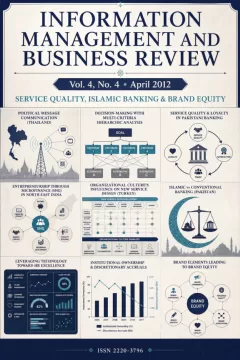 Vol. 4 No. 4 (2012)
Service Quality, Islamic Banking & Brand Equity
View issue contents
Published
Submissions
Have research to publish? Information Management and Business Review welcomes submissions.
Make a Submission