Abstract
Current study empirically investigates the impact of institutional ownership on discretionary accruals; we took a sample size of 68 listed non -financial companies from a population of 652 companies listed on Karachi Stock Exchange (KSE). This data was gathered for the period of 5 years, starting from 2006 up to 2010. Modified Jones Model was employed for this study to quantify discretionary accruals while institutional ownership measured by dividing number of shares kept by institutions from total number of shares outstanding. The fix effect model showed that the magnitude of discretionary accruals in Pakistani listed firms tends to significantly decrease for the firms where institutions hold a decent amount of share of that particular firm. Thus the findings of this study are in consensus with our hypothesis, which proposes that institutional ownership is quite an effective tool in aligning insider management and administration to take the right decision for value maximizing of the companies, and thus shareholders.
Keywords
- Institutional Ownership Search this journal for Institutional Ownership (opens in a new tab)
- Discretionary Accruals Search this journal for Discretionary Accruals (opens in a new tab)
- Non-Financial Companies Search this journal for Non-Financial Companies (opens in a new tab)
- Karachi Stock Exchange Search this journal for Karachi Stock Exchange (opens in a new tab)
References
- Ali, S. M., Salleh, N. M. & Hassan, M. S. (2008). Ownership Structure and Earnings Management in Malaysian Listed Companies: The Size Effect. Asian Journal of Business and Accounting , 1(2), 89-116.
- Beneish, M. (2001). Earnings Management: a perspective. Managerial Finance, 27(3).
- Cheng, C. A. & Reitenga, A. (2000). Institutional Investors and Discretionary Accruals, Paper presented at the 2nd AAA/BAA Globalization Conference. Cambridge: UK.
- Collins, D. & Hribar, P. (1999). Errors in estimating accruals: Implications for empirical research. Working Paper. University of Iowa.
- Dorothy, A., Feldmann, D. & Schwarzkopf. L. (2003). The Effect of Institutional Ownership on Board and Audit Committee Composition. Review of Accounting and Finance , 2(4), 87–109
- Frank, Y. (2006). Corporate Governance and Earnings Management. Working paper, version: June.
- Fayoumi, N. A., Abuzayed, B. & Alexander, D. (2010). Ownership structure and Earnings Management in Emerging Markets: The Case of Jordan. International Research Journal of Finance and Economics, 38, 28-47.
- Hayn, C. (1995). The information content of losses. Journal of Accounting and Economics , 20, 125-153.
- Healy, P. M. & Wahlen, J. M. (1998). A review of the earnings management literature and its implication for standard setting, Harvard Working Paper.
- Holthausen, R. W. & Leftwich, R. W. (1983). The economics consequences of accounting choice. Journal of Accounting and Economics, 5(2), 77-117.
- Hsu, G. C. M. & Koh, P. S. (2005). Does the Presence of Institutional Investors Influence Accruals Management? Evidence from Australia. Corporate Governance , 13(6).
- Jones, J. J. (1991). Earnings management during important relief investigations. Journal of accounting research , 29, 193-228.
- Koh, P. S. (2003). On the Association between Institutional Ownership and Aggressive Corporate Earnings Management in Australia. The British Accounting Review, 35, 105–128.
- Lang, M. & McNicholas, M. (1997). Institutional Trading and Corporate Performance. Research Paper, Stamford University.
- Lev, B. (1989). On the Usefulness of Earnings and Earnings Research: Lessons and Directions from Two Decades of Empirical Research. Journal of Accounting Research , 27, 153-201.
- Rajgopal, S. & Venkatachalam, M. (1998). The Role of Institutional Investors in Corporate Governance: An Empirical Investigation. Working paper, Stanford University.
- Schipper, K. (1989). Commentary on earnings management. Accounting Horizons , 3, 91-102.
- Scott, R. W. (1998). Financial Accounting Theory. Prentice Hall, New Jersey.
- Shah, Z. A., Zafar, N. & Durrani, T. K. (2009). Board Composition and Earnings Management an Empirical Evidence Form Pakistani Listed Companies. Middle Eastern Finance and Economics, 3(29), 30-44.
- Shleifer, A. & Vishny, R. W. (1997). A survey of corporate governance. The Journal of Finance , 52(1), 737–783.
- Watts, R. L. & Zimmerman, J. L. (1986). Positive Accounting Theory. Englewood Clifts: Prentice Hall. Wong, S. Y., Loo, S. C. & Shamsher, M. R. (2009). The Effect of Board Structure and Institutional Ownership Structure on Earnings Management. Master’s thesis, University Putra Malaysia.
- Yeo, G., Tan, P., Ho, K. & Chen, S. (2002). Corporate ownership structure and the in formativeness of earnings. Journal of Business Finance & Accounting, 29, 1023-1046.
Downloads
No downloads have been recorded for this article yet. Figures appear here once readers begin downloading the full text.
How to Cite
Share this article
License
Copyright (c) 2012 Abdul Mateen Shaikh, Muhammad Junaid Iqbal, Syed Zulfiqar Ali Shah (Author)

This work is licensed under a Creative Commons Attribution 4.0 International License.
Author (s) should affirm that the material has not been published previously. It has not been submitted and it is not under consideration by any other journal. At the same time author (s) need to execute a publication permission agreement to assume the responsibility of the submitted content and any omissions and errors therein. After submission of revised paper in the light of suggestions of the reviewers, the editorial team edits and formats manuscripts to bring uniformity and standardization in published material.
This work will be licensed under Creative Commons Attribution 4.0 International (CC BY 4.0) and under condition of the license, users are free to read, copy, remix, transform, redistribute, download, print, search or link to the full texts of articles and even build upon their work as long as they credit the author for the original work. Moreover, as per journal policy author (s) hold and retain copyrights without any restrictions.
Keywords
- Institutional Ownership Search this journal for Institutional Ownership (opens in a new tab)
- Discretionary Accruals Search this journal for Discretionary Accruals (opens in a new tab)
- Non-Financial Companies Search this journal for Non-Financial Companies (opens in a new tab)
- Karachi Stock Exchange Search this journal for Karachi Stock Exchange (opens in a new tab)
Section
Published in
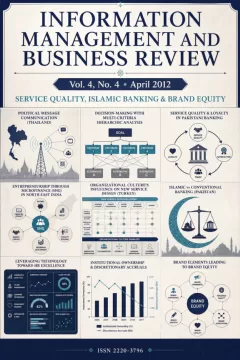 Vol. 4 No. 4 (2012)
Service Quality, Islamic Banking & Brand Equity
View issue contents
Published
Submissions
Have research to publish? Information Management and Business Review welcomes submissions.
Make a Submission