Abstract
The COVID-19 pandemic has expedited the utilization of digital payment alternatives, with e-wallets becoming a significant component of the financial ecosystem. This study examines the diverse benefits and challenges of e-wallets in a post-pandemic context. The researchers conducted a systematic literature review (SLR) of peer-reviewed academic papers utilizing the Emerald Insights database. Forty-four articles published between January 2021 and September 2024 were reviewed, highlighting the study's benefits and challenges. The findings indicate that e-wallets enhance financial inclusion, promote convenience and accessibility, stimulate business and economic growth, support the digital economy, facilitate technological integration, and improve consumer convenience, especially in an increasingly cashless environment. Nonetheless, the study also examines the substantial challenges associated with this swift digital transformation, encompassing security issues, poor adoption rates, insufficient knowledge, trust deficits, regulatory hurdles, feature limitations, and user attitude challenges. This study seeks to elucidate the changing function of e-wallets in influencing the future of commerce through a thorough investigation. The study offers recommendations for e-wallet providers, policymakers, and researchers to successfully manage the complexity of e-wallet adoption, enhancing benefits while resolving the inherent challenges.
Keywords
- e-Wallet Search this journal for e-Wallet (opens in a new tab)
- Cashless Search this journal for Cashless (opens in a new tab)
- Sustainable Development Search this journal for Sustainable Development (opens in a new tab)
- Benefits Search this journal for Benefits (opens in a new tab)
- Challenges Search this journal for Challenges (opens in a new tab)
References
- Ahmed, S., & Sur, S. (2023). Change in the use pattern of digital banking services by Indian rural MSMEs during demonetization and COVID-19 pandemic-related restrictions. Vilakshan - XIMB Journal of Management, 20(1), 166–192. https://doi.org/10.1108/xjm-09-2020-0138
- Alba, R. (2003). Evolution of methods of money laundering in Latin America. Journal of Financial Crime. 10. 137-140. 10.1108/13590790310808718.
- Aref, M. (2024). Sharing economy from the sustainable development goals perspective: a path to global prosperity. Journal of Internet and Digital Economics, 4(2), 116–138. https://doi.org/10.1108/jide-02-2024-0007
- Ariffin, S. K., Abd Rahman, M. F. R., Muhammad, A. M., & Zhang, Q. (2021). Understanding the consumer’s intention to use the e-wallet services. Spanish Journal of Marketing - ESIC, 25(3), 446–461. https://doi.org/10.1108/SJME-07-2021-0138
- Dimitrova, I. (2024). Barrier-breakers’ influence on full adoption of digital payment methods. Internet Research, 34(7), 139–159. https://doi.org/10.1108/INTR-11-2022-0886
- Dimitrova, I., Öhman, P., & Yazdanfar, D. (2022). Barriers to bank customers’ intention to fully adopt digital payment methods. International Journal of Quality and Service Sciences, 14(5), 16–36. https://doi.org/10.1108/IJQSS-03-2021-0045
- Ekong, U. M., & Ekong, C. N. (2022). Digital currency and financial inclusion in Nigeria: lessons for development. Journal of Internet and Digital Economics, 2(1), 46–67. https://doi.org/10.1108/jide-11-2021-0018
- Esawe, A. T. (2022). Understanding mobile e-wallet consumers’ intentions and user behavior. Spanish Journal of Marketing - ESIC, 26(3), 363–384. https://doi.org/10.1108/SJME-05-2022-0105
- Goel, R. & Mehrotra, A. (2012). Financial payment instruments and corruption. Applied Financial Economics. 22. 1-10. 10.1080/09603107.2011.628295.
- Istijanto, & Handoko, I. (2022). Customers’ continuance usage of mobile payment during the COVID-19 pandemic. Spanish Journal of Marketing - ESIC, 26(3), 345–362. https://doi.org/10.1108/SJME-02-2022-0016
- Jayarathne, P. G. S. A., Chathuranga, B. T. K., Dewasiri, N. J., & Rana, S. (2022). Motives of mobile payment adoption during COVID-19 pandemic in Sri Lanka: a holistic approach of both customers’ and retailers’ perspectives. South Asian Journal of Marketing, 4(1), 51–73. https://doi.org/10.1108/sajm-03-2022-0013
- Kamis, R., Ismail, S. &, & Abd Rahman, N. H. (2023). A Study of Literature and Practical Gaps in e-Wallet Acceptance: The Case of Malaysia. Information Management and Business Review, 15(4 (SI)), 181–190. https://doi.org/https://doi.org/10.22610/imbr.v15i4(SI)I.3591
- Kamis, R., Ismail, S. &, & Rahman, N. H. (2022). Go Cashless : A Proposed Conceptual Framework for e-Wallet Acceptance. International Journal of Academic Research in Business and Social Sciences, 12(11), 1797–1808. https://doi.org/10.6007/IJARBSS/v12-i11/15264
- Kamis, R., Ismail, S., Rahman, N. H. A., Muthusamy, G. a/p, Abidin, M. I., Awang, A. H., & Zain, Z. M. (2023). Acceleration towards Cashless: Safeguarding the Low-Income Group? International Journal of Academic Research in Business and Social Sciences, 13(8), 1092 – 1106. https://doi.org/10.6007/IJARBSS/v13-i8/18168
- Mew, J., & Millan, E. (2021). Mobile wallets: key drivers and deterrents of consumers’ intention to adopt. International Review of Retail, Distribution and Consumer Research, 31(2), 182–210. https://doi.org/10.1080/09593969.2021.1879208
- Mohammed, Z. A., Mohammed, M. & Mohammed, S. (2024). Artificial Intelligence: Cybersecurity Threats in Pharmaceutical. IARJSET. 11. 10.17148/IARJSET.2024.11801.
- Nahav, A., Ansari, M. & Masoom, R. (2020). Awareness and Usage of the Emerald Insight Database as Determinant of Research Output for Researcher Scholar of Aligarh Muslim University, India. Collection Management, 45(1):71-86. doi: 10.1080/01462679.2019.1579013
- Nguyen, T. T. H. (2020). Measuring financial inclusion: a composite FI index for the developing countries. Journal of Economics and Development, 23(1), 77–99. https://doi.org/10.1108/JED-03-2020-0027
- Noorshella, C. N., Husna, S. H., Noura, S. A., Siti, A. Z., Noor, U. K., Ariezal, A. H., Wan, S., Aafanii, A., Wan, I., Amaal, F. M., Nazatul, S. M. N. & Md Zaki, M. H. (2024). The path to sustainability begins with going paperless: Antecedents of intention to use electronic wallet using serial mediation approach. Heliyon, doi: 10.1016/j.heliyon.2024.e24127
- Nourallah, M., Öhman, P., & Amin, M. (2023). No trust, no use: how young retail investors build initial trust in financial robo-advisors. Journal of Financial Reporting and Accounting, 21(1), 60–82. https://doi.org/10.1108/JFRA-12-2021-0451
- Ohiani, A. S. (2021). Technology innovation in the Nigerian banking system: prospects and challenges. Rajagiri Management Journal, 15(1), 2–15. https://doi.org/10.1108/ramj-05-2020-0018
- Okonkwo, C. W., Amusa, L. B., Twinomurinzi, H., & Fosso Wamba, S. (2023). Mobile wallets in cash-based economies during COVID-19. Industrial Management and Data Systems, 123(2), 653–671. https://doi.org/10.1108/IMDS-01-2022-0029
- Oloveze, A. O., Ogbonna, C., Ahaiwe, E., & Ugwu, P. A. (2022). From offline shopping to online shopping in Nigeria: evidence from African emerging economy. IIM Ranchi Journal of Management Studies, 1(1), 55–68. https://doi.org/10.1108/irjms-08-2021-0110
- Oloveze, A. O., Okonkwo, R. V. O., Nwachukwu, C. P., Ogbonna, C., & Chukwuoyims, K. (2022). User behavior on continuance intention to use M-commerce in the African context: the mediating effect of perceived value. LBS Journal of Management & Research, 20(2), 21–33. https://doi.org/10.1108/LBSJMR-05-2022-0018
- Oloveze, A. O., Oteh, O. U., Nwosu, H. E., & Obasi, R. O. (2022). How user behavior is moderated by an affective commitment on the point of sale terminal. Rajagiri Management Journal, 16(1), 2–20. https://doi.org/10.1108/ramj-05-2020-0019
- Philip, J., Gilli, K., & Knappstein, M. (2023). Identifying key leadership competencies for digital transformation: evidence from a cross-sectoral Delphi study of global managers. Leadership and Organization Development Journal, 44(3), 392–406. https://doi.org/10.1108/LODJ-02-2022-0063
- Rahman, M. F., & Hossain, S. (2023). The impact of website quality on online compulsive buying behavior : evidence from online shopping organizations. South Asian Journal of Marketing, 4(1), 1–16. https://doi.org/10.1108/SAJM-03-2021-0038
- Rahman, S., Nguyen-Viet, B., Nguyen, Y. T. H., & Kamran, S. (2024). Promoting fintech: driving developing country consumers’ mobile wallet use through gamification and trust. International Journal of Bank Marketing, 42(5), 841–869. https://doi.org/10.1108/IJBM-01-2023-0033
- Raj L., V., Amilan, S., & Aparna, K. (2024). Factors influencing the adoption of cashless transactions: toward a unified view. South Asian Journal of Marketing, 5(1), 74–90. https://doi.org/10.1108/sajm-11-2022-0071
- Ruslim, T. S., Herwindiati, D. E., & Cokki. (2024). Adoption of e-wallet in the post-pandemic era: A study on Generation X’s intention to use e-wallet. Innovative Marketing, 20(2), 267–280. https://doi.org/10.21511/im.20(2).2024.22
- Saadah, K., & Setiawan, D. (2024). Determinants of fintech adoption: evidence from SMEs in Indonesia. LBS Journal of Management & Research, 22(1), 55–65. https://doi.org/10.1108/lbsjmr-11-2022-0076
- Sakuntala, S. S., Sarakanam, S., Dhavan, A., Taggar, R., & Kohli, G. (2024). The complexity of corruption and recent trends in information technology for combating corruption in India. Public Administration and Policy, 27(2), 126–139. https://doi.org/10.1108/PAP-05-2023-0058
- Salman, D., & Ismael, D. (2023). The effect of digital financial inclusion on the green economy: the case of Egypt. Journal of Economics and Development, 25(2), 120–133. https://doi.org/10.1108/JED-05-2022-0087
- Shaikh, A. A., Alamoudi, H., Alharthi, M., & Glavee-Geo, R. (2023). Advances in mobile financial services: a review of the literature and future research directions. In International Journal of Bank Marketing (Vol. 41, Issue 1). https://doi.org/10.1108/IJBM-06-2021-0230
- Tennyson, O., & Mercy, O. E. (2014). E-Payment System and its Sustainable Development in the Nigerian Economy. European Journal of Business and Management Www.Iiste.Org ISSN, 6(8), 48–56. www.iiste.org
- Tomczak, M. T., Ziemia?ski, P., & Gawrycka, M. (2023). Do the young employees perceive themselves as digitally competent and does it matter? Central European Management Journal, 31(4), 522–534. https://doi.org/10.1108/CEMJ-04-2022-0226
- Undale, S., Kulkarni, A., & Patil, H. (2021). Perceived eWallet security: impact of COVID-19 pandemic. Vilakshan - XIMB Journal of Management, 18(1), 89–104. https://doi.org/10.1108/xjm-07-2020-0022
- ????????, ?. ?. (2024). COVID-19 Pandemic : Duration and Epidemiological Forecast. Problems of Particularly Dangerous Infections, 141–148. https://doi.org/10.21055/0370-1069-2023-4-141-148
Downloads
No downloads have been recorded for this article yet. Figures appear here once readers begin downloading the full text.
How to Cite
Share this article
License
Copyright (c) 2024 Rohaiza Kamis, Shafinar Ismail, Hazalinda Harun, Amizatul Hawariah Awang, Mohd Isham Abidin (Author)

This work is licensed under a Creative Commons Attribution 4.0 International License.
Author (s) should affirm that the material has not been published previously. It has not been submitted and it is not under consideration by any other journal. At the same time author (s) need to execute a publication permission agreement to assume the responsibility of the submitted content and any omissions and errors therein. After submission of revised paper in the light of suggestions of the reviewers, the editorial team edits and formats manuscripts to bring uniformity and standardization in published material.
This work will be licensed under Creative Commons Attribution 4.0 International (CC BY 4.0) and under condition of the license, users are free to read, copy, remix, transform, redistribute, download, print, search or link to the full texts of articles and even build upon their work as long as they credit the author for the original work. Moreover, as per journal policy author (s) hold and retain copyrights without any restrictions.
Keywords
- e-Wallet Search this journal for e-Wallet (opens in a new tab)
- Cashless Search this journal for Cashless (opens in a new tab)
- Sustainable Development Search this journal for Sustainable Development (opens in a new tab)
- Benefits Search this journal for Benefits (opens in a new tab)
- Challenges Search this journal for Challenges (opens in a new tab)
Section
Published in
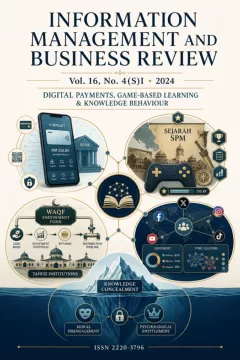 Vol. 16 No. 4(S)I (2024)
Digital Payments, Game-Based Learning & Knowledge Behaviour
View issue contents
Published
Submissions
Have research to publish? Information Management and Business Review welcomes submissions.
Make a Submission