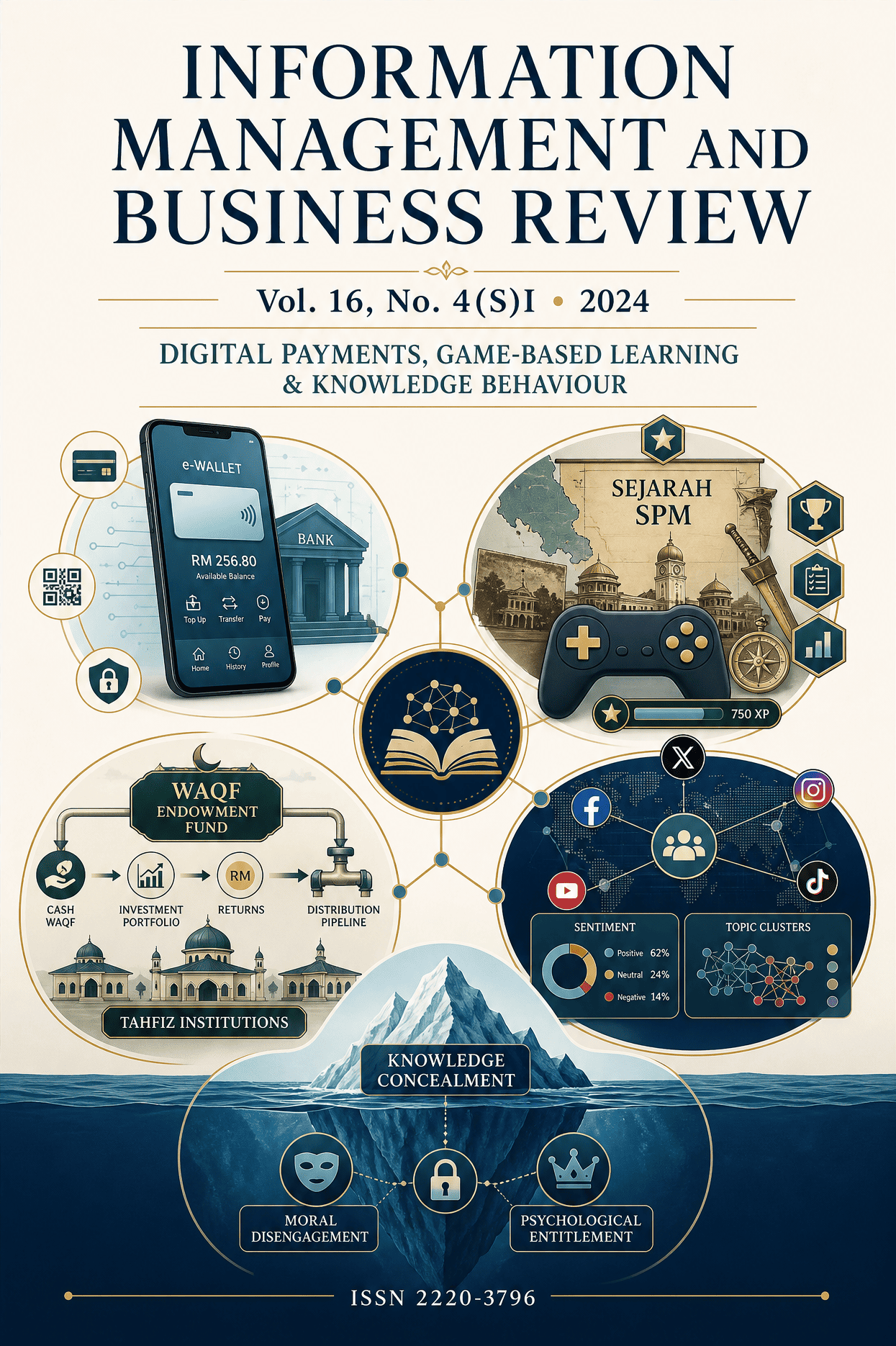
Articles 1–10 of 45

  • Article 1 in this issue

    E-Wallets Unplugged: Navigating Benefits and Challenges in a Post-Pandemic World

    • Author: Rohaiza Kamis, Shafinar Ismail, Hazalinda Harun, Amizatul Hawariah Awang, Mohd Isham Abidin

    The COVID-19 pandemic has expedited the utilization of digital payment alternatives, with e-wallets becoming a significant component of the financial ecosystem. This study examines the diverse benefits and challenges of e-wallets in a post-pandemic context. The researchers conducted a systematic literature review (SLR) of peer-reviewed academic papers utilizing the Emerald Insights database. Forty-four articles published between January 2021 and September 2024 were reviewed, highlighting the study's benefits and challenges. The findings indicate that e-wallets enhance financial inclusion, promote convenience and accessibility, stimulate business and economic growth, support the digital economy, facilitate technological integration, and improve consumer convenience, especially in an increasingly cashless environment. Nonetheless, the study also examines the substantial challenges associated with this swift digital transformation, encompassing security issues, poor adoption rates, insufficient knowledge, trust deficits, regulatory hurdles, feature limitations, and user attitude challenges. This study seeks to elucidate the changing function of e-wallets in influencing the future of commerce through a thorough investigation. The study offers recommendations for e-wallet providers, policymakers, and researchers to successfully manage the complexity of e-wallet adoption, enhancing benefits while resolving the inherent challenges.

    Pages 1-8

    PDF - E-Wallets Unplugged: Navigating Benefits and Challenges in a Post-Pandemic World (opens in a new tab)
  • Article 2 in this issue

    University Students’ Spending Behavior from the Perspective of Entrepreneurship Students

    • Author: Siti Daleela Mohd Wahid, Wan Mohd Hirwani Wan Hussain, Noorain Mohd Nordin

    Investigating spending behavior among students is essential, particularly in understanding how they allocate funds toward academic priorities. This article aims to explore students' spending habits and the key practices that influence the allocation of semester-based educational funding. The study adopts a quantitative, cross-sectional approach, with 501 respondents selected from six higher education institutions in Melaka through a quota sampling technique. Data analysis was conducted using IBM SPSS software (version 28.0). The results indicate that both financial management knowledge and peer influence have a positive impact on students' spending behavior. This research contributes to the literature by enhancing the understanding of spending behavior patterns across the institutions studied, while also offering practical insights for higher learning institutions (HLIs) in Malaysia and their students. Limitations and suggestions for future research are also addressed.

    Pages 9-16

    PDF - University Students’ Spending Behavior from the Perspective of Entrepreneurship Students (opens in a new tab)
  • Article 3 in this issue

    Evaluating Learning Engagement in MyPerjuangan Game-Based Learning Using E-Game Flow: A Case Study of History Education in Malaysia

    • Author: Nor Intan Shafini Nasaruddin, Siti Fatimah Mohd Rum, Muhammad Izzat Iskandar Mohd Tamizi

    Passing the History subject in Malaysia is compulsory for students who want to receive the Sijil Pelajaran Malaysia (SPM) certificate. Traditional teaching methods, often focused on rote memorization, have led to disengagement and low enjoyment among students. This research addresses the need for improved learning engagement and information management by developing MyPerjuangan , a game-based learning platform focusing on Malaya's Japanese occupation. The aim is to evaluate the effectiveness of game-based learning in managing educational content and enhancing student engagement in history education. The study developed the platform using the Game Development Life Cycle (GDLC) methodology. It employed the E-Game Flow model to evaluate user experience across several dimensions: concentration, feedback, goal clarity, and knowledge improvement. Data were collected through a survey of 10 respondents, consisting of teachers and students, with an overall satisfaction rate of 94.3%. The mean values for key factors such as concentration (92%) and knowledge improvement (100%) indicate high levels of engagement and effective information management within the platform. These findings suggest that MyPerjuangan successfully manages and delivers historical information engagingly, significantly improving students’ interaction with the material. However, limitations such as the small sample size and the platform’s exclusivity to desktop use were identified. Future research should expand the study to a larger, more diverse sample and explore multi-platform accessibility to enhance the system's scalability. In conclusion, game-based learning is valuable for improving educational content management and student engagement in history education.

    Pages 17-26

    PDF - Evaluating Learning Engagement in MyPerjuangan Game-Based Learning Using E-Game Flow: A Case Study of History Education in Malaysia (opens in a new tab)
  • Article 4 in this issue

    Let’s Upcycle: Upcycling Awareness Mobile Application Using Game-based Learning Approach

    • Author: Azlin binti Dahlan, Zamlina binti Abdullah, Nurazian binti Mior Dahlan, Nur Najwa Ellya binti Mohd Amri

    Upcycling involves reusing materials to create new products, enhancing their value and helping to reduce waste. However, a lack of knowledge and awareness about upcycling can hinder its adoption, presenting a significant challenge. To address this issue, the "Let’s Upcycle" mobile game application was developed to raise awareness and offer practical upcycling ideas to the general public. The application employs a game-based learning approach combined with gamification and was created using the ADDIE methodology to streamline the development process. The project's effectiveness was assessed through a User Experience Questionnaire, which yielded positive feedback of 91.1 percent regarding overall user experience. However, the app has some limitations, such as being available only in English and compatible solely with Android devices. Future updates will aim to address these issues.

    Pages 27-34

    PDF - Let’s Upcycle: Upcycling Awareness Mobile Application Using Game-based Learning Approach (opens in a new tab)
  • Article 5 in this issue

    Enhancing Hajj Education through Interactive Multimedia Game-Based Learning

    • Author: Mohd Shukor bin Abd Rahman, Alias bin Deraman, Haikal Haziem bin Zul

    The Hajj pilgrimage, a fundamental aspect of Islamic education, often lacks engaging educational tools to convey its experiential and cultural significance. However, traditional methods fail to bridge the gap between theoretical knowledge and practical understanding. Therefore, this study presents the development and evaluation of the “Islamic Insight: Hajj Board Game,” an interactive 2D Game-Based Learning (GBL) tool designed to educate students about the Hajj pilgrimage. The game was developed using Agile methodology, incorporating Unity, Canva, and Microsoft Visual Studio tools. The primary objectives were to design a comprehensive storyboard, create the game, and evaluate user experience. The evaluation phase utilized the Game Experience Questionnaire (GEQ) to gather insights from 39 respondents. The GEQ results indicated a positive reception, with high ratings in competence (mean = 4.26) and immersion (mean = 3.85). Participants found the game engaging and educational, with positive affect scoring a mean of 3.35. However, the challenge aspect received a moderate rating (mean = 2.58), and the negative effect was low (mean = 2.18), suggesting minimal negative emotions during gameplay. Overall, the Hajj Board Game successfully provided an engaging and informative experience, enhancing students’ understanding of the Hajj pilgrimage. Future research should focus on improving accessibility and expanding the game to mobile platforms to reach a broader audience.

    Pages 35-42

    PDF - Enhancing Hajj Education through Interactive Multimedia Game-Based Learning (opens in a new tab)
  • Article 6 in this issue

    Exploring the Influence of Reels and Short Videos on Hiking Motivation

    • Author: Nor Intan Shafini Nasaruddin, Faten Nur Atiqah Mohammad

    This study investigates the influence of reels and short hiking videos on hiking motivation and interest among hikers. This research examines how reels and short videos affect individuals' motivation to participate in hiking. The popularity of social media platforms like Instagram and TikTok has transformed how people perceive and engage with outdoor activities. This study explores how short-form video content influences participants' attitudes and motivation toward hiking by surveying the hikers. The results indicate that visually appealing content significantly boosts motivation, encourages outdoor exploration, and fosters a sense of community among viewers. These findings highlight the potential of social media as a powerful marketing tool for promoting outdoor activities and provide valuable insights for organizers aiming to increase participation in hiking and other nature-related pursuits.

    Pages 43-48

    PDF - Exploring the Influence of Reels and Short Videos on Hiking Motivation (opens in a new tab)
  • Article 7 in this issue

    “ANXISCAPE”: An Adventure in Conquering Anxiety Via Game-Based Learning For Students

    • Author: Mohd Nabil Zulhemay, Albin Lemuel Kushan, Nor Intan Shafini Nasaruddin

    This study discusses the development and evaluation of a Game-Based Learning (GBL) application designed to educate students about anxiety disorders. The study addresses the challenge of engaging students in mental health education by creating an interactive game called “AnxiScape” using the Game Development Life Cycle (GDLC) methodology. The game aims to enhance students’ understanding of anxiety through an enjoyable and immersive experience. Evaluation results, based on the E-Game Flow Model and Heuristic Evaluation, indicate high levels of user enjoyment (90%) and usability (85.4%), demonstrating the game’s effectiveness in capturing attention, providing feedback, and improving knowledge. Integrating educational content with interactive elements can significantly enhance learning outcomes. The study suggests future improvements to optimize the game’s performance and balance educational depth with user engagement.

    Pages 49-54

    PDF - “ANXISCAPE”: An Adventure in Conquering Anxiety Via Game-Based Learning For Students (opens in a new tab)
  • Article 8 in this issue

    Effectiveness of YouTube Videos in Learning Database Courses among University Students

    • Author: Nor Intan Shafini Nasaruddin, Norbahiyah Awang

    This research explores the effectiveness of YouTube videos as supplementary resources for students studying database subjects. With the growing use of digital media in education, it is vital to understand how these resources impact learning outcomes. Using a mixed-methods approach, the study collects quantitative data through surveys and qualitative insights through interviews. The results indicate that YouTube videos significantly improve students' understanding, engagement, and retention of database concepts. The study concludes with recommendations for educators on effectively incorporating YouTube into their teaching strategies. This paper investigates the effectiveness of YouTube videos as a learning tool for students studying database subjects. With the increasing availability of online resources, it is essential to evaluate how these resources impact student learning outcomes. The study utilizes a mixed-methods approach, combining quantitative data from surveys and qualitative data from interviews with students. The findings suggest that YouTube videos enhance understanding, engagement, and retention of database concepts, while also providing flexibility and accessibility. Recommendations for educators on integrating YouTube into curriculum design are discussed.

    Pages 55-60

    PDF - Effectiveness of YouTube Videos in Learning Database Courses among University Students (opens in a new tab)
  • Article 9 in this issue

    Game-based Learning of Fundamentals of Islam

    • Author: Anis Amilah Shari, Mohamad Hafiz Khairuddin, Iman Zakry Tarmezdi, Mohd Rahmat Mohd Noordin

    Back in the old days, our method of learning Islamic Education was always the traditional way which included pen and paper and two-way communication between a teacher and the student. In this digital era, a new method of learning has been implemented which uses electronic devices. Learning Islamic Education often creates boredom among young students, and this will affect their concentration and understanding. To cater to this problem, a game-based learning method needs to be implemented in classrooms. The scope of the project is for young learners of Islamic Education in primary school. This study aims to research the effectiveness of game-based learning methods by using video games. The development of the game is based on the Game Development Life Cycle (GDLC) methodology. GBL Model is the model that was used to ensure it fits for education purposes. Results show that most players understand the learning content and suggest there is room for improvement.

    Pages 61-71

    PDF - Game-based Learning of Fundamentals of Islam (opens in a new tab)
  • Article 10 in this issue

    Real-Time Vegetable Identification and Detection Implementing Yolo

    • Author: Mohd Rahmat Mohd Noordin, Mohamad Hafiz Khairuddin, Nurul Syuhaidah Binti Noor Asihin, Anis Amilah Shari

    Fruits and vegetables are essential sources of nutrition, crucial for preventing chronic diseases like diabetes, cancer, and cardiovascular issues. Maintaining a healthy diet, including the recommended servings of vegetables and fruits, is important for overall well-being. However, many individuals, particularly those unfamiliar with grocery shopping, struggle to distinguish between different types of vegetables due to their similar physical characteristics, leading to confusion and poor dietary choices. Therefore, this project aims to design and develop a real-time vegetable detection and identification system through a mobile application using deep learning and provide healthy recipes based on the identified vegetable. This project used the YOLOv5 object detection algorithm for vegetable detection, utilizing manually captured vegetable images from phones as the dataset. The collected data were organized into a unified folder. The Modified Waterfall model was adopted as the methodology, excluding the maintenance phase, encompassing requirement gathering, design, implementation, and testing. The testing phase demonstrated that the model met all the project’s objectives and successfully identified and detected vegetables with a mAP of 95.7%. All functionality test cases and an accuracy test confirmed that the system effectively resolved the problem. The system was developed as a mobile application to enhance accessibility for target users. Future enhancements could include refining the detection model and incorporating a wider range of vegetables or including other ingredient datasets to broaden its scope.

    Pages 72-82

    PDF - Real-Time Vegetable Identification and Detection Implementing Yolo (opens in a new tab)