Abstract
Passing the History subject in Malaysia is compulsory for students who want to receive the Sijil Pelajaran Malaysia (SPM) certificate. Traditional teaching methods, often focused on rote memorization, have led to disengagement and low enjoyment among students. This research addresses the need for improved learning engagement and information management by developing MyPerjuangan , a game-based learning platform focusing on Malaya's Japanese occupation. The aim is to evaluate the effectiveness of game-based learning in managing educational content and enhancing student engagement in history education. The study developed the platform using the Game Development Life Cycle (GDLC) methodology. It employed the E-Game Flow model to evaluate user experience across several dimensions: concentration, feedback, goal clarity, and knowledge improvement. Data were collected through a survey of 10 respondents, consisting of teachers and students, with an overall satisfaction rate of 94.3%. The mean values for key factors such as concentration (92%) and knowledge improvement (100%) indicate high levels of engagement and effective information management within the platform. These findings suggest that MyPerjuangan successfully manages and delivers historical information engagingly, significantly improving students’ interaction with the material. However, limitations such as the small sample size and the platform’s exclusivity to desktop use were identified. Future research should expand the study to a larger, more diverse sample and explore multi-platform accessibility to enhance the system's scalability. In conclusion, game-based learning is valuable for improving educational content management and student engagement in history education.
Keywords
- Game-Based Learning Search this journal for Game-Based Learning (opens in a new tab)
- History Education Search this journal for History Education (opens in a new tab)
- Student Engagement Search this journal for Student Engagement (opens in a new tab)
- E-Game Flow Model Search this journal for E-Game Flow Model (opens in a new tab)
- Knowledge Improvement Search this journal for Knowledge Improvement (opens in a new tab)
References
- Aisyah, N. J., & Mimi, H. A. B. (2020). Popular Game Elements Used in Designing Game-Based Learning STEM Application for School Students–A Review. Jurnal Kejuruteraan, 32(4), 559–568. https://doi.org/10.17576/jkukm2020-32(4)-01 DOI: https://doi.org/10.17576/jkukm-2020-32(4)-01
- Akengin, H., & Cendek, M. E. (2017). A study of students’ opinions about history subjects in the social studies curriculum. Journal of Literature and Art Studies, 7(10), 1347–1353. https://doi.org/10.17265/2159-5836/2017.10.016 DOI: https://doi.org/10.17265/2159-5836/2017.10.016
- Baderi, M., Ahmad, W. F., & Ridhuan, M. (2019). Review on Preliminary Study on Student’s Motivation in Learning History. 6th International Visual Informatics Conference, Bangi, Malaysia, Advances in Visual Informatics, 513–522. DOI: https://doi.org/10.1007/978-3-030-34032-2_45
- Bernama. (2022, June 22). No plans to review history as an SPM must-pass subject. Selangor Journal. https://selangorjournal.my/2022/06/no-plans-to-review-history-as-a-spm-must-pass-subject/
- Binti, S., & Rozaidi, M. (2018). Enjoyment of Learning Biology through Mobile Game-Based Learning for Form 5 Students: Kidney Rush. https://www.researchgate.net/publication/335755919
- Dimitra, K., Konstantinos, K., Christina, Z., & Katerina, T. (2020). Types of Game-Based Learning in Education: A brief state of the art and the implementation in Greece. The European Educational Researcher, 3(2), 87–100. https://doi.org/10.31757/euer.324 DOI: https://doi.org/10.31757/euer.324
- Diyana, R. (2023, June 20). Over 211,000 students failed or skipped SPM from 2019 to 2021, says NGO. Free Malaysia Today. https://www.freemalaysiatoday.com/category/nation/2023/06/20/over-211000-students-failed-or-skipped-spm-from-2019-to-2021-says-ngo/
- Durin, F., Lee, R., Bade, A., On, C. K., & Hamzah, N. (2018). Impact of Implementing Game Elements in Gamifying Educational Environment: A Study. 12th Seminar on Science and Technology, Journal of Physics: Conference Series, 1358, 1–7. DOI: https://doi.org/10.1088/1742-6596/1358/1/012064
- Hassan, N. H., & Mohamad, M. (2019). An Interactive Malaysian History Mobile Application for Upper Secondary School Students in Malaysia. Multidisciplinary Informatics Journal, 2(1).
- Kiamsin, L., & Talin, R. (2018). Kaedah Pengajaran Sejarah yang Diminati Pelajar dan Justifikasinya. Malaysian Journal of Social Sciences and Humanities, 3(2), 9.
- Kusuma, W. J., Rochmad, R., Isnarto, I. & Hamidah, H. (2021). Constructivism From Philosophy To Mathematics Learning. International Journal of Economy, Education and Entrepreneurship (IJE3). 1, 104-111. 10.53067/ije3.v1i2.16. DOI: https://doi.org/10.53067/ije3.v1i2.16
- Malaysia Ministry of Education. (2021). Laporan Analisis Keputusan SPM 2021.
- Mission US. (2023). *Mission US*. https://www.mission-us.org/play/
- Paintbucket Games. (2020). Through the Darkest of Times. HandyGames. https://store.steampowered.com/app/1003090/Through_the_Darkest_of_Times/
- Pappas, C. (2023, October 22). What Are The Differences Between Serious Games And Gamification? eLearning Industry. https://elearningindustry.com/what-are-the-differences-between-serious-games-and-gamification
- Pratama, L. D., & Setyaningrum, W. (2018). Game-Based Learning: The effects on student cognitive and affective aspects. Journal of Physics: Conference Series, 1097(1). https://doi.org/10.1088/1742-6596/1097/1/012123 DOI: https://doi.org/10.1088/1742-6596/1097/1/012123
- Ramadan, R., & Widyani, Y. (2013). Game development life cycle guidelines. 2013 International Conference on Advanced Computer Science and Information Systems (ICACSIS 2013). https://doi.org/10.1109/ICACSIS.2013.6761558 DOI: https://doi.org/10.1109/ICACSIS.2013.6761558
- Rashadi, N. I., & Ahmad, A. R. (2019). Lesson Study: Enhancing the Teaching and Learning of History Subject. The 2nd International Conference on Sustainable Development & Multi-Ethnic Society, 275–279. DOI: https://doi.org/10.32698/GCS.01110
- Ridzuan, H., Syed Hamid, S. A., Fadzil, M., & Subramaniam, R. (2020). Buku Teks Tingkatan 4 Sejarah. Kementerian Pendidikan Malaysia.
- Seman, A. A., Yaakop, M. R., & Nurdin, I. (2019). Integrative Methods in Teaching and Learning History in Malaysia. International Journal of Asian Social Science, 9(11), 570–576. DOI: https://doi.org/10.18488/journal.1.2019.911.570.576
- Tavares, N. (2022). The use and impact of game-based learning on the learning experience and knowledge retention of nursing undergraduate students: A systematic literature review. Nurse Education Today, 117, 105484. https://doi.org/10.1016/j.nedt.2022.105484 DOI: https://doi.org/10.1016/j.nedt.2022.105484
- Ubisoft Montpellier. (2014). Valiant Hearts: The Great WarTM. Ubisoft. https://store.steampowered.com/app/260230/Valiant_Hearts_The_Great_War
Downloads
Full-text downloads recorded for this article, by month.
No downloads have been recorded for this article yet. Figures appear here once readers begin downloading the full text.
How to Cite
Share this article
License
Copyright (c) 2024 Nor Intan Shafini Nasaruddin, Siti Fatimah Mohd Rum, Muhammad Izzat Iskandar Mohd Tamizi (Author)

This work is licensed under a Creative Commons Attribution 4.0 International License.
Author (s) should affirm that the material has not been published previously. It has not been submitted and it is not under consideration by any other journal. At the same time author (s) need to execute a publication permission agreement to assume the responsibility of the submitted content and any omissions and errors therein. After submission of revised paper in the light of suggestions of the reviewers, the editorial team edits and formats manuscripts to bring uniformity and standardization in published material.
This work will be licensed under Creative Commons Attribution 4.0 International (CC BY 4.0) and under condition of the license, users are free to read, copy, remix, transform, redistribute, download, print, search or link to the full texts of articles and even build upon their work as long as they credit the author for the original work. Moreover, as per journal policy author (s) hold and retain copyrights without any restrictions.
Keywords
- Game-Based Learning Search this journal for Game-Based Learning (opens in a new tab)
- History Education Search this journal for History Education (opens in a new tab)
- Student Engagement Search this journal for Student Engagement (opens in a new tab)
- E-Game Flow Model Search this journal for E-Game Flow Model (opens in a new tab)
- Knowledge Improvement Search this journal for Knowledge Improvement (opens in a new tab)
Section
Published in
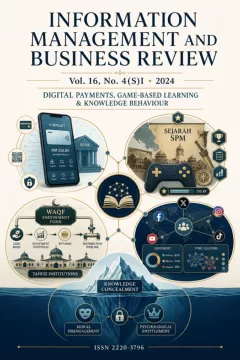 Vol. 16 No. 4(S)I (2024)
Digital Payments, Game-Based Learning & Knowledge Behaviour
View issue contents
Published
Submissions
Have research to publish? Information Management and Business Review welcomes submissions.
Make a Submission