Abstract
This research explores the effectiveness of YouTube videos as supplementary resources for students studying database subjects. With the growing use of digital media in education, it is vital to understand how these resources impact learning outcomes. Using a mixed-methods approach, the study collects quantitative data through surveys and qualitative insights through interviews. The results indicate that YouTube videos significantly improve students' understanding, engagement, and retention of database concepts. The study concludes with recommendations for educators on effectively incorporating YouTube into their teaching strategies. This paper investigates the effectiveness of YouTube videos as a learning tool for students studying database subjects. With the increasing availability of online resources, it is essential to evaluate how these resources impact student learning outcomes. The study utilizes a mixed-methods approach, combining quantitative data from surveys and qualitative data from interviews with students. The findings suggest that YouTube videos enhance understanding, engagement, and retention of database concepts, while also providing flexibility and accessibility. Recommendations for educators on integrating YouTube into curriculum design are discussed.
Keywords
- Database Course Search this journal for Database Course (opens in a new tab)
- Multimedia Learning Search this journal for Multimedia Learning (opens in a new tab)
- YouTube Videos Search this journal for YouTube Videos (opens in a new tab)
- Higher Education Search this journal for Higher Education (opens in a new tab)
References
- Abbas, N. W.,& Qassim, T. A. (2020). Investigating the effectiveness of YouTube as a learning tool among EFL students at Baghdad University. Arab World English Journal (AWEJ) Special Issue on CALL Number 6, 344 – 356
- Alemdag E., Cagiltay K. (2018) A systematic review of eye tracking research on multimedia learning. Comput. Educ.125, 413–428.
- Almara'beh H., Amer E.F., Sulieman A. The effectiveness of multimedia learning tools in education. Int. J. Adv. Res. Comput. Sci. Software Eng. 5(12), 761–764.
- Enas A. A. A., Islam A. I., & Tahani R. K. B. (2021) Understanding quantitative and qualitative research methods: a theoretical perspective for young researchers. International Journal of Research. 08(02).
- Guo, P. J., Kim, J., & Rubin, R. (2014). How video production affects student engagement: An empirical study of MOOC videos. Proceedings of the 1st ACM Conference on Learning@ Scale Conference.
- Guan N., Song J., Li D. (2018) On the advantages of computer multimedia-aided English teaching. Procedia Comput. Sci. 131, 727–732.
- Mayer, R. E. (2009). Multimedia Learning (2nd ed.). Cambridge University Press.
- Berk, R. A. (2020). Multimedia teaching with video podcasts. International Journal of Technology in Teaching and Learning, 16(1), 25-36.
- Cheng, H. K., Tsai, C. C., & Chan, Y. H. (2020). The effects of using visual representations in learning database concepts. Journal of Computer Assisted Learning, 36(2), 153-165.
- Daugherty, E. (2021). YouTube in the Classroom: A Study of Student Engagement and Learning Outcomes. Educational Technology Research and Development, 69(4), 1233-1250.
- Kelly, M., McGrath, M., & Cannon, G. (2009). A multi-method study to determine the effectiveness of, and student attitudes to, online instructional videos for teaching clinical nursing skills. Nurse Education Today, 29(3), 292-300.
- Mackey, T. P., & Jacobson, T. E. (2017). Information Literacy: A Collaborative Approach. Oxford: Chandos Publishing. Mayer, R. E. (2020). Multimedia Learning (3rd ed.). Cambridge University Press.
- Pate?an, M., Balagiu, A., & Alibec, C. (2018). Visual Aids in Language Education. International Conference Knowledge-Based Organization, 24(2), 356–361.
- Qasserras, L., & Qasserras, M. (2023). Gardner’s Theory’s Impact on English Language Teaching: A Constructive Analysis. European Modern Studies Journal, 7(1), 340–347.
- Wang, H., & Kuo, C. (2022). The Role of YouTube in Enhancing Student Engagement: A Meta-Analysis. Computers & Education, 182, 104-129.
- Zhao, L., & O’Neil, H. F. (2021). The Effectiveness of Video Instruction in Learning: A Meta-Analysis. Educational Psychology Review, 33(1), 1-23.
Downloads
No downloads have been recorded for this article yet. Figures appear here once readers begin downloading the full text.
How to Cite
Share this article
License
Copyright (c) 2024 Nor Intan Shafini Nasaruddin, Norbahiyah Awang (Author)

This work is licensed under a Creative Commons Attribution 4.0 International License.
Author (s) should affirm that the material has not been published previously. It has not been submitted and it is not under consideration by any other journal. At the same time author (s) need to execute a publication permission agreement to assume the responsibility of the submitted content and any omissions and errors therein. After submission of revised paper in the light of suggestions of the reviewers, the editorial team edits and formats manuscripts to bring uniformity and standardization in published material.
This work will be licensed under Creative Commons Attribution 4.0 International (CC BY 4.0) and under condition of the license, users are free to read, copy, remix, transform, redistribute, download, print, search or link to the full texts of articles and even build upon their work as long as they credit the author for the original work. Moreover, as per journal policy author (s) hold and retain copyrights without any restrictions.
Keywords
- Database Course Search this journal for Database Course (opens in a new tab)
- Multimedia Learning Search this journal for Multimedia Learning (opens in a new tab)
- YouTube Videos Search this journal for YouTube Videos (opens in a new tab)
- Higher Education Search this journal for Higher Education (opens in a new tab)
Section
Published in
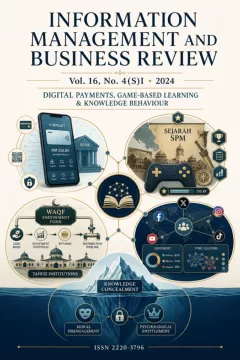 Vol. 16 No. 4(S)I (2024)
Digital Payments, Game-Based Learning & Knowledge Behaviour
View issue contents
Published
Submissions
Have research to publish? Information Management and Business Review welcomes submissions.
Make a Submission