Abstract
Fruits and vegetables are essential sources of nutrition, crucial for preventing chronic diseases like diabetes, cancer, and cardiovascular issues. Maintaining a healthy diet, including the recommended servings of vegetables and fruits, is important for overall well-being. However, many individuals, particularly those unfamiliar with grocery shopping, struggle to distinguish between different types of vegetables due to their similar physical characteristics, leading to confusion and poor dietary choices. Therefore, this project aims to design and develop a real-time vegetable detection and identification system through a mobile application using deep learning and provide healthy recipes based on the identified vegetable. This project used the YOLOv5 object detection algorithm for vegetable detection, utilizing manually captured vegetable images from phones as the dataset. The collected data were organized into a unified folder. The Modified Waterfall model was adopted as the methodology, excluding the maintenance phase, encompassing requirement gathering, design, implementation, and testing. The testing phase demonstrated that the model met all the project’s objectives and successfully identified and detected vegetables with a mAP of 95.7%. All functionality test cases and an accuracy test confirmed that the system effectively resolved the problem. The system was developed as a mobile application to enhance accessibility for target users. Future enhancements could include refining the detection model and incorporating a wider range of vegetables or including other ingredient datasets to broaden its scope.
Keywords
- Vegetable Detection Search this journal for Vegetable Detection (opens in a new tab)
- Vegetable Identification Search this journal for Vegetable Identification (opens in a new tab)
- YOLOv5 Search this journal for YOLOv5 (opens in a new tab)
- Mobile Application Search this journal for Mobile Application (opens in a new tab)
References
- Ebabhi, A., & Adebayo, R. (2022). Nutritional Values of Vegetables. In E. Yildirim & M. Ekinci (Eds.), Vegetable Crops. IntechOpen. https://doi.org/10.5772/intechopen.101090 DOI: https://doi.org/10.5772/intechopen.101090
- Jiang, P., Ergu, D., Liu, F., Cai, Y., & Ma, B. (2021). A Review of Yolo Algorithm Developments. Procedia Computer Science, 199, 1066–1073. https://doi.org/10.1016/j.procs.2022.01.135 DOI: https://doi.org/10.1016/j.procs.2022.01.135
- Kumar, D., Kumar, S., Gochar, C. S., Rampur, M., Saharanpur, M., Pradesh, U., Corresponding, I., & Shekhar, C. (2020). Nutritional components in green leafy vegetables: A review. J Pharmacogn Phytochem 2020;9(5), 2498-2502.
- Morol, Md. K., Rokon, Md. S. J., Hasan, I. B., Saif, A. M., Khan, R. H., & Das, S. S. (2022). Food Recipe Recommendation Based on Ingredients Detection Using Deep Learning. Proceedings of the 2nd International Conference on Computing Advancements, 191–198. https://doi.org/10.1145/3542954.3542983 DOI: https://doi.org/10.1145/3542954.3542983
- Nugroho, B. A., & Izzah, A. (2017). Implementation of Google’s Technology in Android Mobile App "Kediri City Fasum and Fasos Information System". Kinetik: Game Technology, Information System, Computer Network, Computing, Electronics, and Control, 3(1), 45-56. https://doi.org/10.22219/kinetik.v3i1.543 DOI: https://doi.org/10.22219/kinetik.v3i1.543
- Redmon, J., Divvala, S., Girshick, R., & Farhadi, A. (2015). You Only Look Once: Unified, Real-Time Object Detection. http://arxiv.org/abs/1506.02640 DOI: https://doi.org/10.1109/CVPR.2016.91
- Shri Ramswaroop Memorial University, Institute of Electrical and Electronics Engineers, & Institute of Electrical and Electronics Engineers. Uttar Pradesh Section. (2019). 2019 International Conference on Cutting-edge Technologies in Engineering (ICon-CuTE) : Shri Ramswaroop Memorial University, Barabanki, India, Nov. 14-16, 2019.
- Sumit, S. S., Watada, J., Roy, A., & Rambli, D. R. A. (2020). In object detection deep learning methods, YOLO shows supremum to Mask R-CNN. Journal of Physics: Conference Series, 1529(4). https://doi.org/10.1088/1742-6596/1529/4/042086 DOI: https://doi.org/10.1088/1742-6596/1529/4/042086
- Ülger, T. G., Songur, A. N., Ç?rak, O., & P?nar Çak?ro?lu, F. (2018). Role of Vegetables in Human Nutrition and Disease Prevention. In Md. Asaduzzaman & T. Asao (Eds.), Vegetables. IntechOpen. DOI: https://doi.org/10.5772/intechopen.77038
- Zi, T. M. (2020). Covid-19: Tesco Malaysia ‘rescues’ clueless husbands with an illustrated guide to grocery shopping. https://ww.Malaymail.Com/News/Life/2020/03/25/Covid-19-Tesco-Malaysia-Rescues-Clueless-Husbands-with-Illustrated-Guide-to/1850117.
Downloads
Full-text downloads recorded for this article, by month.
No downloads have been recorded for this article yet. Figures appear here once readers begin downloading the full text.
How to Cite
Share this article
License
Copyright (c) 2024 Mohd Rahmat Mohd Noordin, Mohamad Hafiz Khairuddin, Nurul Syuhaidah Binti Noor Asihin, Anis Amilah Shari (Author)

This work is licensed under a Creative Commons Attribution 4.0 International License.
Author (s) should affirm that the material has not been published previously. It has not been submitted and it is not under consideration by any other journal. At the same time author (s) need to execute a publication permission agreement to assume the responsibility of the submitted content and any omissions and errors therein. After submission of revised paper in the light of suggestions of the reviewers, the editorial team edits and formats manuscripts to bring uniformity and standardization in published material.
This work will be licensed under Creative Commons Attribution 4.0 International (CC BY 4.0) and under condition of the license, users are free to read, copy, remix, transform, redistribute, download, print, search or link to the full texts of articles and even build upon their work as long as they credit the author for the original work. Moreover, as per journal policy author (s) hold and retain copyrights without any restrictions.
Keywords
- Vegetable Detection Search this journal for Vegetable Detection (opens in a new tab)
- Vegetable Identification Search this journal for Vegetable Identification (opens in a new tab)
- YOLOv5 Search this journal for YOLOv5 (opens in a new tab)
- Mobile Application Search this journal for Mobile Application (opens in a new tab)
Section
Published in
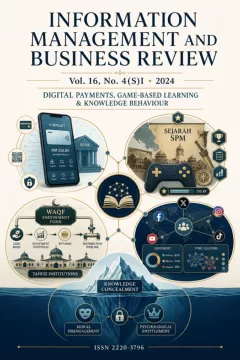 Vol. 16 No. 4(S)I (2024)
Digital Payments, Game-Based Learning & Knowledge Behaviour
View issue contents
Published
Submissions
Have research to publish? Information Management and Business Review welcomes submissions.
Make a Submission