Abstract
This study conducts a comprehensive bibliometric analysis of global research on employability in accounting education from 2000 to 2025. Based on 422 documents retrieved from the Scopus database, it maps the scholarly landscape using citation analysis, authorship trends, source journals, keyword co-occurrences, and geographic and disciplinary distribution. The findings reveal a significant rise in research output since 2015, driven by growing concerns over graduate employability amid rapid technological change. The United States, Australia, and the United Kingdom are the most prolific contributors, with key journals including Accounting Education and Journal of Accounting Education . Frequently cited studies focus on curriculum alignment, soft skills development, and digital competency integration. The analysis underscores a global shift toward future-ready curricula while identifying underexplored areas in developing regions. These insights provide valuable guidance for educators, curriculum developers, and policymakers seeking to improve employability outcomes in accounting education.
Keywords
- Employability Search this journal for Employability (opens in a new tab)
- Accounting Education Search this journal for Accounting Education (opens in a new tab)
- Bibliometric Analysis Search this journal for Bibliometric Analysis (opens in a new tab)
- Graduate Attributes Search this journal for Graduate Attributes (opens in a new tab)
- Curriculum Reform Search this journal for Curriculum Reform (opens in a new tab)
- Soft Skills Search this journal for Soft Skills (opens in a new tab)
- Digital Competencies Search this journal for Digital Competencies (opens in a new tab)
References
- Ahmi, A. (2024). biblioMagika. available from https://bibliomagika.com
- De Villiers, R. (2010). The incorporation of soft skills into accounting curricula: Preparing accounting graduates for their unpredictable futures. Meditari Accountancy Research, 18(2), 1–22. https://doi.org/10.1108/10222529201000007
- Dolce, V., Emanuel, F., Cisi, M., & Ghislieri, C. (2020). The soft skills of accounting graduates: Perceptions versus expectations. Accounting Education, 29(1), 57–76. https://doi.org/10.1080/09639284.2019.1697937
- Donthu, N., Kumar, S., Mukherjee, D., Pandey, N., & Lim, W. M. (2021). How to conduct a bibliometric analysis: An overview and guidelines. Journal of Business Research, 133, 285–296. https://doi.org/10.1016/j.jbusres.2021.04.070
- Dzuranin, A. C., Jones, J. R., & Olvera, R. M. (2018). Infusing data analytics into the accounting curriculum: A framework and insights from faculty. Journal of Accounting Education, 44, 24–39. https://doi.org/10.1016/j.jaccedu.2018.02.002
- Jackling, B., & De Lange, P. (2009). Do accounting graduates’ skills meet the expectations of employers? A matter of convergence or divergence. Accounting Education, 18(4–5), 369–385. https://doi.org/10.1080/09639280902719341
- Kavanagh, M. H., & Drennan, L. (2008). What skills and attributes does an accounting graduate need? Evidence from student perceptions and employer expectations. Accounting & Finance, 48(2), 279–300. https://doi.org/10.1111/j.1467-629X.2007.00245.x
- Lawson, R. A., Blocher, E. J., Brewer, P. C., Cokins, G., Sorensen, J. E., Stout, D. E., Sundem, G. L., Wolcott, S. K., & Wouters, M. J. F. (2014). Focusing accounting curricula on students’ long-run careers: Recommendations for an integrated competency-based framework. Issues in Accounting Education, 29(2), 295–317. https://doi.org/10.2308/iace-50673
- Levant, Y., Coulmont, M., & Sandu, R. (2016). Business simulation as an active learning activity for developing soft skills. Accounting Education, 25(4), 368–395. https://doi.org/10.1080/09639284.2016.1191272
- Moher, D., Liberati, A., Tetzlaff, J., Altman, D. G., & PRISMA Group. (2009). Preferred reporting items for systematic reviews and meta-analyses: the PRISMA statement. BMJ (Clinical Research Ed.), 339(jul21 1), b2535. https://doi.org/10.1136/bmj.b2535
- Mohamed, E. K. A., & Lashine, S. H. (2003). Accounting knowledge and skills and the challenges of a global business environment. Managerial Finance, 29(7), 3–16. https://doi.org/10.1108/03074350310768319
- Pan, G., & Seow, P.-S. (2016). Preparing accounting graduates for the digital revolution: A critical review of information technology competencies and skills development. Journal of Education for Business, 91(3), 166–175. https://doi.org/10.1080/08832323.2016.1145622
- Qasim, A., & Kharbat, F. F. (2020). Blockchain technology, business data analytics, and artificial intelligence: Use in the accounting profession and ideas for inclusion into the accounting curriculum. Journal of Emerging Technologies in Accounting, 17(1), 107–117. https://doi.org/10.2308/jeta-52649
- Rebele, J. E., & St. Pierre, E. K. (2019). A commentary on learning objectives for accounting education programs: The importance of soft skills and technical knowledge. Journal of Accounting Education, 48, 71–79. https://doi.org/10.1016/j.jaccedu.2019.07.002
- Sledgianowski, D., Gomaa, M., & Tan, C. (2017). Toward integration of Big Data, technology and information systems competencies into the accounting curriculum. Journal of Accounting Education, 38, 81–93. https://doi.org/10.1016/j.jaccedu.2016.12.008
- Van Eck, N. J., & Waltman, L. (2014). Visualizing bibliometric networks. In Y. Ding, R. Rousseau, & D. Wolfram (Eds.), Measuring scholarly impact (pp. 285–320). Springer. https://doi.org/10.1007/978-3-319-10377-8_13
- Yorke, M. (2006). Employability in higher education: What it is – what it is not. The Higher Education Academy. https://www.heacademy.ac.uk/system/files/id116_employability_in_higher_education_336.pdf
- Zakaria, R., Ahmi, A., Ahmad, A. H., Othman, Z., Azman, K. F., Ab Aziz, C. B., Ismail, C. A. N., & Shafin, N. (2021). Visualizing and mapping a decade of literature on honey research: A bibliometric analysis from 2011 to 2020. Journal of Apicultural Research, 60(3), 359–368. https://doi.org/10.1080/00218839.2021.1898789
- Zupic, I., & ?ater, T. (2015). Bibliometric methods in management and organization. Organizational Research Methods, 18(3), 429–472. https://doi.org/10.1177/1094428114562629
Downloads
No downloads have been recorded for this article yet. Figures appear here once readers begin downloading the full text.
How to Cite
Share this article
License
Copyright (c) 2025 Inayah Abdul Aziz, Yusliena Yusoff, Emiza Tahar, Rohayati Jusoh (Author)

This work is licensed under a Creative Commons Attribution 4.0 International License.
Author (s) should affirm that the material has not been published previously. It has not been submitted and it is not under consideration by any other journal. At the same time author (s) need to execute a publication permission agreement to assume the responsibility of the submitted content and any omissions and errors therein. After submission of revised paper in the light of suggestions of the reviewers, the editorial team edits and formats manuscripts to bring uniformity and standardization in published material.
This work will be licensed under Creative Commons Attribution 4.0 International (CC BY 4.0) and under condition of the license, users are free to read, copy, remix, transform, redistribute, download, print, search or link to the full texts of articles and even build upon their work as long as they credit the author for the original work. Moreover, as per journal policy author (s) hold and retain copyrights without any restrictions.
Keywords
- Employability Search this journal for Employability (opens in a new tab)
- Accounting Education Search this journal for Accounting Education (opens in a new tab)
- Bibliometric Analysis Search this journal for Bibliometric Analysis (opens in a new tab)
- Graduate Attributes Search this journal for Graduate Attributes (opens in a new tab)
- Curriculum Reform Search this journal for Curriculum Reform (opens in a new tab)
- Soft Skills Search this journal for Soft Skills (opens in a new tab)
- Digital Competencies Search this journal for Digital Competencies (opens in a new tab)
Section
Published in
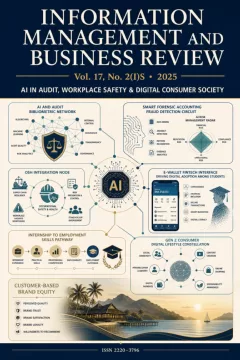 Vol. 17 No. 2(I)S (2025)
AI in Audit, Workplace Safety & Digital Consumer Society
View issue contents
Published
Submissions
Have research to publish? Information Management and Business Review welcomes submissions.
Make a Submission