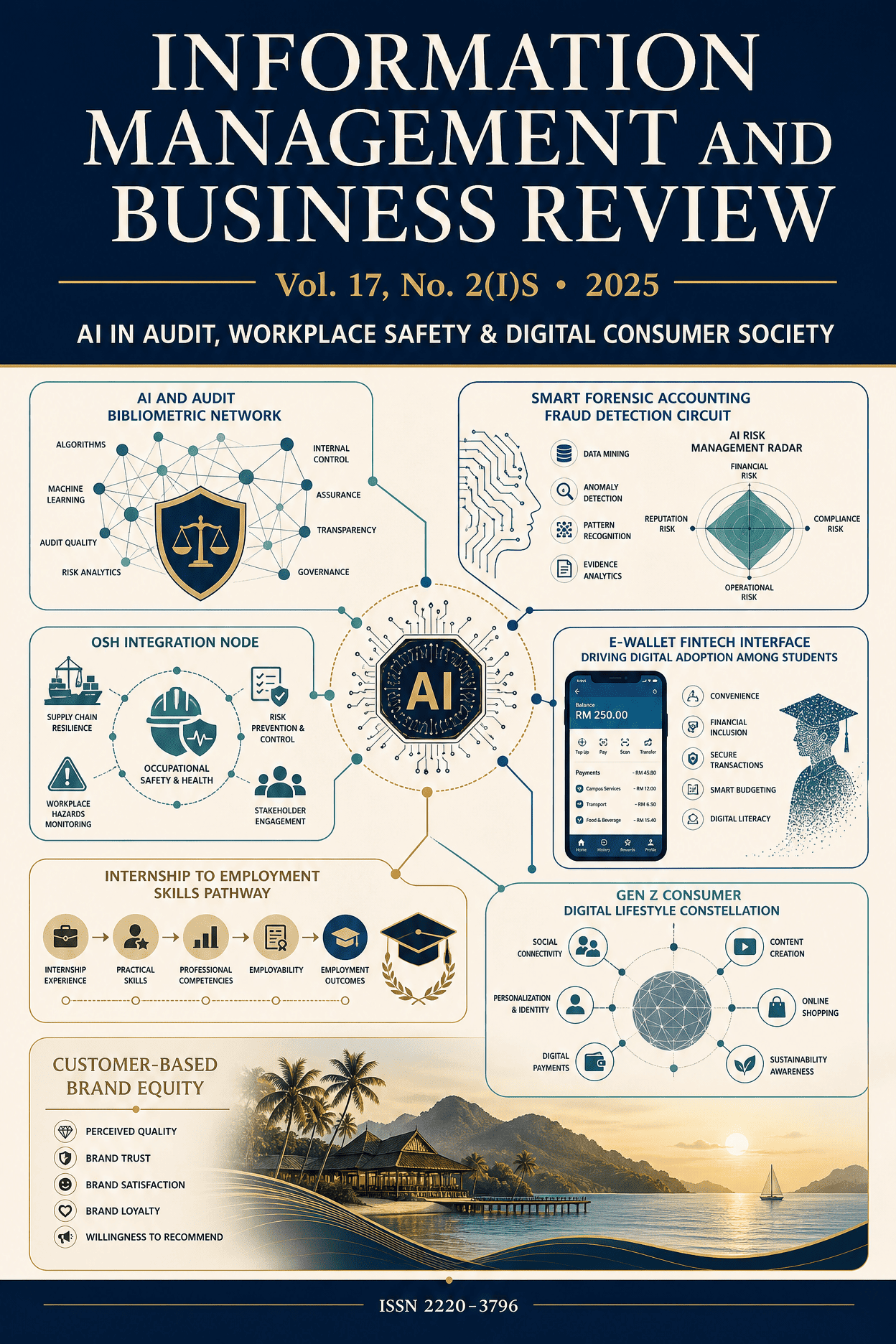
Articles 1–10 of 54

  • Article 1 in this issue

    Mapping the Intersection of Artificial Intelligence and Audit Quality: A Bibliometric Analysis of Research Trends

    • Author: Muhammad Shaqif Azfar Afandi, Noor Emilina Mohd Nasir, Suraya Ahmad, Nur Syuhada Adnan, Syafiq Abdul Haris Halmi

    The integration of artificial intelligence into audit practice has attracted considerable academic interest, particularly about its impact on improving audit quality. This study aims to examine the emerging trends in academic research at the intersection of artificial intelligence and audit quality through a bibliometric lens. A comprehensive dataset was extracted from the Scopus database based on documents published between 2008 and 2025, with a total of 122 documents included in the final analysis. The results show a notable increase in publications, reflecting the growing academic interest in the application of AI in auditing. The keyword analysis revealed that audit quality and artificial intelligence are the most frequently used and cited terms, highlighting them as fundamental topics. To summarize, this study provides a comprehensive bibliometric overview of the current state and future development of research on artificial intelligence and audit quality. It provides valuable insights for academics, practitioners and policy makers who want to understand the development of the field, identify influential contributions and uncover potential gaps for future research. As artificial intelligence continues to reshape the auditing profession, continued interdisciplinary collaboration is essential to ensure that technological advances do not jeopardize audit quality and professional integrity.

    Pages 1-14

    PDF - Mapping the Intersection of Artificial Intelligence and Audit Quality: A Bibliometric Analysis of Research Trends (opens in a new tab)
  • Article 2 in this issue

    Skill Up or Fall Behind: A Global Bibliometric Review of Employability in Accounting Education

    • Author: Inayah Abdul Aziz, Yusliena Yusoff, Emiza Tahar, Rohayati Jusoh

    This study conducts a comprehensive bibliometric analysis of global research on employability in accounting education from 2000 to 2025. Based on 422 documents retrieved from the Scopus database, it maps the scholarly landscape using citation analysis, authorship trends, source journals, keyword co-occurrences, and geographic and disciplinary distribution. The findings reveal a significant rise in research output since 2015, driven by growing concerns over graduate employability amid rapid technological change. The United States, Australia, and the United Kingdom are the most prolific contributors, with key journals including Accounting Education and Journal of Accounting Education . Frequently cited studies focus on curriculum alignment, soft skills development, and digital competency integration. The analysis underscores a global shift toward future-ready curricula while identifying underexplored areas in developing regions. These insights provide valuable guidance for educators, curriculum developers, and policymakers seeking to improve employability outcomes in accounting education.

    Pages 15-30

    PDF - Skill Up or Fall Behind: A Global Bibliometric Review of Employability in Accounting Education (opens in a new tab)
  • Article 3 in this issue

    The Effect of Board Diversity on Firm Performance: An Exploration through Human Capital Theory

    • Author: Nur Mimi Najihah Ghazali, Najihah Marha Yaacob, Nur Raihana binti Mohd Sallem, Siti Nasuha Muhmad

    A crucial element of corporate governance that could affect organizational results and strategic decision-making is board diversity. The diversity of human capital has been recognized as important in ensuring corporate governance effectiveness. Finding opportunities, coming up with ideas, and overcoming blind spots are all made easier for a company and CEO when a diverse group of directors contributes a range of skills, knowledge, and information. The Human Capital Theory explains the value of individual attributes, where individuals from different backgrounds possess unique knowledge and abilities that contribute to productivity. Despite the growing interest in this topic, empirical findings remain inconsistent, calling for more conceptual exploration. The purpose of writing this paper is to explore the effect of board diversity on firm performance. This conceptual paper will explore the relationship by utilizing Human Capital Theory. Specifically, this paper examines how diverse boards could contribute to firm performance and the quality of governance. This paper also highlights the different outcomes in existing literature on these issues and proposes a direction for future research. Through the perspective of the Human Capital Theory, this paper identifies diversity as a strategic asset, where a variety of professional experiences, educational backgrounds, and demographic profiles support innovative capacity, board-level decision-making, and the caliber of oversight.

    Pages 31-38

    PDF - The Effect of Board Diversity on Firm Performance: An Exploration through Human Capital Theory (opens in a new tab)
  • Article 4 in this issue

    Balancing Growth and Sustainability: The Role of Carbon Tax in Malaysia

    • Author: Siti Nurhazwani Kamarudin, Noor Emilina Mohd Nasir, Azmira Abdullah, Quihong Liu

    This concept paper examines the crucial role of the carbon tax as a novel policy tool to strike a balance between economic development and environmental sustainability in Malaysia. The primary objective of this paper is to investigate the potential of carbon taxation to curtail carbon emissions in Malaysia without compromising its economic growth. This study adopts a qualitative approach, incorporating an extensive review of existing literature on carbon taxation, its implementation experiences in other countries, and Malaysia's current environmental and economic landscape. The analysis reveals that carbon taxation has the potential to incentivize carbon-emitting industries to adopt cleaner technologies and sustainable practices while generating revenue for environmental initiatives. The findings suggest that a carefully designed and wellimplemented carbon tax policy can lead to a more sustainable development path for Malaysia. This paper contributes to the body of knowledge by presenting a comprehensive analysis of the potential of carbon taxation to address climate change issues in the country. The originality lies in bridging the gap between economic growth imperatives and the need for sustainable environmental practices, particularly in the context of an emerging economy. This paper offers valuable guidance to policymakers, businesses, and other stakeholders involved in shaping Malaysia's environmental and economic policies. By understanding the potential benefits and challenges of carbon taxation, policymakers can design effective and efficient policies that foster economic growth while mitigating the adverse impacts of climate change. Moreover, businesses can strategize for a greener future, ensuring long-term competitiveness and sustainability in the global market.

    Pages 39-50

    PDF - Balancing Growth and Sustainability: The Role of Carbon Tax in Malaysia (opens in a new tab)
  • Article 5 in this issue

    Smart Forensics: Tracing the Rise of Artificial Intelligence in Forensic Accounting, Fraud Detection and Risk Management

    • Author: Zaiza Norsuriati Zainal Zakaria, Nor Haliza Che Hussain, Yunita Awang, Shazalina Mohamed Shuhidan

    This research examines the evolution of scholarly interest in artificial intelligence (AI) in forensic accounting and risk management. Using a dataset of 261 publications indexed in Scopus between 2002 and mid-2025, the study examines shifts in publication trends, recurring topics, and gaps that remain underexplored. Bibliometric tools, including VOS viewer, Microsoft Excel, and Publish or Perish, were used to analyse citation activity, author collaborations, and keyword patterns. A noticeable increase in published work was seen after 2017, with “forensic accounting” and “fraud” being the most frequently used terms. The results indicate an increasing academic focus on technologies such as blockchain, big data, and advanced analytics. Most studies have been published in peer-reviewed outlets, particularly within the domains of Business, Management, and Accounting. Jordan stands out for its consistent research output, supported by active engagement from several scholars and academic institutions. Eight major themes were identified, covering governance and fraud control, professional skills, financial crime investigation, emerging technologies, forensic audit practices, audit roles, localized education, and analytical methods. Although this review is confined to English-language articles listed in Scopus, it still offers a clear overview of the progression of research in this field over time. It highlights prevailing trends, significant areas of concentration, and existing gaps, providing useful guidance for both researchers and practitioners. With the evolution of AI, this study’s results could also guide future developments in forensic accounting, fraud detection, and risk management.

    Pages 51-68

    PDF - Smart Forensics: Tracing the Rise of Artificial Intelligence in Forensic Accounting, Fraud Detection and Risk Management (opens in a new tab)
  • Article 6 in this issue

    The Role of Financial Reporting Behavior in Determining Audit Quality

    • Author: Noor Emilina Mohd Nasir, Norfadzilah Rashid, Tuan Zafierah Tuan Zainazor, Amirah Husna

    In corporate governance, the integrity of financial reporting is fundamental to stakeholder confidence and market efficiency. The quality of audits is crucial in maintaining the integrity of financial accounts. High audit fees typically signify comprehensive audit initiatives and rigorous controls, demonstrating auditors' dedication to identifying and mitigating misstatements in financial reporting. This study examines the impact of financial reporting practices, including earnings management, financial manipulation, and accounting conservatism, on audit quality. This analysis, grounded in agency theory, investigates the impact of audit quality as a governance mechanism on firms' financial reporting strategies, as evidenced by fluctuations in audit fees that signify perceived audit risk and effort. The approach suggests that assertive financial reporting procedures could lead to enhanced audit quality, whilst accounting conservatism might indicate diminished audit risk. This research seeks to establish a theoretical framework for comprehending the relationship between financial reporting behavior and audit quality through the synthesis of existing knowledge. The proposed model offers practical insights for auditors, regulators, and policymakers seeking to reinforce audit effectiveness and enhance financial reporting integrity in an increasingly complex corporate environment. This study emphasizes the significance of audit quality in enhancing company transparency and safeguarding financial integrity.

    Pages 69-76

    PDF - The Role of Financial Reporting Behavior in Determining Audit Quality (opens in a new tab)
  • Article 7 in this issue

    Engaging Generation Z in Accounting Education: A Student-Centred and Technology-Enhanced Approach to Overcoming Passive Learning

    • Author: Yusliena Yusoff, Emiza Tahar, Inayah Abdul Aziz, Rohayati Jusoh

    This conceptual paper proposes a pedagogical framework for transforming accounting education to meet the learning needs and expectations of Generation Z. Drawing on constructivist learning theory and selfdetermination theory (SDT), the framework advocates for a shift away from passive, lecture-centric models to a student-centred, technology-enhanced, and engagement-driven approach. Generation Z students are characterized by digital fluency, autonomy-seeking behaviors, and a preference for experiential learning, which requires innovative instructional strategies that foster deeper cognitive engagement, motivation, and realworld skill development. The paper introduces a three-pillar framework comprising student-centred learning, technology-enhanced instruction, and active engagement design, each reinforced by empirical evidence and contemporary teaching practices. Key pedagogical strategies such as flipped classrooms, gamification, collaborative technologies, and real-world simulations are discussed as practical applications of the framework. The integration of these approaches supports autonomy, competence, and relatedness, which are psychological needs central to SDT, while promoting knowledge construction through authentic, interactive experiences. The paper concludes with implications for educators, institutions, policymakers, and industry, offering a blueprint for curricular innovation that aligns accounting education with the demands of the modern profession and the learning profiles of Generation Z.

    Pages 77-83

    PDF - Engaging Generation Z in Accounting Education: A Student-Centred and Technology-Enhanced Approach to Overcoming Passive Learning (opens in a new tab)
  • Article 8 in this issue

    Exploring the Adoption of Audit Data Analytics Among External Auditors in Malaysia

    • Author: Nor Haliza Che Hussain, Chin Wai Yin, Lim Wan Leng, Lai Siew Fong, Hen Kai Wah

    This study examines the current adoption of Audit Data Analytics (ADA) among external auditors in Malaysia and explores their perceptions regarding adoption plans, perceived opportunities, and challenges associated with ADA implementation. While ADA has the potential to transform traditional audit practices, its adoption remains inconsistent across audit firms, raising concerns about readiness and perceived benefits. A quantitative survey methodology was adopted, using a structured questionnaire distributed to external auditors from audit firms in Klang Valley, Penang, and Johor. A total of 221 responses were collected and analyzed using descriptive statistics and reliability assessments via SPSS. The findings reveal that while many firms recognize the benefits of ADA, such as improved audit quality and greater transaction testing capabilities, actual adoption levels vary significantly across audit areas. Key challenges identified include client concerns over data confidentiality, insufficient ADA expertise, and inadequate technological infrastructure. This study contributes to current literature by providing empirical insights into ADA adoption within Malaysia’s external auditing sector, an area previously underexplored. The findings offer practical implications for audit firms, regulators, and professional bodies seeking to promote ADA adoption and advance digital transformation in the auditing profession .

    Pages 84-96

    PDF - Exploring the Adoption of Audit Data Analytics Among External Auditors in Malaysia (opens in a new tab)
  • Article 9 in this issue

    Examining the Rising Trend of Elderly Financial Scams in Online News: A Content Analysis of Media Reporting in Malaysia

    • Author: Nor Aishah Mohd Ali, Rozaiha Ab Majid, Siti Aisyah Basri, Norhanizah Johari, Mohd Waliuddin Mohd Razali, Bayu Tri Cahya

    The increasing prevalence of elder financial scams, particularly those perpetrated through online platforms, has become a significant concern for both the elderly population and society as a whole. This study examines the nature and scope of elder financial scams as reported in online newspapers, emphasising their financial consequences for victims. Using content analysis to explore the cases reported in online media from 2020 to 2024, this research aims to shed light on the patterns of fraud targeting older adults, the media's role in raising awareness, and the broader implications for social policy. Findings revealed 119 reports of financial scam cases across 36 online media outlets involving the elderly in Malaysia. Most financial scams involve phishing, followed by investment and love scams. Furthermore, financial repercussions for elderly victims are severe, sparking an urgent need for enhanced public awareness and regulatory frameworks to protect vulnerable individuals.

    Pages 97-106

    PDF - Examining the Rising Trend of Elderly Financial Scams in Online News: A Content Analysis of Media Reporting in Malaysia (opens in a new tab)
  • Article 10 in this issue

    Factors Influencing the Purchase Intention of Modest Fashion Products: A Study on Muslim Women Consumers in Malaysia

    • Author: Wan Annisa Sofia Wan Kamaruddin, Muhammad Tahir Jan, Fatin Husna Suib

    Recognized as one of the Muslim dominated countries, Malaysia is seen to have a good prospect for marketing modest fashion products. Nevertheless, modest fashion presents unique marketing challenges due to its sensitivity to religious issues and its niche consumer base. While established brands like dUCk, Naelofar, and Jovian are believed to benefit greatly from having well-known figures as their founders, other businesses require effective marketing strategies to compete in the market. Therefore, this research aims to identify the primary factors that drive Muslim women consumers in Malaysia to purchase modest fashion products. The study adopts a quantitative research method, with data collected through an online survey from a sample of 116 valid responses. Data analysis was conducted using SPSS version 29 and AMOS version 29 for Exploratory Factor Analysis (EFA), Confirmatory Factor Analysis (CFA), and Structural Equation Modeling (SEM). The result revealed that two out of three hypotheses were supported. Muslim Influencers (MI) had a significant positive effect on Purchase Intention (PI), while Design and Trend (DT) demonstrated a significant negative effect, suggesting that consumers prioritize modesty over trends. Brand Consciousness (BC), however, was revealed to be insignificant in influencing the PI of Muslim women consumers for modest fashion products. The findings contribute to the understanding of Muslim women's consumer behavior in purchasing modest fashion, offering practical guidelines for brands to prioritize value-aligned marketing strategies. The study also discusses its limitations and provides directions for future research.

    Pages 107-121

    PDF - Factors Influencing the Purchase Intention of Modest Fashion Products: A Study on Muslim Women Consumers in Malaysia (opens in a new tab)