Abstract
A crucial element of corporate governance that could affect organizational results and strategic decision-making is board diversity. The diversity of human capital has been recognized as important in ensuring corporate governance effectiveness. Finding opportunities, coming up with ideas, and overcoming blind spots are all made easier for a company and CEO when a diverse group of directors contributes a range of skills, knowledge, and information. The Human Capital Theory explains the value of individual attributes, where individuals from different backgrounds possess unique knowledge and abilities that contribute to productivity. Despite the growing interest in this topic, empirical findings remain inconsistent, calling for more conceptual exploration. The purpose of writing this paper is to explore the effect of board diversity on firm performance. This conceptual paper will explore the relationship by utilizing Human Capital Theory. Specifically, this paper examines how diverse boards could contribute to firm performance and the quality of governance. This paper also highlights the different outcomes in existing literature on these issues and proposes a direction for future research. Through the perspective of the Human Capital Theory, this paper identifies diversity as a strategic asset, where a variety of professional experiences, educational backgrounds, and demographic profiles support innovative capacity, board-level decision-making, and the caliber of oversight.
Keywords
References
- Adams, R. B., & Ferreira, D. (2009). Women in the boardroom and their impact on governance and performance. Journal of Financial Economics, 94(2), 291–309. https://doi.org/10.1016/j.jfineco.2008.10.007 DOI: https://doi.org/10.1016/j.jfineco.2008.10.007
- Ali, F., Gang, B., Zahib, Z., Mughal, A., & Husnain, B. (2023). Does board diversity mitigate firm risk-taking? Empirical evidence from China. Journal of Operational Risk. https://doi.org/10.21314/jop.2022.035 DOI: https://doi.org/10.21314/JOP.2022.035
- Becker G. S. (1964) Human Capital: A theoretical and Empirical Analysis, with special Reference to Education. Third Edition.
- Dong, Y., Liang, C., & Wanyin, Z. (2023). Board diversity and firm performance: Impact of ESG activities in China. Economic Research-Ekonomska Istraživanja, 36(1), 1592–1609. https://doi.org/10.1080/1331677x.2022.2090406 DOI: https://doi.org/10.1080/1331677X.2022.2090406
- EmadEldeen, R., Elbayoumi, A. F., Basuony, M. A. K., & Mohamed, E. K. A. (2021). The effect of the board diversity on firm performance: An empirical study on the UK. Corporate Ownership and Control, 18(3, special issue), 337–347. https://doi.org/10.22495/cocv18i3siart8 DOI: https://doi.org/10.22495/cocv18i3siart8
- Firew, B. G. (2024). Gender diversity and firm performance: Evidence from Malaysia boardrooms. Cogent Economics & Finance, 12(1). https://doi.org/10.1080/23322039.2024.2381135 DOI: https://doi.org/10.1080/23322039.2024.2381135
- Gardiner, E. (2024). What’s age got to do with it? The effect of board member age diversity: a systematic review. Management Review Quarterly, 74(1), 65–92. https://doi.org/10.1007/s11301-022-00294-5 DOI: https://doi.org/10.1007/s11301-022-00294-5
- Hillman, A. J., Cannella, A. A., & Paetzold, R. L. (2000). The resource dependence role of corporate directors: Strategic adaptation of board composition in response to environmental change. Journal of Management Studies, 37(2), 235–255. https://doi.org/10.1111/1467-6486.00179 DOI: https://doi.org/10.1111/1467-6486.00179
- Kabir, A., Ikra, S. S., Saona, P., & Azad, Md. A. K. (2023). Board gender diversity and firm performance: New evidence from cultural diversity in the boardroom. LBS Journal of Management & Research, 21(1), 1–12. https://doi.org/10.1108/lbsjmr-06-2022-0022 DOI: https://doi.org/10.1108/LBSJMR-06-2022-0022
- Li, L., Mohamed Saat, M., Chu, P., Tang, Z., & Lai, X. (2025). Examining the Impact of Board Diversity on Firm Performance: Insights from Demographics, Human Capital, Social Capital, Culture and Structure. International Journal of Academic Research in Accounting, Finance and Management Sciences, 15(1). https://doi.org/10.6007/ijarafms/v15-i1/24890 DOI: https://doi.org/10.6007/IJARAFMS/v15-i1/24890
- Lim, K. P., Lye, C.-T., Yuen, Y. Y., & Teoh, W. M. Y. (2019). Women directors and performance: Evidence from Malaysia. Equality, Diversity and Inclusion: An International Journal, 38(8), 841–856. https://doi.org/10.1108/edi-02-2019-0084 DOI: https://doi.org/10.1108/EDI-02-2019-0084
- Onyekwere, S. C., & Babangida, N. I. (2021). Board Diversity and Firm Performance: Panel Data Evidence from 12 Selected Commercial Banks in Nigeria. Daengku: Journal of Humanities and Social Sciences Innovation, 2(1), 28–53. https://doi.org/10.35877/454ri.daengku587 DOI: https://doi.org/10.35877/454RI.daengku587
- Ooi, C.-A., Hooy, C.-W., & Mat Som, A. P. (2017). The influence of board diversity on human capital and social capital in crisis. Managerial Finance, 43(6), 700–719. https://doi.org/10.1108/mf-08-2016-0226 DOI: https://doi.org/10.1108/MF-08-2016-0226
- Puntaier, E., Zhu, T., & Hughes, P. (2022). Board diversity as a strategic choice and why it should matter to SMEs. International Journal of Entrepreneurial Behavior & Research. https://doi.org/10.1108/ijebr-03-2022-0225 DOI: https://doi.org/10.1108/IJEBR-03-2022-0225
- Saha, R., & Maji, S. G. (2022). Board human capital diversity and firm performance: Evidence from top listed Indian firms. Journal of Indian Business Research, 14(4), 382–402. https://doi.org/10.1108/jibr-08-2021-0289 DOI: https://doi.org/10.1108/JIBR-08-2021-0289
- Sarto, F., Saggese, S., Viganò, R., & Mauro, M. (2019). Human capital and innovation: Mixing apples and oranges on the board of high-tech firms. Management Decision, 58(5), 897–926. https://doi.org/10.1108/md-06-2017-0594 DOI: https://doi.org/10.1108/MD-06-2017-0594
- Simionescu, L. N., Gherghina, ?. C., Tawil, H., & Sheikha, Z. (2021). Does board gender diversity affect firm performance? Empirical evidence from the Standard & Poor’s 500 Information Technology Sector. Financial Innovation, 7(1). https://doi.org/10.1186/s40854-021-00265-x DOI: https://doi.org/10.1186/s40854-021-00265-x
- Tajfel, H., & Turner, J. C. (1986). The social identity theory of intergroup behavior. In S. Worchel & W. G. Austin (Eds.), Psychology of Intergroup Relations (pp. 7–24). Nelson-Hall.
- Wang, K., Ma, J., Xue, C., & Zhang, J. (2024). Board Gender Diversity and Firm Performance: Recent Evidence from Japan. Journal of Risk and Financial Management, 17(1), 20. https://doi.org/10.3390/jrfm17010020 DOI: https://doi.org/10.3390/jrfm17010020
- Wang, T. (2022). Board human capital diversity and corporate innovation: A longitudinal study. Corporate Governance: The International Journal of Business in Society, 22(4), 680–701. https://doi.org/10.1108/cg-03-2021-0126 DOI: https://doi.org/10.1108/CG-03-2021-0126
- Wuttaphan, N. (2017). Human Capital Theory: The Theory of Human Resource Development, Implications and Future. Rajabhat J. Sci. Humanit. Soc. Sci. 18 (2): 240-253, 2017.
Downloads
Full-text downloads recorded for this article, by month.
No downloads have been recorded for this article yet. Figures appear here once readers begin downloading the full text.
How to Cite
Share this article
License
Copyright (c) 2025 Nur Mimi Najihah Ghazali, Najihah Marha Yaacob, Nur Raihana binti Mohd Sallem, Siti Nasuha Muhmad (Author)

This work is licensed under a Creative Commons Attribution 4.0 International License.
Author (s) should affirm that the material has not been published previously. It has not been submitted and it is not under consideration by any other journal. At the same time author (s) need to execute a publication permission agreement to assume the responsibility of the submitted content and any omissions and errors therein. After submission of revised paper in the light of suggestions of the reviewers, the editorial team edits and formats manuscripts to bring uniformity and standardization in published material.
This work will be licensed under Creative Commons Attribution 4.0 International (CC BY 4.0) and under condition of the license, users are free to read, copy, remix, transform, redistribute, download, print, search or link to the full texts of articles and even build upon their work as long as they credit the author for the original work. Moreover, as per journal policy author (s) hold and retain copyrights without any restrictions.
Keywords
Section
Published in
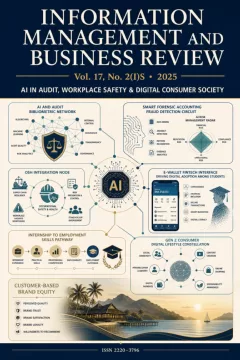 Vol. 17 No. 2(I)S (2025)
AI in Audit, Workplace Safety & Digital Consumer Society
View issue contents
Published
Submissions
Have research to publish? Information Management and Business Review welcomes submissions.
Make a Submission