Abstract
This research examines the evolution of scholarly interest in artificial intelligence (AI) in forensic accounting and risk management. Using a dataset of 261 publications indexed in Scopus between 2002 and mid-2025, the study examines shifts in publication trends, recurring topics, and gaps that remain underexplored. Bibliometric tools, including VOS viewer, Microsoft Excel, and Publish or Perish, were used to analyse citation activity, author collaborations, and keyword patterns. A noticeable increase in published work was seen after 2017, with “forensic accounting” and “fraud” being the most frequently used terms. The results indicate an increasing academic focus on technologies such as blockchain, big data, and advanced analytics. Most studies have been published in peer-reviewed outlets, particularly within the domains of Business, Management, and Accounting. Jordan stands out for its consistent research output, supported by active engagement from several scholars and academic institutions. Eight major themes were identified, covering governance and fraud control, professional skills, financial crime investigation, emerging technologies, forensic audit practices, audit roles, localized education, and analytical methods. Although this review is confined to English-language articles listed in Scopus, it still offers a clear overview of the progression of research in this field over time. It highlights prevailing trends, significant areas of concentration, and existing gaps, providing useful guidance for both researchers and practitioners. With the evolution of AI, this study’s results could also guide future developments in forensic accounting, fraud detection, and risk management.
Keywords
- Forensic Accounting Search this journal for Forensic Accounting (opens in a new tab)
- Artificial Intelligence Search this journal for Artificial Intelligence (opens in a new tab)
- Fraud Detection Search this journal for Fraud Detection (opens in a new tab)
- Risk Management Search this journal for Risk Management (opens in a new tab)
- Bibliometric Analysis Search this journal for Bibliometric Analysis (opens in a new tab)
References
- Adejumo, A. P., & Ogburie, C. P. (2025). Forensic accounting in financial fraud detection: Trends and challenges. International Journal of Science and Research Archive, 14(3), 1219–1232. DOI: https://doi.org/10.30574/ijsra.2025.14.3.0815
- Ahmi, A. (2021). Bibliometric Analysis for Beginners (Pre-print Edition).
- Alam, A., Nugroho, D. W., Isman, I., & Ahmi, A. (2025). Bibliometric study on corporate governance of Islamic banks. International Journal of Economics and Financial Issues, 15(2), 397. DOI: https://doi.org/10.32479/ijefi.18280
- Ali, A. M., Futaih, R. F., Shukur, M., & Al-Orfali, A. K. (2024). Forensic Accounting and Fraud Detection: Emerging Trends and Techniques. Journal of Ecohumanism, 3(5), 525–542. DOI: https://doi.org/10.62754/joe.v3i5.3921
- AL-Raggad, A. K., & Al-Raggad, M. (2024). Analyzing trends: A bibliometric study of administrative law and forensic accounting in the digital age. Heliyon, 10(18). https://doi.org/10.1016/j.heliyon.2024.e37462 DOI: https://doi.org/10.1016/j.heliyon.2024.e37462
- Alshareet, O., & Awasthi, A. (2025). A Novel Framework for Integrating Blockchain-Driven Federated Learning with Neural Networks in E-Commerce. Journal of Network and Systems Management, 33(3), 56. DOI: https://doi.org/10.1007/s10922-025-09928-x
- Alshurafat, H., Al Shbail, M. O., & Mansour, E. (2021). Strengths and weaknesses of forensic accounting: an implication on the socio-economic development. Journal of Business and Socio-Economic Development, 1(2), 135–148. DOI: https://doi.org/10.1108/JBSED-03-2021-0026
- Amani, F. A., & Fadlalla, A. M. (2017). Data mining applications in accounting: A review of the literature and organizing framework. International Journal of Accounting Information Systems, 24, 32–58. DOI: https://doi.org/10.1016/j.accinf.2016.12.004
- Archna, R., & Bhagat, N. (2024). Artificial intelligence challenges and their impact on detection and prevention of financial statement fraud: A theoretical study (pp. 60–80). DOI: https://doi.org/10.4018/979-8-3693-0724-3.ch004
- Badkul, S., Kishor, A., & Madvariya, S. (2025). The Role of Cloud Computing in Regulating Blockchain and Virtual Currency (pp. 457–476). DOI: https://doi.org/10.4018/979-8-3693-9581-3.ch023
- Bello, O. A., Folorunso, A., Onwuchekwa, J., Ejiofor, O. E., Budale, F. Z., & Egwuonwu, M. N. (2023). Analysing the impact of advanced analytics on fraud detection: a machine learning perspective. European Journal of Computer Science and Information Technology, 11(6), 103–126.
- Chávez-Díaz, J. M., Aquiño-Perales, L., De-Velazco-Borda, J. L., Villagómez-Chinchay, J. A., & Flores-Sotelo, W. S. (2024). Artificial intelligence in accounting and auditing: bibliometric analysis in Scopus 2020-2023. Indonesian Journal of Electrical Engineering and Computer Science, 36(2), 1319–1328. https://doi.org/10.11591/ijeecs.v36.i2.pp1319-1328 DOI: https://doi.org/10.11591/ijeecs.v36.i2.pp1319-1328
- Chin, H., & Chew, C. M. (2021). Profiling the research landscape on electronic feedback in the educational context from 1991 to 2021: a bibliometric analysis. Journal of Computers in Education, 8(4), 551–586. https://doi.org/10.1007/s40692-021-00192-x DOI: https://doi.org/10.1007/s40692-021-00192-x
- Cora, E. A., Lopezosa, C., Cavia, J. F., & Bonilla, L. C. (2024). Accelerating research processes with Scopus AI: a place branding case study. Revista Panamericana de Comunicación, 6(1), 3. DOI: https://doi.org/10.21555/rpc.v6i1.3088
- Dao, L. T., Tran, T., Van Le, H., Nguyen, G. N., & Trinh, T. P. T. (2023). A bibliometric analysis of Research on Education 4.0 during the 2017–2021 period. Education and Information Technologies, 28(3), 2437–2453. https://doi.org/10.1007/s10639-022-11211-4 DOI: https://doi.org/10.1007/s10639-022-11211-4
- Daraojimba, R. E., Farayola, O. A., Olatoye, F. O., Mhlongo, N., & Oke, T. T. (2023). Forensic accounting in the digital age: a US perspective: scrutinizing methods and challenges in digital financial fraud prevention. Finance & Accounting Research Journal, 5(11), 342–360. DOI: https://doi.org/10.51594/farj.v5i11.614
- Donthu, N., Kumar, S., Mukherjee, D., Pandey, N., & Lim, W. M. (2021). How to conduct a bibliometric analysis: An overview and guidelines. Journal of Business Research, 133, 285–296. https://doi.org/10.1016/j.jbusres.2021.04.070 DOI: https://doi.org/10.1016/j.jbusres.2021.04.070
- Elsevier. (2024). Scopus AI (Beta). Retrieved July 20, 2025, from https://www.scopus.com
- Elsevier. (2025). Scopus. Retrieved July 20, 2025, from https://www.scopus.com
- Ellili, N., Nobanee, H., Haddad, A., Alodat, A. Y., & AlShalloudi, M. (2024). Emerging trends in forensic accounting research: Bridging research gaps and prioritizing new frontiers. Journal of Economic Criminology, 4, 100065. https://doi.org/10.1016/j.jeconc.2024.100065 DOI: https://doi.org/10.1016/j.jeconc.2024.100065
- Kaur, B., Sood, K., & Grima, S. (2022). A systematic review on forensic accounting and its contribution towards fraud detection and prevention. Journal of Financial Regulation and Compliance, 31(1), 60–95. DOI: https://doi.org/10.1108/JFRC-02-2022-0015
- Kavitha, K. J. V. P., & Joshith, V. P. (2024). The transformative trajectory of artificial intelligence in education: The two decades of bibliometric retrospect. Journal of Educational Technology Systems, 52(3), 376–405. DOI: https://doi.org/10.1177/00472395241231815
- Morales, J., Gendron, Y., & Guénin-Paracini, H. (2014). The construction of the risky individual and vigilant organization: A genealogy of the fraud triangle. Accounting, Organizations and Society, 39(3), 170–194. DOI: https://doi.org/10.1016/j.aos.2014.01.006
- Mustafa Airout, R., Abu Azam, S., & Airout, M. (2024). Bibliometric insights into the intellectual dynamics of forensic accounting research. Cogent Business and Management, 11(1). https://doi.org/10.1080/23311975.2024.2344748 DOI: https://doi.org/10.1080/23311975.2024.2344748
- Naqvi, A. (2020). Artificial intelligence for audit, forensic accounting, and valuation: a strategic perspective. DOI: https://doi.org/10.1002/9781119601906
- Nigrini, M. J. (2012). Benford’s Law: Applications for forensic accounting, auditing, and fraud detection. John Wiley & Sons. DOI: https://doi.org/10.1002/9781119203094
- Ogutu, H., El Archi, Y., & Dénes Dávid, L. (2023). Current trends in sustainable organization management: A bibliometric analysis. Oeconomia Copernicana, 14(1), 11–45. DOI: https://doi.org/10.24136/oc.2023.001
- Öztürk, M. S., & Usul, H. (2020). Detection of accounting frauds using the rule-based expert systems within the scope of forensic accounting, 155–171. DOI: https://doi.org/10.1108/S1569-375920200000102013
- Pritchard, A. (1969). Statistical Bibliography or Bibliometrics? Journal of Documentation, 25, 348–349. DOI: https://doi.org/10.1108/eb026482
- Quang Huy, P., & Kien Phuc, V. (2025). Insight into how legal and ethical considerations of artificial intelligence enhance the effectiveness of cyber forensic accounting. Journal of Global Information Technology Management, 28(2), 136–166. DOI: https://doi.org/10.1080/1097198X.2025.2480972
- Saluja, S., Nayyar, V., Dawra, S., Jain, M., & Shukla, R. P. (2024). Artificial intelligence in forensic accounting, 10–28. DOI: https://doi.org/10.4018/979-8-3693-2215-4.ch002
- Sedighi, M. (2016). Application of the word co-occurrence analysis method in mapping of the scientific fields (case study: The field of Informetrics). Library Review, 65(1–2), 52–64. DOI: https://doi.org/10.1108/LR-07-2015-0075
- Yan, L., & Zhiping, W. (2023). Mapping the literature on academic publishing: A bibliometric analysis on WOS. Sage Open, 13(1). https://doi.org/10.1177/21582440231158562 DOI: https://doi.org/10.1177/21582440231158562
- Van Eck, N. J., & Waltman, L. (2020). VOSviewer. Retrieved July 20, 2025, from https://www.vosviewer.com
Downloads
Full-text downloads recorded for this article, by month.
No downloads have been recorded for this article yet. Figures appear here once readers begin downloading the full text.
How to Cite
Share this article
License
Copyright (c) 2025 Zaiza Norsuriati Zainal Zakaria, Nor Haliza Che Hussain, Yunita Awang, Shazalina Mohamed Shuhidan (Author)

This work is licensed under a Creative Commons Attribution 4.0 International License.
Author (s) should affirm that the material has not been published previously. It has not been submitted and it is not under consideration by any other journal. At the same time author (s) need to execute a publication permission agreement to assume the responsibility of the submitted content and any omissions and errors therein. After submission of revised paper in the light of suggestions of the reviewers, the editorial team edits and formats manuscripts to bring uniformity and standardization in published material.
This work will be licensed under Creative Commons Attribution 4.0 International (CC BY 4.0) and under condition of the license, users are free to read, copy, remix, transform, redistribute, download, print, search or link to the full texts of articles and even build upon their work as long as they credit the author for the original work. Moreover, as per journal policy author (s) hold and retain copyrights without any restrictions.
Keywords
- Forensic Accounting Search this journal for Forensic Accounting (opens in a new tab)
- Artificial Intelligence Search this journal for Artificial Intelligence (opens in a new tab)
- Fraud Detection Search this journal for Fraud Detection (opens in a new tab)
- Risk Management Search this journal for Risk Management (opens in a new tab)
- Bibliometric Analysis Search this journal for Bibliometric Analysis (opens in a new tab)
Section
Published in
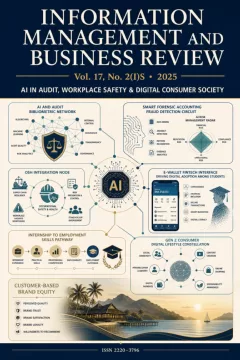 Vol. 17 No. 2(I)S (2025)
AI in Audit, Workplace Safety & Digital Consumer Society
View issue contents
Published
Submissions
Have research to publish? Information Management and Business Review welcomes submissions.
Make a Submission