Abstract
This study examines the current adoption of Audit Data Analytics (ADA) among external auditors in Malaysia and explores their perceptions regarding adoption plans, perceived opportunities, and challenges associated with ADA implementation. While ADA has the potential to transform traditional audit practices, its adoption remains inconsistent across audit firms, raising concerns about readiness and perceived benefits. A quantitative survey methodology was adopted, using a structured questionnaire distributed to external auditors from audit firms in Klang Valley, Penang, and Johor. A total of 221 responses were collected and analyzed using descriptive statistics and reliability assessments via SPSS. The findings reveal that while many firms recognize the benefits of ADA, such as improved audit quality and greater transaction testing capabilities, actual adoption levels vary significantly across audit areas. Key challenges identified include client concerns over data confidentiality, insufficient ADA expertise, and inadequate technological infrastructure. This study contributes to current literature by providing empirical insights into ADA adoption within Malaysia’s external auditing sector, an area previously underexplored. The findings offer practical implications for audit firms, regulators, and professional bodies seeking to promote ADA adoption and advance digital transformation in the auditing profession .
Keywords
- Audit Data Analytics (ADA) Search this journal for Audit Data Analytics (ADA) (opens in a new tab)
- External Auditing Practices Search this journal for External Auditing Practices (opens in a new tab)
- Digital Transformation Search this journal for Digital Transformation (opens in a new tab)
- Adoption Barriers Search this journal for Adoption Barriers (opens in a new tab)
- Malaysian Audit Firms Search this journal for Malaysian Audit Firms (opens in a new tab)
References
- Brown, J. D. (2002). The Cronbach's alpha reliability estimate. JALT Testing & Evaluation SIG Newsletter, 6(1), 17-18. https://hosted.jalt.org/test/bro_13.htm
- Brown-Liburd, H., & Vasarhelyi, M. A. (2015). Big data and audit evidence. Journal of Emerging Technologies in Accounting, 12(1), 1–16. https://doi.org/10.2308/jeta-10454
- Chávez-Díaz, J. M., Aquiño-Perales, L., De-Velazco-Borda, J. L., Villagómez-Chinchay, J. A., & Flores-Sotelo, W. S. (2024). Artificial intelligence in accounting and auditing: bibliometric analysis in Scopus 2020-2023. Indonesian Journal of Electrical Engineering and Computer Science, 36(2), 1319–1328. https://doi.org/10.11591/ijeecs.v36.i2.pp1319-1328
- Eilifsen, A., Kinserdal, F., Messier, W. F., & McKee, T. E. (2020). An exploratory study into the use of audit data analytics on audit engagements. Accounting Horizons, 34(4), 85–110. https://doi.org/10.2308/acch-19-121
- Ellili, N., Nobanee, H., Haddad, A. E., Alodat, A. Y., & AlShalloudi, M. (2024). Emerging trends in forensic accounting research: Bridging research gaps and prioritizing new frontiers. Journal of Economic Criminology, 4, 1–17.
- Hair, J. F. Jr., Babin, B., Money, A. H., & Samouel, P. (2003). Essentials of business research methods. John Wiley & Sons.
- Hanfy, F., Alakkas, A. A., & Alhumoudi, H. (2024). Analyzing the role of digitalization and its impact on auditing. Multimed Tools Appl 84, 21203–21225. https://doi.org/10.1007/s11042-024-19729-0
- Jacky, T. S. T., & Sulaiman, N. A. (2022). Audit data analytics adoption in Malaysian auditing practice: Benefits, challenges and current practices. Universiti Malaya Research Repository.
- Liew, A., Boxall, P., & Setiawan, D. (2022). The transformation to data analytics in Big-Four financial audit: What, why and how?. Pacific Accounting Review, 34(4), 569–584. https://doi.org/10.1108/PAR-06-2021-0105.
- Mugwira, T. (2022). Internet-related technologies in the auditing profession: A WOS bibliometric review of the past three decades and conceptual structure mapping. Revista de Contabilidad-Spanish Accounting Review, 25(2), 201–216. https://doi.org/10.6018/rcsar.428041
- Mustafa Airout, R., Abu Azam, S., & Airout, M. (2024). Bibliometric insights into the intellectual dynamics of forensic accounting research. Cogent Business and Management, 11(1). https://doi.org/10.1080/23311975.2024.2344748
- Salijeni, G., Samsonova-Taddei, A., & Turley, S. (2019). Big data and changes in audit technology: Contemplating a research agenda. Accounting and Business Research, 49(1), 95–119. https://doi.org/10.1080/00014788.2018.1459458
- Vitali, S., & Giuliani, M. (2024). Emerging digital technologies and auditing firms: Opportunities and challenges. International Journal of Accounting Information Systems, 53, 100676. https://doi.org/10.1016/j.accinf.2024.100676
Downloads
No downloads have been recorded for this article yet. Figures appear here once readers begin downloading the full text.
How to Cite
Share this article
License
Copyright (c) 2025 Nor Haliza Che Hussain, Chin Wai Yin, Lim Wan Leng, Lai Siew Fong, Hen Kai Wah (Author)

This work is licensed under a Creative Commons Attribution 4.0 International License.
Author (s) should affirm that the material has not been published previously. It has not been submitted and it is not under consideration by any other journal. At the same time author (s) need to execute a publication permission agreement to assume the responsibility of the submitted content and any omissions and errors therein. After submission of revised paper in the light of suggestions of the reviewers, the editorial team edits and formats manuscripts to bring uniformity and standardization in published material.
This work will be licensed under Creative Commons Attribution 4.0 International (CC BY 4.0) and under condition of the license, users are free to read, copy, remix, transform, redistribute, download, print, search or link to the full texts of articles and even build upon their work as long as they credit the author for the original work. Moreover, as per journal policy author (s) hold and retain copyrights without any restrictions.
Keywords
- Audit Data Analytics (ADA) Search this journal for Audit Data Analytics (ADA) (opens in a new tab)
- External Auditing Practices Search this journal for External Auditing Practices (opens in a new tab)
- Digital Transformation Search this journal for Digital Transformation (opens in a new tab)
- Adoption Barriers Search this journal for Adoption Barriers (opens in a new tab)
- Malaysian Audit Firms Search this journal for Malaysian Audit Firms (opens in a new tab)
Section
Published in
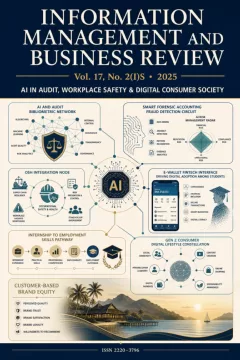 Vol. 17 No. 2(I)S (2025)
AI in Audit, Workplace Safety & Digital Consumer Society
View issue contents
Published
Submissions
Have research to publish? Information Management and Business Review welcomes submissions.
Make a Submission